Create a Holiday Glow with Dining Room Chandeliers
Chandeliers for the Christmas Dining Room: A Practical Design Guide
Chandeliers for the Christmas Dining Room: A Practical Design Guide
By Sophie | Updated for the 2026 Holiday Season
Why Overhead Lighting Defines the Dining Room at the Holidays
Most holiday decorating focuses on the table surface — centerpieces, runners, candles. The ceiling is an afterthought. That’s a mistake.
In dining room design, the overhead fixture establishes what lighting designers call the anchor point — the primary light source that everything else is measured against. In a Christmas context, this matters more than usual, because the room is being asked to perform emotionally: to feel warm, celebratory, and distinct from an ordinary Tuesday dinner.
Research in environmental design shows that color temperature plays a direct role in how we experience a space. Fixtures that output light around 2,700K produce a warm amber tone that reads psychologically as comfortable and relaxed. Cooler temperatures — 4,000K and above — tend to feel clinical in residential dining contexts.
A chandelier, positioned centrally above the table, distributes that warm light directionally and at a consistent height. That’s the technical case for prioritizing it over secondary sources like string lights or floor lamps.
2026 Design Trends: What’s Current in Dining Room Chandeliers
Traditional Crystal
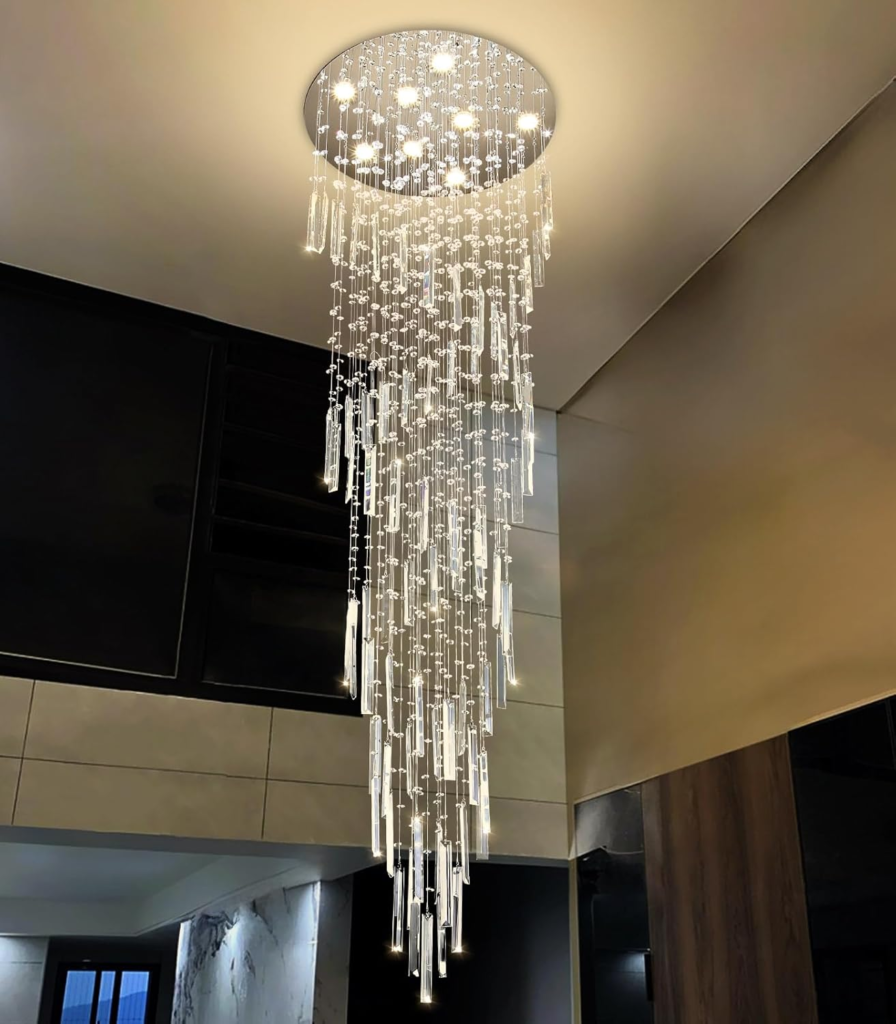
Multi-tiered crystal chandeliers remain the standard reference point for formal holiday dining. In 2026, the design direction favors larger proportions and warmer metal finishes — antique brass and aged gold rather than chrome or bright nickel.
K9 crystal, the most common grade used in residential fixtures, refracts light into prismatic patterns across walls and table surfaces. The visual effect depends heavily on the number of crystal elements and the angle of the light source within the fixture. More tiers generally produce more refraction, which is why this style works well in rooms with higher ceilings and more surface area for the light to travel across.
The Modern Crystal Raindrop Chandelier is a commonly referenced fixture in this category — a layered rod design that produces wide light scatter across a dining table.
Modern and Minimalist
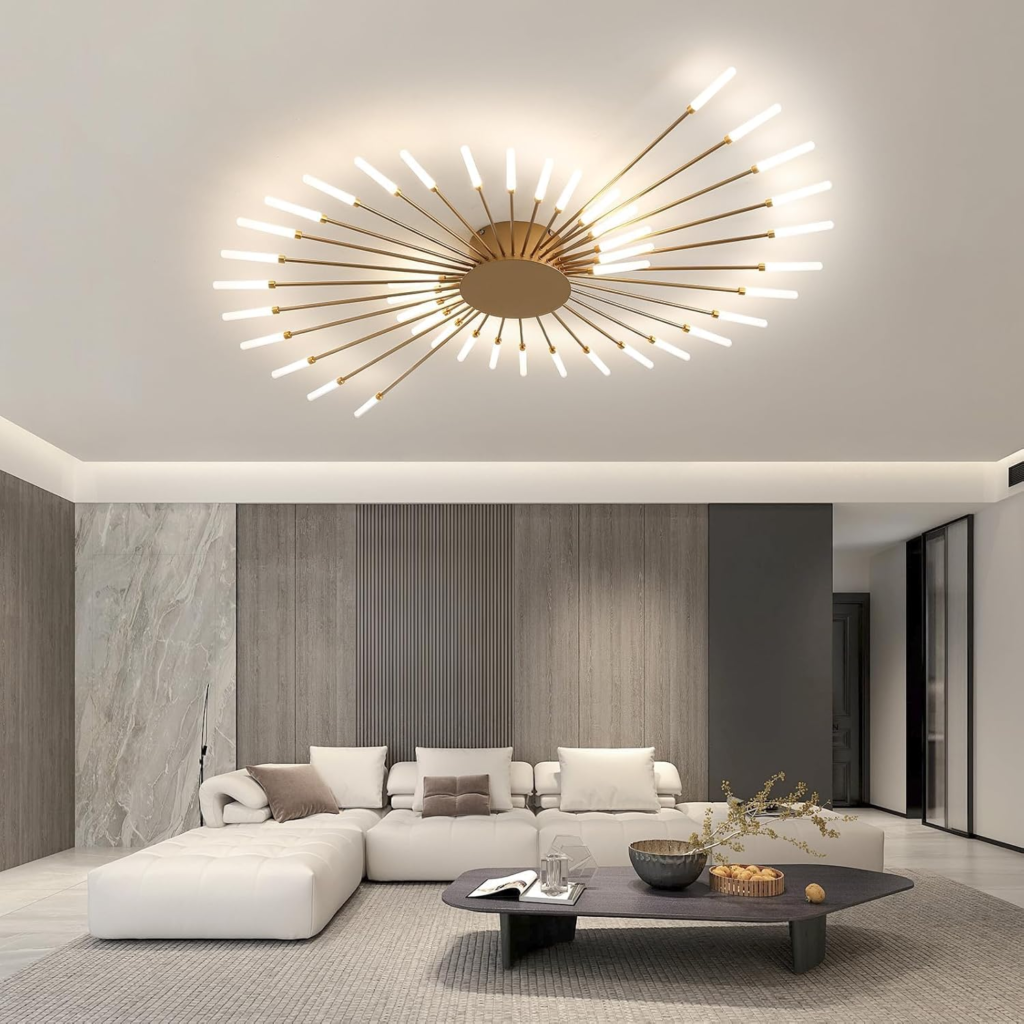
Contemporary dining room fixtures in 2026 are moving toward asymmetrical compositions and matte brushed-brass finishes with integrated LED modules. The shift away from symmetrical geometric shapes reflects a broader trend in residential design toward fixtures that read as sculptural objects independent of their function.
The Sputnik-style fixture — a radial design with arms extending outward from a central body — creates directional shadow patterns that change depending on bulb placement. In rooms with white or neutral walls, this shadow play becomes a secondary decorative element, particularly at low light levels.
This style is technically appropriate for open-plan spaces where a more ornate fixture might visually compete with adjacent areas.
Farmhouse and Rustic
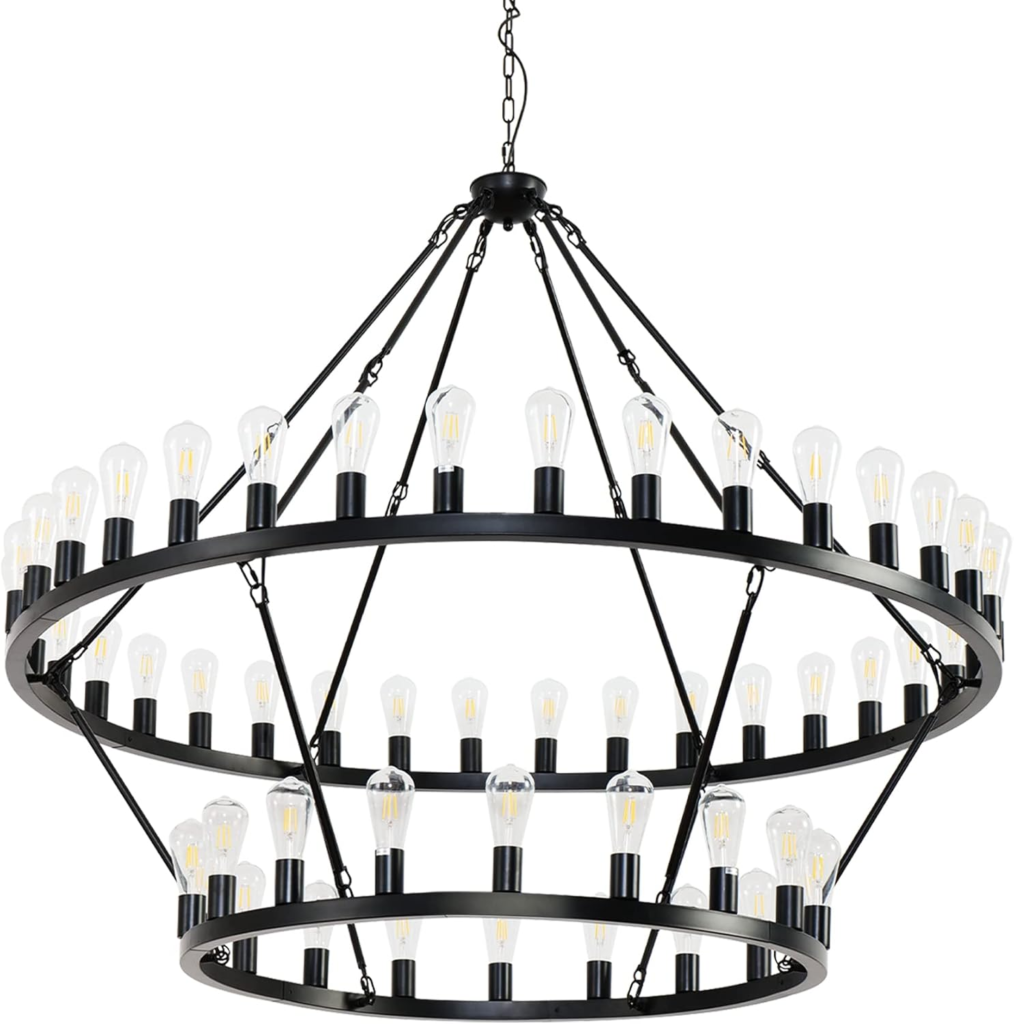
Wagon wheel-style chandeliers, typically constructed with distressed wood and simple metal hardware, produce diffused, ambient light — particularly when paired with Edison-style filament bulbs, which have a color temperature of approximately 2,200K. That’s warmer than most LED equivalents and produces a notably softer glow.
The Wagon Wheel Farmhouse Chandelier falls into this category. It’s an open-frame design, which means light distribution is wider and less focused than enclosed or crystal fixtures.
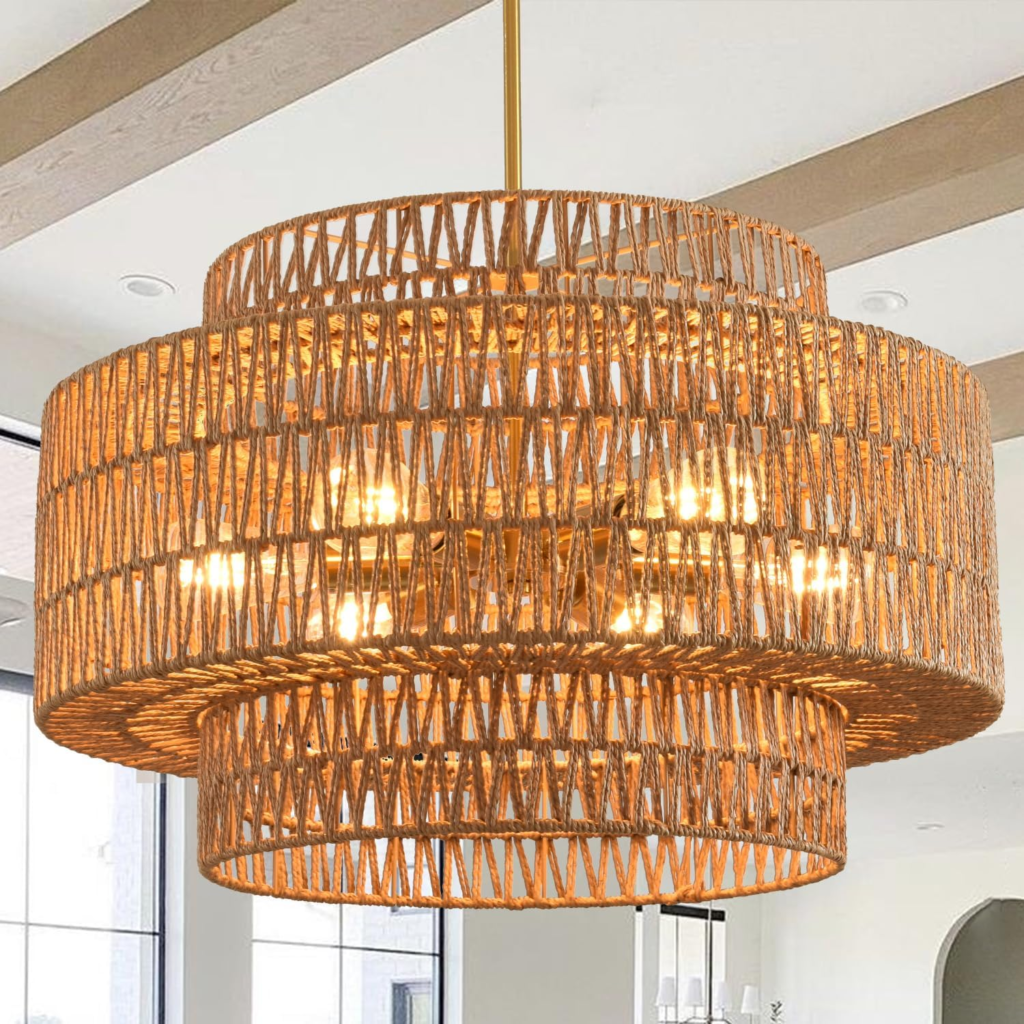
For spaces with a coastal or Scandinavian-influenced aesthetic, rattan pendants offer a lower light output with a soft, ambient quality. The Rattan Boho Pendant is a lightweight option in this style, suited to smaller dining areas or spaces where a secondary pendant arrangement is preferred over a single large fixture.
Sizing and Placement: The Measurements That Matter
Proportion is where most chandelier installations go wrong. The following are standard industry guidelines, not rigid rules — but they provide a useful starting framework.
Fixture diameter: Add the length and width of the room in feet. The result, converted to inches, gives an approximate target diameter. A 12 × 14 ft room suggests a fixture around 26 inches in diameter. For a rectangular table, a linear pendant distributes light more evenly than a round fixture.
Hanging height — the 30–36 inch rule: The bottom of the chandelier should hang 30 to 36 inches above the table surface. This range maintains visual connection between the fixture and the table without obstructing sightlines across it. In rooms with ceilings above 9 feet, add approximately 3 inches per additional foot of ceiling height.
Fixture-to-table ratio: The chandelier should cover roughly half the width of the dining table. A 72-inch table works proportionally with a fixture around 36 inches in diameter.
One factor that’s easy to overlook: visual weight is not the same as physical size. A heavily detailed crystal fixture reads as larger than its measured dimensions. An open rattan or minimalist frame reads as smaller. Adjust expectations accordingly when using standard sizing formulas.
Layered Lighting: Why a Single Fixture Is Rarely Sufficient
A chandelier establishes the primary light level. It rarely produces the full range of warmth associated with well-designed holiday interiors on its own. Layering adds depth and corrects the flatness that comes from relying on a single overhead source.
Three layers work well in a Christmas dining room context:
- Recessed or ceiling-mounted dimmers allow the ambient light level to be reduced so the chandelier becomes the dominant visual element during dinner service
- Integrated fairy lights in garland arrangements at table or sideboard height introduce a mid-level light layer that fills the visual gap between ceiling and table
- Taper candles on the table provide a low-level, flickering source directly at seated eye height
Each layer operates at a different height and intensity. Together they create what lighting designers refer to as depth of field in a lit space — the same principle that makes a well-lit restaurant feel different from a cafeteria.
Style Comparison at a Glance
| Style | Typical Application | Light Quality | Maintenance |
|---|---|---|---|
| Traditional Crystal | Formal dining rooms with higher ceilings | High output; wide prismatic scatter | Moderate — crystal elements require periodic cleaning |
| Modern / Sputnik | Contemporary or open-plan spaces | Medium-high; directional with shadow play | Low — smooth metal surfaces |
| Farmhouse Wagon Wheel | Casual, family-oriented dining rooms | Medium; warm and diffused | Low — open frame, easy to wipe down |
| Rattan Boho Pendant | Smaller rooms; coastal or Scandinavian interiors | Low-medium; soft ambient | Low — lightweight construction |
Installation: When DIY Is Appropriate and When It Isn’t
Chandelier installation is within the capability of most confident DIYers under the right conditions. The primary variable is fixture weight.
Fixtures under approximately 15 pounds can generally be supported by a standard ceiling junction box. Most residential boxes are rated for 35 pounds, but that rating should always be verified before installation — the rating is printed or stamped on the box itself.
Heavier fixtures — particularly multi-tiered crystal chandeliers that can exceed 40 or 50 pounds — require a fan-rated or chandelier-rated box with direct structural support from the ceiling joist. Installing an overweight fixture on an under-rated box is a structural failure risk, not just an electrical one.
Situations that warrant a licensed electrician:
- Fixtures exceeding the existing box’s weight rating
- Any installation requiring new wiring or circuit modification
- Dimmer switch installation (some LED fixtures require specific dimmer compatibility)
- Junction box replacement or reinforcement
The electrical work itself is often straightforward. The structural assessment is where errors tend to occur, and where professional input adds the most value.
Summary
A dining room chandelier functions as both a light source and a spatial anchor. In a holiday context, the right fixture — correctly sized, hung at the appropriate height, and supported by secondary light sources — changes how a room feels to the people in it.
The technical decisions — diameter, hanging height, color temperature, fixture weight — are measurable and consistent across styles. The aesthetic choice between crystal, modern, farmhouse, or organic materials is a function of the room’s existing architecture and the atmosphere the space is intended to produce.
Get the proportions right first. The style will follow from there.
Article by the Interior Design and Lighting team at thepaintly.com | Updated for the 2026 Holiday Season