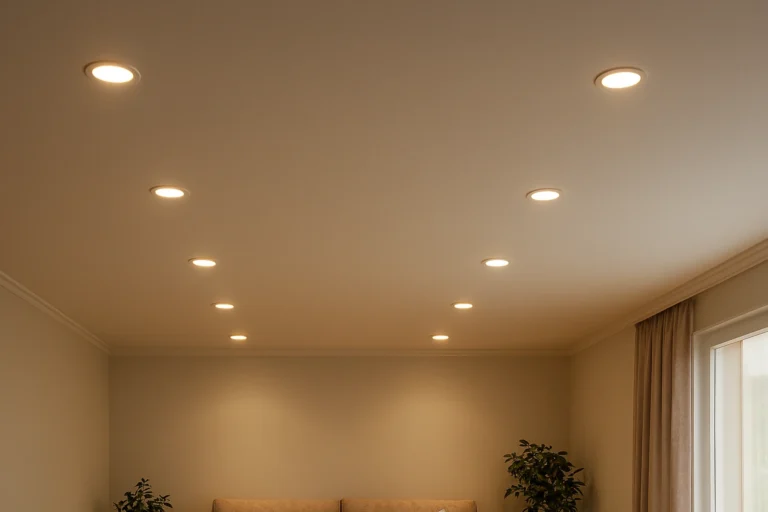
Best Adjustment Recessed Ceiling Lights: 6 Gimbal Picks
Aim the Light, Not the Ceiling: Gimbal Picks That Actually Pivot
Fixed downlights on a sloped ceiling shine sideways; fixed downlights next to artwork light the floor in front of it. That is the problem the best adjustment recessed ceiling lights solve — gimbal and eyeball trims pivot after installation, so the beam lands on the counter, the canvas, or straight down from a vaulted ceiling instead of wherever the framing happened to put the hole. I have installed enough of both to know the tilt spec on the box is where most buyers get burned.
Here are the six adjustable recessed lights I would actually order in 2026, what each is genuinely for, and the honest cases where a gimbal is the wrong tool.
Quick Picks If You Are in a Hurry
| Pick | Size | Type | Best For |
|---|---|---|---|
| HALO HLA406 Canless Gimbal 5CCT | 4″ | Canless gimbal | Best overall |
| Amico 5CCT Gimbal Pack | 6″ | Canless gimbal | Whole-room value |
| Lithonia WF4/WF6 ADJ Wafer | 4/6″ | Wafer gimbal | Tight ceilings, retrofits |
| Sunco Gimbal Retrofit Eyeball | 5/6″ | Retrofit eyeball | Existing cans |
| Lightdot Gimbal 12-Pack | 6″ | Canless gimbal | Large uniform installs |
| Sunco Slim Gimbal | 3/6″ | Canless slim | Accent lighting |
Gimbal vs Eyeball — the 30-Second Version
An eyeball trim is a sphere that swivels inside the housing and protrudes slightly — typically 20–30° of tilt with around 350° rotation. A gimbal sits flush and pivots on a ring — usually up to 35–40° of tilt with full rotation. The number that matters is tilt: a 30° gimbal on a 45° vaulted ceiling still cannot point straight down. Check the ceiling pitch before you order, not after. That one check is the difference between museum lighting and a glare bomb.
The 6 Best Adjustment Recessed Ceiling Lights in 2026
1. HALO HLA406 4″ Canless Adjustable Gimbal, 5CCT — Best Overall
Who this is for: anyone who wants one SKU that handles accents, slopes, and general light without drama.
Selectable color temperature (2700K–5000K), smooth dimming, and a regressed lens that controls glare — the light source sits deeper in the trim, so you see lit surfaces instead of a bright dot. HALO build quality means the pivot stays where you put it instead of drooping over time.
The real limitation: premium price per head. On a 12-light job the delta over budget packs is real money.
Best for: kitchens and living rooms where you will notice quality nightly.
2. Amico 6″ 5CCT Gimbal LED Pack — Best Value for Whole Rooms
Who this is for: full-room makeovers where every head should adjust.
Multi-pack pricing, selectable CCT, respectable CRI, and enough tilt for standard slopes. This is the pick when you want ten adjustable heads for the price of six premium ones.
The real limitation: the gimbal friction is lighter than HALO — heads can drift a few degrees when you swap insulation above or slam doors below. Check aim once a season.
Best for: bedrooms, basements, rental-grade renovations done honestly.
3. Lithonia Lighting WF4/WF6 ADJ Wafer Gimbal — Best for Tight Ceilings
Who this is for: ceilings with ducts, joists, or almost no depth above the drywall.
Wafer-thin body with the junction box remote from the head, from a commercial brand that has been in the ceiling business longer than most. Fits where cans never will.
The real limitation: shallower optics than a regressed gimbal — more visible brightness at wide viewing angles. In a TV room, place them behind the seating line.
Best for: retrofits in finished ceilings and second floors under attic knee walls.
4. Sunco 5/6″ Gimbal Retrofit Eyeball — Best Retrofit for Existing Cans
Who this is for: homes with working recessed cans and fixed trims that point the wrong way.
Screws into the existing socket, springs into the existing can, and suddenly the light aims. This is the cheapest path from dumb downlight to directional light — no drywall work at all.
The real limitation: the eyeball protrudes slightly below ceiling plane. Aesthetically fine in most rooms, but it is not the flush look of a canless gimbal.
Best for: refreshing 1990s–2000s can layouts without rewiring.
5. Lightdot 6″ Gimbal 12-Pack — Best for Large Uniform Installs
Who this is for: whole-floor projects where a dozen matching adjustable heads matter more than premium optics.
Twelve gimbals, one carton, one consistent look. Uniformity is underrated — mixed brands across one ceiling almost always show as mismatched whites, even at the same nominal CCT.
The real limitation: budget drivers dim less smoothly at the bottom 15% of range. On a dimmer-heavy install, test one on your dimmer before committing all twelve.
Best for: basements, open-plan floors, flip renovations with a conscience.
6. Sunco Slim Gimbal, 3″ and 6″ — Best Compact Accent Specialist
Who this is for: art walls, shelving, and niches that want a discreet aimed beam.
The 3″ head nearly disappears into the ceiling and puts a tight pool exactly where you aim it. Pair two small heads per artwork zone at about 600–800 lumens each.
The real limitation: small aperture, small output. These are accents — a room lit only with 3″ heads feels like a jewelry store after closing.
Best for: layered lighting plans where big heads do ambient and these do drama.
The Vaulted Ceiling That Taught Me to Read Tilt Specs
The first time I speced gimbals for a vaulted family room, I ordered on price and assumed “adjustable” meant adjustable enough. The ceiling pitched at 40°; the gimbals tilted 25°. Every head pointed 15° off vertical, raking light down the slope and into eyes on the far sofa. I ate the restocking fee and reordered deep-tilt heads. Here is what I learned: measure the ceiling pitch with a phone app, then buy tilt range with 5° of margin. The spec sheet number is the whole product with these lights.
Related practitioner note: aim gimbals after the room is painted and furnished, at night, with the dimmer at evening levels. Daytime aiming always lands wrong. And if the ceiling needs paint, do it before the heads go in — my best way to paint a ceiling guide explains why cutting around trims is the slowest way to paint anything.
- Pure ambient grids on flat ceilings. If nothing needs aiming, fixed regressed trims give better glare control per dollar. See my LED recessed ceiling lights roundup for those.
- Very low ceilings. A tilted beam at 7½ feet puts the source line-of-sight to anyone standing across the room. Flush fixed trims win — compare with flush mount recessed ceiling lights.
- Insulation-packed cavities without IC rating. Aimable or not, a non-IC housing buried in insulation is a heat problem. Check the rating and, if you are working with existing cans, my guide to recessed light housings covers what fits what.
Buying Guide: What Actually Matters
Four specs decide whether you will be happy: tilt range vs your ceiling pitch (the non-negotiable), CRI 90+ so aimed light flatters what it hits, selectable CCT so a future repaint does not strand you at the wrong white, and dimmer compatibility — test one head on your existing dimmer before buying the case. Aperture size is a layout question: my 4-inch vs 6-inch recessed lighting comparison covers spacing, and ENERGY STAR’s fixture criteria are a decent proxy for driver and thermal quality. For the cut-in itself, Family Handyman’s install walkthrough is the reference I hand to first-timers.
FAQ: Adjustment Recessed Ceiling Lights
What is the difference between gimbal and eyeball recessed lights?
A gimbal pivots on a flush ring, typically tilting up to 35–40°; an eyeball is a protruding sphere that tilts 20–30° but often rotates more freely. Gimbals look cleaner; eyeballs are the easier retrofit into old cans.
How much tilt do I need for a sloped ceiling?
Match or exceed the ceiling pitch: a 30° slope needs at least 30° of tilt for the beam to point straight down. Measure the pitch first — it is the spec that disqualifies most budget gimbals.
Can I replace a fixed recessed light with an adjustable one?
Usually yes. With an existing can, use a retrofit gimbal or eyeball that screws into the socket. With canless wafers, swap the whole unit at the junction box — no can required.
Are adjustable recessed lights good for lighting artwork?
Yes — aim the beam at a 30° angle from vertical to the center of the piece to avoid frame shadows and glare off the glass. Use 600–800 lumens per artwork zone with high CRI.
Do gimbal lights work with dimmers?
Most LED gimbals dim, but smoothness varies by driver and dimmer pairing. Test one fixture on your dimmer before buying a multi-pack, and prefer fixtures listing compatible dimmer models.
What size adjustment recessed lights should I buy?
6″ for general lighting and value, 4″ for modern rooms and tighter beam control, 3″ for pure accents. Smaller heads need closer spacing to reach the same light level.
Verdict
Buy the HALO HLA406 if you want to install once and forget it. Buy the Amico pack if the whole room needs aim on a budget, and the Sunco retrofit eyeball if you already own cans and just want the light pointed somewhere useful. Whatever you pick, read the tilt spec against your ceiling pitch first — it is the one number that cannot be fixed with a ladder and patience.
ThePaintly is reader-supported. We only recommend products we’ve personally evaluated. When you buy through links on this site, we may earn an affiliate commission at no extra cost to you.