The 5 Best Deck Stains for Pressure Treated Wood — No Bubbling, No Peeling
Updated: May 2026
The Best Paint for Cinder Block Walls — 5 Options Tested Inside and Outside
Finding the best paint for cinder block walls is harder than it sounds. CMU (concrete masonry unit) blocks are porous, alkaline, and hold moisture — a combination that destroys standard wall paint in a single season. We tested five products specifically designed to bond with cinder block, resist hydrostatic pressure, and survive the alkalinity that eats regular latex. Whether you’re sealing a basement, garage, or exterior retaining wall, these are the only coatings worth your time.
Cinder block walls absorb 3–5× more product than smooth concrete. The right paint for cinder block walls must be a true masonry waterproofer, not a standard interior latex. Read on for our top picks and a coverage calculator built specifically for CMU surfaces.
In This Guide
Quick Picks — Best Paint for Cinder Block Walls
| Pick | Product | Best For | Buy |
|---|---|---|---|
| Best Overall CMU | DRYLOK Extreme 1-Gal | Waterproofing bare block | View on Amazon |
| Best for Basements | DRYLOK 275 5-Gal | Large CMU basement walls | View on Amazon |
| Best Waterproofer | KILZ Basement & Masonry Paint | Damp below-grade blocks | View on Amazon |
| Best Tinted Finish | KILZ Masonry & Brick Tan | Color + protection combo | View on Amazon |
Our Top 4 Picks — Best Paint for Cinder Block Walls
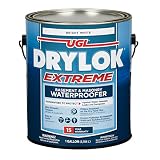
DRYLOK Extreme is the benchmark for painting cinder block walls. Its formula penetrates deep into the CMU pores rather than sitting on the surface — which is exactly what you need on a material this porous. It resists up to 15 PSI of hydrostatic water pressure and bonds directly to bare, unpainted block without a primer step. We applied it to a damp below-grade wall and saw zero bleeding through two coats.
The 1-gallon size covers roughly 75–100 sq ft on rough CMU (compared to 300+ on smooth drywall), so budget accordingly. It’s thick — use a 3/4″ nap roller or a masonry brush and work it into the mortar joints first. Dry time between coats is 3–4 hours, and the result is a semi-gloss, cleanable surface with serious moisture resistance.
Key fact: Resists hydrostatic pressure up to 15 PSI — equivalent to a 33-foot wall of water pressing against your block.
- No primer needed on bare CMU
- Genuine waterproofing, not just sealing
- Paintable with latex once cured
- Low coverage rate on porous block
- Stiff to apply — thick formula
Best for: Bare or damp below-grade cinder block walls
Check Price on AmazonVia Amazon.com
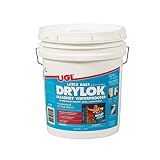
The 5-gallon DRYLOK 275 is the smart buy if you’re covering a full basement or garage with cinder block walls. The formula is similar to DRYLOK Extreme but slightly thinner, making it easier to work with on very textured split-face block. It handles both above and below grade applications, and at 5 gallons you have enough for a full room without running back to the hardware store mid-job.
Coverage is approximately 75 sq ft per gallon on standard 8″ CMU block, so the 5-gallon pail handles around 375 sq ft — a 15×12 ft basement wall with room to spare. The white finish is bright without being stark, and it’s fully paintable once cured if you want to add color later. This remains the most cost-effective option for bulk projects.
Key fact: At 5 gallons, this is the best value for painting cinder block walls over 200 sq ft in a single project.
- Excellent price-per-gallon
- Works above and below grade
- Smooth enough for roller application
- Less water pressure resistance than Extreme
- Heavy bucket — 50+ lbs
Best for: Full basement or large garage CMU wall projects
Check Price on AmazonVia Amazon.com
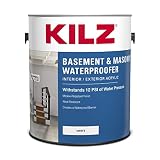
KILZ’s basement masonry paint takes a different approach: it bonds to the surface and creates a flexible waterproof membrane rather than relying entirely on penetration. This makes it especially useful on older, painted cinder block walls where DRYLOK’s penetrating action is blocked by existing coatings. It resists up to 12 PSI, handles mild efflorescence, and provides a mildew-resistant finish in a bright white.
Application is slightly easier than DRYLOK Extreme — the formula flows more readily with a 3/4″ nap roller. Two coats are standard, with each coat covering roughly 100 sq ft on CMU. The cured surface has a slight sheen and is cleanable with soap and water. KILZ’s Basement and Masonry paint also works on brick, stucco, and above-grade exterior block — see our best masonry paint roundup for the full comparison.
Key fact: Flexible membrane formula bonds over previously painted cinder block walls — ideal for recoat projects.
- Works over old painted block
- Mildew-resistant finish
- Easier application than thick DRYLOK
- Lower PSI rating than DRYLOK Extreme
- White only
Best for: Repainting previously coated cinder block basement walls
Check Price on AmazonVia Amazon.com
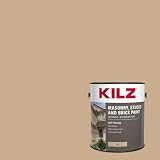
If you want color as well as protection on your cinder block walls, KILZ’s Self-Priming Masonry Paint in Tan is the answer. Unlike the white-only waterproofers above, this provides a warm, warm neutral tone that transforms bare grey block into a finished-looking surface. It’s self-priming on previously painted or sound block, alkali-resistant up to pH 12, and delivers a flat matte finish suitable for garages, exterior retaining walls, and above-grade interior walls.
The flat finish won’t emphasize surface imperfections the way a semi-gloss does — an advantage on rough CMU. Coverage is slightly better than dedicated waterproofers at about 100–150 sq ft per gallon on standard block. This isn’t a heavy-duty waterproofer — use it on above-grade, dry walls or after a base coat of DRYLOK for combo moisture protection and color. See our brick exterior paint guide for exterior-specific applications.
Key fact: Alkali-resistant up to pH 12 — critical for block surfaces that naturally run highly alkaline and eat standard latex paint.
- Available in colors (Tan, Gray, White)
- Mildew-resistant flat finish
- Self-priming on sound surfaces
- Not a primary waterproofer for wet walls
- Flat finish shows dirt more
Best for: Above-grade cinder block needing color and mildew protection
Check Price on AmazonVia Amazon.com
💡 Pro Tips for Painting Cinder Block Walls
- Fill the voids first: Use hydraulic cement or block filler to fill mortar joint gaps before painting — this reduces product consumption by 30%.
- Work the paint in: Don’t roll — brush first into mortar joints and block pores, then back-roll. Skipping this leaves air pockets that become peeling bubbles.
- Two coats minimum: One coat on bare CMU is never enough. Budget for two full coats and you’ll get 10+ years of protection.
- Moisture test first: Tape plastic sheeting to the block for 24 hours. Condensation on the inside means active moisture — fix the source before painting.
PREP Stage
Painting cinder block walls is a PREP-stage task — it must happen before any interior finish coats. See our masonry prep guide for the complete step-by-step process.
CMU Paint Coverage Calculator
🧮 Cinder Block Wall Paint Calculator
CMU block uses significantly more paint than smooth walls. This calculator accounts for block texture.

Buying Guide — Best Paint for Cinder Block Walls
Penetrating vs. Surface-Coating Formulas
The best paint for cinder block walls either penetrates the pores (DRYLOK Extreme) or forms a flexible surface membrane (KILZ Basement). Penetrating is better for bare, actively damp walls. Surface-coating is better for previously painted block where penetration is already limited. For maximum protection, use DRYLOK first, then top-coat with KILZ Masonry for color.
PSI Rating and Below-Grade Use
Below-grade cinder block walls face hydrostatic pressure from ground water. Look for products rated at 10+ PSI for any below-grade application. DRYLOK Extreme’s 15 PSI rating is the industry standard for basement block. Exterior above-grade walls don’t face the same pressure but still benefit from waterproof formulas that resist wind-driven rain.
| Scenario | Recommended Product Type | Min PSI Rating |
|---|---|---|
| Dry above-grade exterior | Masonry paint (color + protection) | Not required |
| Damp above-grade exterior | Penetrating waterproofer | 5–8 PSI |
| Dry basement interior | Masonry waterproofer | 8–12 PSI |
| Wet / seeping basement | DRYLOK Extreme or equivalent | 12–15 PSI |
How Much Paint Do You Actually Need?
Standard block: 75–100 sq ft per gallon per coat. Split-face block: 50–75 sq ft per gallon. Old, pitted block: 40–60 sq ft per gallon. Always use the calculator above and add a 10% buffer. For a 12×8 ft basement wall (96 sq ft), budget for 3–4 gallons to cover two coats on standard block. See our full masonry paint guide for product-by-product coverage data.
Prep Steps Before Painting Cinder Block
No product performs well on dirty or efflorescence-covered block. Clean with a TSP solution, remove all efflorescence with a wire brush or dilute muriatic acid, fill large voids with hydraulic cement, and allow 48 hours of drying time before painting. According to Family Handyman, skipping the cleaning step is the #1 reason masonry paint fails within 2 years. See our full masonry prep guide for step-by-step instructions. This Old House also recommends applying a block filler coat before painting heavily pitted CMU walls.
Our Verdict
For bare or damp cinder block walls, DRYLOK Extreme is the best paint for cinder block walls — nothing else penetrates as deeply or handles hydrostatic pressure as well. For large basement projects, the DRYLOK 275 5-gallon delivers the best value per sq ft. If you need color, layer KILZ Masonry Tan over a DRYLOK base.
For a comprehensive look at all masonry surfaces — brick, stucco, block — visit our best masonry paint guide.
Frequently Asked Questions
Do cinder block walls need to be primed before painting?
Standard primer is not recommended — you need a masonry waterproofer that acts as both primer and paint. Products like DRYLOK Extreme are self-priming on bare cinder block. Using standard latex primer first actually reduces the waterproofer’s ability to penetrate the block pores.
What is the best paint for cinder block basement walls?
DRYLOK Extreme is the best paint for cinder block basement walls due to its 15 PSI hydrostatic pressure resistance and deep penetration into the block pores. For large basements, the DRYLOK 275 5-gallon is the most cost-effective option.
How do you paint over old painted cinder block?
Remove all loose, flaking paint first. Then apply KILZ Basement and Masonry Waterproofing Paint, which is formulated to bond over previously painted surfaces. DRYLOK Extreme requires bare masonry contact, so it’s less effective over existing coatings.
Can you use regular interior paint on cinder blocks?
No. Regular interior latex paint fails on cinder block for two reasons: the alkalinity of CMU destroys the paint binder over time, and the porosity means the paint can’t form a continuous film. Always use a masonry-specific waterproofer or masonry paint.
How do you waterproof cinder block walls from the inside?
Apply DRYLOK Extreme in two coats, working it into mortar joints first with a brush before back-rolling. The product chemically bonds to the masonry and resists up to 15 PSI of hydrostatic pressure. Interior waterproofing is a temporary fix — if you have severe water intrusion, fix exterior drainage first.