
Rent or Buy a Concrete Grinder for One Garage Floor?
Updated: September 2026 | By Sophie Ulman
Most garage floor coatings do not fail because of the coating. They fail because the slab underneath was never opened up, and the epoxy sat on a sealed, troweled surface like a sticker on glass. That is why a concrete grinder is the first tool decision in the whole project — and why the rent-or-buy question is really a question about how many days you are honestly going to be down there working.
The first floor I prepped, I rented a walk-behind for a Saturday and gave it back Sunday morning with maybe two thirds of the slab done. I had budgeted one day. The old mastic near the door ate three hours by itself. I paid a second day’s rate to finish work I had already scheduled around, and the coating went down on a Tuesday evening instead of Sunday afternoon. Here is what I learned: rental math is not about the tool’s day rate, it is about how badly you estimate your own slab.
This guide gives you the break-even point in plain numbers, five tools worth owning at different budget levels, and the one piece of the setup that decides whether you are grinding or making a dust storm.
What this covers
Quick picks at a glance
| Tool | Best for | Why it earns the spot |
|---|---|---|
| WoHenHao 7″ Concrete Grinder Set | One garage, bought instead of rented twice | Grinder, shroud and cup wheel in one box, 7″ path |
| Bosch CSG15 5″ Surfacing Grinder | More than one floor, or work near walls | Dedicated shroud that lets you grind flush to an edge |
| Stadea 5″ Shroud + Double-Row Cup Wheel | You already own a 4.5″ or 5″ angle grinder | Turns a tool you have into a dust-controlled grinder |
| Hardin DS5H Universal Dust Shroud | Rented a bare grinder with no shroud | Three clamp rings fit most 4″ to 5″ grinder necks |
| Bosch VAC090AH 9-Gallon Dust Extractor | Grinding inside an attached garage | HEPA filtration with automatic filter cleaning |
The five tools, and who each one is for
Best for a single two-car garage
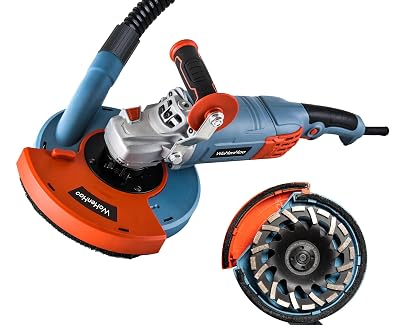
WoHenHao 7 Inch Concrete Grinder Set with Dust Extraction Shroud
This is a dedicated surfacing tool rather than an angle grinder wearing a hat. The 7-inch cup wheel covers roughly twice the path of a 5-inch wheel per pass, and the segments are brazed to take the side load that snaps thin blades. The shroud is skirted with bristles that ride the slab and hold a slight vacuum under the housing, so the dust never gets airborne in the first place.
It is a coarse tool, and that cuts both ways. On a troweled slab it opens the surface fast, which is exactly what an epoxy primer wants. On thin patch material or a feather-edged repair it will dig if you let the head tip, so keep both hands low and let the machine sit flat. The honest limitation: at this weight you feel every minute of a full garage, and the arms complain before the tool does.
Key fact: A 7-inch head covers about 38 square inches per pass versus about 19 for a 5-inch — you cross the floor half as many times.
Pros
- Grinder, shroud and wheel arrive together
- Wide path cuts total passes on a big slab
- Shroud brushes seal well on a flat floor
Cons
- Heavy enough to tire you before the floor is done
- Wide head cannot reach tight corners
Best for: the homeowner doing one epoxy garage floor who has already priced two rental days and realised the numbers are close.
Via Amazon.com

Best for edges and repeat use
Bosch CSG15 5 In. Concrete Surfacing Grinder
The CSG15 is built around one idea: the dust guard is part of the tool, not an accessory clamped onto it. One side of the shroud opens so the wheel can run flush against a wall, which is where every floor job slows down. The motor is geared for surfacing rather than cutting, so it holds wheel speed under load instead of bogging when you lean in.
I ran one of these along the wall line of a basement slab after a rented walk-behind had left a four-inch untouched border all the way around. It cleared the border in under an hour and the transition was invisible once the coating went down. The limitation is the price, and it is not small. If this is the only floor you will ever grind, this tool is more machine than the job needs.
Key fact: The shroud opens on one side specifically so the wheel can reach the wall line without a second edging tool.
Pros
- Grinds flush to walls with the shroud attached
- Holds speed under load on hard slabs
- Built for surfacing, not a repurposed cutter
Cons
- Costs far more than a weekend rental
- 5-inch path means more passes on open floor
Best for: anyone grinding a second floor within a year, or a contractor who needs the wall line clean without switching tools.
Via Amazon.com

Best if you already own an angle grinder
Stadea 5″ Grinder Dust Shroud with Double-Row Diamond Cup Wheel
A double-row cup wheel has two concentric rings of diamond segments, so the load spreads across more contact points and the wheel tracks flatter than a single row. That matters on a floor, where a wheel that wants to tip leaves swirl marks you will see through a thin coating. The metal shroud takes a standard vacuum hose and clamps to the grinder neck.
This is the route I recommend most often, because a 4.5 or 5-inch angle grinder is already in most garages. The catch is spindle thread and neck diameter. The wheel uses a 5/8″-11 arbor, which is the North American standard, but shroud fit varies by brand and you should measure the collar on your grinder before ordering. Also expect the grinder itself to run hot — these tools were designed for short cuts, not forty minutes of continuous surfacing.
Key fact: The double row keeps the cup flatter under side load, which is what prevents visible swirl in the finished slab.
Pros
- Cheapest path to a dust-controlled setup
- Wheel and shroud sized to each other
- 5/8″-11 arbor fits standard US grinders
Cons
- Shroud fit depends on your grinder’s collar
- Angle grinders overheat on long surfacing runs
Best for: the DIYer who owns a decent 5-inch grinder and needs to open 400 square feet, not 4,000.
Via Amazon.com

Best fix for a bare rental
Hardin DS5H Universal 5-Inch Dust Extracting Surface Grinding Shroud
Rental yards hand out grinders with the shroud missing more often than they admit, because shrouds get dropped and cracked and nobody checks them back in. This one ships with three clamping rings sized to fit the neck of most 4 to 5-inch grinders, so it adapts to whatever the counter gives you. The front segment retracts, which lets you push the wheel to an edge without pulling the whole housing off.
It is a plastic housing, and it will scuff and eventually crack if you drag it across an aggressive slab all day. For a weekend it is the difference between a garage you can breathe in and one you cannot. Buy the shroud, rent the grinder — that combination is what most one-floor projects should be doing.
Key fact: Three included clamp rings mean it fits the rental counter’s tool rather than one specific brand.
Pros
- Fits a wide range of grinder necks
- Retracting front for edge work
- Costs a fraction of a second rental day
Cons
- Plastic body scuffs and cracks with hard use
- Seal is only as good as the flatness of the slab
Best for: anyone renting the machine but refusing to inherit the yard’s dust problem.
Via Amazon.com
Best for grinding in an attached garage
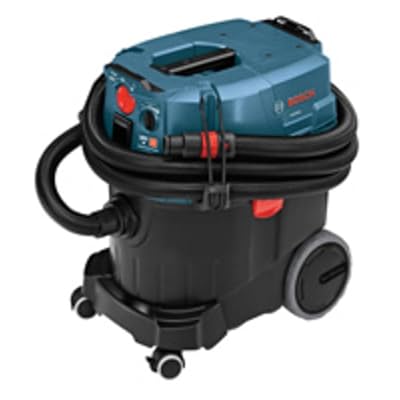
Bosch VAC090AH 9-Gallon Dust Extractor with HEPA Filter
A shop vacuum with a paper filter will pass concrete fines straight through and blow them back into the room, and the filter will clog within minutes so the suction dies exactly when you need it. This extractor runs HEPA media with an automatic filter-cleaning cycle that pulses the cake off the filter while you work, which is why it can hold airflow through a full session instead of the first ten minutes.
The tool-activation outlet is the underrated part. The grinder plugs into the extractor, the extractor starts and stops with the trigger, and you stop leaving a running vacuum in the corner. It is bulky, and if your only dust job all year is a single garage floor, a good drywall-rated filter on a large shop vac will get you through. But if the door to the kitchen is ten feet from the slab, this is the one that keeps the dust out of the house.
Key fact: HEPA media plus automatic filter cleaning is what keeps suction steady across a long grinding session.
Pros
- HEPA filtration for respirable concrete fines
- Filter self-cleans, so airflow holds up
- Tool-activated outlet syncs with the grinder
Cons
- Large, heavy and priced like a serious tool
- More extractor than a single small slab needs
Best for: grinding inside an attached garage or a finished basement, where the dust has somewhere to go.
Via Amazon.com
Field notes from a slab that fought back
Grind in two directions, always. Run the whole floor north-south, then run it east-west. One direction leaves a comb pattern you will not see until the coating is wet and it is too late.
Do the edges first, not last. You will be tired at the end, and edges are the fussy part. Get the perimeter and the door threshold done while your arms still work.
If the wheel stops cutting, it is glazed, not worn. Run it over a scrap piece of hard brick or a block for thirty seconds to expose fresh diamond. People throw away wheels with most of their life left.
Empty the vacuum at half full. Concrete fines are heavy and dense, and a drum you can barely lift is a drum whose airflow died an hour ago.
Mask the door to the house with plastic and tape, even with a shroud. No shroud captures everything, and the fines travel further than you expect.
Renovation Stage: PREP
Grinding sits at the front of the sequence, before any primer or coating touches the slab. Everything downstream — the primer bite, the coating thickness, the way the floor looks in five years — is decided in this stage. Once you have the profile open, move on to the epoxy prep checklist before opening a single kit.
Rent or buy: run your own numbers

How to choose a concrete grinder
Three specifications decide whether the tool suits your slab, and none of them is horsepower. Get these right and the rental-versus-purchase question mostly answers itself.
Disc size sets your pace, and your patience
A 4.5 or 5-inch head is manoeuvrable, cheap to feed with wheels, and slow across open floor. A 7-inch head roughly doubles the path per pass but weighs more and cannot get near a corner. For a single-car garage, 5 inches is honest. Past about 400 square feet, the extra weight of a 7-inch concrete grinder buys back more time than it costs you in fatigue. Walk-behind machines only start making sense above roughly 1,000 square feet, and those are rental territory for almost every homeowner.
Diamond or carbide: the wheel is not a detail
Diamond cup wheels cut cured concrete. Carbide and scarifier drums chew coatings and mastic. If you put a diamond wheel on a floor covered in soft adhesive, the adhesive melts and loads the segments until the wheel stops cutting entirely. Match the wheel to what is actually on the slab, and keep in mind that a soft-bond diamond wheel is for hard concrete and a hard-bond wheel is for soft concrete — the relationship is inverted from what most people assume, because a soft bond keeps exposing fresh diamond on a slab that resists wear.
The dust connection decides everything else
A concrete grinder without a shroud and a vacuum is not a tool, it is a fog machine, and the fog is respirable crystalline silica. OSHA’s construction silica standard lists handheld grinders specifically and calls for a commercially available shroud plus a dust collector sized to the wheel, with a filter that self-cleans. You can read the requirement on the OSHA respirable crystalline silica page. For a homeowner, the practical version is simpler: shroud on the tool, hose to a vacuum with real filtration, and a proper respirator on your face regardless.
When grinding is the wrong call
Skip the grinder on a slab you suspect has lead-based coatings. Pre-1978 industrial floor paint can carry lead, and grinding turns it into fine airborne dust across the whole room. Test first, and follow the EPA renovation, repair and painting rules before any tool touches it.
Skip it on a floor with radiant heat tubing near the surface. You do not know the cover depth, and a nicked tube is a slab demolition, not a repair.
Skip it if the slab is actively damp. Grinding a wet floor packs the pores with slurry instead of opening them, and no coating bonds to that. Fix the moisture source, let it dry, then grind.
Skip it on new concrete under 28 days old. The surface is still gaining strength and you will tear it rather than profile it.
Prep sequence, start to finish
- Clear and sweep the slab. Every screw and pebble left down there becomes a scratch under a spinning wheel.
- Degrease the oil spots. Grinding oil-soaked concrete drives the oil deeper. Pull it first with a degreaser or poultice.
- Strip loose coating mechanically. Old flaking paint should come off before you profile — see removing paint from concrete for the chemical route where grinding is impractical.
- Grind the perimeter and threshold. Edges first, while you are fresh.
- Grind the open floor in two directions. North-south, then east-west, overlapping each pass by about a third.
- Vacuum, then vacuum again. Then wipe with a damp microfibre and let the slab dry fully.
- Check the profile with water. Drop a spoonful on the slab. If it darkens and soaks in within a minute, the surface is open. If it beads, keep grinding.
- Coat within a day or two. A freshly ground floor picks up dust and moisture fast. Match the coating to the use — the garage floor coating comparison and the full concrete floor painting walkthrough both start where this guide ends.
The verdict
For one garage floor and no plans for another, rent the machine and buy your own shroud and respirator. For a floor plus a driveway apron, a basement, or anything you already know is coming next season, buying a 7-inch set costs about what two rental days cost and you still own it afterwards. The tool that actually decides your result is not the grinder at all — it is the vacuum hanging off it. If you are sealing outdoors afterwards, the same prep logic runs through concrete driveway sealers and driveway paint.
Questions people actually ask
How much does it cost to rent a concrete grinder for a day?
Handheld units generally rent for around $25 to $45 a day, and walk-behind floor machines run roughly $85 to $150 a day depending on width and horsepower, with some yards listing larger machines higher. Add the deposit, the wheel wear charge some yards apply, and the trip back.
Is it cheaper to rent or buy a concrete grinder?
For a single project of a few days, renting almost always wins on cost. Buying pulls ahead once you expect more than about two to three rental days of use, which happens faster than people think when a driveway apron or a basement is next on the list.
Do I need to grind concrete before epoxy?
Yes, in almost every case. A troweled slab is sealed at the surface and epoxy has nothing to key into. Grinding gives you a profile roughly comparable to medium sandpaper, which is what the primer needs to bite.
Can I use an angle grinder to grind a concrete floor?
You can, with a diamond cup wheel and a shroud, and for a small area it is the sensible route. On a full two-car garage the tool will run hot and the job will take considerably longer than a dedicated surfacing machine.
How long does it take to grind a two-car garage floor?
Plan on a full day for roughly 400 to 500 square feet with a 5-inch handheld on a reasonably clean slab. Old mastic, thick paint or heavy patching can easily double that.
What respirator do I need for concrete grinding?
A NIOSH-approved N95 is the minimum for short exposure, and a half-mask with P100 cartridges is the sensible choice for a full day. Silica dust is the hazard, and no shroud captures all of it.
Does a shop vac work with a concrete grinder?
It works if the filter can handle fine dust and you empty the drum often. A standard paper filter clogs within minutes and then passes the fines back into the room, which defeats the point.
Will grinding fix cracks in the slab?
No. Grinding levels the surface and opens the pores. Cracks need to be chased out, filled with a semi-rigid polyurea or epoxy filler, and then ground flush.
ThePaintly is reader-supported. We only recommend products we’ve personally evaluated. When you buy through links on this site, we may earn an affiliate commission at no extra cost to you.