Best Industrial LED Ceiling Panels: The 2025 Buyer’s Guide For Warehouses, Factories, And Large Workspaces
Industrial lighting is not just about making a space bright, it is about creating safe, consistent, low-glare light that cuts energy costs, reduces maintenance, and keeps productivity high. This guide breaks down how to choose the best industrial LED ceiling panels, with clear selection criteria, sizing tips, and hands-on reviews of panels you can actually buy today. Where useful, you will also see contextual links to related how-to resources on ThePaintly to help you finish the room like a pro.
Quick takeaways
- For tall, open bays, look first at high-output 2×4 panels with 0–10 V dimming and selectable wattage, they deliver the most lumens per fixture and are easiest to standardize at scale.
- For grid ceilings in offices, corridors, QC rooms, and low to mid-height areas, 2×2 LED ceiling panels and led ceiling panels 600×600 are straightforward retrofits with great uniformity and fast install times.
- Always size to task, not guesswork, typical warehousing targets are about 20 foot-candles for open aisles and 30 to 50 foot-candles for active picking or assembly, verify with a plan.
What “industrial grade” really means for LED panels
When people ask for led lighting for industrial spaces, they are really asking for durability and uniform light with minimal downtime. Here is what to evaluate, with the trade-offs spelled out.
- Light levels, by task
Warehousing with aisles often needs around 20 foot-candles, bulky items can operate at the lower end, fine picking or inspection leans higher. Always plan to target the middle of the recommended ranges to preserve headroom as luminaires age. - Wattage and efficacy
Look for 110 to 130 lm per watt or better on 2×4 class panels. Selectable wattage models simplify stocking and let you tune light levels room by room. - 0–10 V dimming and driver quality
Industrial sites benefit from 0–10 V for daylight harvesting, shift changes, and energy projects. Avoid panels with no-name drivers if you require long maintenance cycles. - Thermal design and frame
Sturdy aluminum frames and back-lit designs usually manage heat better than ultra-thin, edge-lit budget panels, which helps maintain output and color over time. - Mounting options
Decide early, recessed in grid, ceiling mounted led panel frames for solid ceilings, or suspension kits for uneven decks. Many commercial models support multiple mount methods, but surface frames are often sold separately. - Certifications and warranty
For large facilities or incentives, prioritize ETL or UL listings and DLC qualification where relevant, along with multi-year warranties published on the product page.
The best industrial LED ceiling panels, tested against real-world needs
Below are strong, widely available panels suitable for industrial retrofits or new builds. Each review focuses on how the product behaves for different users and spaces, not just a spec sheet.
1) Sunco 2×4 Selectable CCT Flat Panel, 0–10 V Dimming
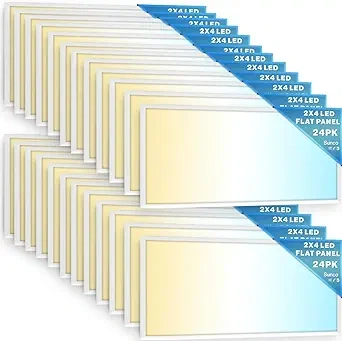
Best for fast standardization across large sites
- Why it stands out: selectable color temperature, selectable wattage on many bundles, 0–10 V dimming, and back-lit construction that keeps brightness even and maintenance low. In warehouses with mixed areas, facility teams love locking in 4000 K for QC stations and 5000 K for aisles without re-ordering variants.
- Ideal users: operations managers overseeing multi-bay retrofits, installers who need repeatable SKUs, energy teams targeting controls and rebates.
- Good in practice: quick starts, no visible flicker, dust-resistant housing that wipes down fast, helpful for food or packaging environments.
- Where it can disappoint: surface-mount frames or suspension kits may be separate line items, plan procurement to avoid delays.
2) Hykolity 2×4 Flat Panel Troffer, Selectable Wattage and CCT
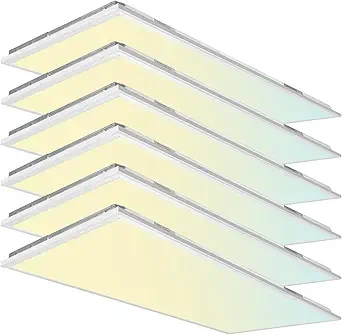
Best for tuning light levels without changing fixtures
- Why it stands out: selectable 40, 50, or 60 W, plus 4000 K, 5000 K, or 6500 K on the same body. You can dial higher wattage for tall bays, then drop to 40 W in offices for uniform appearance and easier spares. 0–10 V dimming is standard.
- Ideal users: plants with mixed ceiling heights, maintenance teams who want one model for stores and floor.
- Good in practice: sturdy construction, even output, widely available multi-packs for budget control.
- Where it can disappoint: verify that mounting kits are included, many surface frames are optional.
3) Sunco 2×2 Flat Panel, Commercial Grade Back-lit
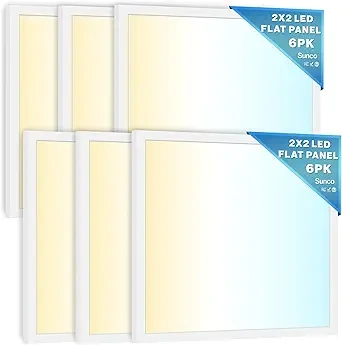
Best 2×2 LED ceiling panels for low to mid-height grids
- Why it stands out: uniform, bright 2×2 panels for corridors, offices, small rooms, and low-bay spaces feeding production lines. The back-lit design improves efficiency versus older edge-lit units. 0–10 V dimming helps match adjacent areas.
- Ideal users: facilities with legacy 2×2 grids, quick office retrofits, inspection labs that need even, glare-controlled light.
- Where it can disappoint: at higher mounting heights you may need more fixtures per bay than with 2×4 panels.
4) Nuwatt LED ceiling panels, back-lit and edge-lit options
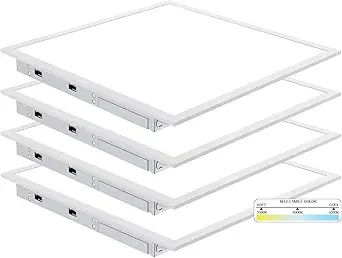
Best brand line if you want value and lots of sizes, including 1×4
- Why it stands out: nuwatt led ceiling panels are offered in 1×4, 2×2, and 2×4 variants with selectable CCT and dimming, a good fit for budget-conscious rollouts.
- Ideal users: price-sensitive retrofits, smaller warehouses, corridors connecting production zones.
- Where it can disappoint: confirm driver specs for controls projects, and check whether your preferred mount kit is included or separate.
5) 2×2, 24×24 Triac or 0–10 V options, budget skus
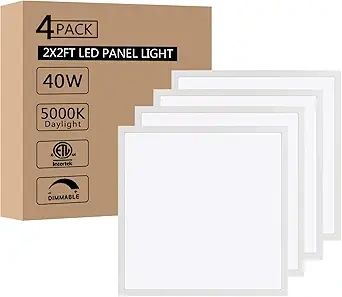
Best for small retrofits, maintenance closets, or non critical rooms
- Why it stands out: economical 2×2 panels work well in support areas, break rooms, and closets. Several listings offer 5-CCT, 5-wattage adjustability, or triac dimming for simple controls.
- Where it can disappoint: many budget models trade driver quality or thermal mass for price, which can shorten life in hot ceilings. For production floors, step up to commercial lines.
Sizing, spacing, and layout that actually works
Use foot-candle targets first, then calculate fixture count. For example, if an open warehouse aisle target is about 20 fc and you have 10,000 square feet, you are aiming for roughly 200,000 lumens on the floor before depreciation. Divide by fixture lumens and add a maintenance factor to set counts and spacing.
If you expect label reading, fine picking, or detailed assembly, design for the higher end of the range, or choose selectable-wattage panels so you can tune after installation without changing fixtures.
Mounting methods explained, recessed, surface, suspended
Recommended products, quick comparison
| Model | Sizes | Dimming | Selectable CCT, Wattage | Good for | Heads-up |
|---|---|---|---|---|---|
| Sunco Flat Panel, 2×4 | 2×4 | 0–10 V | 4000 K, 5000 K, 6000 K, selectable wattage on many bundles | Large retrofits, uniform look | Order surface kit if needed |
| Hykolity Flat Panel, 2×4 | 2×4 | 0–10 V | 3 CCT and 3 wattages on board | Mixed heights, tuning light post-install | Verify kit contents |
| Sunco Flat Panel, 2×2 | 2×2 | 0–10 V | Selectable CCT | Corridors, offices, low bays | Use more fixtures in tall rooms |
| Nuwatt Panels, 1×4, 2×2, 2×4 | Multiple | 0–10 V | 3 or 5 CCT options depending on model | Budget rollouts, varied sizes | Confirm driver, mounts per SKU |
Smart planning tips that save headaches later
Internal guides to finish the room
- Prepping the lid before you light it up, see Best Way to Paint a Ceiling for clean edges and a bright, uniform look next to new panels. https://thepaintly.com/best-way-to-paint-a-ceiling/
- Working over texture, Best Way to Paint a Popcorn Ceiling helps you seal dust and avoid fallout during lighting installs. https://thepaintly.com/best-way-to-paint-a-popcorn-ceiling/
- Choosing sheen and stain blockers for utility rooms and washdown areas, see Zinsser Ceiling Paint and Best Ceiling Paint For High Humidity. https://thepaintly.com/zinsser-ceiling-paint/ , https://thepaintly.com/best-ceiling-paint-for-high-humidity/
- For more panel-specific picks by space, compare Best 2×2 LED Ceiling Panels, Best Surface Mount LED Ceiling Panels, and Best Recessed LED Ceiling Panels to fine-tune by room type. https://thepaintly.com/best-2×2-led-ceiling-panels/ , https://thepaintly.com/best-surface-mount-led-ceiling-panels/ , https://thepaintly.com/best-recessed-led-ceiling-panels/
Frequently asked, short answers
Do I need 2×2 or 2×4: use 2×4 where you need higher lumens per fixture and wider spacing, use 2×2 to match existing grids, low ceilings, and tight rooms.
What color temperature works best: 4000 K to 5000 K is the sweet spot for industrial, 5000 K feels crisper in aisles, 4000 K is easier on eyes in QC and assembly.
How bright should a warehouse be: plan around 20 foot-candles for open warehouse areas, more for small-label picking, receiving, and assembly.
Final verdict
There is no single winner for everyone, the best industrial LED ceiling panels are the ones that meet your task light levels, your mounting constraints, and your maintenance strategy. If you want a single family to standardize on, Sunco’s selectable 2×4 for bays and Hykolity’s selectable 2×4 for mixed-height areas are the simplest way to keep spares lean without sacrificing control. For corridors, offices, and low bays, stick with 2×2 back-lit panels from a commercial line and keep color temperature consistent with the floor.