Best Recessed LED Ceiling Panels: 5 Picks 2026
Updated: June 2026 · By Sophie Ulman
Drop-Ceiling LED Panels That Light a Room Evenly, Not in Stripes
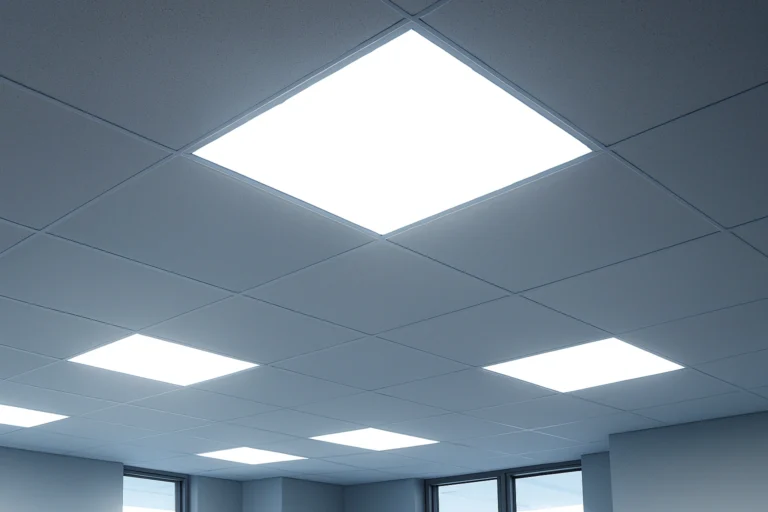
The best recessed LED ceiling panels do one thing the old fluorescent troffers never managed: they put down flat, even, glare-free light with no hum, no flicker, and no warm-up. Drop one into a 2×4 grid opening in a basement, garage, kitchen, or office and the room reads brighter and cleaner instantly. Get the wrong one, though, and you are looking at panels that buzz on the dimmer, two fixtures side by side glowing different shades of white, or a unit that does not actually fit your grid depth.
I have swapped out enough yellowed acrylic troffers for recessed LED ceiling panels to know which specs decide whether a room looks finished or fluorescent. The five panels below are sorted by the job they do best — from a do-everything switchable 2×4 to a compact 2×2 for a small office — and every one is judged on the two things that actually matter in a grid ceiling: dimming behavior and color consistency.
Quick Comparison: Best Recessed LED Ceiling Panels
| Panel | Size | Dimming | Best For | Check Price |
|---|---|---|---|---|
| Lithonia CPANL 2×4 — Best Overall | 2×4 | 0–10V | Whole-room installs | Check Price → |
| Hykolity 2×4 Selectable — Best Value | 2×4 | 0–10V | Multi-panel budgets | Check Price → |
| Sunco 2×4 Commercial — Best Support | 2×4 | 0–10V | Brand trust, warranty | Check Price → |
| Barrina 1×4 — Best for Hallways | 1×4 | 0–10V | Galley kitchens, halls | Check Price → |
| Nuwatt 2×2 Edge-Lit — Best Compact | 2×2 | 0–10V | Small offices, closets | Check Price → |
5 Recessed LED Ceiling Panels Reviewed
Lithonia Lighting CPANL 2×4 — Switchable CCT & Lumens
Lithonia is a name commercial electricians actually trust, and the CPANL is why. The switchable design lets you set both color temperature (3500K/4000K/5000K) and lumen output (anywhere from roughly 3,300 up to about 6,000 lumens) with dip switches on the back before you install. That means one box covers a dim basement and a bright workshop — you are not guessing at the order. Color consistency panel-to-panel is the strong point here: in a room full of fixtures, mismatched whites are the failure you notice every day, and Lithonia holds its tint tightly.
It runs on a 0–10V dimming driver, the dimming standard for panels, which gives smooth low-end dimming without the flicker leading-edge dimmers cause. The honest caveat: 0–10V needs a compatible dimmer and a low-voltage control wire run — it is not a drop-in swap onto a basic wall switch. If you are wiring it to a plain switch and never dimming, that is fine; just know dimming takes the extra control leg.
✔ 2×4 · switchable CCT 3500/4000/5000K · selectable ~3,300–6,000 lm · 0–10V dimming
- Set CCT and lumens before install
- Excellent panel-to-panel color match
- Trusted commercial brand
- 0–10V dimming needs a control wire
- Costs more than budget panels
Best for: Whole-room installs where color consistency and flexibility matter most.
Check Price on Amazon →Via Amazon.com
Hykolity 2×4 Selectable Wattage — 0–10V Dimmable
When you are buying six or eight panels for a basement or garage, the price-per-panel gap adds up fast, and Hykolity is where I send people on a budget who still want selectable wattage and proper 0–10V dimming. You pick the wattage (and on most versions the CCT) at install, so a single SKU covers different rooms. Output is strong — the high setting lights a workshop properly — and it carries the safety listings you want in a ceiling fixture.
It does not match Lithonia’s tint consistency at the very top end, and the build feels a touch lighter in the hand. For a finished living space where you stare at the ceiling all evening, spend up. For a garage, utility room, or rental where bright-and-cheap wins, this is the value pick that does not cut the dimming corner.
✔ 2×4 · selectable wattage/CCT · 0–10V dimmable · best price-per-panel
- Strong value for multi-panel jobs
- Real 0–10V dimming, not skipped
- Selectable wattage flexibility
- Tint match not quite Lithonia-grade
- Lighter build quality
Best for: Garages, basements, and rentals where you need many panels on a budget.
Check Price on Amazon →Via Amazon.com
Sunco 2×4 Commercial LED Panels
Sunco sits between the contractor-grade Lithonia and the budget Hykolity, and its real advantage is U.S.-based support and a clear warranty — the thing you care about only when a driver fails in year two. The panels are clean, even edge-lit fixtures with solid color consistency, ETL listed, and DLC listed on most versions, which matters if you are chasing a utility rebate. They dim on 0–10V like the others.
You pay a little for the support and the listings, and if you never plan to file a warranty claim or a rebate, the value pick saves money. But for a homeowner who wants one company to call if something goes wrong, Sunco earns its spot.
✔ 2×4 · ETL + DLC listed · 0–10V dimming · U.S. warranty support
- Responsive warranty support
- DLC listed for utility rebates
- Consistent edge-lit output
- Priced above budget panels
- Fewer switchable options than Lithonia
Best for: Homeowners who value warranty support and rebate eligibility.
Check Price on Amazon →Via Amazon.com
Barrina 1×4 — 0–10V Dimmable
Not every space wants a 2×4. A 1×4 panel is the right proportion for a hallway, a galley kitchen, or a long narrow utility room — it lays into the grid following the run of the space instead of fighting it. The Barrina 1×4 is bright for its size, dims on 0–10V, and installs the same way as the larger panels: drop it in the grid or surface-mount it with a kit.
Because it is narrower, you need more of them to light a wide room evenly — do not try to stretch one 1×4 across a two-car garage. Used in the right proportion of space, though, it gives a cleaner, more intentional look than cramming a 2×4 into a corridor.
✔ 1×4 · 0–10V dimmable · grid-drop or surface mount · ideal for narrow rooms
- Right shape for halls and galleys
- Bright for a 1×4
- Flexible mounting
- Needs more units for wide rooms
- Less output per fixture than a 2×4
Best for: Hallways, galley kitchens, and long narrow utility spaces.
Check Price on Amazon →Via Amazon.com
Nuwatt 2×2 Edge-Lit — 0–10V Panel
For a small office, a closet-turned-workspace, or a 2×2 grid ceiling, a full 2×4 is simply too big. The Nuwatt 2×2 edge-lit panel gives you the same flat, even, glare-free light in a square footprint that drops cleanly into a 2×2 grid. Edge-lit construction keeps it thin and the light uniform across the face, with no visible LED dots. It dims on 0–10V like the rest.
One 2×2 lights a small room; for anything larger you will want a pair or step up to 2x4s. Confirm your grid is actually 2×2 before ordering — mixing a 2×2 panel into a 2×4 grid leaves you cutting and filler-panel hunting.
✔ 2×2 · edge-lit, uniform face · 0–10V dimming · thin profile
- Right size for small rooms
- Uniform edge-lit light, no dots
- Drops into 2×2 grids cleanly
- One panel only covers a small room
- Must match a true 2×2 grid
Best for: Small offices, closets, and rooms built on a 2×2 ceiling grid.
Check Price on Amazon →Via Amazon.com
If your panels are going into a finished space, do the ceiling work first — new panels make a tired ceiling look worse, not better. Here is how to paint a ceiling cleanly before you cut in the lights. For office-specific picks, our guide to LED ceiling panels for home offices goes deeper on glare and eye comfort, and the 2026 modern home lighting guide covers how panels fit into a whole-home plan.
When a Recessed LED Panel Is the Wrong Choice
⚠ Don’t use a drop-in panel if:
- You have a drywall ceiling, not a grid. These panels are sized for a suspended grid. In a flat drywall ceiling you need a back box or surface-mount kit — or you should be looking at flush mount recessed retrofits instead.
- Your plenum depth is too shallow. Even thin edge-lit panels and their drivers need a little clearance above the grid. In a tight basement plenum, measure before you buy — a panel that will not seat into the grid is a return.
- You want to dim but only have a standard switch. 0–10V dimming needs a compatible dimmer and a low-voltage control wire. If you only have a basic switch and will not run new wire, buy a panel and run it non-dimmed, or pick a TRIAC-dimmable model designed for line-voltage dimmers.
- You want decorative, warm, layered light. Panels are functional, even illumination — great for work, flat for ambiance. For a living room you want layered light, not a glowing rectangle.
Sophie’s Experience: The Mismatched Whites
How Many Panels Does Your Room Need?
💡 Panel Count Calculator
Buying Guide: Fit, CCT & Dimming
1. Match the Panel to Your Grid
Suspended ceilings come in two common openings: nominal 2×4 (24 by 48 inches) and 2×2 (24 by 24 inches), the same grid sizes used by Armstrong and other manufacturers. Measure your actual grid opening before buying. A 2×4 panel will not seat in a 2×2 grid, and forcing the mix means cutting tiles and chasing filler panels. For drywall ceilings, you need a surface-mount or recessed back-box kit — the bare panel is built for a grid.
2. CCT: Pick One and Keep It Consistent
Color temperature (CCT) sets the mood: 3500K is warm-neutral for offices, 4000K is a clean neutral that suits most rooms, and 5000K is the bright daylight look for garages and workshops. Switchable panels let you choose at install, which is the safer buy. The rule that matters most: every panel in one room should be the same CCT and ideally the same batch, or you get the mismatched-white problem.
| Panel Size | Typical Output | Best Use | Notes |
|---|---|---|---|
| 2×4 | 4,000–6,000 lm | Garages, basements, offices | Most output per fixture |
| 2×2 | 2,000–3,500 lm | Small offices, 2×2 grids | Square footprint |
| 1×4 | 1,800–2,500 lm | Halls, galley kitchens | Narrow rooms |
3. Dimming: Why 0–10V Usually Beats TRIAC in Panels
Most quality panels dim on a 0–10V driver. It dims smoothly to a low level without the flicker or buzz that leading-edge (TRIAC) dimmers often cause with LED drivers. The trade-off is wiring: 0–10V needs a compatible dimmer and a separate low-voltage control wire, so it is not a one-for-one swap onto an existing switch. If you want to dim on the wall switch you already have, look specifically for a TRIAC-dimmable panel rated for line-voltage dimmers. ENERGY STAR explains how LED efficiency and dimming compatibility work if you want the background, and Family Handyman’s install walkthrough covers the wiring side before you start.
⚡ Pro Tips from the Field
Buy the whole room in one order: same batch keeps the whites matched. Confirm the listing: ETL or UL listed for safety, DLC listed if you want a utility rebate. Plenum check: measure clearance above the grid for the panel and driver before buying. Prep beats product: paint or clean the ceiling and grid first — bright new panels show every smudge on old tiles.
🎯 Verdict
For a finished room where color consistency matters, the Lithonia CPANL 2×4 is the panel I trust — switchable CCT and lumens, tight tint match, and proper 0–10V dimming. Outfitting a garage or basement on a budget? The Hykolity 2×4 delivers real dimming and selectable wattage at the best price-per-panel. Narrow space? Go Barrina 1×4. Small office or 2×2 grid? The Nuwatt 2×2. Whatever you pick, confirm your grid size, buy every panel for the room in one batch, and decide on your dimming method before you order.
Frequently Asked Questions
Do recessed LED ceiling panels fit Armstrong drop ceilings?
Yes — standard panels fit suspended grids in 2×4 (24×48) and 2×2 (24×24) openings, the same sizes Armstrong uses. Measure your grid opening and check plenum depth above it before buying.
What is the difference between 0-10V and TRIAC dimming?
0-10V uses a low-voltage control wire for smooth, flicker-free dimming and is the panel standard. TRIAC works on a regular wall dimmer but can flicker or buzz with some drivers. Pick 0-10V if you can run the wire, TRIAC if you only have a standard switch.
How many LED panels do I need for a room?
Multiply square footage by your target (about 30 lm/sq ft for offices, 50 for workshops, 20 for basements), then divide by lumens per panel. A 20×12 garage at 50 lm/sq ft needs about 12,000 lumens — roughly three 4,000-lumen 2×4 panels. Use the calculator above.
Can you install LED panels in a drywall ceiling?
Not directly — bare panels are made for a grid. Drywall needs a surface-mount frame or recessed back-box kit. For a drywall ceiling, flush mount recessed retrofits are often simpler.
What color temperature is best?
3500K warm-neutral for offices, 4000K clean neutral for most rooms, 5000K daylight for garages. The key rule is keeping every panel in a room the same CCT and batch.
Do LED ceiling panels flicker?
Quality panels on a 0-10V driver with a compatible dimmer should not. Flicker usually comes from an incompatible leading-edge dimmer or a very cheap driver. Match the dimmer type and buy a listed fixture.