Best LED Ceiling Panel for Warehouses: 2025 Buyer’s Guide
Looking for the best LED ceiling panel for warehouses that actually improves visibility, cuts energy costs, and survives real-world conditions, not just lab specs? This guide explains everything in practical terms, including how to size your lighting by area and task, what specs matter, and how to install panels correctly in a busy facility. You will also find field-tested product picks with pros and cons, plus smart tips that reduce maintenance and downtime.
Why LED Ceiling Panels for Warehouses?
LEDs are already widely praised for energy efficiency, long lifespans, and clean light. But warehouses present special challenges: high ceilings, large open areas, potential for dust and mechanical stress, and zones with varying brightness needs (aisles, docking bays, storage racks). A well-chosen LED ceiling panel bridges the gap between ambient illumination and task lighting, especially when combined with high-bay or strip lighting strategies.
When comparing LED ceiling panels to other fixtures (e.g. high bays, UFOs, linear lights), panels tend to offer:
Still, they’re not perfect for every warehouse zone, so your design must mix and match wisely.
Quick Picks: Best LED Ceiling Panels For Warehouses
Below are reliable, widely available 2×4 panel options with high efficacy, selectable wattage, and 0–10 V dimming, ideal for ambient lighting in packing areas, mezzanines, corridors, and ancillary spaces. Use high bays or linears over tall racking, then use panels where you need uniform ambient light.
Hykolity 2×4 FT Back-Lit Flat Panel, 40/50/60 W, 3-CCT, 0–10 V dimmable
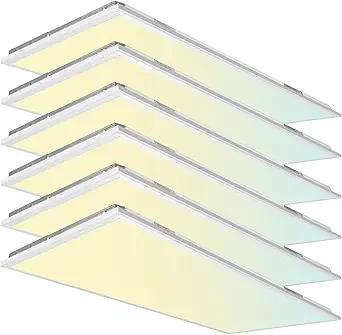
Great all-rounder with selectable wattage and 4000 K, 5000 K, 6500 K options. Uniform output, thin profile, easy to mix across zones.
Best for: general ambient lighting, offices inside warehouses, packing lines.
Consider: add sensors for unoccupied time.
Sunco 2×4 LED Flat Panel, 30/40/50 W selectable, 4000–6000 K, 0–10 V

High-volume commercial panel with dimming and dust-resistant build. Good lumen output per watt, available in multi-packs for large projects.
Best for: multi-bay ambient coverage, corridors, low-to-mid ceilings.
Consider: confirm lumen package per zone, especially under higher ceilings.
7,800-Lumen 2×4 Back-Lit Panel, ~130 lm/W, 5000 K, 0–10 V
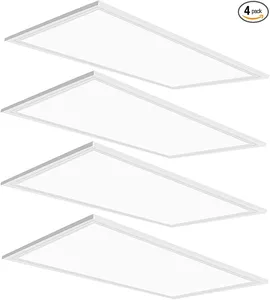
High-efficacy pick that keeps wattage reasonable, useful when you need a brighter 2×4 footprint without jumping to high bays.
Best for: wide open packing areas, cross-aisles, QC tables.
Consider: verify glare control with your ceiling height and finish.
Hykolity 2×4 FT Troffer Panel, 36/42/50 W switchable
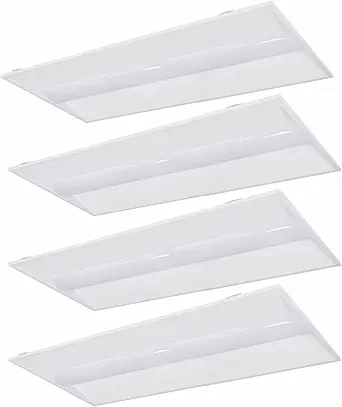
Selectable wattage with clear documentation, smooth 0–10 V dimming, and a straightforward coverage guide that helps with quick planning.
Best for: quick retrofits from fluorescents, standardized grid ceilings.
Consider: pair with occupancy sensors to maximize savings.
Tip: If your warehouse racks are tall, use high bays over aisles and reserve flat panels for open floor areas, offices, and packing lines. Panels are excellent for uniform ambient light, yet high bays often win for vertical illumination down narrow aisles.
How To Choose LED Panels For Warehouses
Match light level to task
Warehouses typically target 10–30 foot-candles for general storage, and more for packing, inspection, or detailed work. Use your target foot-candles to back into the lumens you need, then select panel quantities and spacing to achieve uniformity.
Rule of thumb:
- Storage aisles: 10–20 fc
- Packing, assembly, QC: 30–50 fc
- Offices, break rooms: 30–50 fc
Prioritize efficacy and lumen package
Look for panels around 110–130 lm/W. Many 2×4 panels in this guide sit near 6,500–7,800 lm when driven at 50–60 W, which is a practical sweet spot for low-to-mid ceilings.
Choose color temperature and CRI by task
4000–5000 K is the safest warehouse range, bright and neutral with good contrast. CRI 80+ is sufficient for most tasks, higher if color accuracy is critical.
Favor quality optics
Micro-prismatic or anti-glare diffusers help reduce hotspots and eye strain, which matters in large open spaces and at worktables.
Controls
Select 0–10 V dimmable panels and add occupancy sensors, daylight harvesting, and zoned switching so unoccupied aisles automatically dim or shut off.
Build for the environment
If dust is common, choose dust-resistant lenses and sealed housings. For occasional impacts, consider protective cages or install panels away from forklift mast travel.
LED Lighting For Warehouse, Layout That Works
- Open floor, packing, QC: 2×4 panels in a grid give bright, even ambient light that reduces hard shadows on tables.
- Narrow aisles with tall racks: use linear or UFO high bays for vertical illumination down the face of racking, then add panels only in cross-aisles or staging areas.
- Offices, break rooms, mezzanines: panels excel here for visual comfort and consistency with administrative areas.
If you plan to repaint ceilings for reflectance, consider reading best white ceiling paint and best way to paint a ceiling.
LED Lighting For Warehouse Installation
- Survey the space: measure ceiling heights, aisle widths, rack heights, and note electrical access.
- Set targets: choose foot-candle goals by zone, validate with a layout or sample install.
- Pick the panel type: back-lit 2×4 panels with 0–10 V dimming and 4000–5000 K CCT are safe defaults.
- Controls and zoning: install occupancy sensors and daylight sensors, wire zones separately.
- Mounting and wiring: follow manufacturer’s instructions for anchors, support, and dimmer wiring.
- Commissioning: verify dimming range, sensor timeouts, and uniformity before closing lifts.
- Maintenance: keep spare drivers and panels, schedule lens cleaning, document settings.
For paint and prep guidance while doing ceiling work, check best tools to paint a ceiling and best ladder for painting.
Sizing Example
Scenario: 9,300 sq ft open packing area, 18 ft ceiling, target ~30 fc.
- Total lumens needed = 9,300 × 30 = 279,000 lumens.
- With 7,700-lumen panels, you need ~36 panels, then adjust for spacing and reflectance.
- Space panels evenly, overlap light patterns, and use dimmers to trim output when daylight helps.
FAQs
Are LED panels enough for racks?
Panels are ideal for ambient zones. For tall racking, you usually want linear or UFO high bays aimed down aisles.
What CCT should I choose?
Use 4000–5000 K for most warehouse tasks. It feels bright and neutral, helping with barcode reads and product IDs.
How do I reduce glare?
Pick panels with quality diffusers or micro-prismatic lenses, and avoid mounting directly over glossy worktops.
How do I save the most energy?
Choose high-efficacy panels, add occupancy sensors and daylight controls, and wire zones separately.
Final Verdict
- Use 2×4 back-lit LED panels with 0–10 V dimming for open floors, packing lines, and offices.
- Keep high bays over tall racks, then panels for uniform ambient light elsewhere.
- Target foot-candle levels by task, not guesses, and validate spacing before ordering.
- If you want a safe starting choice, Hykolity’s 2×4 back-lit panel or Sunco’s 2×4 selectable panel are dependable options.