Best Tools to Paint a Ceiling (The Pole Matters Most)
Ceilings are not hard to paint. They are hard to paint comfortably, and almost everything that goes wrong on a ceiling — the missed patches, the roller marks, the second coat that never happens — traces back to the fact that the person doing it was uncomfortable and wanted to stop.
I painted my first ceiling standing on a kitchen chair with a 9-inch roller and no pole, moving the chair every four feet. It took a whole Saturday, my shoulders ached for two days, and the finish was visibly patchy because I was rushing the last third. The paint was fine. The tools were the problem.
So here is the honest ranking of what actually makes a ceiling easier, starting with the one item that changes the job more than everything else combined.
The Short Answer: The Best Tool for Painting a Ceiling Is an Extension Pole
Not a sprayer, not an edger, not a clever gadget. A pole.
Working from the floor rather than a ladder changes three things at once. You can see the whole ceiling instead of the two feet in front of your face, which is the only way to spot a thin patch while it is still wet. You stop climbing down and repositioning every few minutes, which is where most of the time goes. And your arms are below shoulder height instead of above it, which is the difference between finishing and giving up after one coat.
People skip the pole because it feels like an accessory. It is not — on a ceiling it is the primary tool, and the roller is the attachment.
Wooster Sherlock GT Convertible Extension Pole, 4–8 feet
The 4–8 ft covers a standard room from the floor. What makes this one worth buying over a cheap telescopic pole is the locking system: a hexagonal inner pole inside a fibreglass outer, so it does not twist under load. A pole that rotates while you push is exactly how you get a wandering roller line, and cheap poles all do it eventually.
It also has a conversion tip stored in the handle, so it takes ordinary threaded tools as well as Wooster’s own — useful, because you will want to put an edger and a duster on the same pole.
For a stairwell, a vaulted ceiling or a double-height room, the same pole is made in an 8–16 ft version. Buy that one only if you need it — at full extension a long pole is heavy and hard to control, and it is worse than the short pole in a normal room.
The Rest of the Core Kit
Rollers, tray and covers — Bates Paint Roller Kit, 19 pieces
If you are starting from nothing, a kit is better value than assembling the pieces separately. This one has the 9-inch frame and covers you will actually use on the ceiling, a 4-inch frame for the awkward strip behind a light fitting, a tray, a drop cloth, scrapers, a can opener and tape.
One thing a kit will not decide for you is nap depth, and on a ceiling that choice matters more than the frame does. A smooth ceiling wants a short nap; anything textured needs a longer one or you will leave every hollow unpainted. We go through it properly in what nap roller you need for a textured ceiling.
Brushes for cutting in — Pro Grade Paint Brushes, 5-piece set
You need one good angled brush for the perimeter, and the 2.5-inch angled brush in this set is the one you will reach for. The set also gives you a 2-inch angled stubby, which is the tool for the six inches of ceiling behind a pipe or above a cupboard where nothing else fits.
Cutting in overhead is where a cheap brush costs you real time: soft, splayed bristles will not hold a line against the wall, and you end up back on the ladder correcting it. Buy one decent brush rather than three bad ones.
If you hate cutting in — Accubrush MX Standard/XT Ceiling Paint Edger Kit, 10-piece with refills
An edger combines a small roller, a brush and a shield so the line gets cut and the adjacent band gets filled in one pass. It mounts on a pole, which means you can do the wall-to-ceiling junction of a whole room from the floor — including vaulted ceilings and the wall above a stairwell, which is where this genuinely earns its money.
Two honest caveats. It has a learning curve, and your first ten feet will not be your best — practise somewhere that will be covered. And it works far better against a flat, sound junction than against textured or wavy plaster, where the shield cannot sit tight and paint creeps behind it. On a heavily textured ceiling, a brush is still better.
This is the 10-piece kit with refill rollers and brushes included. Be careful when buying replacements later: Accubrush also sells a refill pack of rollers and brushes on its own, which looks similar in listings but is not an edger.
Power Rollers and Paint Sticks: Do They Work on Ceilings?
Yes, and the ceiling is the one place they make the most sense — but with conditions.
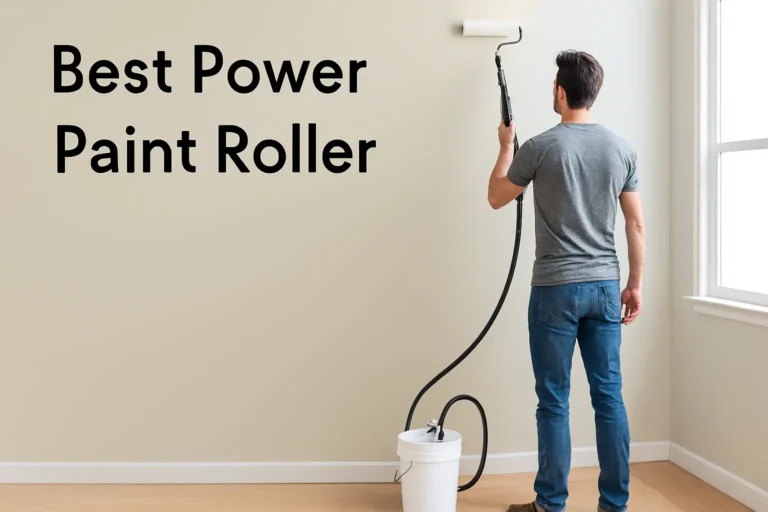
A paint stick feeds paint through the handle into the roller, so you are not going back to a tray every ninety seconds. On a wall that is a mild convenience. On a ceiling it removes the single most annoying part of the job: coming down off the roller, finding the tray without looking away from the wet edge, reloading, and getting back up. It also means no tray on the floor to step in.
HomeRight C800755 EZ-Twist PaintStick
It draws paint straight from the can into an 18 fl oz handle and feeds the roller with a twist. The handle extends to reach ceilings up to about nine feet, so in a standard room you do not need a separate pole at all.
The condition nobody mentions until it is too late: it only works with perforated roller covers. The paint is fed through the holes. A normal roller sleeve from your kit will not work on it, so factor replacement covers into the decision rather than assuming you can use the ones you already have.
Where it is worth it: a big open ceiling, or several rooms in a row. Where it is not: one small bedroom, where filling and flushing it takes longer than the painting saved. Cleaning is genuinely more involved than rinsing a roller — you flush the whole barrel.
What About Extra-Wide Ceiling Rollers?
Wider rollers — 12 and 14 inch, against the standard 9 — are sold on the promise of covering a ceiling in fewer passes, and the arithmetic is real: a 14-inch roller covers about half as much ground again per stroke.
The arithmetic is not the whole story, though. A wide roller loaded with paint is heavy, and you are holding it overhead on the end of a pole. The leverage works against you, and most people find their pace drops after twenty minutes by more than the extra width gained. They also need a wider tray or a bucket-and-grid, and they are awkward around light fittings and in corners, so you end up doing more of the ceiling with a second, normal roller anyway.
My honest view: on a large, uninterrupted ceiling — a garage, a basement, an open-plan room with nothing in it — a wide roller is a real gain. In an ordinary bedroom with a light in the middle, a 9-inch roller on a good pole beats it, because the pole is doing the work rather than your shoulders.
Sprayers: Fast, But Only Past a Certain Size
Spraying a ceiling is dramatically faster than rolling it and produces a better finish on texture, because nothing touches the surface. It is also the option most likely to be a mistake for a home decorator, and the reason is always the same: masking.
Ceiling overspray does not fall politely downward. It drifts, and it settles on walls, floors, window frames and anything you left in the room. Masking a single bedroom properly takes longer than rolling that bedroom would have taken from start to finish. The break-even point is somewhere around an empty house, a whole floor, or a job you are repeating.
If you have passed that point, these three are the ones worth knowing about, at three genuinely different levels.
Homeowner scale — Graco Magnum 257025 Project Painter Plus
The entry point into real airless spraying. It sprays unthinned paint, comes with a 25 ft hose so you can leave the unit on the floor and take the gun up, and it is aimed squarely at people doing their own house rather than contractors. Setup and cleaning take patience — plan on the better part of an hour the first time.
Cordless and nimble — Graco Ultra Cordless Airless Handheld, 17M363
Battery-powered, no hose, no cord to drag across a masked floor. It handles latex and oil without thinning and has adjustable pressure to keep overspray down. The trade is capacity: this is built for doors, trim, cabinets and smaller areas, so a large ceiling means repeated refills. Where it shines is awkward, high, hard-to-reach spots where a hose is more trouble than the job.
Professional — Titan Impact X 440 Electric Airless, 3300 PSI
Be clear-eyed about this one: it is a contractor machine, rated for 50–100 gallons a week, and it is priced accordingly. Nobody should buy it to paint one ceiling. It is here because if you are a painter, a landlord with a portfolio, or someone renovating a whole property, the 30 lb skid frame is genuinely easy to carry room to room and the pressure control keeps overspray sane indoors.
For everyone else, the Magnum does the same job slower for a small fraction of the outlay.
The Things That Make Ceilings Easier That Nobody Sells You
- A work light on the floor, angled up. This is the biggest free improvement available. Raking light across the ceiling shows every thin patch while it is still wet. Overhead room lighting shows you nothing, because it is coming from the surface you are painting.
- Eye protection, seriously. Even a spatter-resistant paint throws a fine mist when a roller is directly above your face. Once you have had paint in an eye you never roll a ceiling without glasses again.
- A cap or a hood. Less about safety, more about not spending your evening getting emulsion out of your hair.
- Proper drop cloths, not a single plastic sheet. Plastic is slippery underfoot and you are looking upward. Canvas stays put.
- A bucket and grid instead of a tray, if you are doing more than one room. It holds more, it does not tip when you catch it with a foot, and it suits pole work far better than a shallow tray.
Which Tools for Which Ceiling
| Your situation | What to buy | Why |
|---|---|---|
| One room, standard height, starting from nothing | Wooster 4–8 ft pole + Bates roller kit + Pro Grade brushes | Covers the whole job and works from the floor |
| Vaulted ceiling, stairwell or double height | Wooster 8–16 ft pole | Reach without a ladder; heavy in a normal room, so buy it only if you need it |
| You dread cutting in | Accubrush edger kit | Pole-mounted cut-in without tape. Poor on heavy texture |
| Large open ceiling, or several rooms | HomeRight EZ-Twist PaintStick | No tray, no reloading. Needs perforated covers |
| Whole house, empty, doing it yourself | Graco Magnum Project Painter Plus | Real airless speed at homeowner scale |
| Awkward high spots, no cord wanted | Graco Ultra Cordless | Portable and precise; limited capacity for big areas |
| You paint for a living | Titan Impact X 440 | Contractor duty cycle. Overkill and overpriced for one house |
Order of Work
- Clear and cover the room, and put a light on the floor angled up at the ceiling.
- Dust the ceiling and wash it if it needs it — see how to clean walls before painting.
- Prime stains and any bare patches. Our drywall primer picks cover the usual cases.
- Cut in the perimeter by brush or edger, and keep that band wet.
- Roll immediately into the wet cut-in so the two blend. Work in overlapping bands away from your light source.
- Let it dry properly, then do the second coat at right angles to the first.
- Check it in raking light before you pack up, while touching up is still easy. Timings for planning are in how long it takes to paint a room.
Frequently Asked Questions
What is the best tool for painting a ceiling at home?
A roller on an extension pole. It lets you work from the floor, see the whole ceiling while the paint is wet, and keep your arms below shoulder height — which is what determines whether you finish both coats properly. Everything else, including sprayers and edgers, is a refinement on top of that.
Do power rollers work for painting ceilings?
They do, and ceilings are where they help most, because they remove the constant reloading that makes overhead work tiring. A paint stick feeds paint through the handle straight to the roller, so there is no tray. Two conditions: they need perforated roller covers rather than standard ones, and cleaning takes longer than rinsing a roller, so they pay off on large ceilings and multiple rooms rather than one small bedroom.
Is an extra-wide ceiling roller worth it?
On a large uninterrupted ceiling, yes. In an ordinary room, usually not. A 14-inch roller covers more per stroke, but loaded with paint it is heavy overhead and most people slow down within half an hour by more than the width gains. It also needs a wider tray or a bucket and grid and is clumsy around light fittings.
Should I spray or roll a ceiling?
Roll it, unless the room is empty and large or you are doing several in a row. Spraying is much faster and gives a better result on texture, but ceiling overspray drifts onto walls, floors and anything left in the room, so masking one bedroom properly takes longer than rolling it would have. The economics only work at whole-floor or whole-house scale.
What length extension pole do I need for a ceiling?
A 4–8 ft pole handles standard ceiling heights comfortably from the floor. Only go to an 8–16 ft pole for vaulted ceilings, stairwells or double-height rooms — at full extension a long pole is heavy and harder to control, so it is a worse tool in a normal room, not a better one.
Do paint edgers actually work on ceilings?
On a flat, sound wall-to-ceiling junction, yes, and a pole-mounted edger lets you cut in a whole room from the floor. They struggle on textured or wavy surfaces, where the shield cannot sit tight and paint creeps behind it. There is also a learning curve, so practise on a stretch that a second coat will cover.
What makes painting a ceiling easier apart from the tools?
Put a work light on the floor angled up — raking light reveals thin patches while they are still wet, which room lighting cannot do. Wear eye protection and something on your head. Use canvas drop cloths rather than plastic, which is slippery when you are looking upward. And roll the second coat at right angles to the first.
Related Guides
- Best ceiling paint — what to put on the roller
- Best way to paint edges between wall and ceiling
- What nap roller you need for a textured ceiling
- Can you spray a textured ceiling without wrecking it?
Written by Sophie Ulman. ThePaintly is reader-supported: when you buy through links on this site we may earn an affiliate commission at no extra cost to you.