
Can You Paint PVC Trim? What Holds Up and What Warps
Get the color wrong and your brand-new PVC trim board bows off the fascia by the second August. That is not a paint failure. That is heat, and it is the one thing nobody warns you about. Yes, you can paint PVC trim — it takes paint beautifully, better than wood in most ways — but it comes with two hard rules that wood never had: it needs a bonding primer, and it will not tolerate a dark color.
I have painted a lot of exterior plastic over the last twelve years, and PVC is the surface where I see the most confident mistakes. People treat it like primed pine. It is not primed pine. It is a slick, non-porous, thermally active board, and standard exterior latex has nothing to grip. This guide covers exactly how to paint PVC trim so the film bonds, the board stays flat, and you do not touch it again for a decade.
What’s on this page
Quick picks at a glance
| Product | Role | Best for |
|---|---|---|
| INSL-X STIX Bonding Primer | Primer | Bare PVC trim you want to paint once and forget |
| KILZ Adhesion Primer | Primer | Big runs of fascia and frieze board on a budget |
| Zinsser Perma-White Exterior | Topcoat | North-facing trim under trees that grows mildew |
| Rust-Oleum Painter’s Touch 2X | Spray topcoat | Cut ends, returns, and narrow profiles |
| Sashco Big Stretch | Sealant | Expansion joints that keep splitting open |
The 5 products I’d actually buy to paint PVC trim
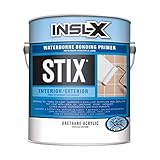
INSL-X STIX Acrylic Waterborne Bonding Primer
STIX is an acrylic-urethane hybrid, and that hybrid chemistry is the whole point. A standard acrylic primer dries into a film that sits on top of a slick surface and relies on mechanical grip — on PVC there is nothing to grip, because the surface has no pores. The urethane resin in STIX wets out the plastic and forms a chemical bond as it cures, which is why it holds on glass, tile, and PVC where an ordinary primer sheets off in strips.
The first time I used STIX on PVC trim I made the classic error: I brushed it on like paint, thick, chasing full opacity in one pass. It stayed tacky for two days in humid weather and I had to scuff the whole board back. Here’s what I learned: STIX wants two thin coats, an hour apart, and it does not need to hide anything — it only needs to bond. Its one real limitation is temperature. Below about 50°F it never fully coalesces, and I have watched a cool-October application fail adhesion by spring on a shaded north wall.
- Bonds to bare, unsanded PVC
- Recoat in one hour
- Tintable toward the topcoat color
- Needs 50°F+ to cure properly
- Costs more per gallon than general primer
Via Amazon.com
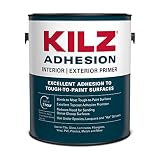
KILZ Adhesion High-Bonding Primer
KILZ Adhesion is a modified latex built for slick substrates — Kynar, Formica, glazed tile, vinyl, and PVC. It works on a different mechanism than STIX: instead of a urethane bond, it uses a soft, aggressive resin that stays slightly flexible and mechanically keys into the microscopic tooth left by a light scuff. That means the scuff step matters more here. On a board I wiped but did not abrade, adhesion was noticeably weaker at the edges.
Where it earns its place is scale. If you are priming 180 linear feet of fascia, the per-gallon difference against STIX is real money, and on a wall that gets scuffed and cleaned first, I have not seen it fail. Its honest limitation: coverage runs about 300 square feet per gallon, which is thin for a primer, and on porous cut ends it drinks more than you expect.
- Widely stocked, easy to reorder mid-job
- Fast recoat window
- Interior and exterior rated
- Wants a light scuff to hit full adhesion
- Only ~300 sq ft per gallon
Via Amazon.com
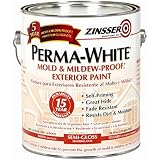
Zinsser Perma-White Exterior Semi-Gloss
Perma-White is a 100% acrylic exterior coating with a mildewcide built into the cured film rather than just the can. That distinction matters on PVC. Plastic trim does not absorb moisture, so condensation sits on the surface instead of wicking in, and on a north elevation under overhanging branches that damp surface is where mildew colonies establish. A film-level mildewcide keeps working after the paint has cured, which surface-treated paints do not.
Being 100% acrylic also means the cured film stays elastic. PVC moves — meaningfully — with temperature, and a brittle film cracks at the joints long before it fails in the field. The limitation is color: Perma-White tints to mid and light tones only, which sounds restrictive until you realize that is exactly the color range PVC trim is allowed to be anyway. If you want charcoal trim, this is not the product, and honestly neither is standard PVC.
- Mildew resistance in the cured film
- Stays flexible over a moving substrate
- Self-priming over previously painted trim
- Tints to light and mid tones only
- Semi-gloss shows trim waves on long runs
Via Amazon.com
Rust-Oleum Painter’s Touch 2X Ultra Cover, Flat White
A brush cannot lay a clean film into a beaded profile or a mitered return without leaving a heavy edge. Aerosol solves that geometry problem — the atomized droplets land evenly on every face of a molding at once, so the film thickness stays consistent through the curve. Over a bonding primer, this holds on PVC as well as anything you can brush.
Use it for the pieces, not the run. On brackets, corbels, small window surrounds, and cut ends, spraying takes ten minutes and looks better than an hour of careful brushwork. The limitation is honest and worth stating: aerosol builds thin film, so it needs three light passes, not one wet one, and it will not survive on bare PVC without primer underneath. If you are working with other plastics too, the same logic runs through our guide to the best spray paint for plastic.
- Even film in profiles and miters
- Sprays at any angle, including upside down
- Cheap enough to keep a spare can
- Requires a bonding primer first
- Thin build — needs three passes
Via Amazon.com
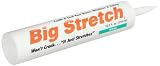
Sashco Big Stretch Acrylic Latex Sealant
This is the product most people skip, and it is the reason most PVC trim jobs fail at the seams rather than in the field. Standard acrylic caulk cures hard and tolerates roughly 15–25% joint movement. Big Stretch is elastomeric — it stretches to several times the original joint width and returns, so when the board grows on a 95°F afternoon and shrinks on a 20°F night, the bead moves with it instead of tearing away from one side.
Do not substitute silicone here. Silicone does not adhere reliably to vinyl and PVC and it cannot be painted, so you end up with a shiny stripe that collects dirt at every joint. Big Stretch’s real limitation is cure time: it skins fast but needs genuine dry weather to cure through, and I have had a bead go milky when a surprise evening shower hit it four hours after tooling.
- Moves with the board instead of tearing
- Paintable, unlike silicone
- Applies down to 40°F
- Needs a genuinely dry cure window
- Tools stickier than standard caulk
Via Amazon.com
Pro tips from the ladder
Wipe the boards with denatured alcohol before you prime, not soapy water. PVC ships with a factory mold-release film and a printed inkjet stamp, and soap moves that film around instead of removing it. Alcohol takes it off and flashes dry in a minute.
Scuff with a maroon abrasive pad, never sandpaper. Sandpaper leaves directional scratches that telegraph straight through a semi-gloss topcoat in raking afternoon light. The pad dulls the sheen without cutting lines.
Prime the cut ends before you fasten the board. Field-cut ends are the thirstiest, most exposed part of the whole installation, and once the trim is up against a corner board you will never reach them properly again.
Two thin coats always beat one thick coat. Always. On PVC this is not just about appearance — a thick film cures with internal stress and lets go at the edges when the board expands under it.
Paint on an overcast 65–75°F day if you can pick one. Direct summer sun on a dark-backed board can push the surface well past what the coating wants during flash-off, and you get lap marks you cannot brush out.
Renovation Stage: PRIME. Painting PVC trim lives or dies at the primer step, not the topcoat step. Everything you do before the color goes on decides whether this holds for ten years or peels in two. If you are still choosing boards, our guide to the best exterior house paint covers how trim and body coatings should pair.
PVC trim coverage calculator
Enter your run and face width. This estimates primer, topcoat, and sealant for two thin coats of each.

How to paint PVC trim: what actually decides the outcome
Three variables decide whether the film holds: adhesion, color, and movement. Get all three right and PVC outlasts painted wood by a wide margin, because there is no substrate underneath to rot, swell, or push the coating off. Get any one wrong and you will be back on the ladder inside three years.
Adhesion: why bare PVC rejects ordinary primer
Wood holds paint because it is porous — the coating soaks into the fiber and locks in. PVC has no porosity at all, and it arrives coated in a factory mold-release agent. Ordinary exterior primer has nothing to bite into, so it forms a skin that sits on the surface and peels off in sheets the first time the board flexes. A dedicated bonding primer solves this chemically instead of mechanically, which is why every manufacturer specifies one. This is the same problem you face when you paint vinyl siding or vinyl shutters — different product, identical chemistry.
Color: the LRV rule that saves the board
This is the rule most guides skip, and it is the one that actually breaks trim. Light Reflectance Value measures how much light a color bounces back, on a scale of 0 (black) to 100 (pure white). Dark colors absorb solar energy and convert it to heat, and PVC softens and distorts at temperatures a dark board can reach on a July afternoon. The practical threshold: stay at LRV 55 or higher. Below that, you need a solar-reflective coating specifically formulated for vinyl and PVC — a “vinyl-safe” line — not standard exterior paint in a dark tint.
If you paint PVC trim charcoal with an ordinary exterior acrylic, the coating may survive perfectly. The board underneath will not. It bows, the fasteners telegraph, and the joints open. That failure is invisible on the paint chip and obvious from the driveway.
Movement: what expansion actually costs you
PVC trim moves with temperature far more than wood. Family Handyman’s installation guidance puts real numbers on it: install between 60 and 80°F and you leave a 1/16-inch gap for every 18 feet of run; install below 60°F and that gap goes to 1/8 inch; install above 80°F and you fit the joints tight, because the board is already expanded. They also specify a 1/8-inch expansion gap where trim meets a clad window, and paintable acrylic or polyurethane caulk to cover it — explicitly not silicone, which does not adhere to vinyl. This Old House’s exterior trim work follows the same logic on the detailing side.
Sheen: why I default to satin
Semi-gloss looks sharp on a short window surround and merciless on a 30-foot fascia. PVC boards are dead flat from the factory, but the framing behind them is not, and gloss amplifies every fastener dimple and every slight wave. Satin holds enough sheen to shed dirt and clean easily without turning your trim line into a mirror.
When NOT to paint PVC trim
Don’t paint it dark. If the color you want sits below LRV 55 and you are not buying a vinyl-safe, solar-reflective product, stop. The paint will hold and the board will warp. That is worse than leaving it white.
Don’t paint it below 50°F. Waterborne bonding primers need warmth to coalesce into a continuous film. A primer applied at 45°F may look perfect in November and fail adhesion in April.
Don’t paint it the same day you install it if the boards were stored cold. Let them sit in place and reach ambient temperature first, or you will caulk joints at one width and watch them open at another.
Don’t paint it at all if white is fine. Factory-white PVC does not need paint to survive. If you like the color it came in, washing it once a year is a completely legitimate finish plan — paint here is aesthetic, not protective.
Spray the boards before they go up
Every painter I know who does PVC trim for a living finishes the boards on sawhorses, not on the wall. Speed is not the reason. The reason is the cut ends and the back edge: once a board is nailed to the sheathing, the faces that decide how long the joint stays tight are the ones you can no longer reach. Priming a board flat in the driveway takes ten minutes and it is the difference between a corner that is still closed in year three and one that opened in year two.
Flat on sawhorses, the tool that earns its place is a fine-finish HVLP unit like the HomeRight Super Finish Max. PVC shows brush marks worse than wood does, because there is no grain to hide behind and no absorption to soften the edge of a stroke. A sprayed coat lands even, and the bonding primer above wants two thin coats rather than one thick one — which is exactly what atomising gives you and exactly what a loaded brush does not. The brass tips also survive alcohol and solvent cleanup, which is where plastic-tipped budget sprayers die after two jobs.
When not to buy it. Two replacement boards on a repair do not justify it — a brush is correct there and a sprayer is an hour of masking for nothing. And do not carry a sprayer up a ladder to shoot trim that is already installed. Overspray onto siding, glass and shrubs costs more to fix than the smoother finish is worth. This tool belongs in the driveway, with the boards flat and the wind behind you.
Prep steps, in order
Prep matters more than the brand. I would rather you buy the cheaper primer and do these five steps than buy the premium one and skip them.
1. Wash and de-grease. Wipe every face with denatured alcohol on a clean rag. This removes mold-release residue, handling oils, and the printed manufacturer stamp. Let it flash off — one minute is plenty.
2. Scuff with a maroon pad. Dull the factory sheen across the whole face. You are not removing material, just killing the gloss so the primer has something to key into.
3. Dust off, then wipe again. Scuffing generates fine PVC dust that will sit under your primer if you leave it. Dry brush, then one more alcohol pass.
4. Prime cut ends first, then two thin coats overall. Ends drink more and are the most exposed part of the board. Prime them, then prime everything, then prime everything again. Recoat at one hour.
5. Seal joints after priming, before topcoat. Elastomeric sealant bonds better to primed PVC than to bare PVC, and tooling it before the topcoat means the color coat carries across the joint in one continuous film. A good stable ladder matters here more than usual — sealant work at fascia height is slow and fiddly.
The verdict
Yes — you can paint PVC trim, and it takes paint better than almost any exterior surface once you respect the chemistry. Buy INSL-X STIX if you are painting new boards you want to leave alone for a decade; buy KILZ Adhesion if the run is long and you will do the scuff step properly. Topcoat with a 100% acrylic exterior paint at LRV 55 or above — Zinsser Perma-White Exterior if your trim sits in shade and grows mildew. Seal the joints with Sashco Big Stretch, not silicone, and spray the small profiles instead of fighting them with a brush.
The one decision that matters most is not on this list. It is the color. Stay light and this holds for a decade. Go dark on standard PVC and no primer on earth will save the board.
Frequently asked questions
Do you have to prime PVC trim before painting?
Yes, unless the paint is explicitly labeled as self-priming on PVC. PVC is non-porous and ships with a mold-release film, so standard exterior paint has nothing to adhere to and will peel in sheets. A waterborne bonding primer is the single most important product in the whole job.
What kind of paint do you use on PVC trim?
A 100% acrylic exterior latex. Acrylic stays flexible after curing, so it expands and contracts along with the board instead of cracking at the joints. Avoid oil-based enamels on large PVC runs — they cure rigid and split as the trim moves.
Can you paint PVC trim a dark color?
Not with standard paint. Dark colors below roughly LRV 55 absorb enough solar heat to soften and warp the board. If you want a dark trim color, you need a vinyl-safe, solar-reflective coating formulated specifically for vinyl and PVC substrates.
Do you need to sand PVC trim before painting?
Sand, no — scuff, yes. Use a maroon abrasive pad to dull the factory sheen. Sandpaper leaves directional scratches that show through a semi-gloss topcoat in low-angle light, and you gain no additional adhesion from cutting deeper.
What caulk should you use on PVC trim?
A paintable elastomeric acrylic or polyurethane sealant. Silicone does not adhere well to vinyl or PVC and cannot be painted over. Standard acrylic caulk is too rigid for the movement PVC generates and tears away from one side of the joint.
How long does paint last on PVC trim?
Properly bonded on a light color, ten years or more is realistic — longer than painted wood, because there is no substrate rot or swelling pushing the film off. Failures I see are almost always traced back to a skipped bonding primer or a color that ran too dark.
Can you paint PVC trim that’s already been painted?
Usually yes, and it’s easier. If the existing coating is sound and well-adhered, wash it, scuff it, and topcoat directly with a quality acrylic — the old film gives you the porosity bare PVC lacks. If it is peeling anywhere, scrape back to bare plastic and start with a bonding primer.
Does painting PVC trim void the warranty?
It depends on the manufacturer, and most allow painting if you follow their color and LRV limits. Painting outside those limits — dark colors on a standard board — is the condition most likely to void coverage, precisely because it causes distortion.