
Gunmetal, Silver or Black: Which Engine Paint Color Still Looks Right After a Hot Summer?
Updated: August 2026 | By Sophie Ulman
Pick the wrong shade and your engine bay looks worse in September than it did in May. That is the part nobody warns you about. Most guides to engine paint colors talk about which one looks best on day one, in a clean garage, under a work light. The real test comes after a full summer of heat cycles, oil mist and brake dust. Some colors survive that. Some go yellow, chalky or streaked, and every wipe-down makes it more obvious.
I learned this the annoying way. I sprayed a small-block silver because it looked sharp on the shelf card, and by the end of August the top of the block had gone a faint tea-brown around the heads. The paint had not failed. It had discolored exactly where the metal ran hottest. Here is what I learned: with engine paint colors, heat does not peel the finish first — it changes the shade first, and it changes it unevenly.
So this article is not a color chart. It is a straight answer to which of gunmetal, silver and black still looks right in September, why, and the five cans I would actually buy.
What’s on this page
Quick comparison of the three engine paint colors
| Color | How it ages over a hot season | Best on | My pick |
|---|---|---|---|
| Gunmetal / cast graphite | Ages best. The metallic flake and dark base hide heat staining and oil film almost completely. | Cast iron blocks, brackets, older engines | Dupli-Color Cast Coat Iron |
| Silver / aluminum | Looks the best on day one and shows the most change. Browning appears first around the heads. | Fresh rebuilds, aluminum covers, show bays | VHT SP127 Universal Aluminum |
| Gloss black | Holds its color, but every oil streak and fingerprint reads as a shine difference. | Accessories, brackets, intakes | Rust-Oleum 248932 Gloss Black |
| Satin black | The quiet winner. Same color hold as gloss, none of the streak problem. | Valve covers, whole bays you want to disappear | VHT SP139 GM Satin Black |
The 5 best engine paint colors, and the exact can for each
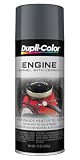
Best for hiding heat stains and oil film
Dupli-Color DE1651 Engine Enamel with Ceramic — Cast Coat Iron
This is the gunmetal answer. The ceramic resin in the binder is the working part: ceramic particles sit in the cured film and hold the film together as the metal expands and contracts through heat cycles, which is why Dupli-Color rates it to resist intermittent temperatures up to 500°F without blistering, flaking, cracking or peeling. The color itself is a dark graphite with a fine metallic flake rather than a flat gray.
That flake is the reason it wins on a hot engine. Heat staining and oil mist both change how a surface reflects light, and a broken, flaky reflection hides that change far better than a smooth one. The honest limitation: on a freshly machined aluminum block it reads muddy. It was designed to look like cast iron, and on aluminum it just looks like you painted over something.
Pros
- Hides heat discoloration better than any other shade here
- Ceramic-loaded binder, not straight enamel
- Forgiving to spray — flake masks light overlap marks
Cons
- Looks wrong on bare aluminum
- Hard to touch up invisibly once cured
Best for: a cast iron block on a daily driver that you want to look the same in October as it did in April.
Via Amazon.com
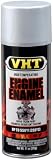
Best silver for a fresh rebuild
VHT SP127 550° Engine Enamel — Universal Aluminum
VHT blends urethane and ceramic resins rather than using enamel alone, and that combination is what buys the extra heat headroom — 550°F against the 500°F you get from most engine enamels. It is also formulated to resist the additives and detergents in modern gasoline blends, which matters more than people expect on an intake or a fuel rail bracket.
This is the silver I reach for, and I still tell people what it will do: silver shows heat change. On my own block the area around the heads went faintly warm-toned by late summer. It did not fail, it did not lift, it just was not the same silver as the oil pan anymore. If your engine lives under a hood and gets driven, expect that. If it lives on a stand at a show, silver is the sharpest looking finish on this page by a wide margin.
Pros
- Highest heat rating of the aerosols here
- Resists modern fuel additives and degreasers
- Best-looking finish on machined aluminum
Cons
- Shows heat discoloration first and worst
- Light coats are essential — silver runs read instantly
Best for: a rebuilt aluminum block or valve cover that will be seen more than it is driven.
Via Amazon.com
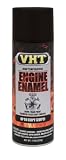
Best black that hides an oil film
VHT SP139 550° Engine Enamel — GM Satin Black
Same urethane and ceramic chemistry as the SP127 above, same 550°F rating, different sheen — and the sheen is the whole argument. A satin surface scatters light in every direction. A gloss surface reflects it in one. When a thin film of oil mist settles on gloss black it creates a second, slightly different reflection, and your eye reads it as a smear. On satin, that same film is close to invisible.
If you asked me which of the engine paint colors here I would put on a whole bay and forget about, this is it. The limitation is honest and specific: satin black swallows detail. Fins, casting numbers and ribbing all flatten out. On a display engine where the casting marks are part of the appeal, you will lose them.
Pros
- Best oil-film concealment of any color here
- 550°F rating, gas and degreaser resistant
- Very hard to spray badly — satin hides overlap
Cons
- Flattens casting detail and fins
- Cannot be polished or buffed like gloss
Best for: a working engine bay where you want the mechanical clutter to visually recede.
Via Amazon.com
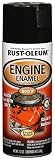
Best gloss black on a budget
Rust-Oleum 248932 Engine Enamel — Gloss Black
Rust-Oleum’s engine enamel is built on their Stops Rust base, rated for automotive surfaces that see intermittent temperatures up to 500°F, and it is specifically gas and oil resistant. The any-angle spray head matters more than it sounds — half of engine painting is spraying upward into the underside of a bracket, and a standard nozzle sputters when inverted.
Gloss black is the color most people picture when they think about engine paint colors, and it does hold its shade. The trade-off is the one covered above: it shows everything. My honest take is that gloss black belongs on accessories rather than the block. Brackets, pulleys, an intake, an alternator housing — pieces you can wipe down in thirty seconds. On a full block you will be chasing streaks all summer.
Pros
- Sprays inverted without sputtering
- Rust-inhibiting base underneath the color
- Deepest gloss of anything here
Cons
- Shows every oil streak and fingerprint
- 500°F ceiling, lower than the VHT cans
Best for: brackets, pulleys and accessories you can wipe clean, not the block itself.
Via Amazon.com
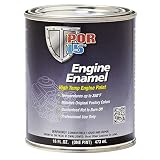
Best for a bare block on an engine stand
POR-15 Engine Enamel — Aluminum, 16 oz brush-on
This one is not an aerosol, and that is the point. When the block is out and sitting on a stand, brushing gets you a thicker, more even film in one pass than three light aerosol coats do, and you are not fighting overspray across the whole garage. POR-15’s engine enamel is also non-flammable, which changes what you can safely do in a closed shop in winter.
The limitation here is real and I will not bury it: POR-15 rates this to handle up to 300°F without discoloring — well below the 500 to 550°F of the aerosols above. On a block surface that is fine. Anywhere near a manifold or a turbo housing it is the wrong product, and you want a dedicated high-heat coating instead. Read our guide to high heat paint for exhaust before you go near those parts.
Pros
- Thicker, more even film than aerosol in one pass
- Non-flammable — safer in a closed shop
- Covers a full block from one container
Cons
- 300°F ceiling — not for manifolds or headers
- Brush marks show if you overwork it
Best for: a stripped block on a stand where you want one thick, even coat and no overspray.
Via Amazon.com
Pro tips before you open a can
Degrease twice, and the second time after you sand. Sanding drags oil down into the fresh scratch pattern. If you only degrease once, you seal it in. This is the single mistake I see most often on engine paint jobs.
Two thin coats always beat one thick coat. Always. On engine paint colors this is doubly true — a thick coat traps solvent, and trapped solvent under a heat cycle is what makes a finish go soft and print your fingerprints permanently.
Warm the can, not the engine. Fifteen minutes in a bucket of warm tap water gets the propellant working properly and the spray pattern gets noticeably finer. Never heat a can with a heat gun.
Test your silver on a scrap first. Every brand’s “aluminum” is a different silver. Two of them side by side on a bracket look like a mistake, not a choice.
Mask the sealing surfaces before you think about color. Paint on a head gasket face or a pulley groove is a problem you fix with a scraper later.
Renovation Stage: PAINT
Everything on this page belongs at the paint stage, after degreasing, stripping and priming. If you are still at the prep stage on rusted metal, start with our guide to the best paint for rusty metal, and if the surface needs a primer coat first, our spray primer picks cover what bonds to bare metal.
How many cans will you actually need?
Aerosol engine enamel covers far less than the can implies once you account for two coats and overspray. Pick what you are painting.

How to choose between engine paint colors
Color does not meaningfully change engine temperature
Let’s kill this one first, because it drives a lot of bad decisions. A matte black surface absorbs and radiates more heat than a polished one, and that is real physics. In an engine bay it is also close to irrelevant. Airflow, coolant capacity and how hard you are working the engine swamp the difference by orders of magnitude. Choose your color for how it looks and how it ages, not for a cooling benefit you will never measure.
Match the color to how dirty the part gets
This is the rule that actually predicts satisfaction. Parts that collect oil mist — the top of the block, the area behind the accessories, anything under a breather — want a color that hides film. Gunmetal and satin black do that. Parts you can reach and wipe in seconds can be gloss or silver.
Match the color to the metal underneath
Cast iron looks right in graphite and gunmetal because that is roughly what it looks like clean. Machined aluminum looks right in silver for the same reason. Fighting the base metal is where engine bays start looking repainted rather than restored. If your build already has painted rims or calipers, keep the family consistent — our picks for the best paint for car rims and best brake caliper paint use the same logic.
Check the heat rating against the hottest part you will spray
Every product on this page is rated for engine surfaces, not exhaust surfaces. 500 to 550°F covers a block, a valve cover, an intake and accessories. It does not cover a manifold, a header or a turbo housing, where you need a coating rated far higher. Rust-Oleum’s high heat line, for example, runs to 2000°F for exactly this reason. For a broader look at what fits where, our roundup of the best engine paint compares the full product range rather than the color question.
Prep decides more than the color does
I will say this plainly: a gunmetal that was sprayed over a degreased, scuffed, primed surface will outlast a silver sprayed over a wiped-down one by years, and the color had nothing to do with it. Family Handyman’s spray can technique guide covers the light-coat and tack-coat method that stops runs before they start.
When none of these engine paint colors are the right can
Anywhere near the exhaust. Manifolds, headers, downpipes and turbo housings run far past 550°F. Engine enamel on those parts will discolor and then burn off. Use a dedicated high-heat coating.
On a hot engine. The surface must be cold. Solvent flashing off a warm block gives you a dry, powdery finish with no adhesion at all.
On oily metal. No engine enamel bonds through an oil film, regardless of what the can claims. If water beads on the surface, it is not clean yet.
Indoors without ventilation. Aerosol coatings are a regulated VOC source, and the EPA’s guidance on VOCs and indoor air is straightforward: increase ventilation when using products that emit them, and follow the label precautions.
The prep sequence that decides the outcome
You do not need to do anything clever here. You need to do all five, in order.
- Degrease everything. A dedicated engine degreaser, then rinse, then dry completely.
- Strip loose paint and rust. Wire wheel on a drill for heavy areas, 180-grit by hand for the rest. You want dull, not shiny.
- Degrease a second time. This is the step people skip and it is the one that matters most.
- Mask sealing surfaces, threads and gasket faces. Take longer than feels necessary.
- Prime bare metal, then paint within the recoat window on the label. Miss that window and you have to scuff again.
Then spray. Light tack coat, five minutes, then two thin color coats about ten minutes apart, moving the can in a different direction on each pass.
The verdict
If you want your engine bay to look the same in September as it did in May, choose gunmetal — the Dupli-Color Cast Coat Iron hides heat staining and oil film better than anything else here, and it does it on the parts that get dirtiest.
If the engine is a rebuild that gets looked at more than driven, silver is the sharper choice and VHT SP127 has the highest heat rating of the aerosols on this page. Just accept it will warm-tone around the heads.
And if you want the safest all-round answer among the engine paint colors here, it is satin black. VHT SP139 holds its color, hides oil, and is close to impossible to spray badly.
Frequently asked questions
What color engine paint is best?
For a driven engine, gunmetal or satin black. Both hold their appearance through heat staining and oil film, which is what actually changes over a season. Silver looks best on day one and shows the most change by the end of summer.
Does engine paint color affect engine temperature?
Not to any degree you will notice. Darker surfaces radiate slightly more heat, but airflow, coolant capacity and load dominate engine temperature completely. Choose the color for appearance and durability instead.
Can you paint an engine block without taking it out?
Yes, on the accessible faces. The engine must be completely cold, everything you are not painting must be masked, and you still need to degrease twice. You will not reach the back of the block, so plan on a color that will not look wrong against unpainted metal.
What is the difference between engine enamel and high heat paint?
Engine enamel is rated for roughly 500 to 550°F and is formulated to resist oil, fuel and degreasers. High heat paint is rated far higher — up to 2000°F on some lines — but is designed for exhaust components and is not formulated for constant oil contact.
Do you need primer under engine paint?
On bare or stripped metal, yes. Use a high-heat engine primer rated to the same temperature as your color coat. Over a sound, well-adhered existing finish that has been scuffed and degreased, you can go straight to color.
How long does engine paint take to cure?
Most engine enamels dry to the touch in about an hour and dry thoroughly overnight. Full chemical cure usually comes from heat cycling — running the engine up to temperature and letting it cool, a few times over the first week.
Will engine paint peel off aluminum?
It will if you skip the etch step. Aluminum forms an oxide layer within minutes of being sanded, and paint bonds poorly to it. Scuff, degrease, and prime with a product intended for bare aluminum before the color coat.