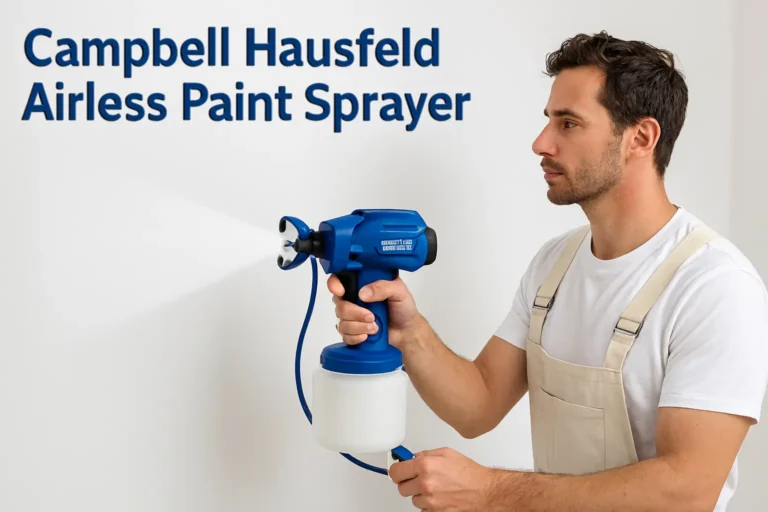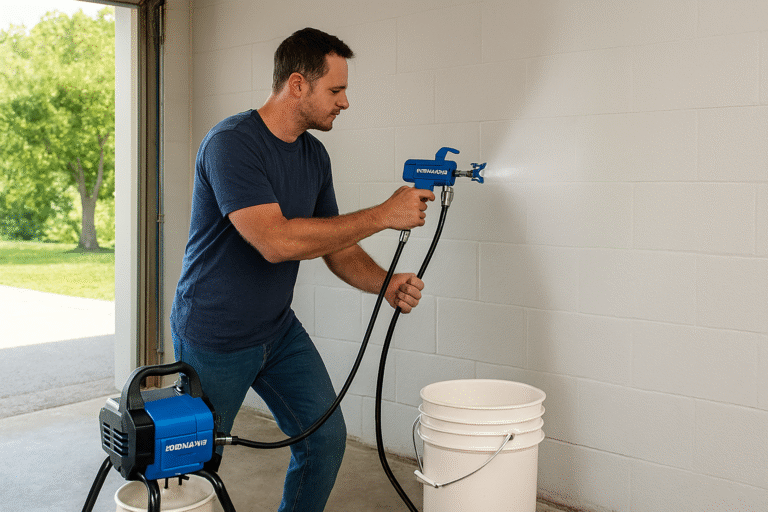
HomeRight Airless Paint Sprayer: 3 Picks Tested for 2026
Updated July 2026 · By Sophie Ulman
The HomeRight Lineup, Sorted: Which Sprayer Actually Fits Your Job
Type “HomeRight airless paint sprayer” into Amazon and you will land on the Finish Max family — which is not airless at all. It is HVLP: a turbine pushes air through the gun and atomizes the paint, instead of a pump forcing paint through a tip at 2,800 PSI. That distinction decides whether you finish a dresser in twenty minutes or fight orange peel all afternoon. Buy the wrong category and no amount of technique saves you. Below I sort out what HomeRight actually sells, which of the three kits earns its spot, and when you should walk away and buy a true airless rig instead.
In This Guide
Quick Picks: HomeRight Sprayers Compared
| Model | Best For | Power | Check Price |
|---|---|---|---|
| Finish Max C800766 Budget Pick | Furniture, crafts, small trim | 400W turbine | Check Price on Amazon → |
| Super Finish Max C800971 Top Pick | Cabinets, doors, fences, unthinned latex | 450W turbine | Check Price on Amazon → |
| Finish Max + Spray Shelter Kit | Indoor furniture work without overspray cleanup | 400W turbine + tent | Check Price on Amazon → |
The 3 HomeRight Kits, Reviewed
HomeRight Finish Max C800766
Who this is for: the weekend furniture flipper who sprays chalk paint, milk paint, and thinned latex on pieces small enough to carry.
The 400-watt turbine atomizes thin and medium coatings well because HVLP relies on air volume, not pressure — the paint lands soft, with far less bounce-back than an aerosol can. Thick latex straight from the can is where it struggles: the turbine simply cannot shear heavy paint into a fine mist, so you must thin it (usually around 10%) or the finish stipples.
One real limitation: the cup holds about 27 oz. On a six-drawer dresser I refilled twice, and every refill is a chance to drip on your finish.
Check Price on Amazon →HomeRight Super Finish Max C800971
Who this is for: the DIYer painting cabinet doors, interior doors, or a fence who wants one turbine sprayer that handles most coatings.
The 450-watt motor is the upgrade that matters — the extra air volume lets it push many latex paints with little or no thinning, and it ships with three brass tips (1.5, 2.0, 4.0 mm) so you can match the orifice to the coating instead of forcing one tip to do everything. Brass tips also seal better than the plastic ones on cheaper turbine guns, which is why the fan pattern stays crisp after a dozen cleanings.
One real limitation: it is loud and slow on large flat surfaces. A fence panel that a true airless covers in 40 seconds took me a good four minutes per side.
Check Price on Amazon →HomeRight Finish Max + Large Spray Shelter Kit
Who this is for: anyone spraying indoors or in a garage who does not want a fog of overspray settling on the car.
Same Finish Max gun as the budget pick, bundled with a pop-up spray shelter. HVLP already produces less overspray than airless because the paint leaves the gun at low velocity, and the tent catches what drift there is. It is the cheapest way to get a controlled spray zone without building one.
One real limitation: the shelter is a containment booth, not a ventilated one — you still need airflow and a respirator. If you spray regularly, build a proper setup; my guide on how to make a DIY spray paint booth covers the exhaust side the tent leaves out.
Check Price on Amazon →HomeRight Airless Paint Sprayer vs HVLP: What You Are Actually Buying
HomeRight does make one true airless unit — the Power-Flo Pro 2800, a 2,800 PSI pump sold mostly through big-box stores — but the models above, and nearly everything HomeRight sells on Amazon, are HVLP turbine sprayers. The difference is mechanical, not marketing:
| Feature | True Airless | HomeRight HVLP |
|---|---|---|
| Paint delivery | Pump, 1,500–3,000 PSI | Turbine air, low pressure |
| Unthinned latex | Yes | Sometimes (Super Finish Max), often thinned |
| Speed on walls/exteriors | Fast | Slow — wrong tool |
| Overspray | Heavy | Light |
| Finish on furniture/cabinets | Good with fine-finish tip | Excellent |
If your project list says “whole exterior” or “every wall in the house,” skip the turbine class entirely and start with my best exterior paint sprayer roundup. If it says “furniture and cabinet doors,” HomeRight is playing its home game — and my furniture sprayer guide shows how the Super Finish Max stacks up against the competition.
Sophie’s Notes From the Garage
The first time I used the Super Finish Max, I poured satin latex straight from the can because the box said “no thinning required for most paints.” Mine was apparently not most paints — the finish came out like the skin of an orange. I let it dry, sanded it flat, thinned the second batch 10% with water, and ran a viscosity test through the supplied cup. The redo was glass-smooth. Here is what I learned: “no thinning required” means “test first,” every time. Run the viscosity cup, and lay down two thin coats. Always.
How to Choose Between the Three
Buy the Finish Max if your projects are small, your paints are thin, and your budget is tight. Buy the Super Finish Max if you spray more than twice a year or want to run latex with minimal thinning — the extra wattage and brass tips are worth every dollar of the difference. Add the shelter bundle if you work indoors. And if you have never sprayed before, read my beginner sprayer guide first — the technique habits transfer directly.
One more thing, because it decides the outcome more than the hardware: prep matters more than the brand. Durability is 50% product quality and 50% surface preparation — a Super Finish Max over unsanded gloss fails faster than a cheap brush over properly scuffed and cleaned wood. Family Handyman’s sprayer tips are a solid technique primer, and if you are spraying indoors, follow the EPA’s indoor air quality guidance on ventilation before you pull the trigger.
When a HomeRight Sprayer Is the Wrong Tool
Do not buy any turbine HVLP unit — HomeRight included — for these jobs:
- Whole-house interiors or exteriors. The coverage rate is a fraction of an airless pump. You will quit halfway.
- Heavy, unthinnable coatings — elastomerics, block filler, some solid stains. The turbine cannot atomize them, full stop.
- Production cabinet work. If you spray doors weekly, the small cup and refill cycle will cost you hours; step up to a dedicated rig.
Frequently Asked Questions
Is the HomeRight Finish Max an airless sprayer?
No. It is an HVLP turbine sprayer. HomeRight’s only true airless unit is the Power-Flo Pro 2800; everything in the Finish Max family atomizes paint with air, not pump pressure.
Can the Super Finish Max spray unthinned latex paint?
Often, yes — with the 2.0 mm tip and a quality latex. But test with the viscosity cup first. Thicker premium paints usually still need about 10% water to atomize cleanly.
Which HomeRight sprayer is best for kitchen cabinets?
The Super Finish Max C800971. The 450W turbine plus the 1.5 mm tip gives a fine finish on cabinet-grade enamels — lay doors flat and apply two thin coats.
Do I need to thin chalk paint for the Finish Max?
Usually a little. Most chalk paints run thick; thin in 5% steps until the paint flows through the viscosity cup in the time the manual specifies.
Can I paint walls with a HomeRight sprayer?
You can, but you should not — a turbine HVLP covers walls painfully slowly. For rooms and exteriors, a true airless sprayer is the right category.
How do I stop orange peel with a HomeRight sprayer?
Thin the paint, slow your hand speed, keep the gun 6–8 inches from the surface, and build coverage with two thin coats instead of one heavy pass.