How to Paint Garage Walls: Complete Guide for a Lasting Finish
Updated: April 25, 2026 | By Sophie Ulman
Most people search how to paint garage walls and hit a wall of advice that misses the point. Garages are not living rooms. They’re high-traffic, moisture-prone, grease-splattered spaces that will destroy cheap paint inside a year. Get the right materials, prep correctly, and a painted garage wall can look sharp and hold up for 8–10 years. Skip either step and you’ll be peeling tape again by summer. This guide covers everything — from surface prep to the best semi-gloss formulas that actually stick.
Whether you’re working with bare drywall, unfinished cinder block, or OSB sheeting, the same principles apply. Clean aggressively, prime strategically, and apply two coats of a durable interior finish. The products below are chosen for those exact conditions.
Quick Picks: Best Paints for Garage Walls
| Category | Product | Finish | Size | Best For |
|---|---|---|---|---|
| Best Overall | Rust-Oleum Sure Color Interior Paint + Primer | Semi-Gloss | 1 Gallon | All wall types, one-coat coverage |
| Eco Pick | RECOLOR Eco-Friendly Interior Premium Latex | Semi-Gloss | 1 Quart | Low-VOC garages, eco-conscious buyers |
| Best for Large Garages | True Value Professional Semi-Gloss Interior | Semi-Gloss | 5 Gallon | 3-car garages, commercial projects |
In-Depth Product Reviews
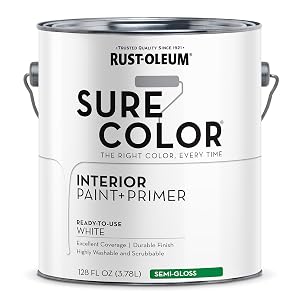
The Sure Color line is built for exactly this situation: walls that don’t have time for a separate primer coat. Rust-Oleum formulated this paint-and-primer hybrid to stick to drywall, wood, aluminum, steel, and brick — which covers every surface type you’ll find in a typical attached garage. One coat can cover gray drywall, but two coats give a noticeably harder, more cleanable finish worth the extra 90 minutes.
The semi-gloss sheen is the right call for a utility space. It reflects light to brighten the interior without looking clinical, and it wipes clean when transmission fluid or tire rubber inevitably makes contact with the wall. The formula dries in roughly 30 minutes and handles recoat at the 1-hour mark — useful when you’re trying to finish a two-car garage in a single weekend day.
Key fact: Covers up to 400 sq ft per gallon on smooth drywall — a typical two-car garage needs 2–3 gallons for full two-coat coverage.
- True paint + primer in one
- Fast 30-min dry time
- Works on 5+ surface types
- White only (tintable at store)
- Quart size unavailable — gallon minimum
Best for: Most homeowners painting a standard 1–2 car garage for the first time.
Check Price on Amazon →Via Amazon.com
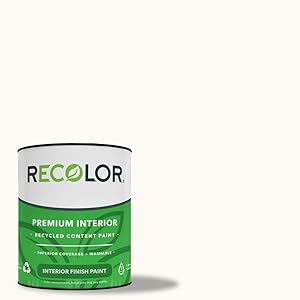
RECOLOR is made from recycled paint — it’s a zero-VOC formula that meets the EPA’s strictest indoor air quality standards. That matters most in garages where ventilation is limited. Standard latex paints can off-gas for 48–72 hours after application, trapping fumes in an enclosed space. RECOLOR finishes off-gassing faster and produces significantly less odor during application, which is worth a lot if you’re painting in a garage adjacent to a living space.
The semi-gloss finish is competitive with conventional paints: good hide, strong adhesion on prepared drywall, and a cleanable surface. The 1-quart size is well suited for smaller garages or accent walls. Reddit painters who’ve tried RECOLOR consistently report that it covers surprisingly well for a recycled-content product — one user noted it matched their standard Behr results on bare drywall.
Key fact: Zero-VOC — meets EPA guidelines for low indoor air pollutants, ideal for attached garages with direct house access.
- Zero VOC — safe for enclosed spaces
- Made from recycled paint content
- Low odor during and after application
- Quart size limits coverage to ~100 sq ft
- Color selection narrower than standard paints
Best for: Attached garages, eco-conscious renovators, or anyone sensitive to paint fumes.
Check Price on Amazon →Via Amazon.com

The math on this product is hard to argue with. A 5-gallon bucket of professional-grade semi-gloss for a cost-per-square-foot that beats most 1-gallon options. True Value’s Professional Coatings line was built for contractors who paint high-traffic commercial interiors repeatedly — school hallways, warehouse walls, and exactly the kind of rough-duty surface a garage represents. The off-white base is bright without being stark and works as a neutral base for tool storage organization zones.
The semi-gloss formula levels well with both roller and sprayer application, which matters when you’re covering 600+ square feet on a 3-car garage. Garage Journal users consistently rank this product as one of the best values in the category — one commented it handled scuffed OSB board without a separate primer coat when applied liberally.
Key fact: At 5 gallons, this covers up to 2,000 sq ft — enough for a full 3-car garage interior with two coats to spare.
- Excellent price-per-gallon ratio
- Professional-grade durability
- Handles both roller and sprayer
- Off-white only — not tintable
- Heavy bucket difficult for solo use
Best for: 3-car garages, workshops, or anyone doing a full interior renovation project.
Check Price on Amazon →Via Amazon.com
⚡ Pro Tips: What Most Guides Won’t Tell You
- Use a degreaser first, not just soap. Garage walls collect oil and carbon residue that standard dish soap won’t lift. TSP (trisodium phosphate) substitute is the standard — one pass and your surface is actually clean.
- Semi-gloss over flat, always. Flat paint hides imperfections but absorbs every stain. In a garage, you’ll be cleaning the walls. Semi-gloss survives scrubbing.
- Paint the ceiling before the walls. Roll the ceiling first to get drips out of the way. Then cut in and roll walls. Saves masking tape and re-work.
- Temperature matters more than humidity. Below 50°F and latex paint fails to bond correctly. Keep the garage above 55°F for the first 24 hours after painting.
🎨 Renovation Stage: PAINT
Painting garage walls falls in the PAINT stage of the Renovation Protocol. This comes after structural repairs, drywall finishing, and priming. If your walls still have exposed block, cracks, or grease stains, complete the PREP stage first. Need help with the right primer before this stage? See our guide on the best paint remover for tough surfaces.
🧮 Paint Coverage Calculator
Enter your garage dimensions to estimate how much paint you’ll need for two coats.

Buying Guide: How to Choose the Best Paint for Garage Walls
Not every interior paint belongs on a garage wall. The buying decision comes down to four variables: surface type, finish, VOC tolerance, and quantity. Get these right and the rest follows.
Surface Type: Drywall, Block, or OSB?
Finished drywall is the easiest surface to paint — standard semi-gloss latex bonds readily with minimal prep. Bare cinder block or concrete block is porous and will absorb paint aggressively; you’ll need a masonry primer or a high-build primer to fill the surface before your topcoat. OSB sheeting requires a stain-blocking primer because the resins in the wood can bleed through light-colored paint if left unsealed.
If you’re dealing with old paint that’s peeling or chalking, strip it back first. Our guide on the best paint remover for 2026 covers exactly what to use on each surface type before repainting.
Finish: Why Semi-Gloss Is the Only Answer
Flat and eggshell finishes hide surface imperfections well, but they absorb moisture and stains — a losing proposition in a garage. Gloss finishes are easy to clean but amplify every blemish and tend to look harsh under fluorescent lighting. Semi-gloss hits the balance: it reflects enough light to brighten the space, resists moisture, and cleans up with a damp cloth. Satin is an acceptable alternative for those who want a slightly softer look, but semi-gloss is the industry standard for utility spaces.
According to the EPA’s guidance on VOCs and indoor air quality, choosing low or zero-VOC paints in enclosed spaces significantly reduces health risk — particularly relevant for attached garages where fumes can migrate into living areas.
VOC Levels: What You Need to Know
VOC stands for Volatile Organic Compounds — the chemicals responsible for paint fumes. Standard interior latex paints typically contain 50–150 g/L of VOCs. Low-VOC products run under 50 g/L. Zero-VOC products like RECOLOR come in under 5 g/L. If your garage shares a wall or ceiling with your home’s HVAC system, zero-VOC is worth the modest price premium. You also want to keep the garage well-ventilated for 24–48 hours post-painting regardless of what product you choose. Also see our DIY spray paint booth guide for tips on improving airflow during application.
Coverage: How Much Paint to Buy
Most interior latex paints cover 350–400 sq ft per gallon on smooth drywall. Rough surfaces like cinder block or textured drywall can drop coverage to 200–250 sq ft per gallon. Use the calculator above to estimate your specific needs. Always buy an extra gallon for touch-ups — color lots vary between batches and touch-up paint purchased months later may not match perfectly.
How to Prep and Paint Garage Walls (Step by Step)
- Clear the garage. Remove vehicles, tools, and storage at least 6 feet from walls. Cover the floor with drop cloths.
- Degrease all surfaces. Use a TSP substitute mixed with warm water and a stiff brush. Focus on areas near the workbench, car doors, and floor level. Rinse thoroughly and allow 24 hours to dry.
- Repair cracks and holes. Fill with spackling compound for drywall or hydraulic cement for block. Sand smooth once dry.
- Sand glossy surfaces. If repainting over old semi-gloss or gloss paint, lightly sand with 150-grit to give the new coat something to grip.
- Apply primer if needed. Bare drywall, block, or stained surfaces need primer before topcoat. A paint+primer hybrid like the Rust-Oleum Sure Color can skip this step on previously painted surfaces in good condition.
- Cut in edges first. Use a 2.5-inch angled brush to cut in at corners, ceiling line, and around outlets. Work in 4-foot sections.
- Roll the walls. Use a 3/8″ nap roller for smooth drywall, 1/2″ nap for textured surfaces. Roll in overlapping W or M patterns to avoid streaks. Start at the top and work down.
- Apply second coat. Wait the manufacturer’s recommended recoat time — typically 1–2 hours for latex. A second coat on garage walls is not optional; the first coat takes abuse and the second delivers the durable, cleanable surface you actually need.
For large garages, using an airless sprayer dramatically cuts application time. See our 2026 beginner’s guide to paint spray guns to find out which sprayer handles thick latex paint without clogging.
✅ Our Verdict
For most homeowners painting garage walls, the Rust-Oleum Sure Color Interior Paint + Primer is the right answer. It handles multiple surface types, skips the separate primer step on previously painted walls, and delivers a durable semi-gloss finish in a single weekend. Eco-conscious buyers with attached garages should reach for the RECOLOR Eco-Friendly Latex — zero VOC and a clean, professional finish. For 3-car garages or large workshop projects, the True Value 5-Gallon Professional bucket offers the best cost-per-square-foot in this category.