Best Airless Paint Sprayer: Which of These 10 Is Actually Airless
Are you fed up with drips, mess, brush hair, and lots of post and pre-hard work while painting? Don’t worry! All you need is airless paint sprayers. These powerful and convenient tools make tiresome painting operations a breeze while providing a professional-looking finish to all of your tasks. They’re easy to use, even for beginners, and they allow you to cover large areas in a surprisingly short length of time – while also reducing feelings of tiredness! Yes! You read it right.
Related Post: “How Long Does it Take To Paint A Fence“
Once you’ve moved to utilize an airless sprayer, you’ll be able to toss off those old rollers and paint brushes. Now you must be wondering and want to know which the best airless paint sprayers are. We’ve got your back! Our team found and made up the list of the best airless paint sprayer reviews, just for you. We hope our detailed reviews and buying guide would help you to choose the finest one. Let’s get deeper!
Airless or HVLP? Read This Before You Read the List
Most “best airless paint sprayer” lists — including this one before we rewrote it — quietly mix two different machines together. They are not interchangeable, and buying the wrong one is the most common expensive mistake in this category. So, plainly:
An airless sprayer uses a piston pump to force paint through a small tip at very high pressure — typically around 3000 PSI on homeowner units. The pressure itself atomises the paint. No air is mixed in. That means it sprays thick unthinned latex straight from a 1 or 5 gallon bucket, it covers a house exterior or a whole room of walls fast, and it produces a lot of overspray. It is a coverage machine.
An HVLP sprayer pushes a high volume of low-pressure air past the paint to atomise it. Far less overspray, far more control, a much finer finish — and far less throughput. It is a finish machine. HVLP is what you want for cabinets, furniture, doors and trim. It is the wrong tool for 2,000 square feet of siding.
| Airless | HVLP | |
|---|---|---|
| How it atomises | High pressure through a small tip | High volume of low-pressure air |
| Typical pressure | Around 3000 PSI on homeowner units | Low, measured in PSI not thousands |
| Handles unthinned latex | Yes, straight from the bucket | Often needs thinning |
| Overspray | High | Low |
| Finish quality | Good, with more texture | Finest available short of a booth |
| Right for | Walls, ceilings, siding, fences, decks | Cabinets, furniture, doors, trim |
| Supply | Suction tube into the paint container | Cup or container on the gun |
Which of the ten below are actually airless: the three Graco units — the Magnum X5, the Magnum X7 and the TrueCoat 360 DS. The other seven are HVLP. We have kept them on the page because they are genuinely good machines and because a lot of people searching for an airless sprayer actually want an HVLP one and do not know it yet. Every entry below now states which technology it is, so you can tell at a glance.
The quick test: if the biggest thing you are painting is a kitchen’s worth of cabinet doors, buy HVLP. If it is a house, a fence, a deck or a room of walls and ceilings, buy airless.
The Ten Sprayers, Labelled by Technology
The below list of the top ten Airless Paint Sprayers that will let you do your painting tasks like a professional. Let’s get started!
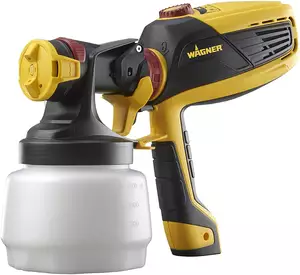
1. Wagner Spraytech FLEXiO 590 — HVLP handheld
Specifications
It’s simple to uniformly paint furnishings and other major house tasks with a best home paint sprayer. Wagner produces many of the most famous hand handled best Wagner paint sprayer for DIY projects because their products are trustworthy and have excellent quality without being as expensive as professional ones.
The Wagner Flexio 590 is a complete sprayer system that allows you to take on any painting job with ease. Along with the benefit of a paint container that attaches directly to the base of the gun without the need for a hose, this high pressure paint sprayer offers numerous distinguishing characteristics. It’s a little smaller than some other paint sprayers’ paint canisters, but it’s also speedier because of the Xboost turbine feature and occupies up less storage space.
It is among the most efficient hand-held paint sprayer systems since it is intended to handle undiluted paint. The Flexio 590, like other higher-end versions, has a movable tip that can be configured to paint horizontal or vertical. One thing we want to mention that arranging this gun takes a bit more time than other comparable handguns, and the first spray is often uneven, so you’ll have to examine this every session.
- Offers pattern adjustment.
- Suitable for exterior as well as interior projects.
- Affordable and cost-efficient.
- 8 gallons per hour usage average.
- The spray tip tends to block with thicker paint.
- The power cord is short.
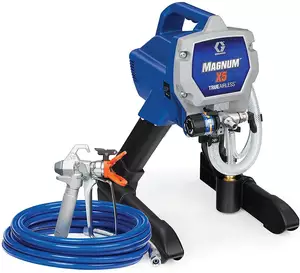
2. Graco Magnum X5 Stand — true airless, 3000 PSI
Specifications
If you’re a householder who wants to undertake an intermediate painting project but wants to save money by doing it yourself, the Graco Magnum X5 airless sprayer might be the best homeowner airless paint sprayer. We describe this machine as a cost-effective alternative for DIYers. When it comes to coatings, knowing that the Graco X5 paint sprayer can operate with various formats can give you peace of mind.
It can take everything from dyes to acrylics and latex, and it usually doesn’t need to be thinned. It’s nice to notice that the pump in this device has a strengthened stainless steel piston, ensuring sustained success. Graco airless spray painters are also great for fixtures and almost any other minor painting jobs around in the house. The hose’s long, flexible reach (7.5m) allows you to reach highly high ceilings and walls easily.
Related Post: “Best Way To Paint Edges Between Ceiling And Wall- Pro Guide and Tips”
It uses a brilliantly constructed piston pick-up mechanism to provide a consistent and steady spray of paint directly from the paint can. Moreover, the most prevalent critique about this Graco vs Wagner is that, while the sprayer is pleasingly lightweight for a ground-standing device, its lack of robustness causes it to ‘stroll’ when it turns to high power.
- Has flush capability for easy cleaning.
- Lightweight and compact design.
- It goes well with unthinned paints.
- Best for small to medium painting tasks.
- Causes extreme vibration on high pressure.
- Not very much suitable for professionals.
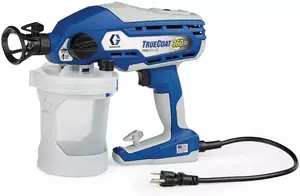
3. Graco TrueCoat 360 DS — true airless, handheld
Specifications
The Graco TrueCoat 360DS, which belongs to the relatively small segment of top airless paint sprayer, promises to deliver a fast and efficient finish to intermediate painting tasks. It allows you to spray slowly and precisely for minor, more detailed chores or quickly for big projects such as fixing fences and railings.
An inbuilt stainless steel hydraulic pump ought to be powerful enough to eject most painting materials without diluting. You can also choose between broad and narrow spraying patterns due to two nozzle ends. Bag liners are used in the one-quart to minimize container washing and allow for quick paint color changes.
Moreover, the best rated airless paint sprayer device will enable you to spray in every direction – vertically, horizontally, or reversed — making it excellent for roof painting. Although this is the best airless paint sprayer, we have noticed a backside of this gun which is its short cord that sometimes makes the operation hassle.
- It contains four flex liner bags.
- Adjustable pattern and speed setting.
- Long-lasting stainless steel pump.
- Best for multi-color painting projects.
- Best handheld paint sprayer.
- The power cord is short.
- Users are not satisfied with the tip size.
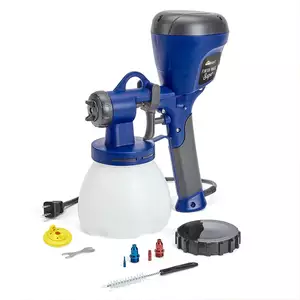
4. HomeRight Super Finish Max — HVLP, 3 brass tips
Specifications
This best small airless paint sprayer is designed to deliver smooth, uniform, and powerful performance in a shorter amount of time. The C800971 model may be used to paint or tint various surfaces, including gates, ceilings, furnishings, and cupboards.
The single-stage motor paint sprayer airless has enough power for modest to medium-sized tasks across the home or in the yard. That would be enough power to allow certain heavier liquids to be used without draining. Three replaceable tips are included with the HomeRight paint sprayer. Because of the bigger tip size, heavier paints or stains could be used without even being diluted.
If you’ve made up your mind, you’ve probably seen that several of your companies utilize plastic tips. Brass spray tips, while serving their job, are far more enduring in this best airless spray gun. After collecting many reviews, we have noticed that the HomeRight paint sprayer is a bit noisy and can make your brain tired. So, see that point if you are not okay with loud types of machinery.
- Simple to use, even novices can operate it.
- Produces excellent results in a shorter time.
- Material waste is reduced by minimizing overspray.
- Three spray tips give varying densities.
- Best power painter.
- Doing larger projects with this can be difficult.
- Creates irritating noise.
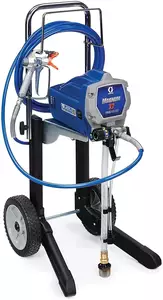
5. Graco Magnum X7 Cart — true airless, 3000 PSI
Specifications
Whenever it comes to big home DIY painting jobs, you’ll need a best airless paint sprayer for house painting that can handle them, like the Graco Magnum X7. It’s tough enough to handle home interior and exterior, wide decks, sheds, and buildings, with a suggested yearly flow of 125 gallons. The X7 is installed on a wheeled cart for easy transport – bulk effort and heavy lifting are necessary. It’s aimed at the extreme DIYer and handyperson.
No need to refill or replenish this machine because it has a vacuum line that pulls straight from paint drums. Variable pressure control lets you modify the output strength according to your spraying medium or coat density needs. An integrated Power Flush connector enables you to clean the machine with a pressure washer when the job is done.
This best professional airless paint sprayer provides you a lot of operating flexibility, allowing you to reach large areas without having to move the pump. Well, as everything is not perfect. A couple of users have pointed out that the hanger is not deep enough to reach the deep huge paint containers. Despite that, this paint sprayer guarantees a smooth, consistent paint flow.
- Best for large painting projects.
- Contains PowerFlush adapter.
- No paint refilling needed.
- Cart feature for easy moving.
- A heavy design.
- Expensive as compared to others.
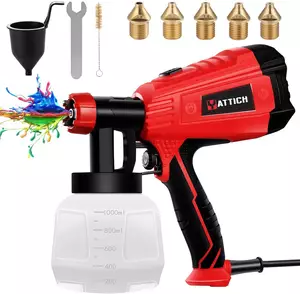
6. YATTICH YT-191 — HVLP, 5 copper nozzles
Specifications
Are you worried about leakage while painting and wonder which airless paint sprayer to buy? Yattich has a solution. Inside the product, place a rear foam cushion to block paints from pouring behind, stop the nozzle, and keep the spraying more consistent.
Compared to plastic nozzles, five copper nozzles help improve the sprayer’s endurance and make it less likely to become blocked, as well as minimize resistance, ensure a sustainable power output, and lengthen the motor’s life. You will obtain detailed paintwork by setting the flowing knob to manage the spraying speed and the flow rate of the project size.
Moreover, the initial consideration in its detachable design is mobility, and it is most useful for convenient and straightforward cleanup after splattering. All of the features of this top rated airless paint sprayers are just awesome, but some users have complained about the blockage of the nozzle if the stain gets thickened. To overcome this issue, always use well-textured paint and do a patch test before beginning the real painting project.
- Easy to clean because of dissembling function.
- Adjustable flow control.
- It contains five copper nozzles.
- Prevents leakage and paint mess.
- Clogs paint sometimes.
- It gets hot very frequently.
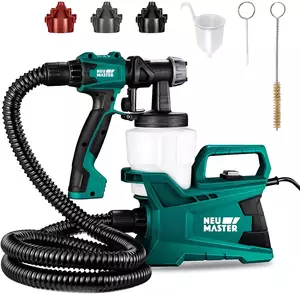
7. NEU MASTER N3140 — HVLP, 600W
Specifications
The best airless sprayer for the money- NEU MASTER HVLP Home Electric Paint Spray Gun is an excellent machine for those who require a sprayer sometimes. Electric paint sprayers’ reviews states that it’s best suited for small chores like staining cupboards, waterproofing decks, and painting windows, according to NEU MASTER Paint sprayer evaluations.
A 600-watt behemoth is capable of propelling stains, sealers, enamels, polyurethanes, and acrylics, among other mediums. Just keep in mind that the latter may necessitate thinning. Users can verify any dilution needs before loading the unit as it arrives with a viscosity cup.
You may also choose between vertical, horizontal, and circular spray patterns by twisting the nozzle head. You can choose the approach that is optimal for your base material to convey your form of media. In addition, the turbine unit has a handle for easier portability. But, this turbine’s disadvantage is that it misses the engine power seen in greater sprayers. You may have fuel trouble with viscous materials.
- Flow control that can be adjusted.
- A viscous cup is included.
- Three spray patterns are available.
- The grip is molded.
- It’s appropriate for inexperienced DIYers.
- Best cheap airless paint sprayer.
- Less durable for larger projects.
- It does not go well with latex paints.
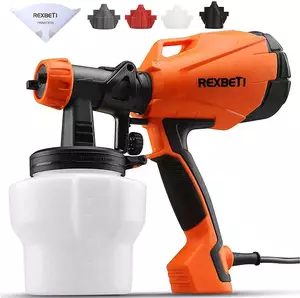
8. REXBETI Ultimate-750 — HVLP, 500W
Specifications
For its amazing performance and tremendous power this best airless spray gun -REXBETI Ultimate-750 REX004 Sprayer was chosen. You may simply draw patterns or paint a plain color with it, and you can anticipate a flawless and stunning result. That is ideal for vehicles, tables, and all types of wood panels, in my opinion. Three spray patterns and four nozzles are included to make the painting process more efficient.
The nozzles are removable and simple to use. Cleaning them is also a breeze because they can be removed. When it comes to spray patterns, simply rotate the tip to change them. A flow control knob at the bottom will aid you in the design process even more. This proved to be quite useful since people are able to manage the amount of paint that is put on the surface.
The top speed is 750 ml per minute, which is rather quick in comparison to its competitors. When using this good airless paint sprayer in warm, dry weather, we discovered that the paint dries quite rapidly. If dried paint adheres to the needle, it becomes more difficult to remove. As a result, we propose that you use it when the temperature is a little colder. If you must use it in dry weather, consider doing so in direct sunlight.
- The body is ergonomic and lightweight.
- The power cord is long enough.
- Easy to use and adjustable.
- It does not work well in a dry climate.
- It’s a bit of hassle to clean this machine.
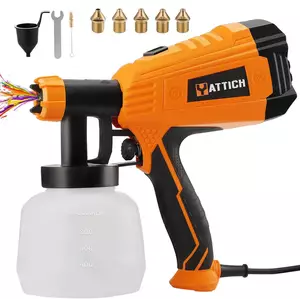
9. YATTICH YT-201 — HVLP, 700W
Specifications
It is a fantastic 3-way professional electric paint sprayer with adjustable dial- HVLP sprayer with a wide range of choices. With enough expertise, you can use this sprayer to coat everything accurately. It’s also much easier to handle because there’s no need for a compressor. Copper nozzles can bear higher pressure and are less prone to clogging than plastic nozzles.
It may also improve the concentration and uniformity of the spraying surface. Its use of double-layer insulating materials eliminates the need to be concerned about safety while functioning. The back foam pad prevents the paint from running backward, blocks the nozzle, and makes the spray extra consistent.
It even has dirt and humidity resistance characteristics, which not only lengthen the motor’s lifetime but also assure the effectiveness of spray color. We have found after a lot of reviews that it’s getting hot too fast. If you buy airless paint sprayer try to work with breaks in between.
- Made up of high-quality material.
- Comes with necessary apparatus.
- It gives even texture to the paint.
- The power cord is long enough.
- It gets hot on continuous use.
- It does not go well with larger projects.
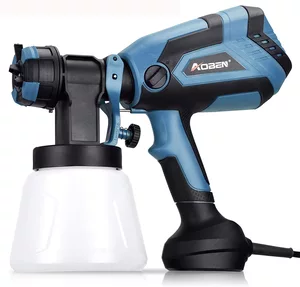
10. AOBEN Paint Sprayer — HVLP, 750W, 4 nozzles
Specifications
AOBEN provides a paint sprayer with a superior design and finishing, giving your design a streamlined appeal. This product has an ergonomic design with a tight grip that allows you to easily carry and use it. This paint spray system has four nozzle sizes allowing you to paint thin and thick layers depending on your demands.
The premium kit includes a clogging needle and a cleansing brush to make cleaning more convenient. This airless paint sprayer has a valve knob that allows you to easily manage the flow rate and get precise and flawless results.
This HVLP spray gun is ideal for spraying base coats or other high viscous coats for automobile, finishing, and furniture color applications. As for this airless spray gun review, everything is not perfect, we have found one downside in this device, and it sometimes gives textured coating if your paint is so thickened or does not mix properly.
- Offers flexible suction direct from the bucket.
- Has a stainless steel piston pump.
- Filters debris and dust.
- Somewhat expensive.
- It does not go well with thick paints.
How to choose a Best Airless Spray Gun – Buying Guide
When purchasing an airless paint sprayer, you should keep the following in mind:
Range
The paint hose or the length of the power cable generally limits the range of an airless paint sprayer. Because these airless paint sprayers require electricity to operate, this is the case. In addition, electric paint sprayers come with a variety of range choices, such as 25 feet, 6 feet, 50 feet, and so on.
Container Capacity
As you may assume, the container capacity of an airless paint sprayer is crucial. It informs you how much paint you can spray without having to reload. Some alternatives enable you to spray paint from 1 or 5-gallon paint containers, while some have small connected containers, such as 1000 ml or 1.5-quart paint canisters.
Weight
Carrying a paint sprayer and using it in various locations is commonly necessary. This is when the mobility factor enters the picture. It’s crucial to double-check the weight prior to making a purchase. The weight of most best airless sprayer ranges from 3 to 15 pounds.
Spray Pattern
The spray pattern of a paint sprayer is the form in which the instrument produces the finish. The best airless paint sprayer can spray in a variety of patterns, including circular, horizontally, and vertically. Because these settings are accessible, you may change from spraying a broad fan across an area to a fan that moves up and down without turning the sprayer.
Frequently Asked Questions
Which Sprayer for Which Job
The ten sprayers above cover most of what a homeowner will ever need. But the honest answer to “which airless sprayer should I buy” is that it depends far less on the machine than on what you’re pointing it at. I learned that the expensive way: I bought a full airless rig to spray a set of kitchen cabinet doors and spent two hours cleaning a pump for twenty minutes of spraying. Wrong tool, right paint. Here’s where to go instead.
| What you’re painting | Go here | Why it’s a different tool |
|---|---|---|
| Kitchen or bathroom cabinets | See the picks | HVLP, not airless — airless lays down too much material for a door face. |
| Siding, fences and exterior walls | See the picks | You want reach and a bigger tip. Wind is the real enemy, not the sprayer. |
| A fence specifically | See the picks | Pickets eat paint. Overspray control matters more than raw power. |
| Ceilings | See the picks | An extension wand saves your shoulders more than any spec on the box. |
| Popcorn or textured ceilings | See the picks | Different problem entirely — pressure too high and the texture comes off. |
| Small rooms, furniture and touch-ups | See the picks | A full airless rig is the wrong tool here. You’ll spend longer cleaning than painting. |
| Cars, bumpers and panels | See the picks | Automotive finishes need a fine-finish gun and a controlled space. |
| Daily professional use | See the picks | Duty cycle and pump rebuild kits decide this, not the price tag. |
| Commercial and industrial jobs | See the picks | Built to run all day. Overkill for a house, essential for a crew. |
| Minimising overspray indoors | See the picks | The charged-particle approach wraps the surface instead of dusting the room. |
Parts that actually change the finish
Most people blame the sprayer when the finish goes wrong. Nine times out of ten it’s the tip.
- Tips and nozzles — The single part that changes your finish most. Worn tips fan wide and waste paint. Full breakdown.
- Hoses — Length costs you pressure. Buy what you need and not much more. Full breakdown.
- Extension wands — For ceilings, soffits and anywhere a ladder would otherwise go. Full breakdown.
Shopping by brand instead of by job? We have dedicated breakdowns for Graco and Wagner, the two names that show up most often in this category.
Final Words
The best airless paint sprayer that you can find on the market is included in our evaluations above. This article will easily assist you in identifying the most important characteristics to look for when purchasing sprayers. Knowing this information can prevent misunderstandings and hasty decisions and lessen the danger of purchasing things that aren’t right for you.
We also provide a buying guide that highlights some key factors to consider before making any selections in this fast-paced market, helping you to make informed choices for the best airless paint sprayer for the money. By reading the reviews on this page, you will be able to quickly choose and purchase a paint sprayer that meets your needs and style while staying within your budget.
The Sprayer I Bought Twice
My first sprayer was a handheld HVLP, bought to do the outside of a small house because the box said “paint sprayer” and the price was reassuring. I spent an entire Saturday on one elevation, refilling a cup that held about as much paint as a large mug, and I ran out of daylight with three walls to go. The finish where I had got to was lovely. The rate of progress was hopeless.
I ended up renting an airless for the rest of the job and finished the remaining three sides in an afternoon. Two years later I used that same HVLP to do a set of kitchen cabinet doors and it was the best tool I owned — the finish came off the doors looking factory-applied and there was almost no overspray to clean up.
Neither purchase was wrong. The mistake was thinking one machine covered both jobs. If you can only own one and your work is mixed, own the airless and hand-finish the cabinets — the reverse does not work.
When Not to Buy a Sprayer at All
- One room, once. Masking a room properly for a sprayer takes longer than rolling it. Sprayers win on large areas and on surfaces a roller cannot reach into, not on a single bedroom.
- You will not clean it the same day. Every sprayer on this page is destroyed by dried paint in the pump or the passages, and the cleaning is not a five-minute job. If you know yourself well enough to know you will leave it, rent instead of buying.
- Neighbours are close and it is windy. Airless overspray travels a long way and lands on cars. This is a real cost, and no amount of masking on your own property prevents it.
- The surface needs the paint worked in. Bare, chalky or porous surfaces often need a first coat brushed or back-rolled so it keys into the substrate. Spraying alone lays paint on top of a surface it has not bonded to.
- You have not thought about injection injury. An airless tip at 3000 PSI will inject paint through skin without breaking it visibly, and it is a surgical emergency that does not hurt much at first. Never point the gun at anyone, always engage the trigger lock when you set it down, and never clear a blocked tip with your finger.
Airless Sprayer Questions People Actually Ask
What is the difference between an airless and an HVLP paint sprayer?
Airless uses a piston pump to force paint through a tip at high pressure, around 3000 PSI on homeowner units, and the pressure alone atomises it. HVLP uses a high volume of low-pressure air instead. Airless covers large areas fast and handles unthinned latex from the bucket; HVLP gives a much finer finish with far less overspray but a fraction of the throughput.
Which airless sprayer is best for a whole house exterior?
A cart-mounted unit with a suction tube that draws straight from a 5 gallon bucket, such as the Graco Magnum X7. The reason is not power, it is refills — a stand unit that pulls from the bucket lets you work continuously, and on a house-sized job that is what decides whether you finish in a day.
Do I need to thin paint for an airless sprayer?
Usually not. Handling unthinned latex is the main practical advantage of airless, and the Graco units on this page state it explicitly. HVLP is the opposite — most handheld HVLP guns need latex thinned to spray cleanly, and that changes both the coverage and the film build you end up with.
Is a handheld airless sprayer good enough?
For doors, shutters, furniture, fences and small exterior sections, yes — a unit like the TrueCoat 360 DS gives you true airless atomisation without dragging a cart around. The limit is the container: anything with an onboard cup means stopping to refill, which is fine on a fence panel and painful on a wall.
How much overspray does an airless sprayer produce?
A lot, and more than people expect. Mask further than feels necessary, cover anything downwind, and do not spray an exterior on a breezy day. This is the single biggest reason people who used a sprayer once say they would not again.
Should I buy or rent an airless sprayer?
Rent for a single large job; buy if you will use it several times a year. The hidden factor is maintenance — an owned sprayer has to be flushed and stored correctly every time, and a neglected one costs more in replacement parts than the rental would have. If you are honest that this is a one-off, rent.
Can I spray a ceiling with an airless sprayer?
Yes, and it is one of the jobs airless is best at, especially on textured or acoustic ceilings where a roller drags the texture off. You will want an extension wand so you are not spraying directly overhead, and everything below has to be covered.
What size tip should I use?
Tip size sets both the fan width and how much material comes through, and the right one depends on the coating rather than the machine. Thinner materials such as stains and lacquers take a smaller orifice; thick latex takes a larger one. Using too small a tip for a thick paint is the usual cause of a fan that spits and tails.
Once the machine is chosen, most of the finish comes down to the consumables — the gun tip, the hose and the extension wand. If the job is specifically a ceiling, see the ceiling sprayer guide, and for cabinets, the cabinet sprayer guide.
Written by Sophie Ulman. ThePaintly is reader-supported: when you buy through links on this site we may earn an affiliate commission at no extra cost to you.