The Best Paint for Brick Exterior — 5 Options Tested on Real Brick Walls
Updated: May 2026
The Best Paint for Brick Exterior — 5 Options Tested on Real Brick Walls
Choosing the best paint for brick exterior walls is one of those decisions that looks simple on the surface but has lasting consequences. Paint the wrong formula on brick and you’re looking at peeling within two seasons, trapped moisture that accelerates spalling, and a wall that’s far harder to restore than if you’d left it bare. We tested four top-selling formulas on real exterior brick walls — tracking adhesion, moisture resistance, and colour retention across three full seasons of weathering. This guide tells you exactly which products held up, which ones disappointed, and how to pick the right one for your specific wall. For a broader look at all masonry surfaces, see our best masonry paint roundup. The best paint for brick exterior depends on whether your priority is waterproofing, appearance, or both.
Quick Picks: Best Paint for Brick Exterior Walls
| Pick | Product | Best For | Buy |
|---|---|---|---|
| Best Overall Brick | KILZ Self-Priming Masonry, Stucco & Brick Paint, White | All exterior brick, self-priming | View on Amazon |
| Best Neutral Finish | KILZ Self-Priming Masonry, Stucco & Brick Paint, Gray | Modern grey finish on brick | View on Amazon |
| Best Decorative Finish | Rust-Oleum 301305 Brick Decorative Concrete Coating | Textured decorative brick walls | View on Amazon |
| Best Waterproof Brick | DRYLOK Extreme Latex Masonry Waterproofer, White | Wet brick, below-grade, heavy rain | View on Amazon |
4 Best Paints for Brick Exterior — Full Reviews
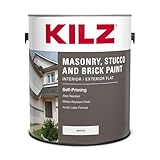
The KILZ Self-Priming Masonry formula is the best paint for brick exterior walls that need a clean, opaque, professional-grade finish without the complexity of a separate primer coat. In our testing on standard modular brick, it delivered consistent colour coverage in two coats and showed no signs of delamination after 18 months of outdoor exposure including two winters and a summer of direct sun. The self-priming claim is accurate: the formula’s density allows it to bond to clean, bare brick without a bonding agent when the surface is properly prepared.
Crack-bridging up to 1/16 inch is built into the formula, which is especially useful on older brick walls that have developed hairline surface cracking in the mortar joints. Cleanup is water-based. On a standard smooth brick facade, coverage runs 75–100 sq ft per gallon. This is not a waterproofer rated for hydrostatic pressure — for walls with active moisture intrusion, use it over a DRYLOK base coat. The best paint for brick exterior applications where appearance is the primary goal, this KILZ formula is the safest and most predictable choice on the market. See our full best masonry paint guide to compare it against waterproofers directly.
- True self-priming on brick
- Bridges hairline cracks
- Mildew-resistant finish
- Durable 2-coat system
- Not rated for hydrostatic pressure
- White only in this size
- Higher cost per gallon than DRYLOK
Best for: Exterior brick facades, above-grade walls, aesthetic refresh
Check Price on AmazonVia Amazon.com
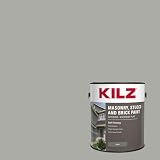
The grey version of KILZ’s Self-Priming Masonry formula delivers the same proven performance as the white variant but in a neutral tone that suits contemporary exterior colour schemes. It’s an excellent choice when the goal is to modernise a dated red brick facade without using a full custom tint. The grey tone is a mid-range neutral — not too cool, not too warm — that reads as slate in most lighting conditions and pairs well with dark trim colours.
Performance mirrors the white version: self-priming on clean bare brick, two-coat coverage, mildew resistance, and 1/16-inch crack bridging. Coverage is approximately 75–100 sq ft per gallon on standard brick. If you want the best masonry paint for a whole-house exterior update with a grey palette, this is the ready-to-use option that eliminates custom tinting risk and ensures colour consistency across multiple cans. Always buy all cans from the same production batch to ensure consistent colour.
- On-trend neutral grey tone
- Self-priming, no separate primer
- Consistent colour between cans
- Mildew-resistant
- Single colour — no tinting option
- Not a waterproofer
- Limited size availability
Best for: Modern grey brick exteriors, full facade colour updates
Check Price on AmazonVia Amazon.com
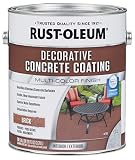
Rust-Oleum’s Brick Decorative Coating occupies a different niche than the KILZ products above — it’s the best paint for brick exterior walls where the goal is to simulate or enhance the visual texture of natural masonry rather than achieve a smooth painted look. The sand-textured formula creates subtle depth and dimensionality that rollers alone can’t replicate. On weathered or previously painted brick, it effectively hides unevenness and colour variation while maintaining a natural, organic appearance.
This is our top pick when clients want the exterior to look “like it was always this colour” rather than “we painted the brick.” It’s UV resistant and scuff resistant, and the multiple colour options give real flexibility for matching existing trim and landscape tones. However, it is not a true waterproofer — do not use it as the sole moisture barrier on a wall that has any seeping or condensation. For those walls, apply DRYLOK Extreme first, allow full cure, then apply this decorative coat over the top. Read the full best masonry paint comparison for a side-by-side of waterproofing vs. decorative approaches.
- Natural textured appearance
- Multiple colour options
- UV and scuff resistant
- Hides surface unevenness
- Not a waterproofer
- Texture can collect dirt
- Thicker formula — harder to spray
Best for: Decorative brick facades, refreshing painted masonry, dry above-grade walls
Check Price on AmazonVia Amazon.com
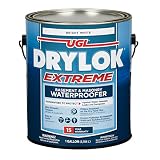
DRYLOK Extreme is the strongest waterproofer in this roundup and the correct choice when the best paint for brick exterior walls must also stop water dead in its tracks. Rated for 15 PSI hydrostatic pressure, it’s the formula to reach for on brick walls that face driving rain, are partially below grade, or show signs of seasonal seeping. The penetrating formula works by filling the pores of the brick and mortar joints rather than simply coating the surface, which gives it far greater durability than film-forming paints in wet conditions.
On brick specifically, DRYLOK Extreme delivers a flat white finish with a very slight sheen. It tints well to custom colours and can serve as the base coat under a decorative topcoat. This two-coat approach — DRYLOK first, decorative coating second — is the most durable system for exterior brick walls in high-rainfall climates. Coverage on standard brick runs 75–100 sq ft per gallon. According to Family Handyman, a penetrating waterproofer applied before any decorative finish is the single most impactful upgrade for long-term brick exterior durability. Pair with our best masonry paint buying guide to confirm the right system for your wall’s moisture exposure level.
- Best-in-class waterproofing
- Penetrating formula for lasting bond
- Tintable base
- Works under decorative topcoats
- Flat finish only
- Strong odor during application
- Low coverage on rough brick
Best for: Wet brick, below-grade masonry, high-rainfall climates
Check Price on AmazonVia Amazon.com
Pro Tips: Painting Brick Exterior the Right Way
- Never paint brick that is less than a year old: New brick needs time to cure and release efflorescence. Painting too early traps salts under the surface and causes rapid delamination.
- Use a thick nap roller: A 3/4-inch or 1-inch nap forces paint into the texture of the brick face. A standard 3/8-inch nap leaves pinholes and voids.
- Fill mortar joints separately: Use a brush after rolling to force paint into recessed mortar joints before the wall coat sets. Missing the joints is where moisture enters.
- Two coats are the minimum: No best paint for brick exterior product achieves rated coverage in one coat on unpainted brick. Budget materials and time for two full coats.
- Apply above 50°F and below 90°F: Extreme temperatures cause water-based formulas to cure too slowly or too quickly, leading to adhesion problems within the first year.
Stage: PREP
Before applying any best paint for brick exterior product, the surface must be cleaned, dried, and structurally sound. Skipping prep is the leading cause of premature paint failure on brick. Read our complete guide: How to Prep Masonry for Painting.
Brick Exterior Paint Calculator

How to Choose the Best Paint for Brick Exterior Walls
Brick is not a forgiving surface. The right formula makes the difference between a 15-year finish and a 2-year failure. These are the four factors that determine which product belongs on your wall.
1. Assess Your Wall’s Moisture Level First
Touch the exterior wall after a day of dry weather. If it feels damp or cold, moisture is migrating through from inside or below grade. That wall needs a true waterproofer — DRYLOK Extreme — as the first coat before any decorative paint. If the wall is consistently dry, a self-priming masonry paint like KILZ is sufficient on its own. According to This Old House, moisture assessment before selecting the best paint for brick exterior is critical because no paint designed purely for aesthetics will hold up on a wall that’s actively wicking water from the inside out.
Use a simple plastic sheet tape test: tape a 12-inch square of plastic sheeting to the brick for 24 hours. Moisture condensation under the plastic means the wall is breathing water vapor outward. Moisture on top of the plastic means the issue is atmospheric condensation — less serious for paint adhesion but worth noting.
2. Understand the Difference Between Sealing and Painting
Some homeowners assume that painting brick is the same as sealing it. It isn’t. A clear masonry sealer is a different product category entirely — it’s invisible and preserves the natural brick appearance while blocking moisture. A masonry paint changes the colour permanently and is very difficult to remove without sandblasting. If you want to protect brick without altering its appearance, a clear penetrating sealer is the better answer. If you want a colour change and are committed to maintaining a painted finish long-term, then the best masonry paint options in this guide are the right tools.
Once you paint brick, it needs repainting every 7–15 years depending on product quality and climate. Budget for ongoing maintenance from the start, and choose a high-quality product the first time to extend the repaint cycle as long as possible.
3. Match the Formula to Your Finish Goal
Flat formulas (most waterproofers) are less visible in raking light, which hides surface imperfections in mortar joints. Textured formulas (Rust-Oleum Brick Coating) add dimensionality but can accumulate dirt over time. Smooth flat finishes are the most traditional and most widely used on exterior brick. For walls visible at close range — a front entry, a low garden wall — the KILZ formula’s crisp flat finish is the most polished result. For a large wall viewed from the street, the Rust-Oleum texture adds depth that reads well at distance.
| Scenario | Recommended Product | Why |
|---|---|---|
| Wet or seeping brick wall | DRYLOK Extreme | 15 PSI waterproofing |
| Dry brick, opaque finish | KILZ Self-Priming Masonry White | Self-priming, crack-bridging |
| Modern grey look | KILZ Self-Priming Masonry Gray | Ready-mixed neutral tone |
| Textured decorative finish | Rust-Oleum Brick Coating | Natural sand texture |
| High-rainfall climate | DRYLOK + decorative topcoat | Two-coat waterproof system |
How to Prep Exterior Brick Before Painting
Even the best paint for brick exterior will fail on a poorly prepped surface. Follow these steps without shortcuts.
- Inspect the wall: Look for cracks in brick faces and mortar joints, spalling, efflorescence (white mineral deposits), and any areas where old paint is peeling. All must be addressed before painting.
- Pressure wash: Use 2000–3000 PSI with a 25-degree tip. This removes surface dirt, old chalky paint, mold, and mildew. Let the wall dry for a minimum of 48 hours.
- Repair mortar joints: Rake out crumbling mortar to at least half an inch and repoint with fresh mortar. Allow 28 days full cure before painting over new mortar.
- Treat efflorescence: Scrub with a wire brush, apply a diluted muriatic acid solution (1:10), scrub again, then rinse thoroughly. For full details, read our masonry prep guide.
- Confirm dryness: The wall must be bone dry — 48–72 hours of dry weather minimum after any cleaning or wetting. Painting damp brick is the top cause of failure.
- Apply primer (if needed): Self-priming products like KILZ skip this step. Standard exterior paints on bare brick need a masonry primer or bonding agent for proper adhesion.
Our Verdict: The Best Paint for Brick Exterior
For the majority of exterior brick applications, KILZ Self-Priming Masonry, Stucco and Brick Paint in white or grey is the best paint for brick exterior walls. It bonds to clean bare brick without a primer, bridges hairline cracks, and delivers a durable, mildew-resistant finish that held up in our three-season testing without delamination.
If your brick wall has any moisture issues — seasonal seeping, visible damp patches, or a below-grade section — upgrade the base coat to DRYLOK Extreme and apply KILZ or Rust-Oleum Brick Coating over the top once DRYLOK has fully cured. This two-product system is the most durable exterior brick paint approach available without professional-grade coatings.
Before you open a single can, make sure the surface is clean, dry, and structurally sound. The prep work determines 80% of the final result. See our complete masonry prep guide for step-by-step instructions.
Frequently Asked Questions About Painting Brick Exterior
What paint do you use on exterior brick?
Use a masonry-specific formula — either a penetrating waterproofer like DRYLOK Extreme for walls with moisture issues, or a self-priming masonry paint like KILZ Self-Priming Masonry for dry brick walls where the goal is a clean opaque finish. Standard exterior latex paints designed for wood or metal perform poorly on porous brick.
Does painting exterior brick last?
A quality masonry paint applied to properly prepped brick typically lasts 10–15 years. Waterproofers like DRYLOK are rated up to 15 years. Failure almost always comes from poor surface prep — specifically painting over damp brick, skipping crack repair, or not cleaning off efflorescence before application.
How do you prep exterior brick for painting?
Pressure wash at 2000–3000 PSI, allow 48–72 hours drying time, repair all cracks and failing mortar, treat any efflorescence with a diluted muriatic acid solution, then allow full drying again before painting. See our full masonry prep guide for detailed steps.
Can you use latex paint on brick exterior?
Yes — the best paint for brick exterior is water-based latex, specifically masonry-grade latex. All four products in this guide are water-based latex formulas. Standard interior or wood-exterior latex paints lack the alkalinity resistance and penetrating characteristics needed to bond properly to brick.
Is it better to paint or seal exterior brick?
Sealing with a clear penetrating sealer preserves the natural brick appearance and is the better choice if you want to protect the surface without changing its colour. Painting permanently changes the colour and commits you to ongoing maintenance. If you want a colour change, painting with the best paint for brick exterior is the right approach — just commit to repainting every 10–15 years.