The Best Paint for Miniatures, Tested Across 40+ Models
Updated: July 2026 | By Sophie Ulman
Pick the wrong paint for your models and you find out the hard way: the detail you spent an hour on disappears under one thick, chalky coat, and the first time you actually game with the figure, color chips off the raised edges. That is the real stakes here. The best paint for miniatures is not the one with the prettiest bottle. It is the one that goes on thin, keeps the sculpt crisp, and survives being picked up, knocked over, and shoved back in a foam tray a hundred times.
I have painted more figures than I can count, from bargain plastic troops to resin display busts, and I have ruined a few learning what actually holds up. Below are the five sets I keep coming back to, each matched to a specific job. The best paint for miniatures depends entirely on how you paint and what you paint.
Quick picks at a glance
| Set | Best for | Type | Bottles |
|---|---|---|---|
| Army Painter Warpaints Fanatic Starter | All-around beginners | Acrylic + wash + primer | 11 |
| Citadel Base Paint Set | Games Workshop plastic minis | High-pigment acrylic | Base range |
| Vallejo Game Color Introduction | Fine detail and thinning | Dropper-bottle acrylic | 16 |
| Army Painter Speedpaint 2.0 Starter | Speed and one-coat armies | Contrast acrylic | 10 |
| Army Painter Fanatic Mega Set | Painting a full army | Acrylic range | 50 |
The 5 best paint for miniatures sets, reviewed

Best Overall — All-Around Starter
The Army Painter Warpaints Fanatic: Starter Set
This set works because it hands you a complete workflow in one box, not just a scattered rainbow. You get seven core acrylics, two metallics, a wash, a brush-on primer, and a brush. The paints are a mid-viscosity acrylic that flows off the brush without immediately pooling, and the triad logic (a base, a shade, a highlight for each family) means you can actually finish a model instead of owning 40 colors you never mix.
The brush-on primer is the quiet hero. I painted a squad of plastic troopers with this set and skipped a separate spray primer to test it, and adhesion held even after weeks of handling. The one honest limitation: the included brush is fine for basecoating but too soft to hold a point for eyeliner-level detail. Buy a proper detail brush alongside it.
- Complete triad workflow
- Brush-on primer included
- Wash for instant depth
- Included brush is basecoat-only
- Limited color range
Best for: A first-time painter tackling D&D or Warhammer figures who wants one box that does everything.
Check Price on Amazon ->
Via Amazon.com
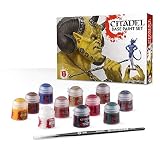
Best for Games Workshop Plastic Minis
Games Workshop Citadel Base Paint Set
Citadel Base paints are engineered for one thing: covering gray and black plastic in a single pass. The pigment load is heavy, so a color like a bright bone or a saturated red hides the undercoat without the muddy translucency you get from thinner craft acrylics. On Games Workshop plastic, which is what most of these paints were formulated against, the match is close to perfect.
That density is also the trade-off. Straight from the pot these paints are thick, and if you do not thin them, brush strokes and texture show. The mistake I see most often is people painting Citadel Base neat and blaming the paint for the ridges. Thin it with a drop of water on a wet palette and it levels beautifully. Pair it with the right brush and the finish is clean.
- One-coat coverage on plastic
- Colors tuned to GW kits
- Excellent opacity
- Thick from the pot
- Pots dry out if left open
Best for: Warhammer 40K and Age of Sigmar painters basecoating plastic kits who want maximum coverage.
Check Price on Amazon ->
Via Amazon.com
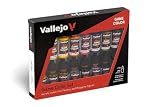
Best for Fine Detail and Thinning
Vallejo Game Color Introduction Set
Vallejo ships in dropper bottles, and once you paint with droppers you resist going back. You dispense one precise drop onto a palette instead of jamming a brush into a pot, so your paint stays uncontaminated and your thinning ratio is repeatable. The Game Color formula is naturally a touch thinner than Citadel, which makes it forgiving for glazing and layering subtle transitions.
Because the paint is thinner, opacity over black is lower. On a dark undercoat you will need two thin coats to reach full color, and bright yellows may want a third. That is the price of control. For faces, freehand, and edge highlighting, this set gives you a finer, more predictable line than any pot-based paint I have used.
- Precise dropper dispensing
- Thin, glaze-friendly formula
- Great for detail work
- Needs two thin coats over dark
- Metallics are less punchy
Best for: Painters ready to layer, glaze, and do face and freehand detail with repeatable thinning.
Check Price on Amazon ->
Via Amazon.com

Best for Speed and One-Coat Armies
The Army Painter Speedpaint 2.0 Starter Set
Speedpaints are contrast paints: they basecoat, shade, and highlight in a single pass by flowing into recesses and staining raised areas lighter. Brush one coat of Speedpaint over a light primer and the model looks shaded in seconds. For anyone facing a box of 40 rank-and-file troops, this is the difference between a painted army and a gray one.
The catch is that Speedpaint lives and dies by the undercoat. It needs a bright, ideally white or bone primer to glow, and it can reactivate if you brush varnish over it wrong, lifting the color. I learned that the first time I sealed a Speedpaint mini with a wet brush-on gloss and watched a streak smear. Use a spray varnish or a light hand, and it holds fine.
- One-coat shading
- Massive time savings on armies
- Great over 3D-printed rank troops
- Demands a bright primer
- Can reactivate under brush-on varnish
Best for: Wargamers who need a whole unit tabletop-ready fast, not display-cabinet perfect.
Check Price on Amazon ->
Via Amazon.com

Best for Painting a Full Army
The Army Painter Warpaints Fanatic Mega Set
Fifty bottles sounds like overkill until you are three units into an army and realize you are out of the one brown you use for everything. The Mega Set gives you skin tones, metallics, effects, and washes in the same Fanatic acrylic formula as the starter, so colors mix predictably across the whole range. Buying breadth up front is cheaper per bottle than replacing colors one at a time.
The honest downside is that a beginner does not need this. If you have painted five models total, most of these bottles will sit untouched for a year, and paint does have a shelf life once opened. This is a commitment purchase for someone who already knows they are in the hobby for the long haul.
- Full color range in one buy
- Consistent formula for mixing
- Lowest cost per bottle
- Overkill for beginners
- Some bottles may sit unused
Best for: Committed hobbyists painting a full army who want every color on hand.
Check Price on Amazon ->
Via Amazon.com

How to choose the best paint for miniatures
The best paint for miniatures for you comes down to three questions: how you apply paint, what your models are made of, and how much you plan to paint. Get those right and any of the sets above will serve you well.
Match the paint type to your method
Standard acrylics like Citadel, Vallejo, and Fanatic give you full control over base, shade, and highlight, but they take more coats and more time. Contrast paints like Speedpaint collapse those steps into one, trading control for speed. Neither is better in the abstract. A display painter wants acrylics; an army painter wants contrast. Many of us keep both.
Consider the surface underneath
These are plastic and resin figures, so adhesion depends on a primer, not the paint. Bare plastic sheds acrylic the same way a slick wall does, which is why every model gets primed first. If you want the background on why acrylic bonds the way it does, Family Handyman has a clear breakdown of acrylic paint. The same adhesion logic that governs the best paint for plastic around the house applies to the plastic on your gaming table.
Buy for your volume, not your ambition
It is tempting to buy the 50-bottle box on day one. Resist it. Start with a triad starter, learn which colors you reach for, then expand. A focused 11-bottle set finishes more models than a giant range that overwhelms you. The right brush matters as much as the paint, so pair any set with the best miniature paint brushes you can afford.
When NOT to buy a miniature paint set
Prep and sealing steps that actually matter
Prep matters more than the brand. Durability on a mini is 50% paint quality and 50% what you do before and after the color coat. Here is the sequence I follow on every figure.
First, wash the model in warm soapy water to strip mold-release agent, then let it dry fully. Second, prime with a thin, even coat, and if you spray-prime, do it with real ventilation, since aerosol primers are not something to breathe in a closed room. This Old House keeps a good primer on paint prep and technique if you want the fundamentals. Third, paint in thin coats. Fourth, and this is the step beginners skip, seal the finished model with a varnish. A matte varnish is what stops your edge highlights from chipping the first time the figure gets handled during a game. Unsealed paint on a mini you actually play with will wear at the high points within a few sessions.
The verdict
If you want one box that teaches you the whole process, the Army Painter Warpaints Fanatic Starter is the best paint for miniatures for most beginners. Painting Games Workshop plastic? The Citadel Base Set covers in one pass. Facing a whole army with a deadline? Reach for Speedpaint 2.0 and prime bright. Whatever you pick, thin it and seal it.
Frequently asked questions
A triad-based starter set like the Army Painter Warpaints Fanatic. It gives you a base, shade, and highlight for each color family plus a brush-on primer, so you can finish a model without buying anything else first.
Yes, almost always. Paint straight from the pot is too thick and fills the fine sculpted detail. Add water on a wet palette until it flows like skim milk, then apply two thin coats.
You can, but the pigment is coarser and coverage is weaker, so you fight ridges and streaks. Hobby paints are milled finer specifically for small-scale detail, which is why they cost more.
Contrast paints like Speedpaint base, shade, and highlight in one coat by pooling in recesses. Normal acrylics do each step separately, giving more control but taking more time. Speed versus precision.
Yes. Bare plastic and resin shed acrylic paint, so a thin primer coat is what makes the paint bond and stay put. Skip it and your paint will rub off with handling.
Seal the finished model with a varnish, matte or satin. Unsealed paint wears at the raised edges within a few gaming sessions, while a sealed figure survives regular handling.