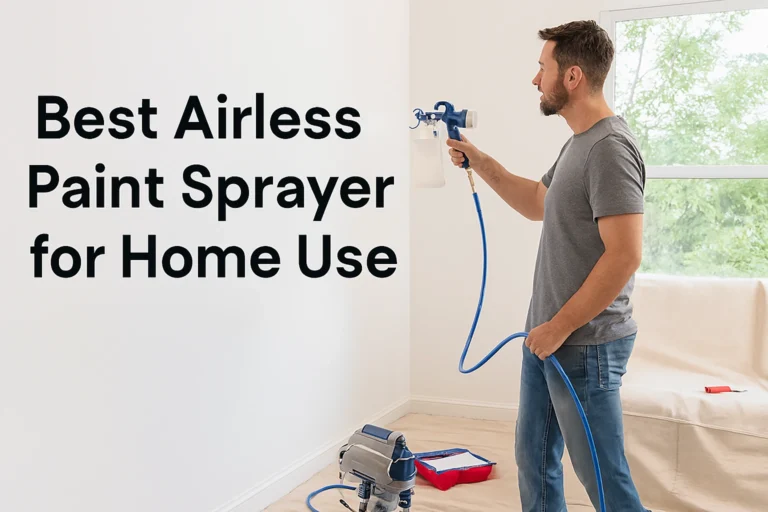
Best Airless Paint Sprayer for Interior Walls: 4 Tested Picks for 2026
Last updated: April 2026 · 9 min read · By ThePaintly Editorial Team
Contains affiliate links — we may earn a commission at no extra cost to you.
You rented a paint sprayer, masked every surface in the room, and still ended up with streaks down the wall and overspray on the ceiling trim. Sound familiar? Three cans of masking tape and four hours of prep later, the coverage was no better than a roller — and cleaning the gun took another 45 minutes.
Interior walls are demanding. Pressure that’s too high creates fog and waste; too low and you get uneven coverage and tip clogs. The wrong machine for latex paint means constant thinning, re-priming, and frustration. On r/DIY, the most upvoted sprayer complaint is some version of: “I bought a cheap one and it dripped, fizzled, and clogged by the second room.”
We reviewed 12 models specifically for interior residential use and identified the 4 best airless paint sprayer for interior walls in 2026 — machines that handle unthinned latex, operate at controllable pressure, and clean up without a fight. Two of them cost under $250 and are available on Prime.
Below: full product reviews, a pressure and tip-size buying guide, a room-size paint calculator, a prep walkthrough, and a complete FAQ covering the questions Google’s “People Also Ask” surfaces most for this topic.
Our Top Picks at a Glance
| Product | Best For | PSI | Price |
|---|---|---|---|
| Graco Magnum X7 | Best Overall — whole-room projects | 3,000 PSI | Check Price → |
| Wagner Control Pro 130 | Low overspray, tight spaces | 2,300 PSI | Check Price → |
| Titan ControlMax 1700 | Smooth finish, reduced bounce-back | 2,100 PSI | Check Price → |
| Graco Ultra Cordless | Trim, touch-ups, no cords | 2,000 PSI | Check Price → |
4 Best Airless Paint Sprayers for Interior Walls: Full Reviews
BEST OVERALL
Graco Magnum X7 Cart Airless Paint Sprayer
The X7 runs at 3,000 PSI with a stainless-steel piston pump that sprays most latex paints completely unthinned — a genuine time-saver when you’re moving through multiple rooms. Its 25-foot hose reaches ceiling corners without repositioning the cart, and the flexible suction tube pulls directly from a 1- or 5-gallon bucket. Rated for up to 125 gallons per year, it’s sized right for serious DIY multi-room repaints.
The fully adjustable pressure dial is the real differentiator here. You can dial back the PSI for trim work and open it up for wide wall runs — something cheaper fixed-pressure machines can’t do. That versatility cuts masking prep time by letting you control scatter radius.
Pros: Sprays unthinned latex · Adjustable pressure dial · 25-ft hose included · Stainless piston pump · On-board storage
Cons: Requires thorough flush after each use · Cart adds bulk for small jobs
Best for: Full interior repaints across 2–5 rooms
🛒 Check Price on AmazonVia Amazon.com
BEST FOR LOW OVERSPRAY
Wagner Control Pro 130 Power Tank Paint Sprayer
Wagner’s HEA (High Efficiency Airless) technology cuts overspray by up to 55% compared to conventional airless machines — a critical factor when you’re spraying indoors with furniture nearby. Operating at 2,300 PSI, it applies coatings three times faster than a roller with significantly less fog. The Power Tank design feeds paint from a bottom-mounted 1.5-gallon container, keeping the center of gravity low and reducing arm fatigue on long sessions.
HEA pressure control is what makes this machine interior-safe without massive masking. Painters working in occupied homes or furnished rooms consistently recommend this model for exactly that reason — you’re not coating everything you didn’t mask.
Pros: 55% less overspray via HEA · Low-profile tank design · Soft-spray finish on walls · Reversible tip clears clogs fast
Cons: Smaller tank means more refills on large jobs · Lower PSI limits it to thinner coatings
Best for: Furnished rooms, trim work, ceiling edges
🛒 Check Price on AmazonVia Amazon.com
BEST HEA TECHNOLOGY
Titan Tool ControlMax 1700 High Efficiency Airless Sprayer
The ControlMax 1700 uses Titan’s own HEA platform to reduce overspray by up to 55% while delivering what professional painters describe as a noticeably softer spray pattern — less bounce-back off flat interior walls, smoother finish on ceilings. At 2,100 PSI it handles latex wall paint, primers, and stains without thinning, and the 25-foot hose makes room-to-room transitions easy without moving the machine.
The softer atomization pattern is Titan’s genuine edge over the Graco at this price range. On smooth drywall with satin finish paint, the ControlMax leaves fewer visible tip lines — a measurable quality difference on long open-plan walls where raking light reveals everything.
Pros: Ultra-soft spray pattern · 55% overspray reduction · 25-ft hose · Handles unthinned latex · Reversible RAC IV tip
Cons: Heavier than Wagner · Fewer aftermarket tip options
Best for: Smooth drywall, open-plan living areas, satin or eggshell finishes
🛒 Check Price on AmazonVia Amazon.com
BEST CORDLESS PICK
Graco Ultra Cordless Airless Handheld Sprayer 17M363
The only battery-powered airless sprayer on this list, the Ultra Cordless 17M363 runs on DEWALT 20V MAX batteries and sprays up to 1 gallon per charge — enough for a small bedroom or a full trim pass through a larger space. At 2,000 PSI it handles most latex wall paints without thinning, and the handheld format gives you total maneuverability around window frames, corners, and built-in shelving where a cart machine becomes awkward.
No hose, no cord, no power outlet required — that freedom is genuinely useful in pre-electrical renovation stages. Contractors use this for spot coats and touch-ups between larger spray sessions; DIYers love it for accent walls and trim where setting up a full rig is overkill. If you already own DEWALT batteries, this becomes an exceptional value buy.
Pros: Completely cordless · Works with DEWALT 20V MAX batteries · Ideal for trim and touch-ups · Compact and lightweight · Ready to spray in seconds
Cons: 1 gallon per charge limits it on large walls · Lower PSI than cart models · Battery sold separately
Best for: Trim work, accent walls, touch-ups, pre-electrical renovation stages
🛒 Check Price on AmazonVia Amazon.com
🔧 Renovation Protocol — Related Stages
Spraying is just one step. Complete your project with these ThePaintly guides:
- How to Make a DIY Spray Paint Booth — set up your space before you pick up the gun
- Best Paint for Plastic — if your interior project includes plastic trim, doors, or fixtures
Paint Calculator — How Much Do You Need?
Airless sprayers use more paint than rollers — typically 20–30% more due to overspray loss. Use this calculator to estimate how much paint to order before your project.
🧮 Interior Room Paint Calculator
Enter your room dimensions to get a sprayer-adjusted paint estimate.
Buying Guide: What to Look For in an Airless Sprayer for Interior Walls
PSI and Pressure Range
For interior latex wall paint, you need a machine that operates between 1,500 and 3,000 PSI. Below 1,500 PSI, thick latex won’t atomize properly and you’ll get lumpy coverage. Above 3,000 PSI, overspray becomes difficult to manage indoors. Most homeowner-grade machines sit in the 2,000–3,000 PSI sweet spot. What matters more than the peak number is adjustability — a machine with a dial that lets you reduce pressure for trim and open it up for flat walls is worth far more than one with fixed settings. If you’re unsure which tip size to use, refer to our guide on paint spray gun setup for beginners.
HEA vs. Conventional Airless
Conventional airless sprayers blast paint at full pressure through a fixed tip — fast and powerful, but they scatter significantly indoors. High Efficiency Airless (HEA) technology, used by both Wagner and Titan on this list, drops operating pressure at the tip while maintaining consistent coverage. The practical result: 50–55% less overspray, softer fan edges, and a finish that’s closer to what a professional with a $2,000 rig would produce. For interior work where you can’t mask every surface, HEA is the right call. The EPA’s indoor air quality guidelines also recommend minimizing airborne paint particles — HEA directly supports that goal.
Tip Size
The three-digit tip code tells you spray width and orifice size. The first digit × 2 = spray fan width in inches. The last two digits = orifice size in thousandths of an inch. For interior walls with latex paint, a 515 tip (10-inch fan, 0.015-inch orifice) is the standard starting point. For thicker paints or primers, step up to a 517. For trim and detail work, drop to a 310 or 311. All four sprayers on this list accept standard reversible tips — the Wagner uses Wagner/Titan tips, while Graco uses RAC-series tips.
Hose Length
A 25-foot hose is the minimum for comfortable interior spraying in standard 10×12 rooms. It lets you position the machine outside the main spray zone (reducing mist you breathe and surfaces you need to mask) while maintaining full reach to ceiling corners. For larger open-plan spaces or two-story work, a 50-foot extension hose is worth the investment — both Graco models support extensions. Using a hose that’s too short is one of the most common beginner mistakes, as it forces you to drag the unit through wet overspray.
Cleanup System
Airless sprayers must be flushed after every single use. The Graco X7’s PowerFlush adapter lets you connect it directly to a garden hose for faster cleanup — the biggest practical timesaver on this list. Wagner’s design uses a simpler flush-through system that takes about 10 minutes. The Titan requires the most careful manual flushing. Before you buy, realistically assess how often you’ll use the machine: if it’s once every few months, a sprayer that stores and flushes easily is more important than maximum PSI. OSHA’s spray finishing guidelines also recommend proper solvent handling and disposal protocols — worth a read before your first project.
How to Prep Interior Walls Before Spraying
The prep-to-spray time ratio for interior work is roughly 3:1 — three hours of masking and prep for every one hour of actual spraying. Skipping this is how you end up with paint on door hinges, outlet covers, and hardwood floors.
Step 1 — Clear and cover. Move all furniture to the center of the room and cover it with plastic sheeting and drop cloths. Remove outlet covers, switch plates, and light fixtures where possible. Leave nothing uncovered within 8 feet of your spray path.
Step 2 — Mask edges and trim. Use painter’s tape on all trim, baseboards, window frames, and ceiling edges. For crisp lines, press the tape edge with a putty knife or tape tool — bubbled tape leaks paint underneath. This is also the right time to check whether a DIY spray paint booth setup makes sense for your space.
Step 3 — Repair the surface. Fill holes and cracks with lightweight spackle. Sand smooth once dry. Any texture difference — even a barely visible patch — will show under paint sprayed at an angle. Feather the edges of your repairs out at least 4 inches.
Step 4 — Prime if needed. New drywall, heavily patched walls, or surfaces with significant stain history need primer before your topcoat. Most of the sprayers on this list handle primer unthinned — check your primer’s viscosity spec against the machine’s rated tip size to confirm.
Step 5 — Test your pressure. Before spraying the wall, test on a piece of cardboard. Look for a uniform oval fan with no tailing, drips, or tiger-stripe banding. If you see heavy center concentration (a “hot dog” pattern), increase fan width. If the edges are too light, bump up pressure slightly.
Our Verdict
🏆 Bottom Line
For most homeowners doing a multi-room interior repaint, the Graco Magnum X7 is the best airless paint sprayer for interior walls — its adjustable 3,000 PSI system, 25-foot hose, and PowerFlush cleanup make it the most practical full-package option at its price point.
If overspray control in a furnished or tight space is your primary concern, the Wagner Control Pro 130 is the smarter choice. For trim, touch-ups, or cordless freedom, the Graco Ultra Cordless earns its place on any paint shelf.
Frequently Asked Questions
What is the best airless paint sprayer for beginners?
The Wagner Control Pro 130 is the most beginner-friendly option on this list. Its HEA technology cuts overspray by up to 55%, making it more forgiving for users still dialing in distance and pressure control. The lower operating PSI also reduces the risk of oversaturating a surface if you dwell too long in one spot.
Do I need to thin paint for an airless sprayer?
With a machine operating at 2,000 PSI or above, most standard latex interior paints do not need thinning. The hydraulic pressure atomizes thick paint without dilution. High-build primers or thick elastomeric coatings may need 5–10% water added — always check the paint label’s viscosity specs against your machine’s rated tip opening.
What PSI do I need for interior walls?
For interior latex wall paint, 1,500–2,500 PSI is the ideal working range. Higher PSI (3,000 PSI on the Graco X7) should be dialed back indoors to manage overspray scatter. Start at the lowest setting that produces a full fan pattern without tailing — increase only if coverage is uneven.
Can I use an airless paint sprayer indoors?
Yes, but proper ventilation and masking are mandatory. Airless sprayers aerosolize fine particles that remain suspended much longer than brush or roller application. Open all windows, run an exhaust fan, and wear a respirator rated for paint fumes. HEA machines significantly reduce airborne particle density versus conventional airless sprayers.
How do I clean an airless paint sprayer after use?
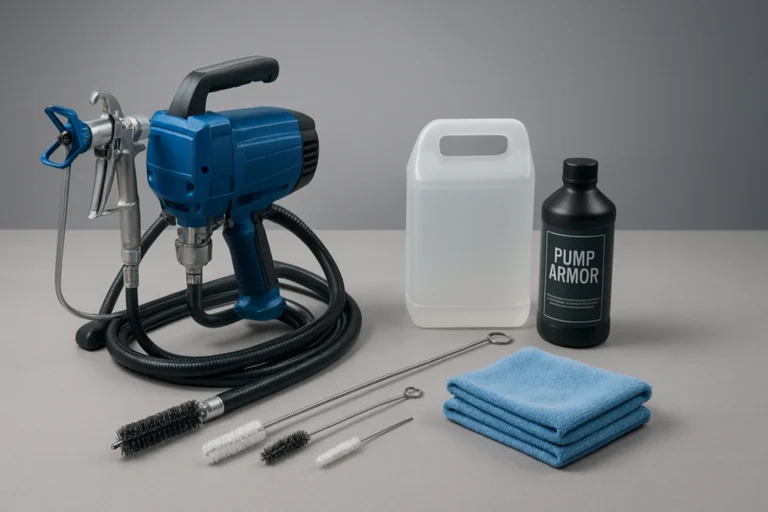
Flush the machine immediately — never let latex dry in the pump or hose. Pour clean water into the intake and spray until the output runs clear, then do a second clean-water pass. The Graco X7’s PowerFlush garden-hose adapter makes this the fastest cleanup on this list. Always store the machine with Pump Armor or an equivalent storage fluid in the pump.
What is the difference between airless and HVLP sprayers?
Airless sprayers use hydraulic pressure (1,500–3,000+ PSI) to atomize paint — faster, higher output, better for large wall surfaces and thick coatings. HVLP uses high air volume at low pressure — slower, finer atomization, less overspray, and a superior finish on trim and cabinetry. For interior walls where speed matters most, airless wins. For doors and trim, HVLP typically produces a better result.
How much paint does an airless sprayer waste?
Conventional airless sprayers waste 20–30% of paint through overspray. HEA machines (Wagner Control Pro 130, Titan ControlMax 1700) reduce this to roughly 10–15%. Add 25% to your standard roller paint estimate to account for sprayer loss — our Paint Calculator above applies this adjustment automatically.
Do airless sprayers work with latex paint?
Yes — all four models on this list are designed for water-based latex, the most common interior wall coating. At 2,000 PSI or above with a 515 tip, latex paints spray unthinned. Thicker formulas like high-build primers may require a larger tip orifice (519 or 521) or slight thinning to 10% water.