
Best Paint Colors for Large Room with High Ceiling (2026)
Updated April 2026 · By the ThePaintly Team
Choosing the best paint colors for a large room with high ceiling is one of the most impactful decisions you can make in a renovation. Scale and light behave differently once ceiling height exceeds 9 feet — colors that look grounded in a standard room can feel overwhelming or washed out in a tall space. The right palette brings a high-ceiling room to life. The wrong one makes it feel like a hotel lobby nobody wants to sit in.
This guide breaks down exactly how to approach color selection for tall rooms: the science behind Light Reflectance Value (LRV), when to go light vs. dark, how to handle vaulted ceilings, which finishes hold up best, and the tools that make painting a high ceiling achievable without a scaffold. Every product recommendation links to Amazon with our affiliate tag.
Quick Picks — Top Products for Large Rooms with High Ceilings
| Award | Product | Best Use | Link |
|---|---|---|---|
| BEST CEILING PAINT | PRESTIGE Interior Ceiling Paint, Brite White | Flat finish, hides flaws, crisp white | View on Amazon → |
| BEST EXTENSION POLE | Wooster Brush Sherlock Extension Pole 4–8 ft | Reaching high ceilings safely | View on Amazon → |
| BEST COMPLETE KIT | Contractor Life Roller Kit with Extension Pole | Full kit — rollers, brush, tray, pole | View on Amazon → |
Understanding LRV: The Number That Changes Everything
Light Reflectance Value (LRV) measures how much light a paint color reflects, on a scale from 0 (absorbs all light — pure black) to 100 (reflects all light — pure white). In a large room with a high ceiling, LRV is the most important single number to understand before choosing paint. According to the EPA, light reflectance also interacts directly with how well a space ventilates and feels — darker walls can make large spaces feel oppressive without adequate airflow and lighting.
For most large rooms with ceilings above 9 feet, designers recommend wall colors with an LRV between 55 and 70 to maintain brightness without the space feeling clinical. If your ceiling height exceeds 12 feet, a mid-tone color (LRV 45–60) on the walls with a lighter ceiling (LRV 75+) creates a visual anchor that makes the room feel inhabited rather than cavernous.
Color Strategies: Light, Mid-Tone, and Bold
Strategy 1 — Light and Airy: Maximize the Scale
Soft whites, warm off-whites, and pale grays with LRV 65+ are the classic choice for large rooms with high ceilings. They reflect natural light across the entire wall surface, making the room feel open and cohesive. The key is avoiding pure white (LRV 95+) on all surfaces simultaneously — it creates glare and makes the space feel sterile rather than spacious.
Instead, use a warm white or soft linen tone on the walls (LRV 70–80) paired with a true bright white on the ceiling (like the PRESTIGE Brite White below). The slight contrast between wall and ceiling creates a natural horizon line that the eye reads as architecture, not emptiness. This pairing works in virtually any high-ceiling space: living rooms, entryways, dining rooms, and open-plan layouts.
Strategy 2 — Mid-Tone Contrast: Depth Without Darkness
Warm grays, soft taupes, dusty blues, and sage greens in the LRV 45–65 range are the most versatile choices for large high-ceiling rooms in 2026. These colors are dark enough to add personality and visual weight, but light enough to maintain the airy quality that makes high ceilings worth having. Behr’s 2026 Color of the Year — a smoky jade — is a strong example of this category: it shifts with light throughout the day without ever feeling heavy.
Transition the mid-tone wall color to a ceiling two or three shades lighter. This creates what designers call a “floating ceiling” effect — the ceiling appears to lift naturally from the walls, emphasizing vertical height rather than flattening it. This approach works especially well in rooms with crown molding or exposed beams, where the lighter ceiling draws attention upward.
Strategy 3 — Bold and Dark: Make the Space Feel Human-Scale
Dark colors on walls — deep navy, forest green, charcoal, or rich burgundy — are the counterintuitive solution for rooms that feel too big. Dark paint absorbs light and compresses perceived scale, transforming a cathedral-like space into something dramatic and intimate. This approach works brilliantly in dining rooms, home offices, and libraries where you want the room to wrap around you rather than open up to the sky.
The critical rule with bold colors in tall rooms: keep the ceiling lighter. A dark forest green wall with a warm off-white ceiling creates a “lid” effect that brings the perceived ceiling down to a human scale without physically lowering it. Pair with warm lighting and light-colored furnishings to prevent the room from feeling oppressive. Dark colors with LRV below 25 need at least 400 lumens per square meter of artificial lighting to balance the absorption.
🔗 Planning your ceiling color specifically? Our detailed ceiling color guide covers how ceiling paint interacts with room lighting and wall tone across different seasons and styles.
Vaulted Ceilings: Unify or Contrast?
Vaulted ceilings are architectural features that demand a deliberate choice: match the ceiling to the walls, or contrast them. Both approaches are valid, and both can look exceptional — the decision depends on the effect you want.
Unified Color (Same Tone on Walls and Ceiling)
Painting a vaulted ceiling the same color as the walls creates a seamless enveloping effect. The entire room reads as one continuous surface, which emphasizes the architectural drama of the vault without highlighting the line between vertical and angled planes. This works best in modern or minimalist spaces and with mid-to-deep tones — a warm sage or muted terracotta carried continuously from floor to ceiling looks intentional and sophisticated.
Contrasting Ceiling (Different Tone Above)
Contrast between walls and vaulted ceiling emphasizes the slope and volume of the architectural feature. A white or cream vaulted ceiling against deeper wall tones draws the eye upward along the angle — it makes the space feel taller and more dramatic. This is the preferred approach in traditional or transitional spaces with crown molding, exposed beams, or skylights, where you want the structure of the ceiling to register as a feature rather than a backdrop.
🔗 Transforming a ceiling into a statement feature? Our master guide to ceiling transformations covers texture, color, and finish techniques for every style of high ceiling.
Product Reviews
 PAINT
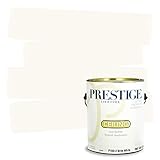
PAINTPRESTIGE Interior Ceiling Paint — Brite White, 1 Gallon
The PRESTIGE Brite White is the anchor paint for any large room with a high ceiling where you want a clean, bright ceiling without visible roller marks or lap lines. The flat finish is specifically formulated to hide surface imperfections — essential in tall ceilings where every texture catches raking light at changing angles throughout the day. One gallon covers approximately 400 sq ft in a single coat, making it efficient for large ceiling areas that would burn through multiple gallons of standard interior paint.
What painters consistently mention in reviews is how easy the touch-up is — you can spot-treat scuffs or damage months later and the repair disappears seamlessly into the flat finish. The main caution: stick to the flat formulation for ceiling work. The semi-gloss version catches imperfections rather than hiding them, which is the opposite of what you want on a high surface where minor flaws are magnified.
Key fact: Flat/matte formulation specifically designed to minimize lap marks and hide ceiling imperfections — essential for high-ceiling rooms where rolling defects are visible from floor level.
- Excellent flat finish — hides flaws
- ~400 sq ft coverage per gallon
- Seamless touch-up months later
- Fast dry time between coats
- Flat finish not washable
- Semi-gloss version less forgiving
- Best suited for ceilings only
🔗 After painting your ceiling, the walls are next. Our guide on how to match paint already on a wall ensures your ceiling and wall colors work together seamlessly.
Wooster Brush Sherlock Extension Pole — 4 to 8 Feet
The Wooster Sherlock is the extension pole that professional painters recommend when someone asks how to reach a high ceiling without a scaffold. It adjusts continuously from 4 to 8 feet with a locking mechanism that holds securely under the pressure of rolling — no slippage mid-stroke, which is the failure mode that makes cheaper poles dangerous on tall ceilings. The universal threaded tip fits virtually every roller frame and most brush extender attachments, so you’re not locked into a single tool ecosystem.
At full 8-foot extension, a 6-foot painter can reach a 14-foot ceiling from floor level. That eliminates ladder repositioning for the majority of the ceiling surface, cutting painting time significantly and reducing the risk of falls. According to This Old House, a quality extension pole is the single tool that separates professional-looking ceiling results from amateur ones — the consistent pressure enabled by a rigid, properly-locked pole eliminates the streaky, uneven coverage that step ladders produce.
Key fact: Continuous adjustment from 4 to 8 ft with a locking mechanism rated for professional use — reaches 14-foot ceilings from floor level with a standard 6-foot reach.
- 4–8 ft continuous adjustment
- Universal tip fits all roller frames
- Secure lock — no slippage
- Lightweight for extended use
- Max 8 ft — not for 16 ft+ ceilings
- Roller not included
- Slightly pricier than no-name poles
Contractor Life Paint Roller Kit with Extension Pole
The Contractor Life kit is the everything-in-one solution for someone tackling a large high-ceiling room for the first time. It includes 9-inch and 4-inch roller covers, a corner roller for tight ceiling edges, a 2-inch angled brush, tray, drop cloth, and an extension pole that reaches up to 8 feet. Having the right tool for every surface in one box prevents the mid-project hardware store runs that kill momentum — and it’s priced to make the full kit cheaper than buying the components individually.
The 9-inch roller is the workhorse for covering large ceiling and wall areas quickly. The 4-inch cover handles the areas between fixtures and in corners that a full-width roller can’t reach cleanly. The angled brush is for cutting in along the ceiling-wall edge — the most demanding part of painting a high-ceiling room. Reviewers consistently note that the kit “does exactly what it promises” for a full room project, with the extension pole saving the most time on ceiling passes.
Key fact: 12-piece complete kit — includes 9″ and 4″ rollers, angled brush, tray, drop cloth, and an 8-foot extension pole. Everything needed for a full high-ceiling room in one box.
- Complete kit — nothing extra needed
- Pole extends to 8 ft
- 9″ + 4″ rollers for full coverage
- Drop cloth included
- Entry-level roller quality
- Not ideal for oil-based paints
- Extension pole less rigid than Wooster
🔗 Painting wood paneling in a high-ceiling room? Our guide on painting wood paneling covers the prep, primer, and paint sequence that keeps tall paneled walls looking clean.
⚡ Pro Tips for Painting Large Rooms with High Ceilings
- Always test paint swatches at ceiling height — color reads differently at 10+ feet due to light angle. A color that looks warm on a sample card can look cold and flat once it’s 12 feet above you.
- Paint the ceiling first, then the walls. Ceiling drips on fresh wall paint are impossible to fix cleanly; the reverse is easy to touch up.
- For rooms above 12 feet, use a ¾-inch nap roller cover — it holds more paint and releases it more evenly across textured ceiling surfaces.
- Work in 4-foot wide strips across the ceiling in one continuous session — stopping mid-ceiling causes lap lines that are visible in raking light.
- LRV above 70 on walls? Use a tinted primer first. Rolling bright white over unpainted drywall without primer requires 3+ coats to achieve even coverage.
🎨 Renovation Stage: PAINT
Color selection and ceiling/wall painting come after surface prep and priming in the renovation sequence: Strip → Patch → Prime → Paint → Seal. Choosing the wrong color at this stage is expensive — test swatches on the actual wall surface (not a sample card) and observe them at different times of day and under artificial lighting before committing. See our ceiling color guide for color-light interaction examples across different ceiling heights.
🧮 Large Room Paint Coverage Calculator
Buying Guide — Finish, Tone, and Tools
Which Paint Finish for High Ceilings?
Flat and matte finishes are the overwhelming professional choice for ceilings in large rooms. They scatter light rather than reflecting it — which means surface imperfections (roller marks, texture variations, minor cracks) become invisible under normal lighting conditions. This matters enormously in high-ceiling rooms, where every ceiling imperfection is visible from below at angles that expose surface defects a horizontal eye-level view would miss.
Satin and eggshell finishes on walls work well in large rooms — they’re durable and washable, and the slight sheen helps reflect artificial light back into the space. Semi-gloss is appropriate for trim, door frames, and architectural details in high-ceiling rooms, where the added reflectivity emphasizes the lines of the architecture without overwhelming the wall surface.
Warm vs. Cool Tones in Tall Spaces
Color temperature interacts with ceiling height in a specific way. Warm tones (beige, cream, terracotta, warm gray) make tall ceilings feel welcoming — the warmth visually draws walls and ceiling closer to the occupant. Cool tones (white, pale blue, gray-green) emphasize the volume and openness of the space, which is ideal when the goal is making a large room feel expansive rather than intimate.
In north-facing rooms with limited natural light, always lean warm — cool tones in low-light conditions look gray and clinical rather than crisp and airy. In south-facing rooms flooded with light, cool tones provide a counterbalance that prevents the space from feeling glaring.
Texture Options: Limewash and Chalky Finishes
Limewash paint has become one of the defining interior trends of 2025–2026, and it works particularly well in large rooms with high ceilings. The mottled, aged texture created by limewash application adds visual warmth and tactile depth that plain flat paint can’t replicate. It disguises imperfections naturally, its variation catches light differently throughout the day, and it gives tall blank walls the kind of character that prevents them from looking like an empty canvas.
How to Paint a Large Room with High Ceilings
Test swatches at the actual height
Paint 12×12-inch swatches directly on the wall surface — at ceiling height, mid-wall, and near the floor. Observe them at morning, midday, and evening under artificial lighting. Color shifts significantly with light angle and intensity at different times of day in tall rooms.
Prep the surfaces thoroughly
Fill cracks, sand rough spots, and wipe down all surfaces. In high-ceiling rooms, imperfections that would be minor at eye level become very visible from below against a flat-painted ceiling. Prime any patched areas and tint the primer close to your final color to reduce the number of topcoats needed.
Paint the ceiling first — all of it
Use the PRESTIGE Brite White (or your chosen ceiling color) with a ¾-inch nap roller on an extension pole. Work in 4-foot-wide strips from one end of the room to the other without stopping. Cut in the ceiling edge with an angled brush before rolling. Allow full dry time before starting walls.
Cut in the walls before rolling
Use a 2-inch angled brush to paint a 3-inch band along every edge — ceiling line, corners, baseboards, door frames, window reveals. This “cutting in” pass creates the crisp lines that rollers can’t achieve. Work in sections so the cut-in edge is still wet when you roll up to it — wet-on-wet blending prevents a visible seam.
Roll walls in a W pattern
Load the roller fully, then apply paint to the wall in a “W” pattern — 3 feet wide and 4 feet tall — before filling in. This distributes paint evenly before you spread it thin. Work in natural light or under full artificial illumination to spot missed areas and lap lines while the paint is still wet enough to correct.
Apply the second coat after full drying
Wait the full recommended dry time (typically 2–4 hours for latex paint) before the second coat — not just touch-dry. Rolling over paint that hasn’t fully dried causes lifting, pilling, and streaks that are visible on large flat surfaces at high-ceiling height.
Verdict
Bottom Line
The best paint colors for a large room with high ceiling come down to one decision: do you want the space to feel expansive or intimate? Light neutrals with LRV 65+ maximize openness and are forgiving across lighting conditions. Mid-tone colors (LRV 45–65) add personality while preserving airiness. Dark bold colors (LRV below 30) transform oversized spaces into dramatic, cozy environments — but require careful ceiling treatment and adequate lighting to avoid feeling oppressive.
For tools: pair the PRESTIGE flat ceiling paint with the Wooster Sherlock extension pole for the best professional result. If you’re starting from zero, the Contractor Life roller kit gives you everything in one box. Test your colors on the actual wall at actual height before you commit — nothing else matters as much as that step.


