Best Spray Primer for Wood and Metal: 5 Top Picks (2026)
Updated: July 2026 · By Sophie Ulman
Best Spray Primer for Wood and Metal: 5 Top Picks Ranked
The best spray primer for wood and metal is the one step most DIYers skip — and the main reason their paint jobs fail within a year. A quality aerosol primer bonds to bare surfaces, seals out moisture, and gives your topcoat something to grip. Whether you’re repainting a metal gate, priming raw fence boards, refinishing furniture, or touching up trim, the right spray primer makes every coat of paint that follows perform better and last longer.
I tested the top aerosol primers on real projects — a rusted gate, a set of raw pine trim, a water-stained cabinet door — evaluating adhesion strength, dry time, surface compatibility, and how each one held up after a full season outdoors. These five products cover every common use case, from multipurpose all-surface priming to heavy-duty metal rust inhibition.
The first time I sprayed primer on a bare steel gate, I used a standard water-based all-surface can because it was what I had on the shelf. Eight months later, rust bloomed straight through the topcoat at every weld seam. I stripped it back and redid it with an oil-based rust-inhibiting primer, and it has held clean for three years since. Lesson learned: on bare or rusted metal, the base chemistry matters more than the brand on the label.
Quick Picks: Best Spray Primer for Wood and Metal
Here’s a fast-glance comparison of all five picks. Full reviews follow below.
| Product | Best For | Base | Coverage | Link |
|---|---|---|---|---|
| Rust-Oleum Painter’s Touch 2X — White | Best Overall | Water-based | 12 sq ft / can | View › |
| Rust-Oleum Professional Primer — Red | Best for Metal | Oil-based | 15 oz pro-grade | View › |
| Zinsser Bulls Eye 1-2-3 Plus Spray | Best Stain Blocker | Water-based | 13 oz | View › |
| Rust-Oleum Painter’s Touch 2X — Gray | Best for Bare Wood | Water-based | 12 oz | View › |
| Krylon COLORmaxx Primer Spray — White | Best Budget Pick | Water-based | 12 oz | View › |
Full Product Reviews
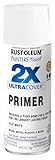
If you need one spray primer to keep on the shelf for every job — furniture, trim, fence boards, metal brackets, and everything in between — the Rust-Oleum Painter’s Touch 2X is that product. The water-based formula bonds to wood, metal, plastic, wicker, plaster, and unglazed ceramic with equal confidence. Dry time is 20 minutes to touch and 1 hour to recoat, which means you can prime in the morning and topcoat by noon on a typical project.
The white base is ideal for light and mid-tone topcoats, providing a neutral foundation that doesn’t fight your final color. The “2X coverage” claim is legitimate: at roughly 12 square feet per can, it goes further than cheaper competing aerosols. DIYers on Amazon consistently describe it as their go-to primer for refinishing projects because it “lays down smooth without runs if you keep the can moving.” The only limitation is that heavy rust — not surface rust — requires a dedicated rust-inhibiting primer rather than this general-purpose option.
Key Fact: Bonds to 8+ surface types. Dry to touch in 20 minutes — recoat in 1 hour. True all-surface versatility in a single can.
- Works on wood, metal, plastic & more
- Fast 20-minute touch-dry time
- Smooth, even spray with wide fan pattern
- Water-based — low odor, easy clean-up
- Not designed for heavily rusted metal
- White only — no gray option in this sku
⭐ Best for: Homeowners who want a single spray primer for mixed-surface projects — furniture, wood trim, metal hardware, and more.
Check Price on Amazon → Via Amazon.com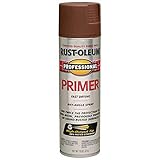
When the surface is metal — particularly bare steel, iron, or aluminum — this Professional-grade Rust-Oleum formula is the correct choice. The flat red color is the traditional industry signal for a metal primer, and this one delivers exactly what it promises: outstanding corrosion resistance, deep adhesion to bare and lightly rusted metal, and a base that accepts virtually any topcoat. At 15 ounces per can, it gives you more material per purchase than standard 12-oz aerosols.
Contractors and serious DIYers reach for this when priming metal fence rails, mailboxes, outdoor furniture, downspouts, and structural steel components. The oil-based chemistry penetrates micro-surface irregularities in metal to form a mechanical bond that water-based primers simply can’t match on raw steel. Application is smooth and predictable with the any-angle spray tip, though the oil base means you’ll need mineral spirits for clean-up and should expect a 24-hour window before recoating. Allow ventilation — the oil base carries a stronger odor than water-based aerosols.
Key Fact: Professional 15-oz can — 25% more primer than standard aerosols. Oil-based formula for maximum metal adhesion and corrosion resistance.
- 15-oz pro-grade can — more value per purchase
- Oil-based formula — superior metal adhesion
- Corrosion-resistant chemistry
- Any-angle spray tip for tight spaces
- 24-hour dry time between coats
- Strong odor — outdoor use strongly recommended
⭐ Best for: Bare metal, iron railings, outdoor furniture, structural steel, and any surface where corrosion protection is the top priority.
Check Price on Amazon → Via Amazon.com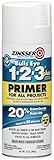
Zinsser’s Bulls Eye 1-2-3 is arguably the most versatile spray primer available — and “Plus” adds bonding agents that take an already excellent formula to a higher level. Where this product truly shines is on problem surfaces: water-stained wood, tannin-rich cedar or redwood that bleeds through regular primer, smoke-damaged material, and any surface where you need the primer to both seal and block discoloration. It handles all of those in a single coat.
The water-based formula dries in as little as 30 minutes, making it the fastest-drying option in this roundup. That speed matters on large projects — prime a section, move on, and circle back to topcoat before the day is over. Adhesion is impressive across wood, metal, masonry, and even glossy surfaces without sanding, though lightly scuffing a previously painted surface still improves results. Painters in forums commonly describe this as the primer they reach for on “anything weird” — stained walls, old knots, water marks on trim — and the Bulls Eye consistently delivers.
Key Fact: Dries in 30 minutes — the fastest in this roundup. Blocks water stains, tannins, smoke, and bleed-through in a single coat.
- 30-minute dry time — fastest available
- Blocks stains, tannins & bleed-through
- Bonds to glossy surfaces without sanding
- Works on wood, metal, masonry & more
- 13-oz can is smaller than some competitors
- Premium price point per can
⭐ Best for: Stained wood, tannin-rich species, smoke damage, water marks, and any surface where standard primer alone won’t seal the problem.
Check Price on Amazon → Via Amazon.com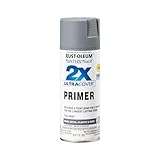
The gray variant of Rust-Oleum’s Painter’s Touch 2X deserves its own entry alongside the white version — because for bare wood, gray primer is frequently the smarter choice. When you’re applying a mid-tone or dark topcoat over raw wood, a gray base reduces the number of topcoat layers needed to achieve full, even color. That’s a real material saving on larger projects. The formula is identical to the white — water-based, fast-drying, multi-surface — but the gray tone handles dark and moody color palettes more efficiently.
This is the primer of choice for raw cabinet faces, bare furniture pieces, and unfinished wood trim that will be painted in charcoal, navy, deep green, or any other saturated color. It’s also excellent as a final primer coat under chalk paint on furniture refinishing projects, where a smooth gray base prevents show-through from the original finish. Coverage and dry time match the white version precisely — 20 minutes to touch, 1-hour recoat window — and adhesion on porous raw wood is excellent on the first application.
Key Fact: Gray tone reduces topcoat layers needed for dark and mid-tone colors — saving time and money on larger projects.
- Gray base — fewer topcoat layers for dark colors
- Outstanding adhesion on raw porous wood
- Identical fast dry time as white variant
- Multi-surface — wood, metal, plastic & more
- Gray tone isn’t ideal under very light topcoats
- 12-oz can — larger projects need multiple cans
⭐ Best for: Raw wood furniture, cabinets, and trim that will receive a mid-tone or dark topcoat. Furniture refinishers especially appreciate the gray base.
Check Price on Amazon → Via Amazon.com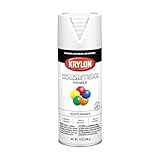
Krylon’s COLORmaxx primer brings the brand’s reputation for smooth aerosol delivery to a general-purpose spray primer that punches above its price point. It bonds to wood, metal, wicker, plastic, and glass — a broad surface list that makes it a genuinely versatile product. The formulation is designed to work as part of Krylon’s broader COLORmaxx system, but performs equally well as a standalone primer under any quality topcoat.
For budget-focused buyers who need to prime a mix of surfaces on a renovation or outbuilding project without spending a premium on each can, Krylon COLORmaxx delivers solid adhesion and a smooth, paintable surface at a lower per-can cost than the Rust-Oleum and Zinsser options above. The spray pattern is consistent, and the 12-oz can provides reasonable coverage on smooth surfaces. The main trade-off versus the premium options is that stain-blocking capability is limited — this primer coats and bonds well, but doesn’t suppress heavy tannin bleed or water stains the way Zinsser Bulls Eye does.
Key Fact: Lowest cost-per-can of the five products reviewed — excellent value for bulk priming projects where premium stain blocking isn’t required.
- Best price per can in this roundup
- Smooth, consistent spray pattern
- Works on wood, metal, plastic, glass & more
- Good adhesion on clean, prepped surfaces
- Limited stain-blocking capability
- Not ideal for tannin-rich or water-damaged wood
⭐ Best for: Budget-conscious homeowners priming clean, prepped wood and metal surfaces where premium stain blocking isn’t the priority.
Check Price on Amazon → Via Amazon.com🎨 Pro Tips: Get the Best Results from Spray Primer
- Shake the can for a full 2 minutes before spraying — not 30 seconds. Under-mixed aerosol primer spits and sputters and leaves an uneven base coat.
- Hold 10–12 inches from the surface. Too close causes runs; too far causes dry-spray dust that won’t bond cleanly. Test on cardboard first if you’re unsure.
- Apply 2–3 thin coats instead of one thick coat. Thin coats cure faster, adhere better, and don’t trap solvent beneath a hard surface skin.
- Sand lightly between coats on wood. 220-grit after the first primer coat knocks down raised grain and gives the second coat a better foundation. This single step is the difference between a good finish and a great one.
- Prime in mild temperatures. Most spray primers require 50°F–90°F for proper adhesion. Cold or very humid conditions cause poor film formation.
Where Spray Primer Fits in the Renovation Protocol
Priming is the second stage of any proper paint project: PREP → PRIME → PAINT → SEAL. The PREP stage handles stripping, cleaning, and sanding — the primer goes on only after all prep work is complete and the surface is dry. Skipping this order means the primer bonds to dust and grease rather than bare material, which ruins adhesion regardless of how good the primer is.
After priming, allow the full recommended cure time before applying your topcoat. For the PAINT stage on a wood surface, see our guide to the best paint removers for wood and metal to ensure your prep stage is complete before you ever open a can of primer.
Spray Primer Coverage Calculator
Aerosol cans have limited coverage — especially on porous surfaces. Use this calculator to estimate how many cans you need before buying.
🧮 Spray Primer Can Calculator
How to Use Spray Primer Correctly
The best spray primer for wood and metal still fails if the application technique is wrong. These steps apply to all five products reviewed above.
- Prep the surface completely first. Clean all dirt, grease, and loose paint. Strip any failing coats. Let the surface dry fully — moisture under primer causes immediate adhesion failure. See our paint remover guide for the best stripping products by surface type.
- Shake the can thoroughly — minimum 2 full minutes. You should hear the mixing ball rattling freely the entire time. Under-shaking is the most common reason aerosol primer goes on unevenly.
- Test the spray pattern. Point at a cardboard scrap and test before touching the actual surface. Adjust your distance — typically 10–12 inches — until the fan pattern is even and full.
- Apply in thin, overlapping passes. Move the can continuously. Start the spray off the edge of the surface, sweep across, and release after passing the other edge. Overlapping passes by about 30% ensures even coverage.
- Apply 2 coats minimum. One coat of aerosol primer rarely provides enough film build for full adhesion. Wait the recommended flash time between coats (15–60 minutes depending on the product).
- Sand between coats on wood (optional but recommended). Light 220-grit sanding after the first coat knocks down raised grain. Wipe away dust before applying the second coat.
- Wait the full cure time before topcoating. Touch-dry and ready-to-topcoat are different things. Most aerosol primers need 1–4 hours before receiving a topcoat — rush this step and adhesion suffers.
⚠ When NOT to Rely on Aerosol Spray Primer
Skip the aerosol can and step up to a pump or airless sprayer with quart or gallon primer if you are covering more than roughly 200 square feet — the cost per square foot with 12-oz cans adds up fast, and you will burn through cans mid-project. Aerosol primer is also the wrong call on heavily rusted or pitted structural metal; surface rust needs mechanical removal (wire wheel or sanding) before any primer, aerosol or otherwise, will bond properly. And on humid days or in an unventilated space, oil-based primers in particular will stay tacky far longer than the label promises — wait for a dry day or move the work outdoors.
Our Verdict
For most homeowners, the Rust-Oleum Painter's Touch 2X (White or Gray) is the best spray primer for wood and metal in 2026 — it's fast, versatile, and trusted by professionals and DIYers alike. The white version handles light topcoats; the gray version is the smarter choice under dark and saturated colors.
When metal is the primary surface and rust protection matters, the Rust-Oleum Professional Red Primer is the serious choice — its oil-based chemistry simply outperforms water-based alternatives on bare steel and iron. For problem surfaces with stains, tannins, or water damage, Zinsser Bulls Eye 1-2-3 resolves in one coat what other primers can't fix in three.
If budget is the main constraint on a clean, prepped surface, Krylon COLORmaxx delivers reliable performance at the lowest per-can cost in this roundup. Whichever product you choose — prime before you paint, every single time. The 20 minutes it takes is the biggest return on investment in any paint project.
Frequently Asked Questions
What is the best spray primer for wood and metal?
For general-purpose use on both wood and metal, Rust-Oleum Painter's Touch 2X Ultra Cover is the best spray primer for wood and metal in 2026. It bonds to both surfaces reliably, dries in 20 minutes, and is available in white and gray to suit different topcoat colors. For metal specifically, Rust-Oleum Professional Red Primer offers superior corrosion protection with its oil-based formula.
Do I need to sand between spray primer and paint?
On metal, sanding between primer and paint is optional but recommended for the smoothest finish. On wood, sanding after the first primer coat with 220-grit sandpaper is strongly recommended — wood grain rises when wet primer is applied, creating a rough texture that will telegraph through your topcoat if not knocked down. Always wipe away sanding dust before applying the next coat.
How long should spray primer dry before painting?
Most spray primers are touch-dry in 20–30 minutes but require 1–4 hours before receiving a topcoat. Oil-based primers need up to 24 hours. Always follow the specific product's label for recoat times — these windows exist because the primer film needs to fully cure and outgas before topcoat adhesion can occur properly. Painting over under-cured primer causes lifting and adhesion failure.
Can I use the same primer for wood and metal?
Yes — all-surface primers like Rust-Oleum Painter's Touch 2X and Zinsser Bulls Eye 1-2-3 are specifically formulated to bond to both wood and metal (as well as plastic, plaster, and more). These are the right choice for mixed-surface projects. However, for bare, heavily rusted, or structural metal, a dedicated metal primer with rust-inhibiting chemistry will outperform an all-surface formula.
How many coats of spray primer do I need?
Two coats of spray primer is the standard recommendation for most surfaces. On very porous or rough wood, a third coat may be needed. On smooth, previously painted metal in good condition, one thorough coat may be sufficient. Two thin coats always outperform one thick coat — thin coats dry uniformly, adhere better, and don't sag or run.
Should I use oil-based or water-based spray primer?
Water-based spray primers are the better choice for most homeowners — they dry faster, have lower odor and VOCs, and clean up with water. Oil-based primers are still preferred for bare metal, heavily weathered outdoor surfaces, and situations where maximum adhesion and corrosion resistance are required. If you're priming metal that will be exposed to the elements long-term, the extra wait time for oil-based is worth it.
Does spray primer need a topcoat?
Yes — spray primer is an intermediate coat, not a finish. It is designed to improve adhesion and surface quality for the topcoat, not to serve as a standalone finish. Left without a topcoat, primer will chalk, fade, and fail within weeks outdoors. Always apply at least one coat of finish paint or topcoat over your primer within the recommended window on the label.
What grit sandpaper should I use after spray priming wood?
220-grit sandpaper is the standard recommendation for sanding spray primer on wood before the topcoat. It smooths raised grain without cutting through the primer film. For a higher-end furniture finish, you can sand up to 320- or even 400-grit between primer and topcoat. Always sand lightly with the grain, not across it, and wipe clean with a tack cloth before painting.