SprayIt Airless Paint Sprayer Review 2026: Honest Take
Updated: June 2026 · By Sophie Ulman
Is the SprayIt PRO 21 the Cheapest Way Into Real Airless Spraying?
The SprayIt airless paint sprayer sits in a tempting spot: it is a true piston-pump airless unit that costs a fraction of a Graco or Titan, which is exactly why it lands in so many carts. The PRO 21 pulls paint straight from a 1- or 5-gallon bucket, pushes it to around 3000 PSI, and lays latex, primer, and stains down faster than any roller. Buy it for the right job and it is a genuine bargain. Buy it expecting it to behave like a $700 contractor rig on day one, and you will be back to a brush in frustration.
I have run cheap airless units alongside name-brand ones on the same fence, the same set of cabinet doors, and the same garage walls, so I know where a budget sprayer like the SprayIt airless paint sprayer earns its keep and where it makes you pay in cleanup time and clogged tips. This review breaks down what the PRO 21 actually does well, the corners it cuts, and the two or three projects where it is the smart buy — plus when you should spend up instead.
SprayIt Airless Paint Sprayer: Specs at a Glance
| Spec | SprayIt PRO 21 | What It Means |
|---|---|---|
| Pump type | Piston (true airless) | Sprays unthinned latex, not just thin coatings |
| Max pressure | ~3000 PSI | Enough to atomize wall paint and primer |
| Motor | ~1.0 HP | Hobby/light-pro duty, not all-day commercial |
| Paint pickup | Direct from 1 or 5 gal bucket | No cup to refill mid-wall |
| Tip | Reversible (anti-clog) | Flip to clear a clog without disassembly |
| Best use | Fences, garages, cabinets, decks | Intermittent DIY projects, not daily use |
The SprayIt PRO 21 Reviewed
SprayIt PRO 21 Electric Airless Paint Sprayer
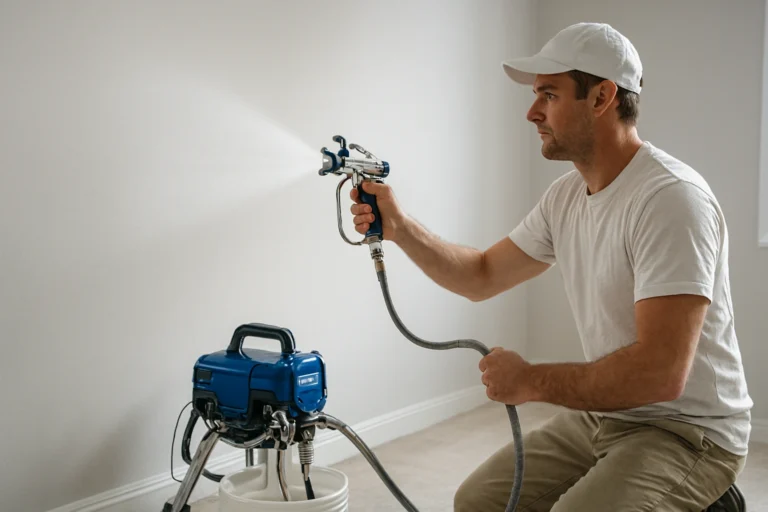
What you are really buying here is a piston pump at a price that usually only gets you a diaphragm or HVLP cup gun. The piston matters: it can move full-bodied latex and primer without thinning, so a fence or a set of garage walls that would take a roller a whole weekend goes down in an afternoon. At around 3000 PSI it atomizes wall paint into a fine, even fan, and pulling straight from a 5-gallon bucket means no stopping to refill a cup every few minutes — the single biggest time-saver over a handheld sprayer.
The reversible tip is the feature that keeps a budget unit usable: when a fleck of dried paint clogs the spray, you flip the tip, pull the trigger to blow the clog clear, and flip it back — no tear-down. The build, though, tells you where the money was saved. The fittings and packings are lighter-duty than a Graco, so this is a sprayer for intermittent project use, not a daily driver. Treat it as a tool you clean meticulously after every job and it lasts; leave paint to dry in it once and you will be ordering seals.
✔ True piston airless · ~3000 PSI · bucket pickup · reversible anti-clog tip
- Real airless performance at a budget price
- Sprays unthinned latex and primer
- Bucket pickup, no cup refills
- Reversible tip clears clogs fast
- Lighter-duty seals and fittings
- Punishing if you skip cleanup
- Not built for all-day pro use
Best for: A DIYer with a fence, deck, garage, or cabinet project who wants airless speed without a contractor-grade price.
Check Price on Amazon →Via Amazon.com
How the SprayIt Compares to Graco & TCP Global
The SprayIt only makes sense once you see what the money above and around it buys. Against a Graco Magnum you trade durability and resale for a lower upfront cost; against another budget unit like the TCP Global you are mostly choosing which set of compromises you prefer.
| Sprayer | Tier | Best For | Trade-Off | Check Price |
|---|---|---|---|---|
| SprayIt PRO 21 | Budget airless | Intermittent DIY projects | Lighter-duty seals | Check Price → |
| Graco Magnum X5 | Prosumer | Frequent use, resale value | Costs much more | Check Price → |
| TCP Global Airless | Budget airless | Similar DIY jobs | Same duty-cycle limits | Check Price → |
If you spray a few projects a year, the SprayIt’s savings outweigh its lighter build. If you paint often or want a tool that holds resale value, the Graco Magnum X5 vs X7 breakdown is the smarter starting point, and our wider guide to airless sprayers for beginners covers the whole budget-to-prosumer ladder. For a head-to-head on another value unit, see the TCP Global airless review.
When the SprayIt Is the Wrong Buy
⚠ Skip the SprayIt PRO 21 if:
- You spray every week. The lighter packings and fittings are built for intermittent use. A weekly painter will wear it out fast — step up to a Graco or Titan that is rated for the hours.
- You will not clean it thoroughly every time. Airless pumps are unforgiving. Dried latex in the pump or tip means new seals. If meticulous flush-and-clean is not going to happen, an HVLP cup gun is more tolerant.
- You only have one small item to spray. For a single chair or a small craft piece, the setup and cleanup of any airless unit is overkill. A rattle can or a small handheld sprayer wins on time.
- You need a flawless furniture finish. Budget airless lays a great wall and fence coat, but for glass-smooth cabinet doors the fine control of an HVLP or a fine-finish tip on a higher-end pump gives a cleaner result.
Sophie’s Experience: The Clogged Tip
Project Time & Paint Calculator
💡 Airless Spray Project Estimator
Buying Guide: Tips, Cleanup & Safety
1. Match the Tip Size to the Coating
Airless spray tips are sized by orifice and fan width, and the orifice has to match how thick your coating is. A thin stain or sealer wants a small tip (around 0.011 to 0.013 inch); wall paint and primer want a mid tip (around 0.015 to 0.017). Too small a tip for thick paint and the pump strains and spits; too big for a thin coat and you flood the surface. The SprayIt ships with a general-purpose tip — buy the right size for your actual coating and the difference in finish is night and day.
2. Cleanup Is Half the Tool
This is the line between a budget airless that lasts and one that dies in a season. Flush the pump and hose with clean water (for latex) until it runs clear, remove and clean the tip and the inlet filter, and store the pump wet with pump-saver fluid so the packings do not dry out. It takes ten to fifteen minutes and it is the most important thing you do with the machine.
| Coating | Tip Size | Thin? | Notes |
|---|---|---|---|
| Stain / sealer | 0.011–0.013 | No | Light, fast passes |
| Wall paint | 0.015–0.017 | No | The everyday tip |
| Primer | 0.017–0.019 | Sometimes | Thicker body |
| Cabinet enamel | 0.010–0.012 fine-finish | No | Finer atomization |
3. Spray Safe: Pressure and Fumes Are Real
Airless pressure is high enough to inject paint under your skin — never put a hand in front of the tip, always engage the trigger lock when not spraying, and use the tip guard. Spraying also aerosolizes solvent and pigment, so a proper respirator matters; OSHA’s guidance on respiratory protection explains why a particulate-and-vapor respirator beats a paper dust mask for spraying. Work in ventilation, and for an enclosed setup our DIY spray booth build keeps overspray contained. Family Handyman’s airless walkthrough is a solid primer on technique.
⚡ Pro Tips from the Field
Two thin coats always beat one thick coat: a heavy airless pass runs and sags — keep the gun moving and overlap each pass by half. Strain your paint: a paint strainer over the bucket stops the lumps that clog cheap tips. Prep beats product: mask and cover everything first — overspray travels farther than you think. Keep the gun 12 inches off the surface and parallel, not arced, for an even film.
🎯 Verdict
The SprayIt PRO 21 is a real airless sprayer at a price that makes sense for a DIYer with a fence, deck, garage, or set of cabinets to knock out a few times a year. It sprays unthinned latex, pulls from a bucket, and clears clogs with a reversible tip — the things that make airless worth it. The compromises are the lighter-duty build and its zero tolerance for skipped cleanup. Clean it religiously and match the tip to your coating, and it punches well above its price. If you spray weekly or want resale value, spend up to a Graco. For occasional projects, this is the cheapest honest way into airless.
Frequently Asked Questions
Is the SprayIt airless paint sprayer any good?
For intermittent DIY use, yes. It is a true piston airless that sprays unthinned latex and primer and clears clogs with a reversible tip at a budget price. The catch is lighter-duty seals and zero tolerance for skipped cleanup — it is for occasional projects, not daily pro work.
Do you need to thin paint for it?
Usually no. At ~3000 PSI it atomizes full-bodied latex and primer without thinning. Just strain the paint to remove lumps that clog the tip. Most wall paint sprays straight from the can.
What tip size should I use?
Match it to the coating: 0.011–0.013 for stains, 0.015–0.017 for wall paint, 0.017–0.019 for primer, and a fine-finish 0.010–0.012 for cabinet enamel. Wrong size means spitting or flooding.
How do I clean it?
Flush pump and hose with clean water (latex) until clear, clean the tip and inlet filter, and store wet with pump-saver fluid. Cleanup after every job is what makes a budget airless last.
SprayIt vs Graco?
SprayIt if you spray a few times a year and want the lowest cost. Graco if you paint often or want resale value and more rated hours. You trade durability for price.
What can you spray with it?
Latex and acrylic wall paint, primers, and stains — great for fences, decks, garage walls, siding, and cabinets. Less ideal for a glass-smooth furniture finish, where HVLP or a fine-finish tip wins.