How to Make a DIY Spray Paint Booth: 10-Step Build Guide + Cost Breakdown
Updated: June 2026 · By Sophie Ulman
Knowing how to make a DIY spray paint booth is the difference between projects you are proud of and projects you sand down and redo. Without a booth, aerosol mist hangs in the air and settles on every surface within 15 feet. VOC vapors accumulate in enclosed spaces faster than most people realize. And dust floating back onto wet paint produces a finish that looks rougher than what came out of the can. A proper booth solves all three — and you do not need $2,000 worth of commercial equipment to build one that works. Related: best small paint sprayer.
I have built three of these over the years: a cardboard tabletop version for detail work, a PVC frame booth for furniture and cabinet doors, and a semi-permanent negative-pressure setup in my garage that I still use today. This guide covers all three, with the complete 10-step build for the PVC version that most people actually need. Related: best chrome spray paint.
Portable vs. Permanent vs. Cardboard: Which Build Is Right for You
| Build Type | Best For | Approx. Cost | Setup Time | Portability | Ventilation |
|---|---|---|---|---|---|
| Cardboard tabletop booth | Models, crafts, small parts, RC bodies | $10–$25 | 30 min | Fully portable | Minimal — outdoor or open window only |
| PVC frame + plastic sheeting | Furniture, cabinet doors, mid-size projects | $75–$130 | 3–4 hours | Foldable/storable | 2 fans, filtered intake and exhaust |
| Negative-pressure garage booth | Automotive panels, large surfaces | $120–$250 | Half day | Semi-permanent | High-CFM inline fan, exterior exhaust |
| Ready-made inflatable kit | Professional/frequent use, vehicles | $300–$800 | 20 min (inflate) | Deflates for storage | Integrated, safety-tested design |
Most readers are here for the PVC frame build. It is the most versatile, the most searched, and the one that makes the most sense for furniture, cabinet doors, and home decor projects. The 10-step guide below covers the full PVC garage setup. Related: best airless paint sprayer gun tip.
Cost Breakdown: Building DIY vs. Buying Ready-Made
| Option | Upfront Cost | Setup Time | Ventilation Quality | Lifespan | Best For |
|---|---|---|---|---|---|
| Cardboard tabletop (DIY) | $10–$25 | 30 min | Low | 5–10 sessions | Small parts, aerosols only |
| PVC frame booth (DIY) | $75–$130 | 3–4 hours | Good (2 fans) | 3–5 years | Furniture, cabinet doors |
| Negative-pressure garage (DIY) | $120–$250 | Half day | Excellent | 5+ years | Automotive, large panels |
| Inflatable kit (ready-made) | $300–$800 | 20 min | Excellent (tested) | 5–10 years | Professional/frequent use |
| Commercial spray booth | $2,000+ | Installation day | Certified | 10+ years | Auto body shops |
Verdict on cost: The PVC build at $75–$130 is the right investment for most homeowners who spray more than a few times a year. The savings over buying ready-made ($300+) pay back the 4-hour build time in the first use. If you spray more than once a month or do automotive work, the negative-pressure or ready-made option is worth the higher cost for the better ventilation control. Related: graco airless paint sprayer.
Complete Materials List: PVC Garage Booth (8x8x7 ft)
This size accommodates most furniture pieces, cabinet doors, and mid-size panels. Adjust pipe lengths if your space is smaller.
| Item | Qty | Notes | Amazon |
|---|---|---|---|
| 3/4″ PVC pipe, 10 ft lengths | 8 | Cut to size: 8 ft rails, 7 ft uprights | Buy local — see note below |
| 3/4″ PVC elbows (90°) | 8 | Top corners of frame | Buy local — see note below |
| 3/4″ PVC T-joints | 8 | Mid-frame connections and base corners | Buy local — see note below |
| 6-mil plastic sheeting, 10×25 ft roll | 1 | Covers 4 walls + ceiling; heavier mil is more durable | Frost King 10×25, 6-mil → |
| 20″ box fan or inline duct fan | 2 | 1 exhaust + 1 intake; 2,000 CFM combined minimum | Lasko 3723 20″ → |
| 20x20x1″ furnace filters (MERV 8+) | 6 | Tape to fan intake; replace every 3–5 sessions | Filtrete MERV 8, 4-pk → |
| 2″ heavy-duty duct tape | 2 rolls | Sealing seams; do not use cheap tape — it fails | Gorilla Tape, 35 yd → |
| Spring clamps (3″ or larger) | 20 | Attaching sheeting to frame every 12–18 inches | Bessey XM7 3″ → |
| Zip ties, 12″ heavy duty | 1 bag | Securing frame joints without PVC cement | 12″ ties, 120 lb → |
| LED shop lights, 4 ft (2-pack) | 2 | Hang from top frame rails; LED only — no halogen | hykolity 4 ft, 4-pk → |
| Half-face respirator (OV cartridge + P95 pre-filter) | 1 | Non-negotiable for solvent-based paints | 3M 6502QL OV/P95 → |
| PVC pipe cutter or hacksaw | 1 | Already own? Skip this cost | RIDGID RC-1625 → |
Total estimated cost: $85–$130 depending on fan choice and tools you already own.
A note on the PVC: buy the pipe and fittings at a hardware store, not online. A 10-foot length of 3/4″ PVC costs about $4 on the rack and roughly triple that once someone has to box and ship a 10-foot tube. Elbows and T-joints are the same story — they are 60–90 cents each in the plumbing aisle. I list no link for those three rows on purpose. Everything else in the table is worth ordering, because the specification matters more than the price.
The Three Parts Where the Spec Actually Decides the Outcome
Nine of the twelve rows above are commodity. Any 3″ spring clamp holds sheeting; any roll of tape that is not the dollar-store one seals a seam. Three items are not commodity, and picking wrong on any of them is the difference between a booth that works and a booth that just contains the mess while you breathe it. Here is what I run and why.
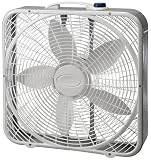
Lasko 3723 20″ Box Fan
A box fan moves air by pressure difference, and the number that matters is what it still moves once you tape a filter across its face. A clean MERV 8 filter costs you roughly 15–20% of free-air CFM the moment you install it, and more as it loads. The 3723 pushes about 2,500 CFM on high in free air, so two of them — one drawing in, one pushing out — still clear the 2,000 CFM combined minimum with the filters fitted and partly loaded. A single fan does not, no matter what the box says.
The honest limitation: this is a residential fan with a brush motor that is not rated for flammable atmospheres. It sits outside the sheeting, pulling through a filtered port — never inside the booth with solvent vapor passing over the motor. I have seen people mount a box fan inside the plastic to save a step. Do not do that. If you are spraying lacquer or solvent-based automotive paint in volume, step up to a sealed inline duct fan instead.
Key fact: two 20″ box fans with MERV 8 filters fitted hold roughly 2,000–2,200 CFM combined — enough to turn over an 8×8×7 ft booth about every 12 seconds.
Best for: water-based and light aerosol work in a garage, with both fans mounted outside the plastic.
Via Amazon.com
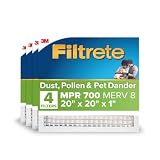
Filtrete 20x20x1 MERV 8 Furnace Filter (4-Pack)
The intake filter is what stops your booth from being a dust magnet. Air pulled straight off a garage floor carries grit, and grit that lands in wet paint becomes a nib you have to sand out later. MERV 8 catches particles down to about 3 microns, which covers everything that realistically ruins a finish. Going higher — MERV 11, MERV 13 — sounds better and is worse here: the denser media chokes a box fan hard enough to drop you under your ventilation minimum.
The honest limitation: these are intake filters, not exhaust filters. Do not tape one over your exhaust and expect it to catch overspray — pleated furnace media blinds off with atomized paint in one session and then your booth goes positive-pressure and vents mist back into the garage. Use fiberglass paint-arrestor pads on the exhaust side instead.
Key fact: swap the intake filter every 3–5 spray sessions. Hold it to a shop light — if you cannot see light through the pleats, it is already costing you airflow.
Best for: the intake side of a two-fan garage booth, in a 20×20 opening cut into the sheeting.
Via Amazon.com
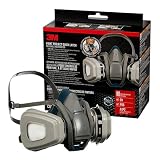
3M 6502QL Quick Latch Respirator, OV Cartridge + P95
Two separate things are coming at your lungs, and they need two separate defences. The paint solids are a particulate — the pink P95 pre-filter stops those. The solvent is a vapor, and no particulate filter of any rating stops a vapor; it walks straight through. That is what the black organic-vapor cartridge underneath is for, and it is the half of this that a dust mask does not have. This is why a $2 N95 from the paint aisle is not a cheaper version of this product. It is a different product that does not do the job.
People search for “OV/P100” because P100 sounds like the safer number. For paint aerosol the practical difference between P95 and P100 is negligible — 95% versus 99.97% capture of particles the filter is already catching. The organic-vapor cartridge is the part that decides whether you are protected. The quick-latch chin lever matters more than either: it lets you drop the seal to talk without taking the mask off your face, which is the reason I actually keep it on for the whole session instead of pulling it off every few minutes.
Key fact: OV cartridges have a service life once opened — date the cartridge with a marker the first time you break the seal and bin it after about 40 hours of use, or sooner if you smell solvent through it. Smelling the paint means the cartridge is done, not that it is working.
Best for: anyone spraying solvent-based paint, lacquer, or automotive clear in an enclosed garage booth.
Via Amazon.com
10-Step Build Guide: PVC Garage Spray Booth
Plan and Measure Your Space
Measure the floor space available in your garage or workshop. An 8x8x7 ft booth accommodates most furniture and cabinet doors but requires a footprint of at least 10×10 ft to allow airflow around the booth and room for you to move. Mark the booth outline on the floor with painter’s tape before cutting any pipe — it is much easier to adjust dimensions at this stage than after cutting.
Cut the PVC Pipe Frame
Cut list for an 8x8x7 ft booth using a PVC cutter or hacksaw:
- 8 uprights at 7 ft (four corners, each side doubled for rigidity)
- 8 horizontal rails at 8 ft (top and bottom perimeter, front and back)
- 4 horizontal rails at 8 ft (side-to-side mid-frame bracing at 3.5 ft height)
Deburr all cut ends with sandpaper to prevent tearing the plastic sheeting during assembly.
Assemble the Base Frame
Lay out all four bottom rails in a rectangle on the floor. Connect corners with T-joints (flat side down, upright port facing up). Verify the rectangle is square by measuring diagonals — if the diagonals are equal, the frame is square. If not, adjust now. Secure joints with zip ties rather than PVC cement if you want the booth to disassemble for storage.
Build the Vertical Frame
Insert uprights into the T-joints’ upward ports at each corner. Connect top rails between uprights using 90° elbows at each corner. Add mid-height horizontal bracing on the rear wall at about 3.5 ft height — this is where you will mount the exhaust fan. Once the frame is standing, push it sideways to check for racking. If it leans, add a diagonal brace from one upper corner to the opposite lower corner on the rear wall using a zip tie and a spare pipe offcut.
Cut and Mount the Exhaust Fan Opening
Before hanging sheeting, cut a 20×20″ opening in the rear plastic sheeting panel, centered at about 18″ from the floor. Paint mist is heavy and sinks — exhausting low captures more of it than exhausting high. Tape the exhaust fan frame over the opening with the blade facing outward (blowing air out of the booth). Stack two MERV 8 furnace filters on the fan’s intake face inside the booth. Tape all filter edges completely — gaps here allow unfiltered paint mist to clog the fan blades within two sessions.
Hang the Plastic Sheeting
Cut the 6-mil plastic into panels for each wall and the ceiling. Work one panel at a time:
- Drape each panel over the frame rail and clamp with spring clamps every 12–18 inches
- Overlap adjacent panels by at least 4 inches and seal the seam with 2″ duct tape on the inside
- Leave the front panel unsealed at the centre — fold it vertically to create a flap door
- Seal the ceiling panel to all four top rails with duct tape — this is where leaks cause the most overspray escape
Run a second bead of duct tape along every inside seam. Paint mist under pressure finds gaps from the inside faster than you expect.
Mount the Intake Fan
Cut a 20×20″ opening in the front sheeting panel, centered high (near the ceiling). Place the second box fan blowing inward, with a clean MERV 8 furnace filter on its intake face on the outside of the booth. This creates diagonal airflow: clean air enters high at the front, sweeps across the workpiece, exits low at the rear. Your spray gun moves with this airflow, not against it. This cross-flow pattern is dramatically more effective than a single exhaust fan.
Install the Lighting
Hang two 4 ft LED shop lights from the top frame rails, one on each side of the ceiling. LED lights do not generate enough heat to affect plastic sheeting and do not produce sparks. Aim for 50+ foot-candles at the work surface. If you are painting auto parts or anything with sheen, add a side light at workpiece height to reveal surface texture. Keep all light cords outside the booth — run them through the filtered intake opening and tape along the outside of the frame.
Test the Negative Pressure
Turn on both fans. Hold a piece of tissue near the entry flap. The tissue should pull toward the booth interior, not blow outward. If it blows out, your exhaust fan is not strong enough or there are gaps in the sheeting. Fix the gaps first — they are almost always the culprit before blaming fan power. The tissue test tells you whether you have true negative pressure, which is what keeps overspray contained.
Set Up Your Workpiece and Spray
Place the workpiece on a rotating turntable or a piece of scrap wood elevated on paint stands so you can spray all sides without handling wet surfaces. Position yourself so you are spraying with the airflow, not against it — stand near the intake side and spray toward the exhaust. Load the spray gun, test your pattern on cardboard inside the booth before spraying the actual piece, and maintain 6–12 inches of distance depending on your gun type and material.
Sophie’s Failure: The First Spray Booth I Built Collapsed on Itself
“The first spray booth I built collapsed on itself — mid-session, with a freshly sprayed cabinet door inside it. I had used 1/2-inch PVC instead of 3/4-inch, connected the joints with just tape instead of zip ties, and built the frame too tall relative to its base footprint. The whole thing torqued sideways when I leaned against it reaching for the spray gun. The cabinet door fell, hit the floor wet, and picked up every piece of dust and debris in the garage.
Three lessons from that: (1) 3/4-inch PVC is not optional — 1/2-inch racks under the weight of the plastic sheeting. (2) Zip-tie every joint, even if you are not using cement. (3) The frame needs mid-height bracing on the rear wall — without it, the top of the frame swings. After rebuilding with all three changes, the booth has been standing for three years with no issues. Build it right the first time.”
Ventilation and Safety: The Section Most DIY Guides Get Wrong
How Much Airflow Do You Actually Need?
The rule of thumb for a hobby booth: replace the full air volume of the booth at least once per minute. For an 8x8x7 ft booth, that is 448 cubic feet per minute (CFM) minimum. A 20″ box fan moves about 2,500 CFM on high — technically sufficient, but two fans (one exhaust, one intake) give you true cross-flow ventilation, which is dramatically more effective at removing paint mist from around your workpiece than a single fan setup.
According to OSHA’s spray finishing guidelines, ventilation in spray areas must be sufficient to maintain vapor concentrations below 25% of the Lower Explosive Limit (LEL) of the spray material. For most lacquers and enamel paints, this means you need high-volume exhaust running throughout the entire spray session — not just at the end. The U.S. EPA’s guidance on spray painting operations reinforces this with specific requirements for residential and small-shop operations.
Ventilation by Paint Type
| Paint Type | VOC Level | Minimum CFM | Fan Requirement | Special Notes |
|---|---|---|---|---|
| Aerosol spray paints (water-based) | Low–Medium | 500 CFM | Standard box fan acceptable | Still need filtered exhaust |
| Oil-based spray paints | High | 800 CFM | Standard box fan acceptable | No open flames; run 10 min after spraying |
| Lacquers / nitrocellulose | Very High | 1,200+ CFM | Explosion-proof fan required | High fire and explosion risk |
| Automotive enamel / primer | Very High | 1,200+ CFM | Explosion-proof fan required | Ground spray gun; Class B extinguisher present |
| Water-based latex / chalk paint | Low | 400 CFM | Standard box fan | Lowest risk; still need ventilation |
Safety Non-Negotiables
⚠ These Rules Are Not Optional
Spray painting without proper safety gear in an enclosed space has sent people to the emergency room. The booth helps, but it does not replace personal protection. For small chips and scratches that don’t justify a full spray session, a touch-up paint pen is the faster, no-booth option.
- Respiratory protection: half-face respirator with OV/P100 cartridges. A dust mask or N95 does nothing against solvent vapors. OV (organic vapor) cartridges filter the solvent gases; P100 filters the paint particulate. Replace cartridges when you start smelling solvent through the mask — this means the carbon has saturated (typically around 40 hours of use).
- No open flames within 20 feet. This includes water heater pilot lights and gas furnace burners. Turn them off or block access to the spray area with a non-sparking barrier.
- Use explosion-proof fans for lacquers and automotive finishes. Standard box fans have exposed motors that can spark. For aerosol cans and water-based paints, a standard fan is acceptable risk. For solvent-based HVLP work with lacquer or enamel, the extra $60 for an explosion-proof inline fan is non-negotiable.
- Keep a Class B fire extinguisher at the booth entry. Outside the booth, within arm’s reach. Rated for flammable liquid fires.
- Safety glasses and nitrile gloves. Paint mist at sprayer pressure can penetrate the eye before you can blink. Nitrile gloves for solvent resistance — latex gloves offer minimal protection against lacquer thinners and mineral spirits.
- After the session: Leave the exhaust fan running for 10 minutes after you finish spraying. Remove used filters outdoors. Dispose of solvent-soaked rags in a sealed metal container filled with water.
Worth saying while you are still buying materials: the finish most people build a booth for is a metallic. Gold, brass and champagne aerosols are the least forgiving paints in a can — the flake orients as it lands, so a draft, a wrong-angle pass or a heavy coat shows up as a stripe you cannot buff out. That is exactly why they belong in a booth with controlled airflow rather than on the lawn. If that is your project, our best gold spray paint picks flag which formulas keep an even flake lay-down.
When Building Your Own Booth Is the Wrong Call
I have built three of these and I still tell people to buy a pop-up booth in two situations. If you are spraying small parts a handful of times a year, a ready-made pop-up folds into a bag and costs less than the PVC and sheeting bill once you count the fittings you will inevitably buy twice. And if you are renting, a permanent frame in a garage is a deposit argument waiting to happen. The DIY build wins when the booth stays up for a run of work — a kitchen’s worth of cabinet doors, a furniture flip season — because you can size it to the pieces you actually spray instead of to a catalogue dimension. If you want to compare the two paths honestly, see our roundup of portable spray paint booths before you buy a single length of pipe.
One more failure mode worth knowing before you build: the filter is a consumable, not a fixture. A MERV 8 furnace filter loads up with overspray within roughly four to six hours of active spraying, and a loaded filter does not just filter less — it chokes the fan, airflow across the booth collapses, and overspray starts settling back onto the wet piece as dust nibs. If the fan note changes pitch or you can no longer feel draw at the booth mouth with the back of your hand, change the filter mid-job. I keep four spares in the garage for exactly this reason, because the alternative is sanding a finished door back.
Cardboard Tabletop Spray Booth (Under $25)
For models, RC car bodies, 3D-printed parts, or anything that fits on a desk, skip the full garage setup entirely. (If you’re painting 3D prints specifically, see our picks for the best paint for 3D prints — primer and enamel compatibility matter more than most guides admit.) Here is what I use for tabletop work:
- Find a cardboard box at least 24x24x24″ (appliance boxes work perfectly).
- Cut three sides down to 12″ high, leaving the back panel full-height as a backdrop.
- Line the inside with fresh newspaper — easy to swap when it gets coated.
- Cut a 6×6″ opening in the back panel near the top and tape a small PC fan (80–120mm) over it blowing outward. Power it from a USB phone charger. Tape a carbon filter pad over the fan intake to catch most of the mist.
- Use outdoors on a calm day or near an open window for any solvent-based paints — the tabletop box improves containment but is not sufficient for heavy vapor loads.
Cost breakdown: cardboard box (free), small USB fan ($8–$15), paint arrestor pads → ($5–$10). Total: under $25.
Related Spray Guides on ThePaintly
- Complete beginner’s guide to paint spray guns
- Best airless paint sprayer for furniture
- Best airless paint sprayer for home use
- Wagner airless paint sprayer review
- HomeRight airless paint sprayer review
- Best airless paint sprayer for garage walls
- How to make paint dry faster between spray coats
- Best way to paint a ceiling after your booth projects
- How to recycle or dispose of leftover spray paint responsibly
⚡ Pro Tips From the Field
Filter replacement schedule: Exhaust-side MERV 8 filters last 3–5 sessions before becoming visibly coated and reducing airflow. Keep a 6-pack ready. Intake-side filters last 8–12 sessions. Do not run a session with clogged filters — the exhaust fan cannot move air and you lose all ventilation benefit. Workpiece rotation: Use a lazy Susan turntable under the workpiece to spray all sides without handling wet paint. Pattern test first: Always test your spray pattern on cardboard before touching the actual piece. A clogged tip or wrong pressure setting will ruin a workpiece in one pass. Prep matters more than the booth itself.
🎯 Verdict
Knowing how to make a DIY spray paint booth is not complicated, but the details matter: 3/4-inch PVC (not 1/2-inch), zip-tied joints, mid-height rear bracing, two fans in cross-flow configuration, and MERV 8 filters on both sides. The ventilation section above is the most important part of this guide — get the airflow right and everything else follows. At $85–$130, the PVC build is the right investment for any homeowner who sprays furniture, cabinet doors, or decorative pieces more than a few times a year. The savings in finish quality and cleanup alone pay for the build in the first two sessions. If you spray lacquers or automotive finishes, upgrade to explosion-proof fans — it is a $60 difference that is not optional. Once your booth is ready, the most popular first project is plastic furniture or outdoor gear — see our guide to the best paint for plastic for product recommendations.
Frequently Asked Questions
How do you make a DIY spray paint booth at home?
Build a 3/4-inch PVC pipe frame (8x8x7 ft), cover with 6-mil plastic sheeting clamped every 12–18 inches, cut two 20×20″ fan openings (intake at the top front, exhaust at the bottom rear), mount a box fan in each position with MERV 8 filters, hang LED shop lights inside. Full build cost is $85–$130 and takes 3–4 hours.
How much CFM do I need for a DIY spray booth?
Replace the booth’s air volume at least once per minute. For an 8x8x7 ft booth (448 cubic feet), you need 448 CFM minimum. A 20″ box fan provides 2,500 CFM on high — technically sufficient. Two fans in cross-flow configuration are dramatically more effective at removing paint mist than the numbers suggest.
Can I use a regular box fan in a DIY spray booth?
For water-based paints and aerosols, yes. For lacquers, automotive enamel, and any solvent-based HVLP work — no. Standard box fans have exposed motors that can spark near flammable vapors. Use an explosion-proof fan for any solvent-based finish application.
What plastic sheeting thickness do I need?
6-mil (0.006 inch) polyethylene minimum. 4-mil tears under the spring clamps. 6-mil handles clamping and survives multiple sessions. For a semi-permanent garage setup, use 8-mil or 10-mil for longer lifespan.
How do I know if my spray booth has enough ventilation?
Hold a tissue near the entry flap with both fans running. The tissue should pull toward the booth interior (negative pressure). If it blows outward, fix sheeting gaps first — they are almost always the cause before blaming fan power.
How much does it cost to build a DIY booth vs. buying one?
DIY PVC frame: $85–$130, 3–4 hours. Ready-made inflatable kit: $300–$800, 20 minutes. Commercial booth: $2,000+. For home use with furniture and cabinet work, the DIY build is the right call. For lacquers and automotive finishes professionally, the ready-made or commercial option provides better airflow control and safety testing.
What do I do with used spray booth filters?
Remove filters from the booth immediately after each session and store outdoors. Do not seal them in a plastic bag indoors — wet filters soaked in oil-based paint can self-heat in rare cases. Dispose at your local household hazardous waste collection event.