Best Airless Paint Sprayer Hose Kits: Fit, Length and Pressure
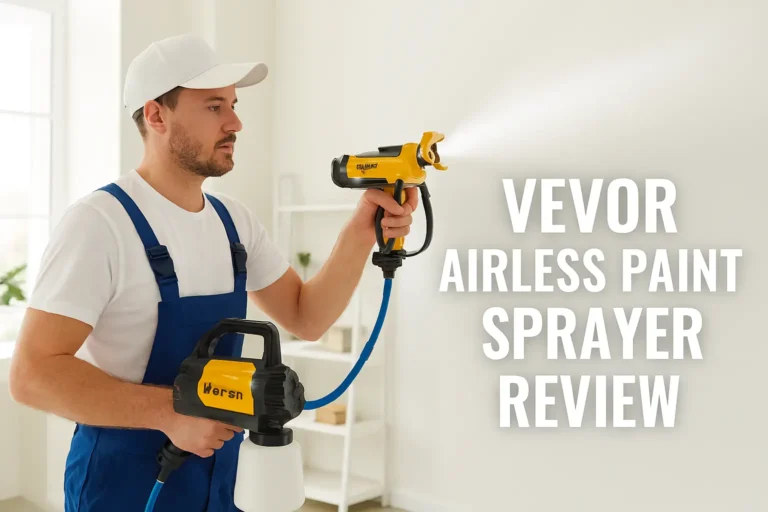
The hose that fits most home airless sprayers is a 1/4-inch line with standard NPSM threads, rated at or above your pump’s maximum pressure, and 25 to 50 feet long. Brand matters far less than those three numbers. If you need the gun and tips as well, the VEVOR spray gun and hose kit is the all-rounder I would start with; if you only need the line, the hose-only picks are further down.
I check hoses the way I check ladders now: rating first, length second, price last. Below are the seven I would consider, the fit question answered properly, and the signs that a new hose is not what your sprayer actually needs.
Why the Hose Kit Matters
An airless sprayer pushes paint under thousands of PSI pressure. The hose is what keeps that power consistent from sprayer to gun. A poor-quality hose leads to pressure loss, uneven coats, or worse, burst leaks mid-job.
Here’s what makes a great airless sprayer hose kit worth the investment:
- Consistent paint flow: Keeps pressure stable throughout.
- Right length: Whether you need a 10 ft, 25 ft, or 50 ft reach.
- Safe fittings: Properly sealed connections prevent leaks.
- Durability: Reinforced materials withstand high PSI and solvents.
Factors to Consider Before Buying
1. Pressure Rating
Your sprayer determines how powerful your hose must be. Most consumer-grade sprayers operate between 3000–3600 PSI, while professional or industrial ones reach up to 8500 PSI.
For example:
- A Gyfent 8500 PSI hose can handle thick coatings and industrial workloads.
- A VEVOR 3600 PSI hose kit is ideal for residential or renovation projects.
2. Length
- 10 ft hoses → tight indoor or furniture projects.
- 25 ft hoses → balanced for most homes; less lag, good flexibility.
- 50 ft hoses → outdoor work or large walls.
- 100 ft hoses → large exteriors or commercial use.
A longer hose gives freedom, but it also holds more paint (which means more cleanup). For most homeowners, a 25 foot airless sprayer hose is the sweet spot.
3. Build Quality and Material
A good hose feels sturdy but flexible. Look for:
- Fiber-reinforced inner tubing (for strength)
- Brass or stainless fittings (for corrosion resistance)
- Swivel joints to prevent twisting
Cheaper plastic hoses tend to stiffen, crack, or burst under high pressure.
4. Fittings and Compatibility
Always confirm that the airless paint sprayer hose fittings match your sprayer brand — whether it’s Graco, Wagner, Titan, or Magnum. Adapters can work, but a direct fit is safer and more efficient.
5. Replacement vs. Full Kit
- Replacement Hose Only → best if you already own a quality gun and tips.
- Full Kit (Hose + Gun + Tips) → perfect for beginners or upgrading from entry-level sprayers.
Top 7 Best Airless Paint Sprayer Hose Kits for Everyone
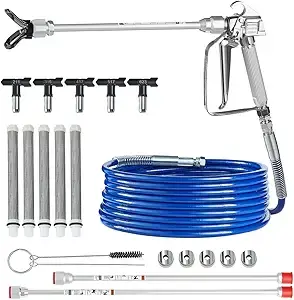
1. VEVOR Airless Spray Gun & Hose Kit (3600 PSI, 5 Tips)
Overview:
The VEVOR kit offers everything a serious DIYer or renovator needs, hose, gun, tip guard, and a 517 spray tip. It’s reliable, well-built, and delivers steady performance even during long paint sessions.
Pros:
Cons:
Verdict:
If you want a dependable kit for both interior and exterior projects, this is one of the best airless paint sprayer hose kits to start with. Best Airless Paint Sprayer for Home Renovation
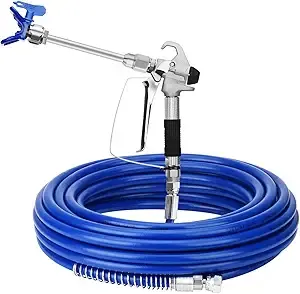
2. FUNTECK Airless Spray Gun & Hose Kit (3600 PSI, 8 in Pole)
Overview:
Designed for bigger surfaces, this kit gives you 50 ft of reach, reducing the need to move the sprayer constantly. Perfect for exterior walls and large ceilings.
Pros:
Cons:
Verdict:
Best value option for those who need more reach without paying premium prices. Best Airless Paint Sprayer for DIY Projects
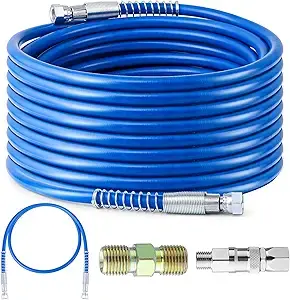
3. Gyfent 50 ft x 1/4″ Airless Paint Sprayer Hose (8500 PSI)
Overview:
This industrial-grade hose is built for heavy-duty work. With an 8500 PSI rating, it easily handles thick paints, oil-based coatings, and long work hours.
Pros:
Cons:
Verdict:
If you want a professional hose that lasts years, the Gyfent hose is a powerhouse. Best Airless Paint Sprayer for Contractors
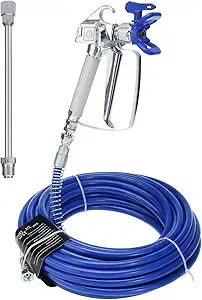
4. YaeTek Airless Paint Spray Gun & Hose Kit (50 ft – 3600 PSI)
Overview:
A balanced, budget-friendly option for homeowners or first-time painters.
Pros:
Cons:
Verdict:
A simple and effective kit that delivers solid results without breaking the bank.
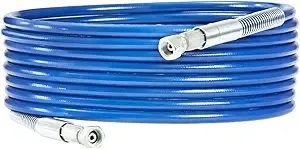
5. VEVOR Airless Paint Sprayer Hose (50 ft, 4350 PSI)
Overview:
A hose-only option for users who already own a gun and tips. Strong, flexible, and built to last.
Pros:
Cons:
Verdict:
A dependable replacement hose for users upgrading from old or leaky lines.
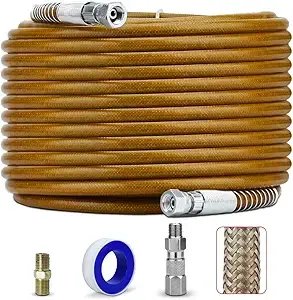
6. 100 ft Airless Spray Hose Kit (Brass Braided Connector)
Overview:
Built for large exterior and industrial projects, this 100 ft hose gives maximum reach with minimal movement of the main sprayer.
Pros:
Cons:
Verdict:
A great pick for professional painters who need distance more than flexibility.
7. 25 ft Reinforced Braided Airless Hose
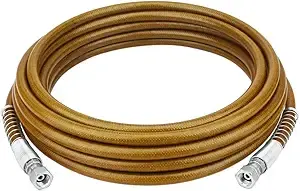
Overview:
A short braided budget line for small jobs, or a spare to keep in the van.
Pros:
Cons:
Verdict:
Good for beginners or quick home touch-ups, not meant for long-term professional use.
Quick Comparison Table
| Product | Length | Max PSI | Includes Gun | Best For |
|---|---|---|---|---|
| VEVOR Gun & Hose Kit | See listing | 3600 PSI | ✅ Yes | Home Projects |
| FUNTECK Gun & Hose Kit | See listing | 3600 PSI | ✅ Yes | Large Walls |
| Gyfent Hose | 50 ft | 8500 PSI | ❌ No | Professionals |
| YaeTek Kit | 50 ft | 3600 PSI | ✅ Yes | Budget Users |
| VEVOR Hose | 50 ft | 4350 PSI | ❌ No | Replacements |
| Brass Braided Hose | 100 ft | See listing | ✅ Yes | Commercial Use |
| 25 ft Braided Hose | 25 ft | See listing | ❌ No | Small Jobs |
Pros of Upgrading Your Hose Kit
Possible Drawbacks
Expert Buyer Tips
If the hose is fine and the fan pattern still has tails, look at the tip before anything else; my airless gun tip guide has the size chart. And if the job is a fence rather than a house, the airless sprayers for fences roundup covers the machines that suit long runs of boards.
Out-of-the-Box Insight
A small tweak that most people miss:
Pair your 25 ft paint spray hose (25 feet) with a 5 ft whip hose. This reduces wrist strain and improves control when spraying detailed areas or ceilings. Professionals do this to prevent fatigue on large jobs.
Also, label each hose (short vs. long) using colored shrink tubing, helps organize and switch fast on job sites.
Final Verdict
If you want the best all-round option, choose the VEVOR 25 ft 3600 PSI Hose Kit, perfect length, great fittings, and durable enough for years of use.
For professionals, the Gyfent 8500 PSI hose remains the gold standard. It’s overbuilt, but that’s exactly what makes it worth every penny.
And if you’re just getting started or want something inexpensive, the 25 ft reinforced braided hose is a practical first step.
Whichever route you choose, remember this, a good hose isn’t just an accessory. It’s what connects your precision, power, and performance into one seamless finish.
Will This Hose Actually Fit My Sprayer?
This is the question behind most airless paint sprayer hose searches, and almost no product listing answers it directly. Here is the short version.
The fitting is the thing to check, not the brand. Consumer and prosumer airless sprayers overwhelmingly use a 1/4 inch NPSM thread at the pump outlet and at the gun. That is why a hose sold with no brand name on it will still thread onto a Graco, a Titan, a Wagner or a Magnum — they share the standard. What varies is the hose end itself: some hoses come with a male fitting at both ends, some male at one end and female at the other, and a mismatch there needs a cheap union to solve rather than a return.
Larger commercial units step up to 3/8 inch. High-output contractor rigs use a 3/8 inch main line to reduce pressure drop over distance, then a short 1/4 inch whip hose at the gun end for flexibility. If you are working from a rig like that, buying a 1/4 inch main line is a downgrade even if it threads on.
Pressure rating is a ceiling, not a target. A hose rated to 8500 PSI on a 3000 PSI sprayer is not delivering more pressure, it just has a wider safety margin and usually a heavier construction. What you must never do is go the other way — a hose rated below your pump’s maximum output is a burst waiting to happen, and an airless burst at 3000 PSI is an injection injury risk, not a mess.
Length costs you pressure and paint. Every added foot drops a little pressure at the tip and holds a little more material that you will flush out at the end. A hundred feet of 1/4 inch line holds a surprising amount of paint. That is why the honest answer for most house-sized jobs is 25 to 50 feet, and why contractors run a bigger diameter rather than simply running longer.
If the problem is at the gun end rather than the hose, the fixes are covered in the guides to airless sprayer gun tips and the extension wand, and if you are still choosing the machine itself, start with the airless sprayer guide.
The Hose That Taught Me to Check the Rating
I bought a cheap replacement hose for a rented sprayer once because the one that came with the machine had a weeping fitting and I wanted to keep working. I did not look at the pressure rating on the sleeve; I looked at the price and the length, threaded it on, and turned the pump up to get a fan pattern out of a thick exterior acrylic.
It did not burst. What it did was balloon slightly under pressure and then pulse, and the pulsing showed up in the finish as faint horizontal banding across a garage wall that I did not notice until the light changed. I had to re-coat the whole elevation. The hose had cost me a fraction of a proper one and about four hours.
The lesson I took: with airless hose, the rating on the sleeve is the specification that matters and everything else is convenience. Read it before you read the price.
When a New Hose Is Not Your Problem
- The spray pattern has tails or fingers. That is almost always a worn tip or paint that is too thick, not the hose. Tips wear out and the orifice goes oval; the fan collapses at the edges before you notice anything else.
- The pump pulses at idle with the gun closed. That points at the packings or the inlet valve inside the pump. A new hose will not settle it, and running it that way makes it worse.
- The leak is at the threads, not the hose body. A weeping joint usually needs the fitting cleaned and reseated, or a new union, not a whole new line. Check before you buy.
- You have any visible bulge, blister or exposed braid. This is the reverse case — do not repair, do not tape, do not use it once more to finish the wall. A damaged airless hose can inject paint through skin under pressure, which is a surgical emergency and not an injury you feel properly at the time. Replace it.
- You are spraying an interior room under twelve feet. A hundred-foot line is not an upgrade there. It is more paint to flush, more hose to coil, and more pressure drop for no gain.
Airless Hose Questions People Actually Ask
Are airless paint sprayer hoses universal?
Close to it at the consumer end. Most homeowner and prosumer airless sprayers use a 1/4 inch NPSM thread, so a generic hose will thread onto a Graco, Titan, Wagner or Magnum. Check whether the ends are male or female before ordering, and check that the pressure rating meets or exceeds your pump’s maximum. Larger contractor rigs use 3/8 inch and are a different fit.
What length airless hose do I need?
Twenty-five feet handles most interior rooms and small exteriors. Fifty feet is the sensible default for a whole house exterior or high ceilings, because it saves repositioning the pump. Go past that only when the job genuinely demands it — extra length costs pressure at the tip and holds more paint that you flush away at the end.
Can I join two airless hoses together?
Yes, with a proper high-pressure union rated to the same PSI, and both hoses must carry a rating at or above your pump’s maximum. Never join with a standard air-hose coupler. The joint is the weak point, so inspect it every time you set up.
How do I clean an airless sprayer hose properly?
Flush with the correct solvent for the material — water for latex and acrylics, mineral spirits for oil-based — until it runs clear at the gun, then relieve pressure and coil it loosely. Dried paint inside the line is what stiffens a hose and eventually cracks it. Coiling it tight while it still has material in it is the second most common way people ruin one.
What is a whip hose and do I need one?
A whip hose is a short, thinner, more flexible length that goes between the main line and the gun. It takes the stiffness of the main hose off your wrist, which matters a great deal over a full day of spraying and hardly at all over an hour. Several of the kits above include one.
Why does my sprayer lose pressure with a long hose?
Friction. Paint moving through a narrow tube loses pressure over distance, and the effect compounds with thicker material. The fix is a larger diameter main line rather than turning the pump up, because raising pressure to compensate wears the tip and the packings faster.
How long does an airless hose last?
There is no fixed figure, because it depends far more on how it is flushed and stored than on hours of use. Judge it by condition instead: any bulge, blister, kink that has set, exposed braid or weeping through the sleeve means retire it immediately. A hose that is flushed properly and coiled loosely outlasts one that is used twice as little and left with paint in it.
Written by Sophie Ulman. ThePaintly is reader-supported: when you buy through links on this site we may earn an affiliate commission at no extra cost to you.