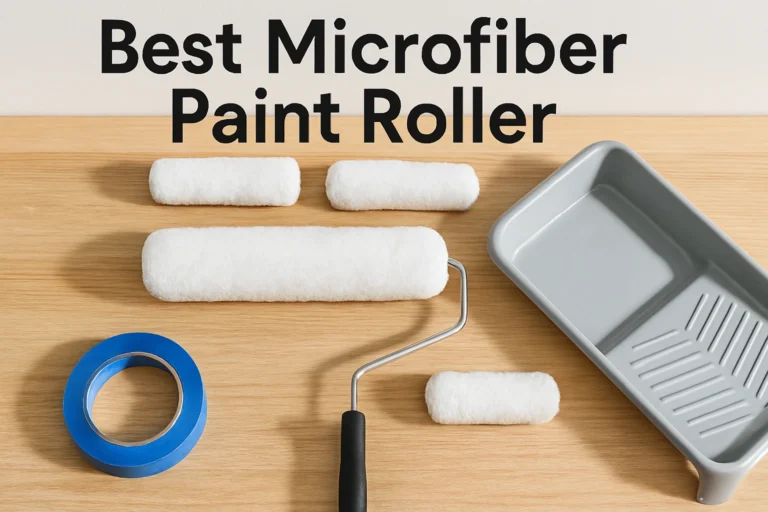
Best Ceiling Paint Roller: Choosing the Right Nap for Your Ceiling
The roller matters less than the nap on it. That is the part almost every ceiling roller guide skips, and it is the reason people buy a nine-piece kit, roll a textured ceiling with the 3/8 inch cover it came with, and end up with white-tipped bumps and grey shadow in every hollow. A smooth drywall ceiling and an Artex or popcorn ceiling need two genuinely different roller covers, and the frame, pole and tray are almost interchangeable by comparison.
So this guide starts with nap depth, then gets to the kits. If you only take one thing away: match the nap to the texture first, and buy the handle second.
Related Post: Best Ceiling Paints — Reviews and Buying Guide
Which Roller Nap for a Textured, Artex or Popcorn Ceiling?
Nap is the pile depth of the roller cover, and its whole job is to reach into the low points of a surface. Too short and it only paints the peaks. Too long on a smooth ceiling and it leaves an orange-peel stipple you did not ask for. The rule of thumb that has never let me down:
| Ceiling surface | Nap depth | What goes wrong with the wrong one |
|---|---|---|
| New or skimmed smooth drywall | 1/4 in – 3/8 in | Longer nap prints a stipple onto a flat ceiling |
| Lightly textured, orange peel, knockdown | 1/2 in – 3/4 in | Short nap misses the hollows and leaves shadow |
| Artex, swirl, stipple, heavy texture | 3/4 in – 1-1/4 in | Short nap coats peaks only; ceiling looks patchy from below |
| Popcorn / acoustic tile | Purpose-made popcorn cover | Ordinary covers tear the loose texture off the ceiling |
Purdy 144672094 White Dove Roller Cover, 9 in x 3/4 in — for Artex and textured ceilings
This is the cover to reach for on a textured or Artex ceiling. Purdy rates the White Dove line for semi-smooth through semi-rough surfaces and lists drywall, ceilings and floors as its intended uses; the 3/4 inch nap is deep enough to carry paint down into a swirl pattern without loading so heavily that it drips on you. The pile is woven Dralon on a polypropylene core, so it does not shed fibres into the finish — which matters overhead, because a shed fibre on a ceiling is not something you can wipe off without repainting the section.
It is a bare cover, not a kit. It fits any standard 9 inch frame, including the ones in the kits further down this page.
Wooster Brush R234-9 Popcorn Acoustical Roller Cover, 9/16 in Nap, 9 in — for popcorn and acoustic ceilings
Popcorn is a special case and a general-purpose cover will make it worse. The texture is loosely bound, and a stiff nap grabs it and pulls it off in clumps as you roll, so you finish with bald patches that then need re-texturing. Wooster builds this cover specifically for popcorn and acoustical ceilings, along with textured walls, masonry and stucco. The 9/16 inch nap is shorter than you would expect, and that is deliberate — it is the pile construction, not the depth, that lets it ride over loose texture instead of digging into it.
Roll it slowly and in one direction. Back-rolling over popcorn is what tears it, more than the cover itself.
Whichever cover you land on, the paint underneath it still decides the finish. A textured ceiling shows every sheen difference, which is why the guide to flat ceiling paint is worth a look before you start, and if your ceiling is old plaster there is more to check first in painting a plaster ceiling.
Best Ceiling Paint Roller Reviews
Here’s a short rundown on all of the best-selling items. Keep reading to know so much about choosing and using a paint roller for the ceiling.
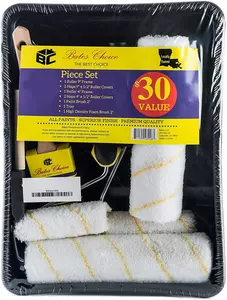
1. Bates Paint Roller Kit – 19 Piece Home Painting Supplies
Specifications
Bates paint roller is the best ceiling paint roller that comes with all the necessary supplies. It has a tremendous capacity to perform tasks quickly and with a high level of quality. If you work with Bates paint rollers, you can count on complete satisfaction because this paint tray kit is of high quality, a design that would last a long period and be easy to maintain.
Spending money on paint trays that can only last an hour is a costly affair. Perfectionists and money savers would appreciate this high-quality kit. For the price, the quality you get in this Paint Tray package is outstanding. It really doesn’t matter whether you’re a true professional or an inexperienced.
- Reasonable and high-quality product.
- Perfect for smooth and semi-smooth surfaces.
- Great for beginners and professionals both.
- Ideal for high ceilings.
- Users face streaked texture while using Bates paint roller.
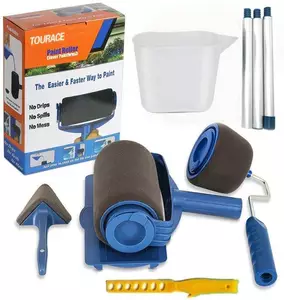
2. TOURACE 9Pcs/set Paint Roller Set with Sticks Paint Roller Pro
Specifications
This paint roller is a best type of roller for ceiling paint and a game-changer as it has the advanced and unique feature of pouring paint inside so you don’t have to bend down again and again. It can easily work for painting any surface. The best part about the Tourace paint roller is that it’s a multipurpose tool. You can also paint the walls with a large roller, the door frames and window frames with a medium roller, and the corners with a little brush.
Good-quality sticks, totaling 73 cm, are provided to support you in painting high ceilings. It is made up of a staff of outstanding consistency that will never break. The painting roller of Tourace is very easy to use and can be washed super easily. You just have to give it a short wash under the water. Moreover, you just have to keep in mind that fill 60 to 70 % paint in it. Otherwise, it will leak.
- It is easy to use for both beginners and professionals.
- Ease of painting ceilings without a ladder.
- Works on any surface.
- Quickly washable under the tap.
- Gives high coverage.
- If it falls off accidentally, it will spill all the inside paint.
3. Wagner Spraytech HomeRight PaintStick EZ-Twist C800952.M Roller Applicator
Specifications
Trying to paint the ceilings has never ever been simpler, but Wagner has made it even easier. Apart from typical rollers, the EZ-Twist has a 64-inch length, meaning you can make the ceiling stand out without any splashes or spill.
The EZ-Twist gives you extra reach and influence so you can paint those damn difficult places in your house like stairwells, high ceilings, and far more! This advanced roller keeps the color on the handle and paints straight through this, and that’s twice as quicker than a traditional roller and comes in handy when painting quickly. You will see that it’s time to reload since the stick is transparent.
There are no splashes and no-spill because you don’t have a painting tray. The fill tube is simple to get to and clips onto a range of different paint container sizes. Easily rotate the handle to manage paint flow; the EZ-Twist pushes paint onto the roller cover and moves it all to the surface. The EZ-twisting Twist’s feature helps you to effectively track the painting flow.
- Paints without the need of a ladder.
- Can paint a wall of 8 x 8 in a minute.
- It shows you the need for refill as it is transparent.
- Upgraded and twisted handle benefits.
- It becomes heavy when loaded with paint, causing pain.
- Difficult to wash.
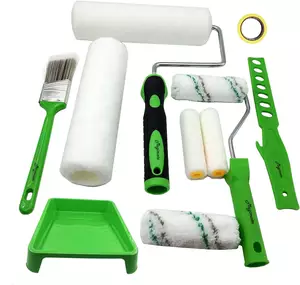
4. Magimate Paint Roller Kit 9 Inch 4 Inch Roller Set
Specifications
With the Magimate Paint Roller Kit, you won’t be disappointed. This best paint roller for textured ceiling is a package that has everything you’ll just want to get the work completed quickly and easily. It’s ideal for indoor and outside use, as well as a variety of paint jobs such as emulsification, furniture, and on and on. Amateurs and experienced painters will benefit from the Magimate 12-piece Paint Roller Kit.
The simplicity of picking up and releasing Magimate paint rollers seems to be another great aspect. The rollers’ centre is also resistant to all kinds of solvents, and therefore uniformly distribute colour. This set includes materials for both outdoor and indoor painting project. As a result, you can use them for scribbled ceiling art. So overall it’s ideal if you need some extra texture on your ceilings.
- Masking tape, a silicone paint tray, and a paint stick are included.
- Package of powerful painting tools.
- Release and pickup paint very smoothly.
- A handy and compact kit.
- The roller set doesn’t come with an extension pole to paint decks and ceilings with ease.
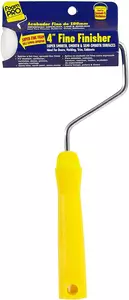
5. FoamPRO 164 Fine Finish Roller (High-Density Foam)
Specifications
Searching for a low-cost yet best paint roller for textured ceiling that always looks decent? This FOAM PRO paint roller is designed that can be used on rugged surfaces such as popcorn walls, roofs, boards, textured surfaces, harsh fences, and much more. FoamPRO 164 falls as one of the best ceiling paint rollers as it gives a spray like finish on your ceilings.
Moreover, FoamPRO promises you to give a streak-free and super-smooth texture. It is ideal if you are planning to use oil paint on your ceiling with some budget-friendly tool, then we suggest you go for it because of its high-density feature.
- Pocket friendly.
- Lightweight and easy to use.
- Saves paint and time.
- Much suitable for beginners and small projects.
- Best paint roller for popcorn ceiling.
- Not designed for high ceilings and bigger projects.
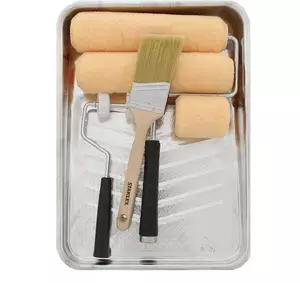
6. STANLEY PTST03508 8 Piece Paint Kit
Specifications
Two roller covers with high-density vinyl fabrics are included in the Stanley 8-Piece Paint Kit. You can store these painting reusable polyester rollers safely after washing them. Lint-free paint rollers are usually recommended for use on tough ceilings. Roller covers, a 3-inch roller case, and a 2-inch angled paintbrush with polyester material are also included in this kit.
As promised, STANLEY paint rollers and tools work exceptionally well and considered as the best roller to paint knockdown ceiling. Their microfiber rollers catch a lot of paint and spread it evenly, much like professional equipment. A plastic tray lining, three 9-inch roller frames, and a metal painting tray are also included in the set. We must say that Stainly is the perfect kit of roller for your ceiling without any doubt.
- High density fibers for holding large amounts of paint.
- Solvent resist.
- Easy to use and easy to clean.
- Suitable for all paint types.
- Best roller to paint knockdown ceiling.
- According to users, it does not let the paint spread very well.
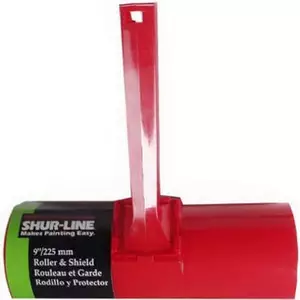
7. Shur-Line 3510 9-Inch Roller and Shield
Specifications
Shoreline is a reputable brand with a comparatively low cost and brilliant quality, so it would be wise to give their roller a shot the very next time you paint the ceiling. If you’re considering several little touch-ups within your house or on the ceiling, this roller will make the whole thing much simpler than the other roller from the local dollar store.
This roller guarantees you a smooth and even-textured ceiling. You can fit extension poles very easily to fulfil high ceilings painting projects. The most beneficial part of Shoreline is that it will prevent any drips or splatters. Moreover, it features a 9 inches roller shield along with 3/8 inches quality roller cover. Overall, you have to accept that the Shurline roller is durable, lightweight, easy to use and a convenient design.
- Easily washable.
- Lightweight and durable.
- Ideal for small areas and priming.
- Ideal for beginners.
- It prevents splashes and drips.
- It does not come with supportive tools.
- Not suitable for higher ceilings.
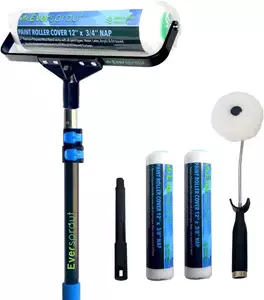
8. EVERSPROUT 1.5-to-3.5 Foot Paint Roller Kit
Specifications
You can paint difficult-to-reach positions and ceiling cuts without using a ladder and adopt the best way to paint a ceiling with a roller that you deem work best for you. The EVERSPROUT paint roller pack, on the other hand, works with a pole that can be adjusted from 5 to 12 feet. Brush and rollers are kept in place by sturdy frames on this extender.
This EVERSPROUT removable handle, unlike others, has a tri (3-stage) telescopic feature. A part of the design is covered to improve the gripping ease. You may also precisely apply a thick layer of paint to ceilings. Purchase roller packages that can be used for water, oil, latex, and acrylic paints when you choose to renovate your old unfurnished apartment. This paint roller kit includes two poly-wool covers, a screwdriver, and other tools.
- Works on multiple surfaces.
- Lightweight and easy to use the pole.
- Lock poles in tabs.
- Two paint roller covers.
- Wider design.
- Although the Eversprout extension pole is attractive, it is not made of the durable component.
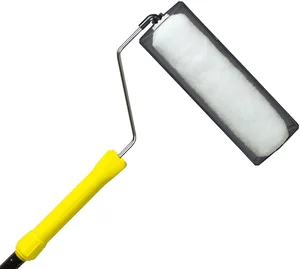
9. Mr. LongArm 9026 Painter System II Extension Pole
Specifications
This spatter shield roller eliminates sticky paint splatters when painting walls, ceilings, and floors. The changing shield can be adjusted with only one hand, making it smoother, quicker, and more ‘on the move.’ It has 11 pivot points that cause the shield to rotate 360 degrees.
It has amazing features of 9 inches paint ADJ extension pole for giving a smooth and elegant finish on your ceiling. The advantageous thing about this best ceiling paint roller is that it reduces messy paint splatters. Moreover, it also has the exclusive quality of translucent shield, which allows you to see the loaded or remaining paint.
- Easily adjustable to paint in any position.
- Works very well for higher ceilings.
- Gives smooth and even texture.
- The material of the roller is not durable and long-lasting.
Buying Guide
Paint rollers can appear to be a basic paint instrument to use, but few people are not well aware that there are many specific sorts of paint rollers.This is why we designed this guide to answer all the possible questions when you think, “What is the best roller to paint a ceiling” and select the right paint roller for ceilings.
Length of Roller Cover
The actual length of the roller cover is the variable that needs to be considered while buying a painting roller for the ceiling. It will most likely be determined by the paint roller frame you have on hand. The traditional 9 inch roller cover is the most popular size of the roller cover.
These might, however, be as wide as 12 inches or wider for coating larger surface areas or as small as mini rollers for painting floorboards or cracks. However, the length of the roller you pick is more of a personal preference, and it will only count if the surface you’re painting is big or tiny. A regular 9-inch roller, on the other hand, can do the majority of the job.
Length and Style of a Roller Nap
The thickness of the material used to make the cover determines the nap of the cover. Painting rollers are available in a variety of nap lengths, varying from ¼ inch nap to a ¾ inch nap roller being the most common. So how would you choose the correct one for your painting job? Well, we are here for the answer.
The best roller nap for ceiling paint is a 3/8-inch nap. The 3/4-inch nap is extremely dense, making it ideal for rough surfaces such as textured or popcorn ceiling, drywall, and cement.
Different Paint Roller Covers
Although selecting the correct paint roller cover will not seriously affect your painting project, it will make it easier to achieve a wonderful finished look like a pro.
Fortunately, identifying the best roller covers for you depending on the paint job you’re attempting to complete is pretty easy. So, let us just have a glance at the most popular paint roller cover styles so you can understand how to pick the correct one for you and produce great excellent results.
1. Synthetic Fiber
Paint roller covers made from synthetic fiber such as polyester or nylon are often more popular and liked by users. Synthetic fiber covers are flexible and durable, which can be used on gritty as well as on smooth ceilings, and they often perform well with latex paint. This feature makes them perfect for ceiling paint.
2. Natural Fiber
Natural fiber roller covers are usually made of a material such as cotton yarn or lambs furs, which are ideal for setting down water-based latex paint. Moreover, natural fiber roller covers are extremely flexible, making them super easy to use on rough and smooth surfaces.
3. Foam Roller Covers
Foam roller covers might be a more advanced alternative which can be helpful in just a few cases. Foam covers, for example, are ideal for use with oil-based or high-gloss latex paints. They’re also great for working on porous services like bare wood, cement, and bricks. So, based on the kind of ceiling you’re attempting to paint, these would be a viable choice to consider.
Grip and Handling
When selecting the best type of roller for ceiling paint, roller’s handle grip is an important component. That if you want to work on the roller, you must stay with a tight grip on the handle for a longer length of time, which is difficult to do if the grasp is uncomfortable. Working in the industry gets even more difficult after that. Well, for a sleek and superb drawing, you should purchase an excellent padded grip roller.
FAQs
After research, we brought the answers to the most common question related to a ceiling paint roller.
Final Verdict
You would save money on hiring a painter by keeping the best ceiling paint tool. Whenever it comes to applying tidy finishing to walls and ceilings, many people like this idea. It is simple to enhance the confidence and enjoyment of enthusiastic hobbyists and experts in the painting industry by assisting them in selecting the best roller for ceiling paint.
Most buyers make errors when selecting materials, which makes their paint jobs more difficult. But now, you have a variety of the best ceiling paint roller sets to choose from, and this article will hopefully help in making a better choice.
What I Learned Rolling a Swirl-Textured Ceiling With the Wrong Cover
I did a bedroom ceiling with a fine swirl texture using the 3/8 inch cover that came with a kit, because it was in my hand and the ceiling looked flat enough from the doorway. Two coats in, standing under the window in the afternoon, the whole thing looked mottled — bright on every raised swirl and grey in every trough. I had painted the tops of the texture and nothing else.
The fix cost me a third coat with a 3/4 inch cover and an afternoon I did not have. What made it worse is that the ceiling looked fine while it was wet; the mottling only appeared as it dried and the sheen evened out. So if you are unsure which nap you need, err long. A slightly over-long nap on a smooth ceiling gives you a faint stipple you will probably never notice. A too-short nap on a textured ceiling gives you a job you have to do again.
When a Roller Is the Wrong Tool Entirely
- The popcorn texture has never been painted. Unpainted popcorn absorbs water, swells and releases from the ceiling. It wants to be sprayed, not rolled — rolling puts mechanical drag on a surface that cannot take it. If spraying is not an option, test a corner first and accept that some of it will come off.
- The ceiling has asbestos-era texture. Textured ceiling coatings applied before the late 1980s can contain asbestos in some regions. Do not sand, scrape or disturb it. Have it tested before any prep work, not after.
- You are covering a water stain. A roller spreads the stain rather than sealing it. That needs a stain-blocking primer on the mark first, and the leak found, before any topcoat.
- The area is a single small patch. Rolling a patch leaves a different sheen from the surrounding ceiling. Either roll the whole ceiling or accept that the patch will show.
- The ceiling is above about twelve feet. Past the reach of a standard extension pole, a roller on a long pole loses the pressure control that makes a textured ceiling come out even. That is sprayer territory.
Ceiling Roller Questions People Actually Ask
What paint roller is best for an Artex ceiling?
A 3/4 inch nap woven cover on a standard 9 inch frame. Artex is a raised pattern with real depth, and anything shorter than about 1/2 inch only reaches the peaks, leaving grey shadow in the hollows once the paint dries. If the pattern is a deep swirl or a heavy stipple, go to 1 inch or longer.
Is a Purdy roller worth it for a ceiling?
The difference shows up in shedding rather than coverage. Cheap covers drop fibres, and a fibre stuck in a ceiling finish means sanding and repainting that section rather than wiping it off. On a wall you can reach it. On a ceiling you are back up the ladder. That is where the money goes.
Can I use the same roller for the ceiling and the walls?
The frame and pole, yes. The cover, usually not — ceilings are commonly textured while walls are smooth, so they want different nap depths. Buying two covers for one frame costs very little and saves the mismatch.
Why does my ceiling look patchy after two coats?
Two usual causes. Either the nap was too short for the texture, so you coated the high points only, or you spot-primed and topcoated without taking the finish coat wall to wall, which leaves areas of different porosity. Both look fine wet and show up as the ceiling dries.
Should I use a 9 inch or an 18 inch roller on a ceiling?
Nine inch for a room-sized ceiling. Wider covers hold more paint and cover ground faster, but loaded overhead they are heavy and hard to keep at even pressure, and uneven pressure on a textured ceiling is exactly what causes mottling. Wide rollers earn their keep on large open commercial ceilings, not bedrooms.
Do I need an extension pole or can I work from a ladder?
A pole, in almost every case. From a ladder you can only reach a small area before repositioning, and every reposition risks a lap mark where the previous section has started to set. A pole lets you keep a wet edge across the full run, which is the single biggest factor in an even ceiling.
How do I stop the roller dripping on me?
Load less and roll off more. Most overhead dripping is a cover carrying more paint than the nap can hold, and a long nap makes it worse. Roll the loaded cover out on the tray ramp until it stops releasing paint freely, then take it up.
Written by Sophie Ulman. ThePaintly is reader-supported: when you buy through links on this site we may earn an affiliate commission at no extra cost to you.