Best Electrostatic Paint Sprayer: What You Need to Know Before Buying
Electrostatic Paint Sprayer Buying Guide: Which One Actually Fits Your Job?
The first electrostatic gun I ever ran was a rented cart unit, and I spent the first twenty minutes convinced it was broken. I was spraying a wrought-iron railing, standing on one side of it, and paint kept showing up on the back of the bars where I had not aimed. That is the whole point of the technology — the charged droplets chase the grounded metal instead of sailing past it — but nobody tells you how strange it looks the first time. On that railing I used roughly a third of the material I would have burned with a conventional gun, and I did not have to walk around to the far side once. — Sophie Ulman
That railing is also the honest summary of who this tool is for. Electrostatic spraying pays for itself on complex metal shapes: railings, grilles, fencing, shelving, machinery, lockers, cart frames. On a flat drywall ceiling it gives you almost nothing that a good airless will not, and it costs considerably more to buy and to maintain. So before comparing models, be sure the shape of your work matches the technology. Below is a side-by-side of the four units covered in this guide, then the detail on each.
Quick pick: for repeat work on complex metal at commercial volume, the unit in this guide built for that job is the Graco 233747 Triton ProXP 60 Cart Electrostatic Package. For small jobs and disinfecting, the cordless Ryobi ONE+ 18V 0.5 Gal Sprayer (P2890) is the lighter pick.
| Model | Type | Best for | Main limitation |
|---|---|---|---|
| Graco 233747 Triton ProXP 60 Cart Package | Cart-mounted, air-assisted | Continuous commercial and industrial work | Heavy, needs a compressor and real setup knowledge |
| Ryobi ONE+ 18V Cordless 0.5 Gal (P2890) | Cordless handheld tank | Disinfecting and light coatings over large floor areas | Small reservoir; frequent refills and battery swaps |
| Ryobi ONE+ 18V Handheld Electrostatic Sprayer | Cordless handheld | Furniture, fixtures and detailed indoor surfaces | Not built for full-bodied architectural paint |
| JINGEDD Electrostatic Powder Coating System | Powder coating gun | Powder finishing metal parts in a shop | Needs a curing oven; not a house-painting tool |
If you want to take your painting projects to the next level, whether for home interiors, commercial spaces, or even disinfecting tasks, an electrostatic sprayer can transform the way you work. These sprayers wrap paint around surfaces, minimize drips, reduce overspray, and leave a more professional finish. But not every model is worth the investment. In this guide, we’ll explore what makes the best electrostatic paint sprayer, compare handheld and professional options, and highlight some of the top-rated choices on the market.
Why Choose an Electrostatic Sprayer?
Electrostatic spraying uses charged particles that are attracted to grounded surfaces, creating a unique “wrap-around” effect. This allows for better coverage, less paint waste, and an overall smoother finish.
For example, if you’ve ever struggled with paint not adhering evenly, much like when choosing the best ceiling paint to get a uniform surface, an electrostatic sprayer can solve those challenges by distributing paint more efficiently.
Benefits
- High transfer efficiency up to 90 percent
- Excellent coverage on railings, grills, machinery, and other complex shapes
- Cleaner job sites with less overspray
- Time and cost savings due to reduced paint consumption
Limitations
- Higher upfront cost than rollers or traditional sprayers
- Requires proper grounding and safety practices
- Some non-conductive materials may need priming first
- A learning curve for setup, cleaning, and maintenance
Features to Look For in the Best Electrostatic Paint Sprayer
When shopping for a sprayer, pay attention to these key factors:
- Voltage and Charge Control: Adjustable power settings to match different coatings
- Reservoir Size: Larger tanks for commercial jobs, smaller for handheld portability
- Nozzle Options: Flexibility to change spray width and atomization
- Mobility: Handheld units for small areas, cart systems for large projects
- Maintenance: Easy cleaning systems save valuable time
- Safety: Proper insulation and grounding features
- Paint Compatibility: Not all sprayers handle thick paints or specialty finishes well
Best Electrostatic Paint Sprayer Reviews
Here are some of the most reliable options available on Amazon, including professional and handheld units.
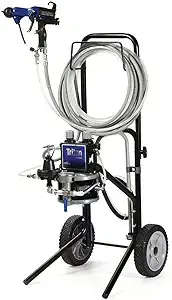
Graco 233747 Triton ProXP 60 Cart Electrostatic Package
- Best for professionals and large commercial projects
- High-efficiency design with excellent finish quality. Perfect for continuous spraying
- Cons: Heavy, expensive, and requires technical know-how
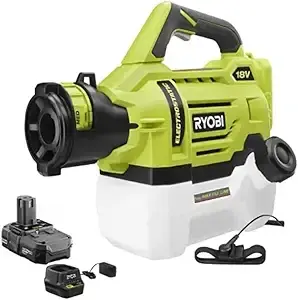
Ryobi ONE+ 18V Cordless Electrostatic 0.5 Gal Sprayer (P2890)
- Best handheld electrostatic sprayer for everyday use
- Cordless, lightweight, and easy to maneuver. Great for disinfecting schools or quick touch-ups
- Limitations: Smaller tank and shorter battery life mean frequent refills
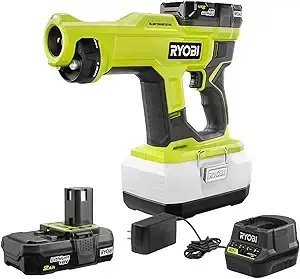
Ryobi ONE+ 18 Volt Cordless Handheld Electrostatic Sprayer
- Best handheld electrostatic disinfectant sprayer
- Compact design works well for indoor furniture and detailed surfaces
- Drawbacks: Not powerful enough for thick paint applications
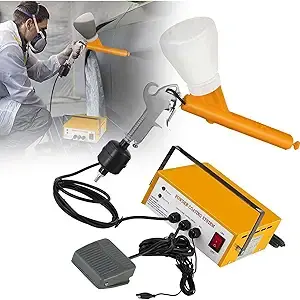
JINGEDD Electrostatic Powder Coating System
- Best for specialized powder coating
- Creates durable finishes for factory or industrial settings
- Not recommended for house painting due to complexity
Which Sprayer Fits Your Needs?
For Disinfection and Sanitization
The best handheld electrostatic disinfectant sprayer is ideal. Portable models like the Ryobi P2890 quickly cover surfaces in schools, gyms, and offices.
For Large Commercial Projects
A commercial electrostatic paint sprayer like the Graco Triton ProXP is designed for high-volume work. It is often considered the best paint sprayer for professionals in industrial settings.
For Home Renovations
A professional house paint sprayer with electrostatic features or a hybrid HVLP sprayer works well for trim, ceilings, and doors. If ceilings are your main concern, check out the best paint sprayer for popcorn ceiling.
For DIY and Small Projects
Choose a top rated electric paint sprayer that is lightweight and cordless. It offers mobility at a lower price point, making it more suitable for occasional users.
Common Issues to Watch Out For
Even with the best equipment, there are challenges:
- Orange peel texture if paint isn’t thinned properly
- Maintenance costs from replacement filters and nozzles
- Safety risks if grounding is ignored
- Incomplete coverage in corners due to the Faraday Cage effect
This is why surface preparation is so important. For tips, see our guide on how to clean walls before painting to avoid adhesion problems.
Electrostatic vs Traditional Painting
Rollers and brushes are still fine for simple flat walls, especially if you’re experimenting with the best way to paint edges between wall and ceiling. However, for speed, precision, and finish quality, electrostatic sprayers clearly outperform traditional methods.
Final Verdict
If you need the best handheld electrostatic sprayer for small projects or disinfecting, the Ryobi ONE+ 18V Cordless 0.5 Gal Sprayer is an excellent choice.
If you’re a contractor or professional handling large-scale projects, the Graco 233747 Triton ProXP 60 Cart Electrostatic Package is unmatched in power and efficiency.
Owning both a handheld and a commercial unit can give you the flexibility to handle almost any painting or sanitizing task.
Is an Electrostatic Paint Sprayer Worth It for a Homeowner?
For most homeowners, no — and I would rather say that plainly than sell you a tool you will use twice. The wrap-around effect only happens when the target can carry a ground. Bare and primed metal works. Damp concrete sometimes works. Vinyl, dry wood, plastic and drywall do not, and on those surfaces an electrostatic gun behaves like an ordinary sprayer with extra rules attached.
Run the count on your own house. If the metal you want to coat is one gate and a set of patio chairs, a rattle can or a small conventional sprayer finishes the job the same afternoon. If you own a long run of ornamental fencing, a commercial railing system, restaurant shelving, or you refinish metal furniture for money, the arithmetic flips: the material you stop wasting on every job is what pays for the gun, not the finish quality. Contractors quoting repeat metal work should compare this against a conventional setup in our guide to commercial paint sprayers, and if the work is mostly broad flat area rather than complex shapes, an airless sprayer built for contractors is the cheaper answer.
When NOT to Use an Electrostatic Sprayer
- Non-conductive surfaces. Wood, vinyl, most plastics and drywall cannot hold the ground that creates the wrap-around effect. You lose the entire advantage and keep all of the cost.
- Deep recesses and inside corners. The Faraday cage effect means charged particles crowd the outer edges of a cavity and starve the inside of it. Box sections and deep channels still need a conventional pass.
- Heavy-bodied architectural paint in a handheld unit. The cordless models here are built around thin liquids. Full-bodied wall and trim paint needs thinning that the finish may not survive.
- One-off small jobs. Setup, grounding checks and cleanup take longer than the spraying on a single chair or gate.
- Anywhere you cannot verify a solid ground path. Grounding is a safety requirement with these tools, not a performance tip. If the workpiece and the operator cannot be grounded properly, use something else.
Where electrostatic genuinely shines outside a shop is exterior metalwork — the same job that ruins a weekend with a brush. If that is your project, the coating you choose matters as much as the gun; our notes on the best paint for a metal fence cover which formulations survive the weather once they are on.
Frequently Asked Questions
Can you use regular paint in an electrostatic sprayer?
Only if the coating is formulated to carry a charge and is thinned to the manufacturer’s stated viscosity. Many standard latex paints are too resistive and too thick to atomize properly in these guns. Check the technical data sheet for the coating before you buy the sprayer, not after — the coating dictates the gun, not the other way round.
Does an electrostatic sprayer work on wood or vinyl?
Not in any meaningful way. Wood and vinyl are not conductive, so the charged droplets have nothing to be attracted to and simply land where you aimed them. Some shops pre-treat non-conductive parts with a conductive primer, but for ordinary painting on those materials a conventional sprayer does the same job for far less money.
Why is my electrostatic sprayer leaving thin spots in the corners?
That is the Faraday cage effect, and it is physics rather than a fault. The electric field concentrates on the outermost surfaces of a shape, so recesses and inside corners receive less material. The standard fix is to shoot the recesses first with the charge reduced or switched off, then bring the charge back up for the outer surfaces.
Do I need to ground the object I am spraying?
Yes, and it is not optional. Grounding is what completes the circuit that makes the wrap-around effect work, and it is also the safety mechanism that keeps charge from accumulating where you do not want it. Follow the grounding procedure in your unit’s manual before every session, and confirm the path is intact rather than assuming it.
Is an electrostatic sprayer the same as a disinfectant sprayer?
They share the technology but not the duty. Cordless handheld units like the Ryobi models are designed around thin disinfectant solutions and light coatings, which is why they cover a gym floor or a classroom quickly. Running architectural paint through a sprayer built for disinfectant is where most people are disappointed.
How much paint does electrostatic spraying actually save?
It depends entirely on the shape of the work. On complex open metal — railings, grilles, wire shelving — manufacturers cite transfer efficiency far above conventional spraying, and the saving is obvious the first time you spray a fence. On a flat wall the difference narrows sharply, because a conventional gun was not wasting much material there to begin with.
Can a beginner use an electrostatic paint sprayer?
A beginner can learn one, but it is a poor first sprayer. You are managing viscosity, charge level, grounding and cleaning at the same time, and mistakes in any of them show up in the finish. Learn spray technique on a conventional unit first, then move across once the motion is automatic.
Tips for Best Results
- Clean surfaces before spraying. See our step-by-step on how to remove paint with steam
- Mask and protect areas using the best painters tape
- Test your spray pattern before starting
- Adjust paint viscosity to prevent clogging
- Clean the sprayer thoroughly after each use
Conclusion
Investing in a professional electrostatic paint sprayer can dramatically improve your efficiency and results. Whether you go for a commercial electrostatic paint sprayer for large projects or a best handheld electrostatic disinfectant sprayer for portability, these tools provide superior coverage, less waste, and a polished finish that traditional methods simply can’t match.