
Best Ceiling Paint: 7 That Actually Belong on a Ceiling
Ceiling paint is the one product in a house where the cheap option and the expensive option often look identical on the wet roller and completely different a week later. The difference is almost never colour — it is sheen, hiding power and spatter. Get those three right and the ceiling disappears, which is exactly what you want a ceiling to do. Get them wrong and every drywall seam, patch and roller lap shows the first time low sun comes through a window.
Below are seven products that genuinely belong on a ceiling, sorted by the problem they solve rather than by brand. Five are ceiling paints, one is a moisture-resistant interior paint for the bathroom exception, and one is a texture rather than a paint — each is labelled so you know which is which.
What Actually Makes a Good Ceiling Paint
- Flat or ultra-flat sheen. This is the single most important property and the one people ignore. Light in a room travels nearly parallel to the ceiling, so any lustre at all reflects it and outlines every imperfection. Eggshell on a ceiling is a mistake you only make once.
- Hiding power. A ceiling is one continuous plane with no trim to break it up, so a thin paint that flashes over patches shows the difference across the whole surface. Body matters more here than on a wall.
- Spatter resistance. Ceiling formulas are thickened to cling to the roller. Wall paint overhead rains down on you, the floor and the furniture, and cleaning that up costs more time than the paint saved.
- Coverage feedback. White paint on a white ceiling is invisible while you work. Colour-change formulas that go on pink and dry white solve the hardest practical problem in the job, which is knowing where you have been.
- Texture compatibility. On acoustic or popcorn ceilings, a paint that fills the texture flattens it permanently. Dedicated ceiling paints are formulated not to.
The Seven Picks
1. INSL-X Color-Changing Ceiling Paint, 1 Gallon — best overall
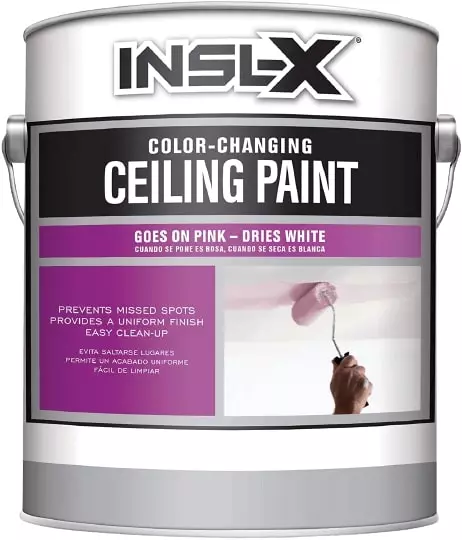
A pre-tinted acrylic paint-and-primer that rolls on light pink and dries white in about an hour. It has an ultra-flat finish that minimises glare, and it is rated for both smooth and textured ceilings on drywall, plaster and metal. Apply between 50°F and 90°F.
It earns the top spot on practicality rather than chemistry. Every other paint on this list requires you to guess where the wet edge is, from below, at an awkward angle, in white on white. This one shows you.
2. KILZ Color-Change Stainblocking Interior Ceiling Paint, 1 Gallon — best for stains
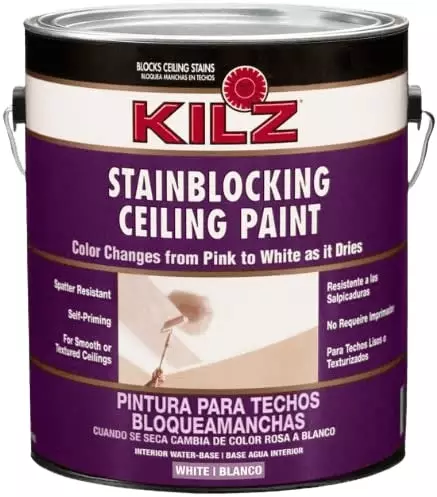
The same pink-to-white behaviour with stain blocking built in. If the ceiling carries a brown water mark, this is the one — an ordinary ceiling paint will let that mark bleed through the second coat and sometimes the third. Coverage runs 250 to 400 square feet per gallon depending on porosity, and it is spatter-resistant and low odour.
If the stain is still damp, stop. Find the leak, let the ceiling dry out completely, then paint. Sealing moisture in guarantees the paint lifts.
3. Rust-Oleum 260967 Zinsser Ceiling Paint, 1 Gallon — best over repairs
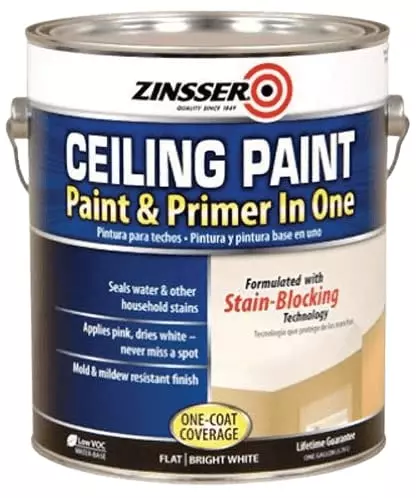
A straightforward bright white ceiling paint and primer with a dead-flat finish and no colour-change theatre — which some people prefer, because a pink ceiling is unnerving if you have not read the tin. Its strength is body: it has enough film build not to flash over a filled crack or a sanded patch, which is where thin ceiling paints give themselves away.
This is the topcoat we point people to after a repair. The full sequence for that job is in ceiling paint to cover cracks.
4. Glidden Interior Latex Ceiling Paint, White Flat, 1 Gallon — best budget
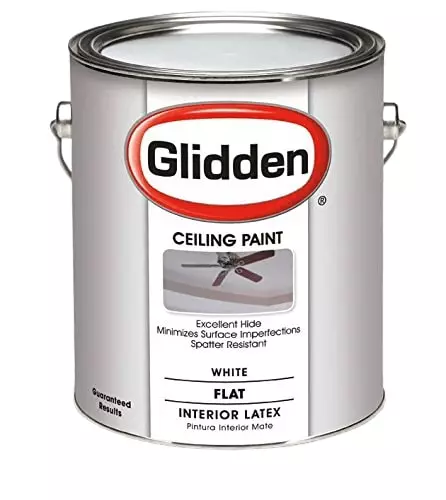
A plain flat white ceiling latex, splash-resistant, and the sensible choice when you are doing several ceilings and the surfaces are sound. It does not block stains and it will not tell you where you have rolled, so it wants a ceiling that is already white, already flat and already in reasonable condition.
On that job it does everything the more expensive tins do. On a stained or patched ceiling it does not.
5. Benjamin Moore Waterborne Ceiling Paint — best finish quality
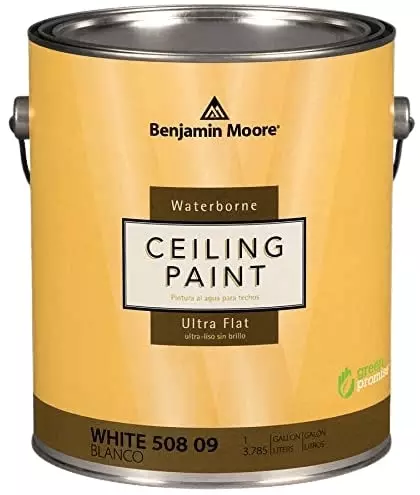
An acrylic waterborne ceiling paint built around three properties: easy application, superior hide and spatter resistance. That combination is what you are paying the premium for, and it shows most on a ceiling that has been patched or that has an uneven paint history, where hide is doing real work.
If your ceilings are plain, sound and white, the Glidden above gets you most of the way for less. If they are not, this is where the money goes.
6. Zinsser 02774 Perma-White Mold & Mildew Proof Interior Paint, Eggshell, Quart — the bathroom exception
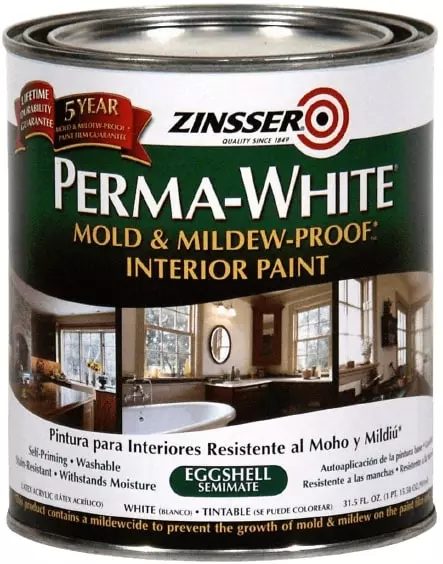
Be clear about what this is: it is an eggshell interior paint, not a ceiling flat, and on a normal ceiling that sheen would show every seam. It is on this list for one situation — a poorly ventilated bathroom or laundry ceiling where the paint keeps growing mildew and peeling, and where a wipeable, moisture-resistant, mould-resistant film is worth more than a perfectly matte surface. It is water-based, dries in about two hours, and covers up to 350 square feet per quart-sized can.
It prevents mould growing on the paint film. It does not remove mould that is already there and it does not fix the ventilation that caused it — see bathroom ceiling paint for mould for the order of operations.
7. Homax Smooth Roll-On Wall Texture, White, 2 Gallon — when paint alone will not hide it
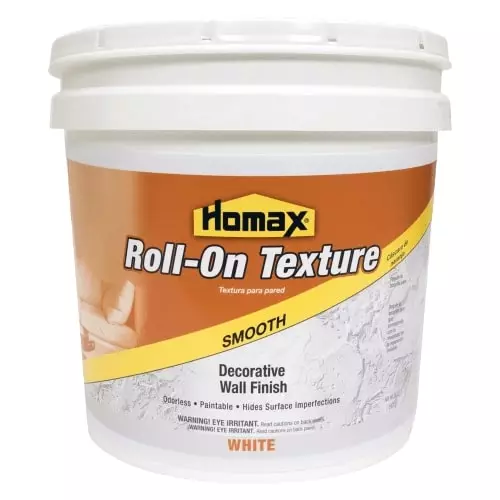
This is a texture, not a paint, and it is here because the most common reason people search for a better ceiling paint is that they want to hide something no paint can hide. A ceiling with visible seam tape, a patchwork of old repairs or a wavy plaster surface is a texture problem. Rolling a light texture over it breaks up the flat plane so light no longer reads the defects, and then you paint over the top.
It is a ready-to-use, low-odour, paintable finish for interior walls and ceilings, and the two gallon tub covers a room-sized ceiling. It is a one-way decision — texture is much harder to remove than to apply — so test a small area first.
Match the Paint to the Ceiling
| Your ceiling | Pick | Why |
|---|---|---|
| Any ceiling, first time spraying or rolling white on white | INSL-X Color-Changing | Shows you where you have already rolled |
| Brown water mark | KILZ Color-Change Stainblocking | Blocks the stain the others bleed through |
| Patched, filled or repaired | Rust-Oleum 260967 | Enough body not to flash over the patch |
| Several sound white ceilings | Glidden Ceiling Paint | Does the job without paying for extras |
| Uneven paint history, want the best hide | Benjamin Moore Waterborne | Superior hide and spatter resistance |
| Bathroom that keeps growing mildew | Zinsser Perma-White | Mould-proof film — accept the eggshell sheen |
| Visible seams or a wavy surface | Homax Roll-On Texture | A texture problem no paint will solve |
Why I Stopped Buying the Cheapest Tin
I did a hallway ceiling with a contractor-grade flat white because it was half the price and the ceiling was in perfect condition, so I reasoned there was nothing for the paint to hide. Two coats, evenly rolled, no complaints on the day.
What I had not accounted for was that the ceiling had been patched years earlier by someone else, and those patches had a different porosity from the original plaster around them. The cheap paint soaked into them at a different rate and dried to a slightly different sheen, so three rectangles appeared in the finished ceiling that had not been visible before I painted. I had made the ceiling worse by painting it.
A high-hide ceiling paint would have sat on top of that difference instead of sinking into it. The lesson is that “the ceiling looks fine” is not the same as “the ceiling is uniform”, and you cannot tell the difference until the paint dries. If a ceiling has any history you do not know, spend the extra on hide.
When Ceiling Paint Is Not the Answer
- The stain is still wet. Any coating over active moisture traps it and lifts. Find the leak, let it dry through, then paint.
- Mould is already growing. Paint does not kill mould and mould-resistant paint only protects the new film. The growth has to be treated and the ventilation improved first.
- Cracks that keep reopening. No ceiling paint bridges a moving crack. That needs filler, mesh and a high-build binding primer before any topcoat.
- Unpainted popcorn texture. It absorbs water, swells and detaches. Spraying is far safer than rolling — see how to paint a popcorn ceiling.
- New, unprimed drywall. Bare board and joint compound absorb at completely different rates, so the finish flashes badly. That is a primer job first — see drywall primer.
- Nicotine or heavy smoke staining. This bleeds through water-based ceiling paint no matter how many coats you put on. It needs a dedicated blocking primer.
Ceiling Paint Questions People Actually Ask
What is the best ceiling paint to hide imperfections?
A high-hide, ultra-flat ceiling paint — the Benjamin Moore waterborne and the Rust-Oleum 260967 are the two here that lead on body and hide. But be honest about the defect: paint hides differences in colour and porosity, not differences in shape. Visible seams, ridges or a wavy surface are a texture problem, and no paint fixes them.
Is there a really bright white ceiling paint?
Yes — look for products described as bright white rather than simply white, such as the Rust-Oleum 260967. Bear in mind that ultra-flat finishes read slightly softer than the same colour in a sheen, because they scatter light instead of reflecting it. That softness is what makes them hide well. There is more on shade choice in the white ceiling paint guide.
Can I use regular wall paint on a ceiling?
On a smooth drywall ceiling, flat wall paint works. It is not spatter-resistant, so expect more mess overhead, and it is the wrong choice on textured or acoustic ceilings because it fills the texture in. Anything above flat — eggshell, satin, semi-gloss — is a mistake on a ceiling regardless of quality.
How many coats of ceiling paint do I need?
Two, nearly always. One coat over an existing white ceiling looks acceptable wet and shows uneven porosity as it dries. Colour-change paints at least tell you honestly where the first coat landed, which is why they save people a third coat rather than a second.
What sheen should ceiling paint be?
Flat, or ultra-flat where you can get it. The only common exception is a poorly ventilated bathroom, where some people accept a slight sheen in exchange for a wipeable, moisture-resistant film. More detail on sheen is in the flat ceiling paint guide.
How much ceiling paint do I need?
Most ceiling paints publish 250 to 400 square feet per gallon, and the lower end is what you should plan for on a porous or previously unpainted surface. For two coats on a typical 12 by 15 foot room, one gallon is tight and two is comfortable. Running out mid-ceiling is worse than over-buying, because a new tin can dry to a marginally different shade.
Does ceiling paint really spatter less?
Yes, and it is a genuine formulation difference rather than marketing. Ceiling paints are thickened to cling to the roller under gravity. The difference is obvious the first time you roll wall paint overhead. Nap length matters too — see the ceiling roller guide for matching nap to your texture.
What paint should I use on a high living room ceiling?
The same flat ceiling paint you would use anywhere, but the application changes more than the product does. High ceilings are viewed from further away and usually under more raking light from tall windows, which makes lap marks more visible, not less. Work in one direction, keep a wet edge across the full run, and use an extension pole rather than a ladder so you are not repositioning every few feet.
For the rolling technique itself, see the best way to paint a ceiling. If the ceiling is large enough that rolling is impractical, an airless sprayer is the alternative.
Written by Sophie Ulman. ThePaintly is reader-supported: when you buy through links on this site we may earn an affiliate commission at no extra cost to you.