Best Paint for Kitchen Cabinets: Top Picks for a Flawless Finish
Updated: April 2026 | By ThePaintly Editorial Team
Finding the best paint for kitchen cabinets is one of the highest-return decisions in any kitchen refresh. A good cabinet paint transforms scratched, dated surfaces into something that looks brand new — without the $10,000+ price tag of a full remodel. The wrong paint, though, chips within months and leaves you worse off than when you started.
We researched dozens of options, filtered for durability, adhesion, and real-world performance. Below you’ll find our top picks — each with validated Amazon links and honest assessments of where they shine and where they fall short.
Quick Picks at a Glance
| Pick | Product | Best For | Link |
|---|---|---|---|
| 🥇 Best Overall | Rust-Oleum Transformations Basics Pure White | Classic white kitchens | View on Amazon |
| 🥈 Best Dark Tone | Rust-Oleum Transformations Basics Black | Modern, dramatic cabinets | View on Amazon |
| 🥉 Best Neutral | Rust-Oleum Transformations Basics Cadet Gray | Timeless gray finish | View on Amazon |
| 🏅 Best Cabinet-Specific | KILZ Tribute Cabinet & Trim Paint White | Maximum durability & block resistance | View on Amazon |
Top 4 Cabinet Paints Reviewed
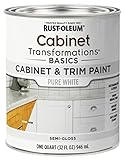
Rust-Oleum Transformations Basics Cabinet & Trim Paint — Pure White
This is the paint we reach for first when someone asks what to put on kitchen cabinets. Rust-Oleum’s Transformations Basics line delivers a factory-smooth semi-gloss finish that is fully washable and genuinely resistant to scratches and stains — the two things that destroy cabinet paint in a busy kitchen. One quart covers up to 50 sq ft, which means a standard 10-cabinet kitchen requires roughly 3–4 quarts for two coats.
Application is forgiving. The formula levels well, which minimizes brush marks even on flat cabinet faces. It dries to the touch in 30 minutes and reaches full hardness in about 7 days. One real-world downside: the satin sheen is closer to a semi-gloss than a true eggshell, so if you want a matte look, this isn’t your pick. Otherwise, it’s the most predictable performer in this price range.
✅ Pros
- Excellent leveling — minimal brush lines
- Highly washable semi-gloss
- Fast recoat time (2 hrs)
❌ Cons
- Sheener than advertised
- Quart size only — costly at scale
Best for: White or light kitchens needing a durable, clean finish.
Check Price on Amazon →Via Amazon.com
🔗 Related Reads on ThePaintly
- Best Airless Paint Sprayer for Furniture — ideal for spraying cabinet doors flat
- Beginner’s Guide to Paint Spray Guns — skip the brush entirely
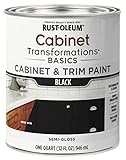
Rust-Oleum Transformations Basics Cabinet & Trim Paint — Black
Dark kitchen cabinets became a design staple for a reason — they hide grime better than white and create a striking contrast with light countertops. The Transformations Basics in Black delivers on that promise. Coverage is consistent across both brush and foam roller application, and the pigment load is high enough that two coats over a primed surface builds full opacity on previously white or light-colored cabinets.
The formula shares the same washable semi-gloss base as the white version. One important note from real users on Reddit: skip the second coat until the first is completely dry — rushing it causes micro-crazing in dark tones more than in light ones. Give each coat 2 full hours before recoating. Budget an extra quart for dark-over-light projects, since you may need three coats for true depth.
✅ Pros
- Rich, deep black tone
- Pairs with any hardware style
- Scrubbable finish stands up to grease
❌ Cons
- May need 3 coats over white
- Shows dust and fingerprints more
Best for: Modern or industrial kitchens going dark for the first time.
Check Price on Amazon →Via Amazon.com
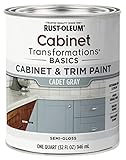
Rust-Oleum Transformations Basics Cabinet & Trim Paint — Cadet Gray
Gray cabinets remain the most searched kitchen color trend, and Cadet Gray sits in a sweet spot: warm enough to avoid looking cold and blue, neutral enough to pair with virtually any countertop. This quart delivers the same durable, semi-gloss formula as the rest of the Transformations Basics line. Coverage is solid — expect 45–50 sq ft per quart on previously painted, smooth cabinet faces.
Where Cadet Gray earns its place on this list is versatility. It photographs exceptionally well, transitions between traditional and contemporary styles, and holds up to grease spatters without showing staining. Users on home improvement forums consistently note that it requires almost no touch-up in high-traffic kitchens even after 18+ months of use — a strong signal of real durability.
✅ Pros
- Extremely versatile neutral
- Hides minor surface imperfections
- Easy two-coat coverage
❌ Cons
- May run slightly cool under certain lighting
- Limited to quart size online
Best for: Transitional kitchens that need a safe, crowd-pleasing neutral.
Check Price on Amazon →Via Amazon.com
🔗 More Painting Resources
- Best Paint Remover for Wood & Metal — strip old finishes before painting cabinets
- How to Remove Paint with Steam — a heat-gun alternative for tough surfaces
KILZ Tribute Cabinet, Door & Trim Paint — Semi-Gloss White
KILZ built Tribute specifically for the demands of cabinet surfaces. That means it’s formulated for block resistance — painted cabinet doors won’t stick to frames after closing within 3 hours of dry time. This matters far more than most DIYers realize. Standard interior wall paints bond to themselves when compressed, which is how doors and cabinets end up pulling paint off frames every time you open them. Tribute eliminates that problem by design.
The semi-gloss white is bright and clean, with slightly better hide than the Rust-Oleum picks when going over bare MDF or raw wood. It dries to touch in one hour and is recoatable in 2 hours. For cabinets that see daily opening and closing — which is every cabinet in a functioning kitchen — this formulation edge makes a measurable difference over the long term.
✅ Pros
- True cabinet-grade block resistance
- Excellent hide on MDF and bare wood
- Interior/exterior rated — handles humidity
❌ Cons
- Slightly pricier per quart
- Less color variety available online
Best for: Anyone who’s had cabinet doors stick and peel — this solves it.
Check Price on Amazon →Via Amazon.com
💡 Pro Tips Before You Buy
Always prime first. Even “no-primer-needed” paints bond better and last longer over a dedicated primer — especially on MDF or previously varnished cabinets.
Pull the doors off. Painting cabinet doors flat (laid on sawhorses) eliminates drips and brush marks. It takes 30 extra minutes to set up and saves hours of touch-up work.
Two thin coats beat one thick coat. Every time, on every surface.
Renovation Stage: PAINT
This article covers the PAINT stage of your kitchen renovation. Make sure your cabinets are cleaned, deglossed, and primed before applying any of the paints above. Need primer recommendations? See our sprayer guide for applying primer efficiently.
Paint Coverage Calculator
Estimate how much paint you need for your kitchen cabinets.

Buying Guide: How to Choose the Best Paint for Kitchen Cabinets
Not all paint is cabinet paint. Standard interior latex formulated for walls fails on cabinet surfaces within months. Here’s what separates good cabinet paint from everything else.
Sheen Level: Semi-Gloss Is the Standard
Kitchen cabinets need a sheen that is easy to wipe clean. Semi-gloss is the industry standard for a reason — it repels moisture, handles grease, and tolerates repeated cleaning better than any flat or eggshell finish. Some manufacturers offer a “satin” option that performs similarly. Avoid anything labeled flat or matte for surfaces that get touched daily.
Block Resistance: The Feature Nobody Talks About
Block resistance refers to a paint’s ability to resist bonding to itself under pressure. When a painted cabinet door closes against a painted frame, both surfaces touch. If the paint has poor block resistance, those two surfaces fuse slightly — and every time you open the door, you pull up a little paint. Over time, this creates obvious peel and chipping around door edges. Look for paints that explicitly list block resistance on the label, like the KILZ Tribute above. According to This Old House, this is one of the most overlooked specs when shopping for cabinet paint.
Water-Based vs. Oil-Based
Oil-based cabinet paints were the historical gold standard because they self-level beautifully and cure to an extremely hard finish. The downsides are significant: long dry times (8–24 hours between coats), strong solvent smell, and cleanup requiring mineral spirits. Modern water-based alkyd hybrids have largely closed the gap. They clean up with water, dry faster, and still deliver the hard, leveled finish that oil paints are known for. Unless you’re restoring antique furniture, go water-based.
Adhesion: Will It Stick Without Sanding?
The paint itself needs to bond to whatever is currently on your cabinets. Previously painted cabinets with a shiny finish are notoriously slippery. Even if a paint claims “no sanding required,” a light scuff with 220-grit or a liquid deglosser dramatically improves adhesion. The Family Handyman recommends deglossing as a non-negotiable step before any cabinet repaint project.
Prep Steps Before You Paint
Even the best paint for kitchen cabinets fails without proper surface preparation. Follow these steps in order:
- Remove all doors and hardware. Label each door with painter’s tape so reinstallation is simple.
- Clean with a degreaser. Kitchen cabinets accumulate cooking grease that paint won’t bond to. Use a TSP substitute or a dedicated degreasing cleaner.
- Degloss or sand lightly. A liquid deglosser (like Krud Kutter Gloss-Off) or 220-grit sandpaper gives the paint something to grip.
- Apply a stain-blocking primer. Especially on dark, greasy, or tannin-rich wood cabinets. Shellac-based primers like Zinsser BIN stop bleed-through that water-based primers miss.
- Apply paint in thin coats. Two coats of thin paint always outlasts one thick coat that takes forever to cure.
Our Verdict
For most kitchens, Rust-Oleum Transformations Basics Pure White is the right call — durable, well-leveling, washable, and priced accessibly. If you’re dealing with cabinets that stick or you’re painting bare MDF, upgrade to KILZ Tribute for its purpose-built block resistance. Going dark? The Transformations Basics in Black or Cadet Gray delivers the same reliable performance in on-trend finishes.
Whatever you choose, the prep work matters more than the brand. Clean, degloss, prime, then paint — in that order.
Frequently Asked Questions
What is the best type of paint for kitchen cabinets?
Semi-gloss or satin water-based alkyd paints are best for kitchen cabinets. They combine easy cleanup with the hard, washable finish that kitchen surfaces demand. Look for formulas with block resistance to prevent doors from sticking to frames.
Do I need to prime kitchen cabinets before painting?
Yes — almost always. Even paints labeled “no primer required” bond better and last longer over a dedicated primer. On previously varnished, greasy, or tannin-rich wood cabinets, a shellac-based primer like Zinsser BIN is essential to prevent bleed-through and ensure adhesion.
How long does paint last on kitchen cabinets?
A properly prepped and painted kitchen cabinet finish typically lasts 5–10 years before needing a refresh. The main factors are surface prep, primer quality, paint choice, and the number of coats applied. Semi-gloss finishes generally last longer than flat finishes in kitchen environments.
Can I paint kitchen cabinets without sanding?
You can use a liquid deglosser instead of sanding, which is easier and faster on raised-panel doors. However, skipping both sanding and deglossing almost always leads to adhesion failure — the paint peels within months. At minimum, use a deglosser like Krud Kutter Gloss-Off before painting.
How many coats of paint do kitchen cabinets need?
Two coats is the standard. Three coats may be needed when painting a dark color over light, or when going from a light color to a deep, saturated tone. Always allow full dry time between coats — rushing recoat times is the #1 cause of brush marks and peeling.
What sheen is best for kitchen cabinet paint?
Semi-gloss is the most popular and practical choice. It’s easy to wipe clean, resists grease and moisture, and holds up to repeated scrubbing. Satin is a close second if you prefer a slightly lower sheen. Avoid eggshell and flat finishes on kitchen cabinets — they absorb grease and stain permanently.