
Garage Ceiling Paint: 3 Picks That Resist Drips (2026)
Updated: July 2026 · By Sophie Ulman
Choosing the right garage ceiling paint is one of the most overlooked decisions in a garage renovation — yet it has a bigger impact on how the space looks and feels than almost anything else. A bright, well-painted ceiling reflects light down into your workspace, makes the garage feel larger, and creates that clean, finished look that separates a real workshop from a cluttered storage space.
The challenge is that garage ceilings are harder to paint well than walls. The surface is often bare drywall or exposed concrete decking, and standard interior paint sags, drips, and requires multiple coats to achieve proper opacity overhead. The right garage ceiling paint is thicker, applies without dripping, and covers in fewer passes. This guide gives you the best products for 2026 and the exact technique to apply them.
The first time I painted a garage ceiling, I grabbed a half-used can of standard wall paint from the shelf instead of driving back to the store for the real thing. Big mistake. It ran off the roller in thin streams the whole session, and I spent more time wiping drips off my drop cloths than actually painting. Two coats of proper garage ceiling paint the following weekend fixed what one coat of the wrong product never could.
Quick Picks: Best Garage Ceiling Paints
| Pick | Product | Best For | Check Price |
|---|---|---|---|
| Best Overall | Rust-Oleum Interior White Flat Ceiling Paint | Drywall ceilings, maximum brightness | Amazon → |
| Best Budget 5-Gal | True Value EasyCare Ceiling White | Large garages, cost-effective coverage | Amazon → |
| Best for Texture | Best Look Flat White Ceiling Paint | Textured or uneven surfaces | Amazon → |
Product Reviews: Best Garage Ceiling Paints
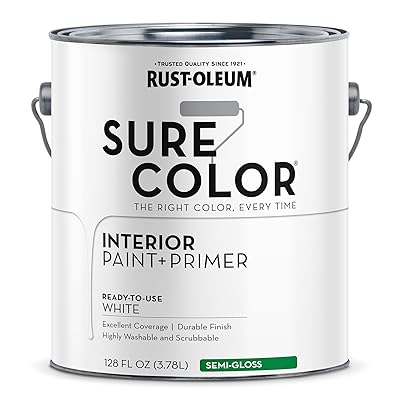
Rust-Oleum Interior White Flat Ceiling Paint
Rust-Oleum’s flat ceiling paint is formulated specifically for overhead application — it’s thicker than standard wall paint, which reduces drips and allows a loaded roller to carry more paint without splatter. The flat finish eliminates the glare that semi-gloss and eggshell create overhead, and the bright white reflects a maximum amount of light downward into the workspace. For a typical garage with fluorescent or LED shop lights, the difference between a painted and unpainted ceiling is dramatic.
Coverage runs approximately 400 sq ft per gallon on smooth drywall — a standard two-car garage ceiling (around 400–450 sq ft) takes one gallon per coat. Two coats are standard for bare drywall; previously painted ceilings often need only one. The paint dries in 1 hour and can be recoated in 2 hours, making it possible to finish both coats in a single morning. On Reddit’s r/garageporn, this is the most frequently recommended product when users ask what paint transformed their garage ceiling.
Key Fact: Thicker formula designed for overhead application — less dripping and splatter than standard wall paint.
✔ Pros
- Thick, drip-resistant formula
- Flat finish — no glare overhead
- Bright white maximizes light reflection
- Fast dry — recoat in 2 hours
✘ Cons
- Flat finish doesn’t wipe clean easily
- Available in white only
Best for: Drywall or drywalled garage ceilings where maximum brightness and ease of application are the priorities.
Check Price on AmazonVia Amazon.com
For large garage ceilings, a paint sprayer dramatically cuts application time. See our guide to paint spray guns for beginners — the right sprayer makes ceiling work much less tiring.

True Value EasyCare Ceiling White
For large garages — three-car, detached shops, or anyone doing a ceiling repaint across a big footprint — buying by the 5-gallon bucket is the smart financial move. True Value’s EasyCare Ceiling White costs significantly less per square foot than buying individual gallons, and the formula holds up well for garage applications. It applies smoothly with a 3/8-inch nap roller, levels without visible lap marks, and dries to a uniform flat white.
The coverage is slightly less efficient than premium ceiling paints — expect around 350–380 sq ft per gallon on bare drywall, though previously painted surfaces get closer to 400 sq ft per gallon. This is the budget-conscious choice for anyone covering 1,000+ sq ft or planning a full garage renovation where the ceiling is just one of several surfaces. The 5-gallon bucket gives you enough for a large garage with a full second coat to spare.
Key Fact: 5-gallon format covers up to 1,900 sq ft — enough for two full coats on a standard two-car garage ceiling.
✔ Pros
- Lowest cost per square foot
- 5-gallon covers large spaces
- Smooth application with standard roller
- No lap marks when applied correctly
✘ Cons
- Slightly thinner than premium ceiling paints
- More drip-prone on rough surfaces
Best for: Large garages, shops, or anyone doing a full renovation where cost per square foot matters more than premium finish quality.
Check Price on AmazonVia Amazon.com
Already painting the ceiling? While you’re up there, check our guide on best paint colors for large rooms with high ceilings — the same principles apply to making your garage feel spacious and well-lit.
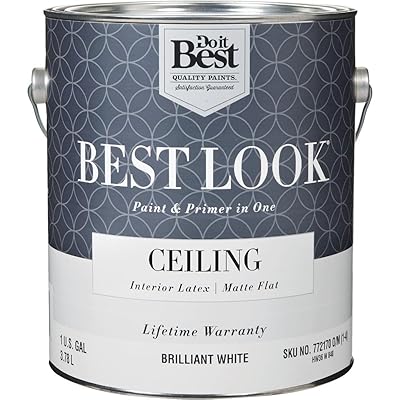
Best Look Flat White Ceiling Paint
Many garage ceilings — particularly older ones — have texture: orange peel, knockdown, or popcorn finishes applied decades ago. Standard ceiling paint struggles on these surfaces because the peaks of the texture absorb more paint than the valleys, leading to patchy coverage. Best Look Flat White is a higher-solids formulation that fills into texture more evenly, delivering consistent opacity in fewer coats. It’s particularly effective on garage ceilings with slight irregularities or repair patches.
The formula is also designed for garages with older drywall that may have minor staining from roof leaks or humidity. Its higher hide power covers minor water stains in two coats without requiring a separate stain-blocking primer in most cases. It applies well with a 1/2-inch nap roller, which is the right choice for any textured surface. Coverage averages around 350 sq ft per gallon on textured surfaces — expect to need 15–20% more product than you would on smooth drywall.
Key Fact: Higher-solids formula covers texture and minor staining without a separate stain-blocking primer in most cases.
✔ Pros
- Excellent hide on textured ceilings
- Covers minor water stains
- High-solids — fills small surface variations
- Works with thicker nap rollers
✘ Cons
- Lower coverage per gallon on textured surfaces
- Heavier — roller requires more effort overhead
Best for: Textured ceilings, older garages with minor staining, or any ceiling with surface irregularities.
Check Price on AmazonVia Amazon.com
🔧 Pro Tips: Painting a Garage Ceiling
- Use an extension pole: An 18–24 inch roller extension keeps your arms at a natural angle and dramatically reduces fatigue — painting a ceiling without one is brutal.
- Cut in first: Use a 3-inch brush to paint 3–4 inches along all wall edges before rolling the field. Dried cut-in lines show through the rolled finish.
- Work in sections: Roll 4×4 foot sections at a time, keeping a wet edge. Moving too slowly causes visible lap marks where dried and wet paint meet.
- Protect everything: Drop cloths on the floor, plastic sheeting over walls you’ve already painted. Ceiling paint drips more than you expect.
- Wear safety glasses: Ceiling painting sends paint particles directly toward your eyes — protect them every time.
🎨 PAINT Stage — Ceiling in the Renovation Sequence
Ceiling painting is always done first in the PAINT stage sequence — ceiling before walls, walls before trim. This way, any drips or splatter on the walls get covered when you paint them next. For more ideas on transforming your garage ceiling space, see our master guide to ceiling transformations. If you’re matching a color already on your ceiling, read our guide on how to match paint already on a wall — the same technique applies overhead.
🧮 Garage Ceiling Coverage Calculator
Calculate how many gallons of garage ceiling paint you need.

How to Paint a Garage Ceiling: Step-by-Step
- Clear and cover: Move everything out of the garage or push it to the center and cover with drop cloths. Lay plastic sheeting along the walls. Ceiling painting is the messiest task in any garage renovation.
- Fix surface issues: Fill any cracks or drywall tape seams with joint compound. Sand smooth after drying. Address any active moisture issues before painting — paint applied over a wet or actively leaking ceiling will fail.
- Prime if needed: New drywall requires a PVA drywall primer before topcoating. Previously painted ceilings in good condition don’t need primer. Stained areas need a stain-blocking primer (Zinsser BIN or KILZ Original) before the topcoat — ceiling paint won’t reliably cover water stains in two coats without it.
- Cut in the perimeter: Use a 3-inch brush to paint a 3–4 inch band along all walls where they meet the ceiling. This creates clean lines that the roller can’t reach.
- Roll the field: Load the roller generously. Work in 4×4 foot sections, rolling in one direction then crossing perpendicular. Maintain a wet edge by moving quickly and not letting sections dry before blending them together.
- Allow to dry fully: Most ceiling paints are recoatable in 2 hours. Wait for the surface to look uniform and feel dry before assessing whether a second coat is needed — often patches that look thin when wet look fine once dry.
- Apply second coat: Roll in the opposite direction from the first coat. This cross-rolling technique fills any gaps left by the first pass and creates the most uniform finished appearance.
When NOT to Use Standard Garage Ceiling Paint
Do not roll a flat ceiling paint over active moisture. If the ceiling deck is still damp from a roof leak or condensation, the paint film will trap that moisture and blister or peel within a season — fix the leak and let the surface dry fully first. Do not skip the stain-blocking primer on water-stained drywall. Ordinary ceiling paint alone will not reliably cover a stain in two coats; it just fades back through. And do not expect a flat finish to survive being wiped down — if you park a bike against the wall or the garage sees a lot of dust and grease transfer, a washable ceiling paint or a scrubbable eggshell will hold up better than the flat white picks above.
Our Verdict
The best garage ceiling paint for most people is Rust-Oleum Interior White Flat — it’s thick, drip-resistant, dries fast, and delivers the brightest possible result. For large garages where cost per square foot drives the decision, True Value EasyCare in a 5-gallon bucket is the smart bulk buy. Textured or stained ceilings get the best coverage from Best Look Flat White. Any of these three choices will transform your garage — a painted ceiling is the single cheapest way to make the whole space feel clean and professional.
Frequently Asked Questions
What is the best paint for a garage ceiling?
The best garage ceiling paint is a flat white ceiling-specific formula such as Rust-Oleum Interior Flat Ceiling Paint. These are formulated with higher viscosity to reduce dripping during overhead application and deliver better coverage than standard wall paint.
Do I need special paint for a garage ceiling?
Yes — ceiling-specific paint is worth buying for garage applications. It’s thicker to prevent dripping overhead, and the flat finish avoids glare from shop lighting. Standard interior paint can be used in a pinch but will drip more and require more coats.
Should I prime the garage ceiling before painting?
New drywall requires a PVA primer first. Previously painted ceilings in good condition usually don’t need primer. Water-stained areas should be spot-primed with a stain-blocking primer like Zinsser BIN before topcoating.
How many gallons do I need to paint a two-car garage ceiling?
A standard two-car garage ceiling (approximately 400–450 sq ft) needs about 1 gallon per coat. Two coats is standard for bare drywall, so budget 2–3 gallons total including waste. Use the coverage calculator above for a precise estimate.
What sheen should I use for a garage ceiling?
Flat sheen only. Semi-gloss and satin sheens create uncomfortable glare from overhead shop lights. Flat paint scatters light evenly and is the standard choice for every garage ceiling application.
Can I use the same paint on the garage ceiling and walls?
Technically yes, but it’s not ideal. Wall paint is thinner and more prone to dripping during ceiling application. Using ceiling-specific paint overhead and a separate wall paint on the walls gives better results for both surfaces.
How long does garage ceiling paint take to dry?
Most ceiling paints dry to touch in 1 hour and are recoatable in 2 hours under normal conditions. Full hardness is typically reached in 24–48 hours. Don’t paint in temperatures below 50°F — cold extends dry times significantly.