Best White Paint for Kitchen Cabinets (2026): Top Picks Reviewed
Updated April 2026 · By ThePaintly Editorial Team
Choosing the best white paint for kitchen cabinets is not as simple as grabbing the whitest can on the shelf. White cabinet paint needs to cure hard against daily grease and moisture, self-level enough to hide brush marks, and stay true white without yellowing under kitchen lighting. The wrong choice peels in months or turns cream without warning. The right choice lasts a decade.
We reviewed the top cabinet-specific white paints available in 2026 — evaluating urethane reinforcement, self-leveling behavior, chip resistance, and VOC levels. Below are our three top picks, a buying guide covering everything from sheen selection to white tone, and a paint coverage calculator so you know exactly how much to order before you start.
Quick Picks at a Glance
| Pick | Product | Sheen | Best For |
|---|---|---|---|
| 🥇 Best Overall | INSL-X Cabinet Coat Satin White | Satin | Durable, self-leveling daily use |
| 🥈 Best Semi-Gloss | INSL-X Cabinet Coat Semi-Gloss White | Semi-Gloss | High-traffic kitchens, easy wipe-down |
| 🥉 Best Complete Kit | Rust-Oleum Cabinet Transformations Kit | Satin | All-in-one no-prime transformation |
Top 3 White Paints for Kitchen Cabinets Reviewed
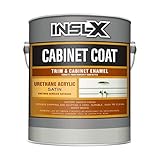
INSL-X Cabinet Coat consistently earns its reputation as the best white paint for kitchen cabinets at the consumer level, and the reasons are concrete. The urethane-reinforced acrylic formula self-levels aggressively — meaning it flows out after application to eliminate most brush marks before drying. That characteristic alone sets it apart from standard latex paints, which tend to hold every bristle trace in their final surface.
The white in Cabinet Coat Satin is a clean, bright white with minimal undertone — close to a true neutral white that reads well under both warm and cool kitchen lighting. It cures to an extremely hard surface over 7 days, resisting chips, grease stains, and repeated wiping. The satin sheen level is low enough to be forgiving on slightly imperfect surfaces while being easy to clean. Cabinet painters on Reddit and DIY forums consistently cite Cabinet Coat as the product that “finally got me a finish that looks like new cabinets” without professional spray equipment. Coverage runs 400–450 sq ft per gallon.
- Self-levels to hide brush and roller marks
- Cures extremely hard for daily kitchen use
- Clean, neutral white with minimal yellowing
- Low VOC, water-based, easy cleanup
- Requires 7 days full cure before heavy use
- Premium price vs. standard cabinet paint
Best for: Anyone who wants the smoothest, most durable white cabinet finish without professional spray equipment.
Check Price on Amazon →Via Amazon.com
🎨 Want to understand undertones before choosing your white? Read: How to Match Paint Already on a Wall.
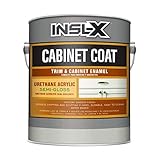
The semi-gloss version of Cabinet Coat shares the same legendary urethane acrylic formula as the satin option — identical self-leveling, identical cure hardness, identical chip resistance — but with a noticeably higher sheen level. That extra gloss makes it ideal for high-traffic kitchens where easy wipe-down is the top priority. Grease, fingerprints, and food splatter all lift off semi-gloss surfaces more readily than from satin, making this the right call for households with children or frequent cooking.
The trade-off with semi-gloss is that it shows surface imperfections more readily. Any remaining texture in your cabinet doors — grain raised by moisture, small dents, or uneven primer — will be more visible in strong side-lighting. If your cabinet doors have been properly primed and are relatively smooth, semi-gloss rewards you with a crisp, almost reflective white that looks genuinely luxurious in a well-lit kitchen. It is the choice of many professional cabinet painters when working in high-humidity or high-use kitchen environments.
- Easier to clean than satin in daily use
- Same ultra-hard urethane cure as satin version
- Crisp, bright white appearance
- Excellent for high-humidity kitchens
- Shows surface imperfections more than satin
- Requires smooth, well-prepared surface for best results
Best for: Busy households where easy cleaning is more important than hiding minor surface imperfections.
Check Price on Amazon →Via Amazon.com
🖌️ Painting surfaces beyond cabinets? Check out: Can You Paint Vinyl Windows? for a related surface upgrade.
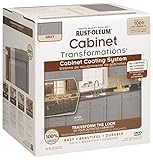
Rust-Oleum Cabinet Transformations takes a different approach to white cabinet refinishing — instead of separate deglosser, primer, and topcoat purchases, it bundles the essential products into a single kit with one goal: get first-timers to a finished kitchen with the least complexity possible. The kit includes a bonding coat, a topcoat finish, a decorative glaze option, and an applicator pad, covering all the functional steps without requiring you to research product compatibility.
The system works without stripping, sanding, or priming in most cases, making it a genuine all-in-one solution. The finish is not as hard as INSL-X Cabinet Coat’s urethane cure, but it performs well for light-to-moderate use kitchens. The kit’s gray premix listed here can be mixed to produce a light neutral that works well as a base under a tinted version — but the white and light color variants of the kit are the most popular for brightening outdated wood cabinets. For anyone overwhelmed by the number of individual product choices, Cabinet Transformations provides a defined, predictable process from start to finish.
- All-in-one kit — no separate primer needed
- No stripping, sanding, or priming required
- Includes applicator tools
- Predictable, well-documented process
- Less durable than urethane enamel alternatives
- Limited color customization versus standalone paints
Best for: First-time cabinet painters who want a simple, all-inclusive process without separate product selection.
Check Price on Amazon →Via Amazon.com
🎯 Pro Tips for White Cabinet Paint
- Test your white paint on an actual door before committing. White reads differently under warm vs. cool lighting — always evaluate samples in your kitchen’s specific light.
- Apply thin coats. White paint is most prone to drips and sag when applied too heavily. Two or three thin coats outperform one thick coat every time.
- Use a Purdy Nylox or Wooster Shortcut brush. High-quality synthetic bristles leave the fewest marks in self-leveling enamel.
- Let white paint yellow less by choosing a formula with UV inhibitors. INSL-X Cabinet Coat is notably resistant to yellowing over time.
- Work face frames first, then doors laid flat — this order minimizes drip risk and keeps the most visible surfaces cleanest.
🎨 Renovation Stage: PAINT
This article covers the PAINT stage of your kitchen cabinet renovation — the visible transformation after all prep work is complete. Your white paint is only as good as the primer layer beneath it. For a complete no-sand approach that pairs perfectly with Cabinet Coat, see our guide on painting wood paneling for related surface techniques.
Paint Coverage Calculator
🪣 How Much White Cabinet Paint Do You Need?

Buying Guide: Sheen, White Tone, and Formula
Satin vs. Semi-Gloss: Which Sheen Is Right for You?
Satin sheen (LRV around 20–35%) is the most forgiving choice for kitchen cabinets. It hides minor surface imperfections, resists fingerprints reasonably well, and looks elegant without being stark. Semi-gloss (LRV 50–70%) is more reflective, cleans faster, and stands up to grease better in the long run — but it magnifies any texture in your prep work. Choose satin if your cabinet surfaces have any roughness or grain texture; choose semi-gloss if you prepped meticulously and want maximum cleanability. Both sheens outperform eggshell and flat finishes for kitchen use.
Understanding White Paint Undertones
White paint undertones matter enormously on kitchen cabinets because cabinets cover large surface areas where undertones become visible. A warm white (yellow or cream undertone, like Benjamin Moore White Dove) pairs well with warm wood tones, brass hardware, and warm lighting. A cool white (blue or gray undertone, like Sherwin-Williams Extra White) reads crisper and works better in modern kitchens with stainless steel appliances and cool LED lighting. INSL-X Cabinet Coat’s standard white leans neutral — a safe choice that reads well in most kitchens without committing strongly to warm or cool.
Why Cabinet-Specific Formulas Outperform Regular Latex
Regular latex wall paint was designed for vertical surfaces that receive minimal physical contact. Cabinet surfaces are opened, closed, wiped, bumped, and grease-splattered daily. Cabinet-specific formulas add urethane reinforcement (INSL-X Cabinet Coat), cross-linking agents, or specialized binders that cure to a significantly harder film than standard latex. According to This Old House, cabinet enamel typically cures 2–3 times harder than standard interior latex — a difference that is immediately apparent after 12 months of kitchen use.
VOC Levels and Indoor Air Quality
All three recommended products in this article are waterborne and low-VOC, making them safe for indoor application with normal ventilation. Oil-based cabinet enamels provide excellent hardness but require mineral spirits for cleanup and produce significantly higher VOC emissions during application and curing. Unless you have very specific durability requirements that waterborne formulas cannot meet, low-VOC waterborne cabinet paint is the right call for kitchen renovation projects.
🖼️ Thinking about custom color mixing? Read: How to Make Custom Colored Chalk Paint at Home with 4 Ingredients.
Application Tips for White Cabinet Paint
- Prime with a stain-blocking bonding primer. White paint is particularly vulnerable to tannin bleed-through from oak, pine, and mahogany. A stain-blocking primer (like INSL-X Stix or Zinsser BIN shellac) prevents tannins from yellowing your white topcoat over time.
- Apply 2–3 thin coats, not one thick coat. White paint drips and sags more visibly than dark colors. Thin coats dry faster, level better, and stack into a more opaque final result.
- Use a high-quality synthetic brush. Cheap bristle brushes leave tracks in self-leveling enamel. A Purdy Nylox or Wooster Shortcut brush produces a dramatically smoother result.
- Work in a temperature range of 60–85°F. Cold temperatures cause self-leveling paints to dry too slowly, sometimes causing runs. Very hot temperatures cause the paint to skin before it can flow out, trapping brush marks.
- Allow full cure time before cleaning. White cabinet paint can appear fully dry within hours but cures to its maximum hardness over 7 days. Avoid harsh wiping or cleaning products during this curing period.
- Check for tint drift in store lighting. Hardware store lighting is often cool and fluorescent — always take a paint chip home before buying and evaluate it in your kitchen’s actual lighting.
Our Verdict
For the best white paint for kitchen cabinets in 2026, INSL-X Cabinet Coat Satin White wins on finish quality, durability, and versatility. Its self-leveling urethane formula consistently produces smoother results than standard cabinet paint, and its neutral white tone works across nearly every kitchen style and lighting condition. If cleanability is your priority, the Cabinet Coat Semi-Gloss provides the same hardness with extra wipe-down ease. For first-time painters who want a guided, all-in-one experience, the Rust-Oleum Cabinet Transformations Kit removes the guesswork entirely. Whichever you choose, commit to proper priming first — no white paint performs well on an unprepared surface.