How to Thin Latex Paint: Exact Ratios for Spray or Roll
By Sophie Ulman · Updated August 2026
Before you learn how to thin latex paint, learn when not to. Most interior latex sold today is formulated to spray straight from the can through a correctly sized airless tip — Sherwin-Williams’ own product data sheets for SuperPaint and Duration interior latex say “no reduction needed” — and every ounce of water you add past that point costs you hide, sheen uniformity, washability, and film build. Thinning is a fix for a specific problem. It is not a default step.
That said, there are four situations where thinning is the right call: HVLP spraying, paint that has thickened in storage, cold-stiffened paint, and brush work in heat where the coat skins before it can level. This guide covers exactly how much to add in each case, and how to tell the difference between paint that is too thick and equipment that is too small.
The Gallon I Ruined Learning This
Early on I sprayed a bedroom with an airless and got tails and fingers off the tip — those long streaks at the edges of the fan. I did what everyone does and added water. About a cup to the gallon, then another. The pattern cleaned up beautifully, so I sprayed the whole room.
Two coats later the wall still showed the old color through it in patches, and the sheen was blotchy where the light raked across. I ended up applying a third full-strength coat over the whole thing. The tip was worn — that was the actual problem, and a five-dollar replacement would have fixed it. Water fixed the symptom and destroyed the film.
So the first diagnostic question is not “how much water?” It is: is this a viscosity problem or an equipment problem? Tails and fingers, spitting, and a fan that will not open are usually a worn tip, a clogged filter, or a tip too small for the material. Genuine over-thick paint shows up as heavy brush drag, a roller that skids, and paint that pulls into ridges instead of flowing out.
Water vs. Floetrol: They Do Different Jobs
Latex paint is a water-borne dispersion of acrylic or vinyl-acrylic polymer held in suspension by thickeners — commonly hydroxyethyl cellulose and associative thickeners. Those thickeners respond to both shear and dilution, which is why what you add matters as much as how much.
Water lowers viscosity by diluting everything, including the binder. That is the trade: thinner paint, weaker film. Clean, room-temperature water, in small amounts, is the right choice when the paint simply needs to flow through a smaller orifice — which in practice means HVLP.
Floetrol is a conditioner rather than a thinner. It extends open time by slowing the initial evaporation phase, so the paint stays workable long enough to level out, without diluting the binder-to-pigment ratio the way water does. When your problem is brush marks, lap marks, or a coat skinning over in heat, Floetrol is the correct answer and water is the wrong one.
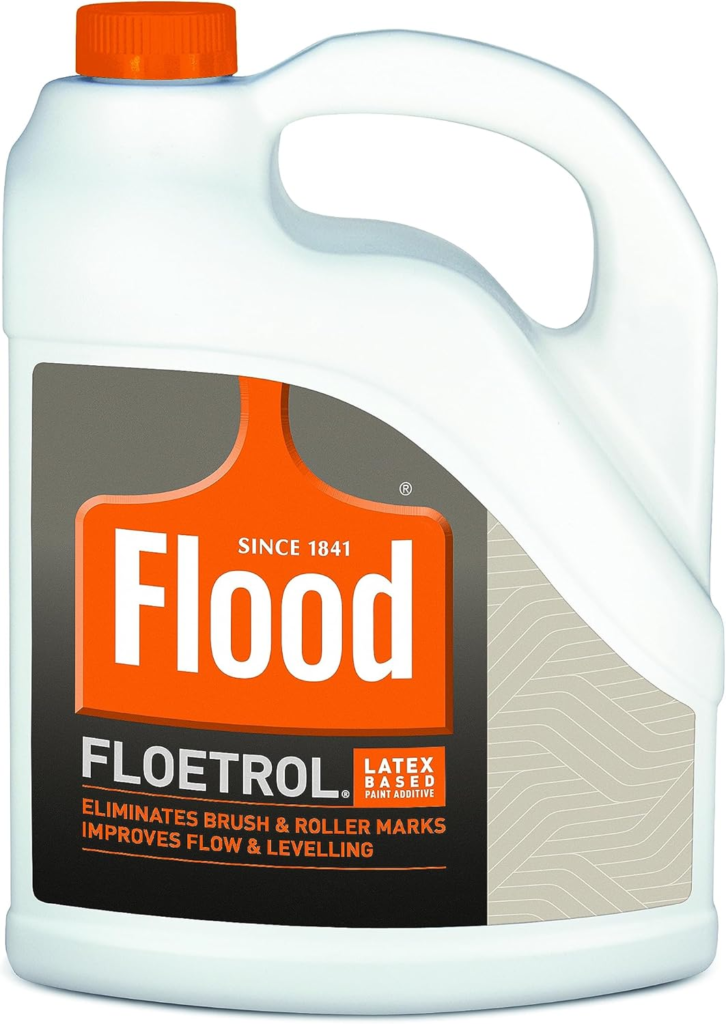
Best for: trim, cabinets, doors, and any brush or roller work above about 75°F. The standard dose is 1 cup per gallon. Where it disappoints: it will not rescue paint that has genuinely gone too thick from age or from sitting open — that needs water, or replacing. And it does nothing for tip clogs, because it is not making the paint meaningfully thinner.
How Much to Add, by Application Method
Percentages below are volume of diluent relative to volume of paint. Add in 5% steps, stir two full minutes after each addition, and test on cardboard before committing. You cannot take water back out.
| Method | Start here | Cold paint (under 50°F) | Hot, dry, or windy |
|---|---|---|---|
| Airless, interior walls | None — check the label first | Up to 5–8% water | None; slow down instead |
| Airless, exterior | None to 5% | Up to 10% water | Floetrol per label |
| HVLP | 10–15% water | 15–20% water | 10% water |
| Brush / roller, walls | None | 5–8% water | Floetrol, 1 cup/gal |
| Brush, trim and cabinets | Floetrol only | Floetrol only | Floetrol only |
Airless: fix the tip before you touch the water
Airless sprayers work by hydraulic pressure, not air, and they are built to atomize full-bodied latex. Standard guidance for interior latex is roughly 2,000 psi through a .017 to .021 tip. If the fan is not opening, work through this order: replace a worn tip, clean the gun and manifold filters — our rundown of airless sprayer filters covers which ones actually clog — then raise the pressure, then step up one tip size. Water is the last resort, not the first.
Cold paint is the honest exception. Latex stiffens sharply below 50°F, and a gallon that came out of an unheated garage genuinely needs help. Bring it indoors overnight first — often that alone solves it.
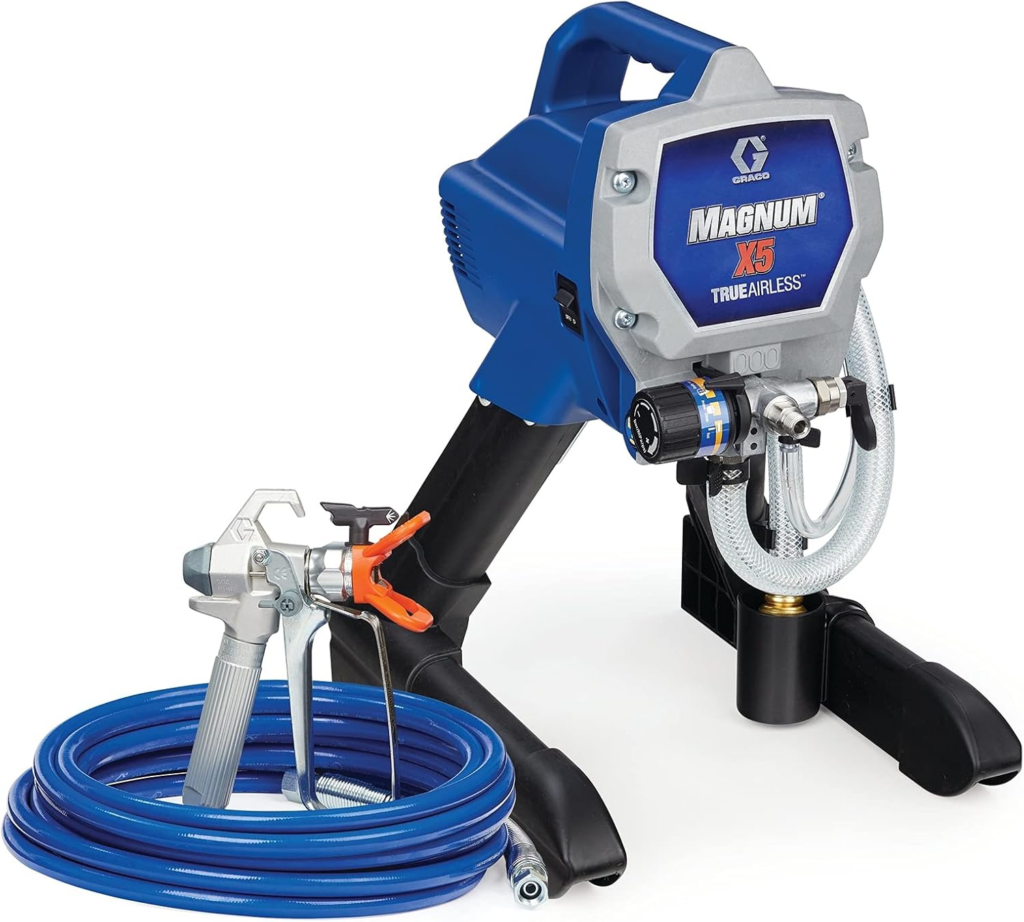
Best for: whole rooms, ceilings, and exteriors where you want to spray unthinned latex and keep full film build. The Graco Magnum X5 handles standard interior latex without reduction, and its flexible suction tube draws straight from the bucket so you are not decanting and whipping air into the paint. Where it disappoints: it is loud, it uses a lot of paint priming and flushing the hose, and on anything smaller than a full room the cleanup outlasts the job. More options in our guide to airless sprayers for doors and trim.
HVLP: this is where thinning is genuinely required
HVLP guns atomize with a high volume of low-pressure air through a fluid needle usually between 1.3mm and 1.8mm for latex. Full-strength wall paint will not pass through that cleanly, so 10–15% water is the normal starting point and 20% is the outer limit before hide starts to visibly suffer. If you need more than 20% to get it through the gun, the needle is too small for the material — change the needle, not the recipe.
Strain every batch. Thinned latex carries the same skins and grit the full-strength can did, and a 1.4mm needle finds all of it.

Wagner Control Spray Max — the HVLP this section assumes. A turbine unit rather than a handheld, which matters for latex: the turbine sits on the floor and pushes a much larger volume of air than a compressor-fed cup gun, so the 1.8mm needle actually atomizes reduced wall paint instead of spitting it. Best for: cabinets, doors, trim, and deck rails — the jobs where an airless is the wrong tool and a brush is too slow. Where it disappoints: the hose is stiff and the cup is small, so whole-room work means constant refilling. And it will not spray unreduced wall paint no matter what you do to the pressure — this is the tool that makes thinning mandatory rather than optional.
Brush and roller
Fresh paint at room temperature needs nothing. What you are usually fighting on a brush is not thickness but open time — the coat skinning before it levels, which shows up as brush marks that will not flow out and lap marks where a wet edge died. That is a Floetrol problem, and it is why trim work and kitchen cabinets get conditioner rather than water: you want full film build with better flow, not a thinner film.
Two thin coats always beat one thick coat, and that rule survives thinning. A properly conditioned coat that levels is worth more than a heavy one that does not.
Measuring Viscosity: What the Cup Can and Cannot Tell You
This is worth being precise about, because a lot of DIY advice gets it backwards.
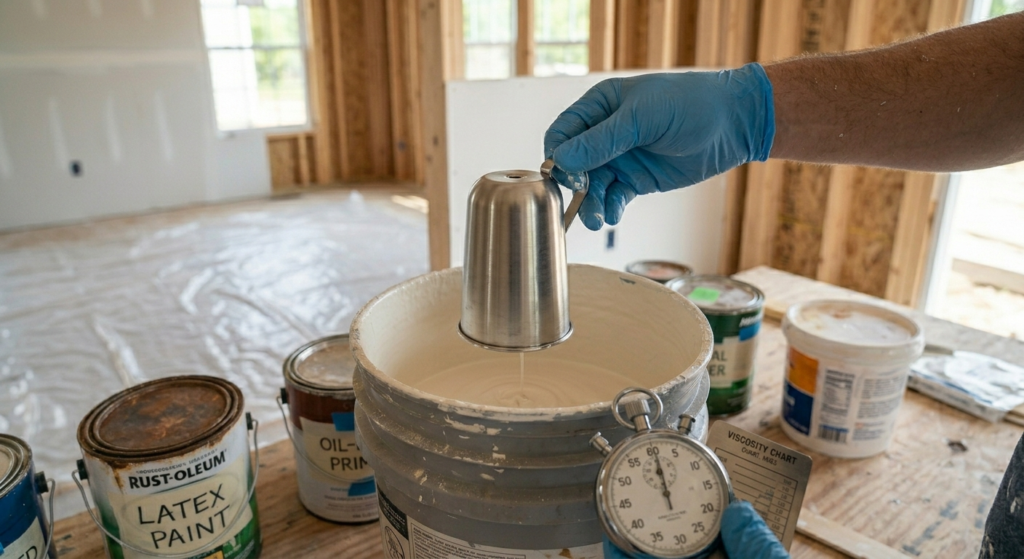
Architectural latex is a non-Newtonian, shear-thinning fluid — it flows more easily the harder you push it, which is exactly what makes it stay on a roller and then level on a wall. Paint manufacturers therefore specify it in Krebs units, measured on a rotating-paddle Stormer viscometer under ASTM D562, and most interior latex is formulated to land somewhere around 90–110 KU. Efflux cups like the Zahn and Ford measure a single flow rate through an orifice, and published conversions between cup seconds and true viscosity are only valid for Newtonian fluids. Full-strength latex is neither Newtonian nor thin enough to run through a Zahn #2 in a meaningful time.
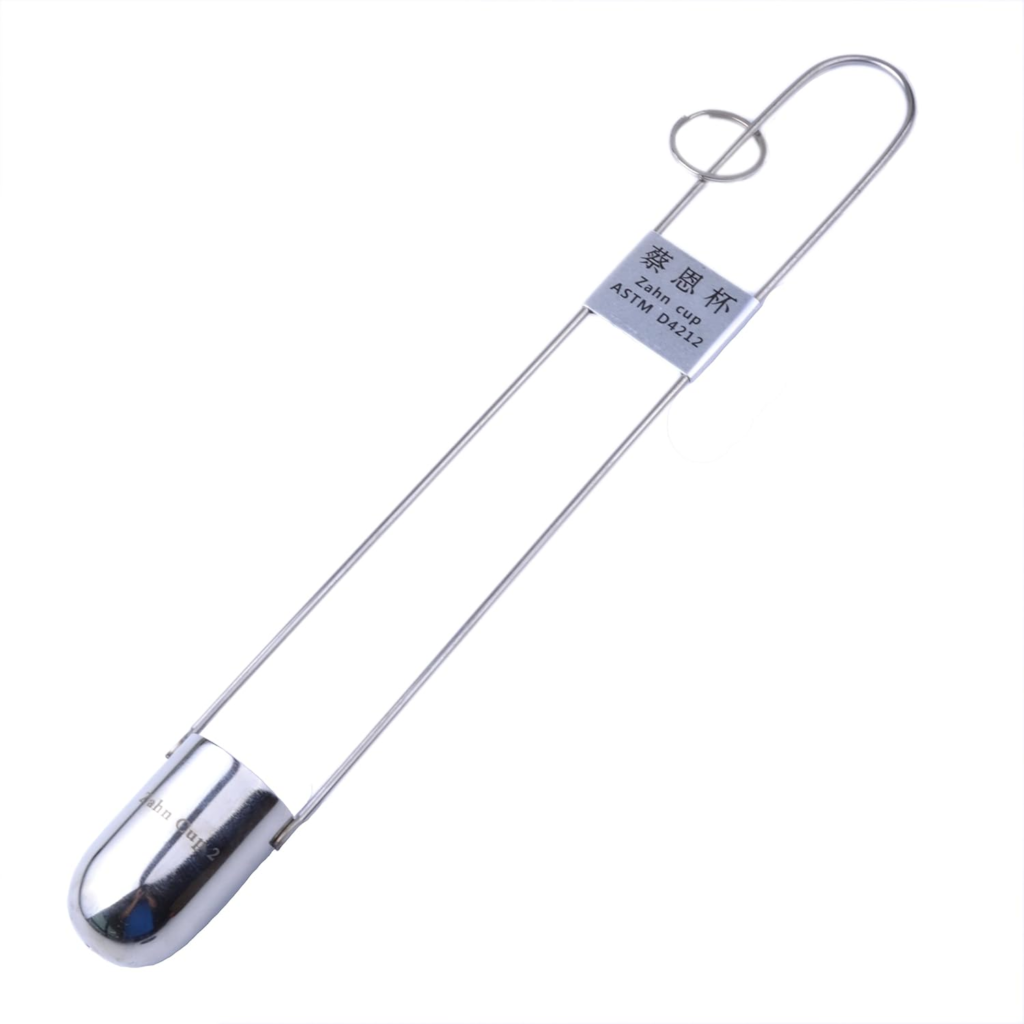
Best for: HVLP work, where the paint is already thinned into the range a cup reads properly and repeatability actually matters — mix a batch you like, record the seconds, and reproduce it exactly next time. Where it disappoints: do not expect it to read full-strength wall paint against a published chart. It is a repeatability tool for thinned material, not a lab instrument for architectural latex. If you only ever brush and roll, skip it.
The practical no-instrument test: stir thoroughly, lift the stir stick out, and watch the paint come off it. Properly thinned spray-grade latex runs off in a continuous stream that breaks into drips after a couple of seconds. If it sheets off instantly like milk, you have gone too far.
Cold Paint: The Problem Thinning Cannot Fix
Every guide tells you cold latex is thick and that warming it or adding water gets it moving again. Both are true. Both also miss the thing that actually ruins cold-weather work, and it is worth understanding before you thin a single gallon in an unheated garage.
Latex paint does not dry the way oil paint cures. It is a suspension of solid polymer particles in water, and the film forms when the water leaves and those particles squash together and fuse into one continuous sheet. That fusing is called coalescence, and it only happens above a specific temperature the chemists call the minimum film formation temperature, or MFFT. Manufacturers dose in coalescing solvents to push the MFFT down, which is how most architectural latex ends up rated to about 50°F, and why the low-temperature formulas are labelled down to 35°F.
Below that line the water still evaporates. The particles just never fuse. What you get is a film that looks painted and is actually a layer of loose polymer beads — chalky under a fingernail, cracking at the edges, and it washes off. The failure I see most often is on an exterior done on a mild afternoon in November where nobody checked the overnight low. The wall looked perfect at dusk and was powdering by the weekend.
Here is the part that matters for thinning: warming a cold gallon fixes viscosity, and viscosity was never the real risk. The temperature that decides whether the film forms is the temperature of the surface and the air for the whole cure window, not the temperature of the paint in the can. And adding water dilutes the coalescing solvent along with everything else, which nudges the effective MFFT up at exactly the moment you need it down. Thinning cold paint to spray it in a cold room makes the one failure you cannot repaint over more likely, not less.
The rule I work to: check the overnight low, not the daytime high, and give yourself a four-hour margin above the label minimum. If the forecast will not give you that, the honest answer is to wait. There is no recovery from a coat that never coalesced — warming it up afterwards does nothing, because the water is already gone. It comes off with a scraper and you start again.
One thing worth deciding before you thin anything: whether the can is worth saving at all. Thinning fixes viscosity, not spoilage — if the paint smells sour, has gone stringy, or has been through a freeze-thaw cycle, no amount of water brings it back and you are better off getting rid of the old paint responsibly instead of spraying a gallon that will fail on the wall.
Fixing Paint You Over-Thinned
You cannot remove water. There are only two real recoveries.
Before the recovery options, it is worth seeing what the loss actually is in numbers, because “you lose hide” is vague enough to ignore. A gallon of decent interior latex is specified around 350 to 400 square feet, which lands roughly 1.5 mils of dry film on the wall. Thin it 20% and you now have 1.2 gallons of material carrying the same amount of solids. Roll it out at the same wet thickness — which you will, because your arm does not know the difference — and the dry film drops by about a sixth, to somewhere near 1.25 mils. Two coats gets you 2.5 mils where the manufacturer designed for 3.
That half a mil is the whole argument. It is the difference between covering a red accent wall in two coats and covering it in three, and it is also where washability lives — there is simply less binder per square foot holding pigment to the surface when you take a sponge to it a year later.
Blend it back. Mix the over-thinned batch with fresh unthinned paint from the same product and colour until it comes back into range. This preserves hide and sheen better than anything else, and it is why you should never thin the last gallon of a job.
Demote it to a first coat. If you have nothing to blend with, spray it thin and even as a base, let it cure, and put a full-strength coat over it. It will not hide on its own, so plan on the extra coat rather than discovering you need it.
What does not work: adding a thickener from the hardware store to bring it back. Architectural latex rheology is a balance of several additives, and dosing one of them into a finished paint tends to give you a gelled, stringy mess that ropes off the roller.
Flash drying, and why thinning is the wrong cure for it
Flash drying is the coat skinning over before it levels — a pebbly or wrinkled look on walls, brush marks on trim that refuse to flow out. It happens in heat, low humidity, wind, direct sun, and next to an HVAC vent that is blowing on your wet edge.
Adding water makes this worse, not better, because water is the component evaporating fastest. Floetrol is the fix, along with shutting vents, closing windows, working out of direct sun, and keeping a wet edge by loading generously and moving fast. If you are also fighting the opposite problem, our guide on speeding up paint drying covers the other direction.
When NOT to Thin Latex Paint
- The data sheet says no reduction needed. Sherwin-Williams says exactly that for SuperPaint and Duration interior latex on airless. Thinning past a manufacturer’s spec can also affect warranty coverage — check before, not after.
- You are spraying a self-priming or one-coat product. Those claims depend on film build. Water removes the film build and the claim with it.
- The problem is a worn tip, a clogged filter, or low pressure. Thinning masks equipment faults and you pay for it in coverage.
- You are painting exterior masonry or elastomeric. These are formulated thick to bridge hairline cracks. Thin them and they stop bridging.
- It is the last gallon. Keep something unthinned in reserve — it is the only reliable way to rescue an over-thinned batch.
And the thing that outranks every ratio in this article: prep matters more than the brand, and more than the mix. Perfectly thinned paint over a dusty, glossy, or unprimed wall still fails. Clean, dull, and sound first — then worry about viscosity. On slick or previously varnished work, that starts with the right bonding primer, not with the mix.
Thinning Latex Paint FAQ
How much water do you add to a gallon of latex paint?
For HVLP, start at 10–15% by volume, which is roughly 13 to 19 ounces per gallon, and treat 20% as the ceiling. For airless, start with none and only add if the paint is cold. For brush and roller, use Floetrol at 1 cup per gallon rather than water.
Do you need to thin latex paint for an airless sprayer?
Usually not. Sherwin-Williams’ data sheets for SuperPaint and Duration interior latex state no reduction is needed for airless. Run roughly 2,000 psi through a .017 to .021 tip and fix a bad spray pattern with a new tip or a clean filter before you reach for water.
Is Floetrol better than water for thinning?
They solve different problems. Floetrol extends open time so paint levels out, without diluting the binder — right for brush marks, lap marks, and heat. Water genuinely lowers viscosity so paint fits through a small orifice — right for HVLP. Floetrol will not push thick paint through a small needle.
What happens if you thin latex paint too much?
You lose hide, so the old colour ghosts through; sheen becomes blotchy because film thickness varies; and washability and adhesion drop because there is less binder per square foot. It also runs and sags more readily on vertical surfaces.
Can you use a Zahn cup on latex paint?
On thinned spray-grade latex, yes, as a repeatability check — mix a batch that sprays well, record the seconds, reproduce it. On full-strength architectural latex, no. Manufacturers spec it in Krebs units on a Stormer viscometer, typically 90–110 KU, because latex is shear-thinning and efflux-cup conversions only hold for Newtonian fluids.
Does thinning paint void the warranty?
It can. Product warranties assume application at the specified spread rate and film thickness, and thinning beyond the data sheet changes both. If the can says no reduction needed, thinning it is on you.
How do you thin paint that has gone thick in the can?
Bring it to room temperature, remove any skin whole rather than stirring it in, then mix on a drill paddle for a full three minutes before judging it — a lot of “thick” paint is just poorly stirred. If it is still heavy, add water in 5% steps with two minutes of mixing between each.
The Four Things Worth Owning
- Floetrol Latex Paint Conditioner — the one to buy first, for brush and roller work in heat
- Wagner Control Spray Max HVLP — the turbine gun that makes reduced latex spray cleanly
- Graco Magnum X5 Airless Sprayer — for spraying latex unthinned at full film build
- Zahn #2 Viscosity Cup — repeatability for HVLP batches; skip it if you brush and roll
About the author
Sophie Ulman has renovated and painted more rooms than she can count — and made every mistake in the book so you don’t have to. She focuses on real-world durability: not how products perform on day one, but whether the repair holds through a full seasonal cycle.
ThePaintly is reader-supported. Our picks are based on manufacturer specifications and what users report. When you buy through links on this site, we may earn an affiliate commission at no extra cost to you.