Can You Paint Laminate Cabinets Without the Paint Peeling Off?
Updated: August 2026 | By Sophie Ulman
Brush regular cabinet enamel straight onto a laminate door and it will look perfect for about six weeks. Then the edges start lifting, and one fingernail takes off a strip the size of a business card. So can you paint laminate cabinets? Yes. But laminate is a printed melamine film pressed over particleboard, and nothing bites into it on its own. You are not painting wood. You are painting plastic that happens to be shaped like a cabinet. Related: can you paint laminate countertops.
I skipped the bonding primer once on a set of laminate uppers in a rental kitchen. I told myself the paint said “adheres to any surface” on the can. Two months later the paint was peeling at every door edge and I redid the whole job on my own time. Never again. That one mistake is the entire reason this article exists.
What This Covers
Can You Paint Laminate Cabinets? Yes, With One Condition
The condition is a bonding primer. Not a regular wall primer, not a “paint and primer in one” topcoat, not a stain-blocking primer you had left over from a ceiling job. A bonding primer is formulated with resins that grip non-porous surfaces mechanically and chemically, which is exactly what a slick melamine face needs. Standard latex primers are built to soak into porous substrates. There is nothing to soak into here, so they sit on top and wait to fail.
That is the whole answer. Everything else in this article is about which bonding primer, which topcoat, and how to prep so the primer has a fighting chance. If you want the broader product roundup rather than the yes-or-no question, our guide to the best paint for laminate cabinets goes deeper on topcoat color and sheen.
Quick Picks at a Glance
| Product | Role | Recoat | Best for |
|---|---|---|---|
| INSL-X Stix Bonding Primer | Primer | ~4 hours | Clean, intact laminate – the default choice |
| Zinsser B-I-N Shellac Primer | Primer | ~45 min | Laminate with grease, smoke or tannin bleed |
| INSL-X Cabinet Coat | Topcoat | ~6 hours | A hard, factory-smooth white finish |
| KILZ Tribute Cabinet & Trim | Topcoat | ~4 hours | Smaller budgets and lower-use cabinets |
| Rust-Oleum Transformations Basics | Topcoat | ~2 hours | Changing color on a tight timeline |
The 5 Products That Make This Work
Two of these are primers and three are topcoats. You need one from each group. Buying two topcoats and no bonding primer is the single most expensive mistake in this project, because the cost is not the paint, it is doing the whole kitchen twice.
 Best bonding primer for slick laminateStage: Prime
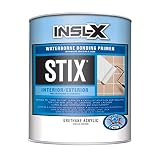
INSL-X Stix Acrylic Waterborne Bonding Primer, 1 Quart
Stix uses a modified acrylic-urethane binder rather than a standard acrylic one. That matters because urethane-modified resins stay slightly flexible after cure and form a chemical grip on glossy plastics instead of relying on surface texture alone. On melamine that is the difference between a film that peels in sheets and one that stays put. It also sands to a genuinely smooth base, so your topcoat is not fighting a gritty surface.
Where it disappoints: it is thin in the can and it wants to run on vertical door edges. I loaded the brush the way I would for a wall primer on my first door and got three sags along the bottom rail that I had to sand out the next morning. Two thin coats. Always. It also needs a full week at room temperature to reach maximum hardness, so do not stack doors flat on top of each other on day three.
Pros
- Bonds to melamine without sanding to bare board
- Water-cleanup, low odor compared with shellac
- Sands to a smooth base for the topcoat
Cons
- Runs easily on vertical edges
- Weak stain blocking against grease or tannin
- Full hardness takes about seven days
Via Amazon.com
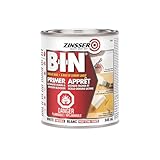 Best when stains bleed throughStage: Prime
Zinsser B-I-N Shellac-Based Primer-Sealer, Quart
Shellac is a natural resin dissolved in alcohol. Because the solvent flashes off instead of evaporating slowly like water, B-I-N locks down anything water-based would reactivate – nicotine, cooking grease, marker, water rings, tannin from the particleboard core exposed at a chipped edge. On laminate it also bites hard, which is why cabinet painters keep a can of it around even when they prefer waterborne primers for everything else.
The trade-off is the smell and the cleanup. It needs denatured alcohol, not water, and the fumes are strong enough that you want windows open and a respirator on. Read the EPA guidance on volatile organic compounds before you shut yourself in a kitchen with it. It also dries brittle, so on a door that flexes it is less forgiving than Stix over a full seasonal cycle.
Pros
- Blocks grease, nicotine and tannin completely
- Fastest recoat window of any primer here
- Grips melamine and old varnish equally well
Cons
- Heavy fumes, respirator required
- Alcohol cleanup only
- Brittle film, less flexible than acrylic-urethane
Via Amazon.com
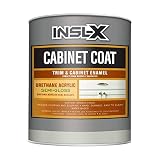 Best topcoat for a factory finishStage: Paint
INSL-X Cabinet Coat Semi-Gloss Enamel, 1 Quart, White
Cabinet Coat is a urethane-modified acrylic enamel, which means the cured film cross-links rather than simply drying. That cross-linking is what gives you block resistance – the property that stops two painted surfaces from sticking to each other when a door sits closed against a frame in a warm kitchen. Ordinary latex trim paint has almost none of it, which is why cabinet doors painted with wall paint make a tearing sound when you open them.
It levels beautifully, which is both the appeal and the catch. If you brush it and then go back to fix a spot ten minutes later, you will leave a permanent ridge. Load it, lay it off in one direction, and walk away. I painted a set of laminate uppers with this over Stix in a house I still visit. Three years, two kids, zero chips at the handle edges.
Pros
- Hardest and most block-resistant film here
- Self-levels to a near-sprayed finish by brush
- Wipes clean without burnishing
Cons
- Punishes any attempt to touch up a wet area
- Limited off-the-shelf colors, mostly white bases
- Costs more per quart than trim enamel
Via Amazon.com
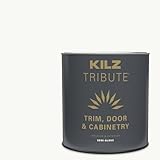 Best budget topcoatStage: Paint
KILZ Tribute Cabinet, Door and Trim Paint, Semi-Gloss White
Tribute is a waterborne alkyd. The alkyd resin is dispersed in water instead of solvent, so you get the flow and hardness people associate with old oil trim paint without the yellowing or the mineral-spirit cleanup. On a primed laminate door it lays down flat and cures harder than a standard acrylic enamel at roughly two-thirds the price of Cabinet Coat.
It is not as tough at the pinch points. On a set of laminate base cabinets under a sink, I saw a small chip appear at the strike edge inside the first year where Cabinet Coat had none after three. For uppers, a laundry room, or a bathroom vanity that gets opened a few times a day, that difference never shows up. For a busy family kitchen it does.
Pros
- Oil-like flow with water cleanup
- Noticeably cheaper per quart
- Tintable to a wide color range
Cons
- Less chip resistance at high-contact edges
- Slower to reach full hardness
- Needs careful brush work in cold rooms
Via Amazon.com
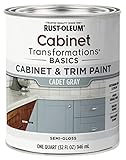 Best for a fast color changeStage: Paint
Rust-Oleum Transformations Basics Cabinet Paint, Cadet Gray
This is a thick, high-build acrylic designed to hide the substrate in two coats rather than three or four. The heavier body is what lets it bury the printed woodgrain pattern that shows through thinner enamels on cheap laminate. If your doors have a pronounced fake-oak texture, this is the topcoat that hides it fastest.
The build is also the limitation. It stays softer than the two enamels above and it holds brush texture more readily, so it never looks quite sprayed. Rust-Oleum markets the Basics line as needing no separate primer, and on real wood that is defensible. On laminate it is not. Prime it anyway – the peel I described at the top of this article happened under a can that made exactly that claim.
Pros
- Hides printed woodgrain in two coats
- Fast two-hour recoat
- Ready-mixed colors, no tinting trip
Cons
- Softer film than either enamel above
- Holds brush marks, less self-leveling
- Marketed as self-priming – not true on laminate
Via Amazon.com
Pro Tips From the Doors I Got Wrong
Take the doors off. Every time. Painting them hanging saves an hour and costs you every drip along the bottom rail, because gravity works on wet enamel exactly the way you would expect.
Number the hinge locations in pencil on the inside of each door before you unscrew anything. Laminate doors from the same kitchen are not interchangeable, and you will not remember which is which by hour four.
Scuff-sand with 220 grit, not 120. You want to dull the sheen, not cut through the melamine film. If you see the brown particleboard core anywhere, you have gone too far and that spot now needs edge-sealing before primer.
Let primer cure overnight before the first topcoat, even when the can says four hours. The can is telling you when it is dry. It is not telling you when it is hard.
How Much Primer and Paint Do You Need?

Can You Paint Laminate Cabinets and Get a Factory Finish?
You can get close. Not identical – factory finishes are sprayed and oven-cured, and your kitchen is neither a spray booth nor an oven. But the gap between a good brushed job and a factory door is smaller than most people expect, and it comes down to three choices you make before you open a can.
Choose the primer for your problem, not the shelf label
If the laminate is clean and intact, Stix is the right call. If there is grease, smoke residue, marker, or an exposed particleboard edge that will bleed tannin, use B-I-N. There is no penalty for using shellac on clean laminate other than the fumes, so when you are unsure, B-I-N is the safer default. For a wider comparison across substrates, our roundup of the best primer for kitchen cabinets covers wood and thermofoil too.
Choose the topcoat for the traffic, not the color card
Block resistance is the property nobody shops for and everybody notices. It is what stops a painted door from sticking to a painted frame in July. Cabinet Coat has the most of it, Tribute has enough for moderate use, and the high-build Rust-Oleum has the least. Match that to how hard the room gets used, then pick a color inside whatever product survives.
Choose the application method honestly
A good synthetic brush and a foam mini-roller will get you 90 percent of the way there on a normal kitchen. Spraying gets you the last 10 percent and adds a full day of masking and cleanup. If you have more than 20 doors it starts paying for itself – see our cabinet sprayer comparison before you commit. Under 20 doors, brush and roller, and put the saved time into prep.
Prep matters more than the brand
Durability on laminate is about half product and half surface preparation, and the preparation half is the one people cut. A cheap topcoat over a degreased, scuff-sanded, properly primed door will outlast a premium enamel over a greasy one. That is not a slogan, it is the reason my first laminate job failed and the four after it did not.
When You Should Not Paint Laminate Cabinets at All
Painting will not fix damage. If the laminate is bubbling, delaminating at the corners, or swollen from a water leak under the sink, paint locks the moisture in and the bubble grows underneath the film. Replace or reface those doors instead.
Skip it too if the particleboard core is crumbling at the bottom edge of a base cabinet. There is nothing structurally sound for the primer to hold onto, and the failure will start exactly there.
And be honest about thermofoil. Thermofoil doors are a vinyl film heat-wrapped over MDF, not a pressed laminate sheet, and they peel at the edges when the film has already released from heat near an oven or dishwasher. If the film is lifting anywhere, no primer will bring it back.
One more: if the cabinets are pre-1978 and you are sanding anything, check for lead before you make dust. The This Old House painting archive has plenty on safe handling, and testing takes ten minutes.
The Prep Sequence That Decides Everything
Can you paint laminate cabinets by shortcutting this list? You can. It just fails sooner, and it always fails at the edges first. This is the order I use now, and it has not failed since the job I described at the top. Do not reorder it to save time.
1. Remove and label. Doors, drawer fronts, hinges, handles. Pencil-number the inside of each door and bag the hardware by number.
2. Degrease twice. Kitchen laminate carries an invisible film of cooking oil, especially near the range. Wash with a degreaser, rinse with clean water, then do it again. Primer cannot bond through grease and this is where most failures actually begin.
3. Scuff-sand with 220 grit. You want the sheen gone and the surface uniformly dull. Do not sand through to the core. Vacuum, then wipe with a damp cloth and let it dry fully.
4. Seal any exposed edges. Chipped corners expose raw particleboard, which drinks primer and swells. Fill with a knife-grade filler, sand flush, and spot-prime those areas first.
5. One coat of bonding primer. Thin and even. Let it cure overnight, then knock it back with 320 grit so the topcoat has a smooth base.
6. Two thin coats of topcoat. Always two thin, never one thick. Lay off in one direction and leave it alone while it levels. Full recoat time between coats, no shortcuts.
7. Wait before you rehang. Doors go back on after a couple of days, but keep them from resting closed against the frames for two weeks while block resistance develops. If you want the full room-by-room version, our guide to painting kitchen cabinets walks through the whole project, and the no-sanding method covers the shortcut version and where it breaks down.
The Verdict
Can you paint laminate cabinets and have the result hold up? Yes, and it is one of the highest-return projects in a kitchen – as long as you accept that the bonding primer is not optional. Degrease, scuff, prime with INSL-X Stix or Zinsser B-I-N, then two thin coats of INSL-X Cabinet Coat. That combination has held for three years in a kitchen I still see regularly. Skip the primer and you will be doing this again before next summer.
Questions People Actually Ask
Can you paint laminate cabinets without sanding?
You can, but only with a shellac or bonding primer rated for glossy surfaces, and the result is measurably less durable at the edges. A five-minute scuff with 220 grit roughly doubles your odds of a finish that survives a full year of daily use. If you skip sanding, degrease twice as carefully.
What kind of paint sticks to laminate cabinets?
None of them stick to bare laminate on their own. The primer does the sticking. Once a bonding primer is down and cured, a urethane-modified acrylic enamel or a waterborne alkyd will bond to the primer without trouble.
How long do painted laminate cabinets last?
With a bonding primer and a cabinet-grade enamel, five to ten years in a normal kitchen before you would consider a refresh. Without a bonding primer, expect visible edge peeling inside the first year.
Do I need to remove the cabinet doors to paint them?
Yes. Painting doors flat is the single easiest way to avoid sags and drips, and it lets you coat the edges properly – which is exactly where laminate finishes fail first.
Can you paint laminate cabinets a dark color?
Yes, and dark colors actually hide the printed grain pattern better than white does. Expect three coats rather than two if the existing laminate is a pale woodgrain, and use a gray-tinted primer to cut a coat off the total.
Will painted laminate cabinets chip?
At the handle edges and the strike points, eventually – that is true of every painted cabinet, wood included. A harder topcoat with strong block resistance delays it considerably. Keep a small labeled jar of your topcoat for touch-ups.
Can you paint laminate cabinets in a bathroom?
Yes, and bathrooms are the easier case because vanities get opened far less than kitchen cabinets. Humidity is the variable to watch – let each coat cure with the fan running and do not rehang doors early.