How to Paint Kitchen Cabinets Without the Chipping and Peeling
Updated: August 2026 | By Sophie Ulman
Get how to paint kitchen cabinets wrong and you are sanding the whole kitchen back down in eighteen months. Get it right and you save $5,000–$15,000 over replacement, and the finish holds for a decade. The difference is not the paint brand. It is three things most DIY guides skip: degreasing to bare film, a shellac primer that actually bonds, and thin coats that cure hard. Related: can you paint laminate cabinets.
What I learned the hard way. The first time I painted cabinets I wiped the doors with a damp rag, called it clean, and went straight to primer. They looked perfect for about five weeks. Then the paint started lifting off the two doors beside the stove — exactly where cooking grease lands — in sheets, like sunburn. Cabinet paint does not fail on the wall. It fails on the film of kitchen grease you could not see. Now I degrease twice, and I test with water: if it beads, there is still oil there and I go again. Related: how to paint garage cabinets.
We’ll walk through every stage from pulling the doors to the final topcoat, name the exact tools that work, and give you honest time estimates so you can plan the project without surprises. Before you buy anything, it is worth reading which primer for kitchen cabinets suits your door material, because a primer mismatch is the single most expensive mistake in this project. If your doors are laminate or thermofoil rather than wood, the rules change enough that you should start with the paint for laminate cabinets guide instead.
Tools & Supplies You Need
Before you start, assemble everything. Running to the hardware store mid-project is the fastest way to ruin a wet edge. Here’s the complete list:
- 🧴 Degreaser / deglosser
- 🖌️ 2–2.5″ angled sash brush
- 🪣 Shellac-based primer
- 🎨 Cabinet-grade paint (semi-gloss)
- 📦 Foam rollers (4″ mini)
- 🔩 Screwdriver + labels (painter’s tape)
- 🪚 220-grit sandpaper
- 🧹 Tack cloth
Product Picks for Each Stage
These are the four products we recommend across the full project — all validated and available on Amazon with our affiliate tag.
| Stage | Product | Purpose | Link |
|---|---|---|---|
| 🟠 PREP | Krud Kutter Gloss-Off 32oz | Degrease & degloss in one step | View on Amazon |
| 🔵 PRIME | Zinsser BIN Shellac Primer | Stain-blocking adhesion primer | View on Amazon |
| 🟢 PAINT | Rust-Oleum Transformations Basics Pure White | Durable semi-gloss cabinet finish | View on Amazon |
| 🖌️ APPLY | Purdy XL Glide 2″ Angle Sash Brush | Smooth, no-brush-mark application | View on Amazon |
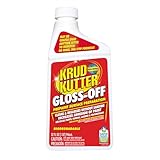
Krud Kutter Gloss-Off Prepaint Deglosser — 32 oz
If there’s one product that saves the most people from a failed cabinet paint job, it’s a quality deglosser. Krud Kutter Gloss-Off cleans, degreases, and etches the surface in one application — you wipe it on, let it sit for 10 minutes, and the old glossy finish is ready to accept new primer. No sanding required. No rinsing required. This 32 oz bottle covers a typical kitchen’s worth of cabinet surfaces easily.
The formula dissolves grease, cooking oil, and waxy buildup that accumulates on kitchen cabinets over years. These are exactly the contaminants that cause paint to peel even when everything else is done correctly. Krud Kutter solves that at the prep stage, before primer goes on. Users on multiple home improvement forums consistently name it the non-negotiable first step for any cabinet repaint.
✅ Pros
- Eliminates sanding on smooth surfaces
- Removes grease that primer won’t stick to
- Fast — dry in under 20 minutes
❌ Cons
- Strong smell — ventilate well
- Not a substitute for sanding rough or damaged surfaces
Best for: Previously painted or varnished cabinets in good condition.
Check Price on Amazon →Via Amazon.com
🔗 Related Reads on ThePaintly
- Best Paint Remover for Wood & Metal — for cabinets that need full stripping, not just deglossing
- How to Remove Paint with Steam — steam as an alternative prep method
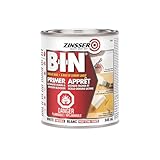
Zinsser BIN Shellac-Based Primer-Sealer — 1 Quart
Zinsser BIN is the primer contractors keep in their van for a reason. It’s shellac-based, which means it bonds to virtually any surface — bare wood, previously painted surfaces, glossy varnish, and even slick MDF — without needing sanding. More importantly, it seals tannins and stains so completely that dark wood knots and water stains simply disappear under it. Water-based primers can’t make that claim reliably.
For kitchen cabinets, shellac primer serves another critical function: it seals cooking grease into the surface rather than letting it bleed through your topcoat. If you’ve ever painted cabinets and seen yellow or brown bleed-through appear weeks later, water-based primer was the culprit. BIN stops that. It dries in 45 minutes and can be recoated in under an hour — so it doesn’t slow down your workflow significantly.
✅ Pros
- Bulletproof adhesion — even over glossy varnish
- Stops bleed-through that water-based primers miss
- Fast dry time
❌ Cons
- Strong alcohol smell — needs ventilation
- Cleanup requires denatured alcohol
Best for: Oak, pine, or any wood cabinet with tannins or previous staining.
Check Price on Amazon →Via Amazon.com

Purdy XL Glide Angular Sash Paint Brush — 2 inch
The brush is responsible for whether your cabinets look painted or sprayed. A cheap brush deposits bristle marks that become permanent once the paint cures. The Purdy XL Glide is a professional-grade tool with a proprietary Clearcut filament blend — synthetic bristles engineered to hold more paint and release it smoothly, without the chatter marks you get from stiff or low-quality bristles.
The 2-inch angle sash width is the ideal size for cabinet faces and door panels. It’s narrow enough to cut in cleanly on edges and inside corners, but wide enough to move efficiently across flat faces. Pair it with a 4-inch mini foam roller for the flat sections — brush for edges and detail, roll for flat faces — and your finish will rival spray work. Purdy brushes are handcrafted in the USA and, with proper cleaning, last through multiple projects.
✅ Pros
- No bristle marks in cured finish
- Holds paint well — fewer dips needed
- Durable — lasts multiple projects
❌ Cons
- Higher price than discount brushes
- Requires proper cleaning to maintain
Best for: Anyone who wants a brush finish that looks as smooth as spray.
Check Price on Amazon →Via Amazon.com
🔗 Want to Spray Instead of Brush?
- Best Airless Paint Sprayer for Furniture — lay doors flat and spray for a factory finish
- Beginner’s Guide to Paint Spray Guns — learn spray technique before you buy
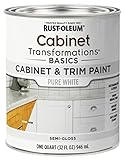
Rust-Oleum Transformations Basics — Pure White Cabinet Paint
Once the surface is deglossed, primed, and dry, this is the topcoat we reach for on white or light kitchen cabinet projects. The Transformations Basics formula is engineered for exactly this use case — it dries hard enough to resist scratches and chips within a week, accepts cleaning without dulling, and applies beautifully with either a foam roller or the Purdy brush above. The semi-gloss finish sits at exactly the right sheen level for kitchens: reflective enough to wipe clean, subdued enough not to highlight surface imperfections.
One quart covers up to 50 sq ft. A standard kitchen with 12 standard-sized cabinet faces requires roughly 3 quarts for two coats. Order one extra — you’ll want it for touch-ups in year two. The 30-minute dry time keeps your project moving without marathon wait gaps between coats.
✅ Pros
- Fast recoat time keeps project on schedule
- Excellent leveling — minimal brush marks
- Washable finish for busy kitchens
❌ Cons
- Quart-only sizes mean more bottles for large kitchens
- Reaches full hardness after 7 days
Best for: The topcoat on light or white kitchen cabinet projects.
Check Price on Amazon →Via Amazon.com
💡 The 3 Mistakes That Ruin Cabinet Paint Jobs
1. Skipping degreasing. Cooking oil residue is invisible but completely blocks paint adhesion. Always degrease, even on cabinets that look clean.
2. Using wall primer. Standard drywall primer has poor adhesion on wood and no stain-blocking. Use a dedicated cabinet primer — shellac if in doubt.
3. Rushing the recoat. Applying a second coat before the first is fully dry causes crinkling, lifting, and bubbles that require sanding back and starting over.
Project Time & Cost Estimator
Estimate your total project time and material cost before you start.

Step-by-Step: How to Paint Kitchen Cabinets
Follow these 7 steps in order. Each one is load-bearing — skip a step and the one after it is compromised.
Step 1 — Remove Doors, Drawers, and Hardware
Take every door off its hinges. Label each door with painter’s tape and a number corresponding to its cabinet opening — reinstalling unlabeled doors takes four times as long. Remove drawer fronts, pull out all hinges and handles, and set hardware in a labeled zip-lock bag. Working on doors flat (laid across sawhorses or a work table) eliminates drips entirely and gives you access to the full edge.
Step 2 — Clean and Degrease
Wipe every surface with Krud Kutter Gloss-Off or a TSP substitute. Apply with a clean cloth, work in sections, and allow 10 minutes of dwell time. Grease and cooking oil that accumulate over years are invisible but completely prevent paint adhesion. This step is the single biggest predictor of how long your cabinet paint job will last.
Renovation Stage: PREP → PRIME → PAINT
This project spans three renovation stages. Most cabinet paint failures happen at the PREP stage — not the paint stage. Invest your time here first. See our guide to painting wood surfaces for more surface prep techniques.
Step 3 — Lightly Sand or Degloss
If your cabinets have a shiny varnish or lacquer finish, the deglosser alone may not be enough. A light scuff with 220-grit sandpaper across all surfaces provides mechanical adhesion that deglosser alone can’t guarantee. You’re not sanding to bare wood — just dulling the sheen. Wipe off all dust with a tack cloth before continuing.
Step 4 — Apply Shellac Primer
Apply one coat of Zinsser BIN using a separate cheap brush or foam roller — save your Purdy for the topcoat. Work quickly because shellac dries fast. You don’t need thick coverage; a thin, even coat is all that’s needed. Allow 45 minutes to dry, then lightly sand with 220-grit to smooth any raised grain. Wipe with a tack cloth. According to the EPA, proper ventilation during primer application is essential — open windows and run a fan.
Step 5 — Apply First Coat of Cabinet Paint
Load the Purdy brush and cut in all edges, inside corners, and raised panel details first. Then roll the flat faces with a 4-inch mini foam roller. Work in the direction of the wood grain. Apply thin coats — it’s far better to add a third coat than to flood the surface trying to cover in two. Allow 2 full hours before the second coat, even if the paint feels dry to touch sooner.
Step 6 — Apply Second Coat and Inspect
Repeat Step 5. After the second coat dries, hold a work light at a raking angle to the surface. This reveals any brush marks, drips, or missed spots while the paint is still young enough to sand back lightly if needed. Sand with 320-grit if required, wipe clean, and apply a third coat only where necessary.
Step 7 — Reinstall After Full Cure
Most cabinet paints reach functional hardness in 24 hours but achieve full cure in 7 days. Reinstall doors and hardware after 24 hours, but avoid hard impacts or heavy scrubbing for a full week. The paint continues hardening during this period — treat it gently and it will reward you with a finish that lasts.
Pro Summary
Painting kitchen cabinets is a 2–3 day project that returns enormous value per dollar spent. The process is straightforward when done in the right order: degrease → degloss → prime → sand → paint (×2) → cure.
The products that make the biggest difference are the deglosser (most skipped) and the primer (most downgraded to cheap latex). Krud Kutter and Zinsser BIN solve both. The Purdy brush solves the brush-mark problem. The rest is patience and thin coats.
Oak Grain: Why Painted Cabinets Still Look Like Oak
This is the complaint I hear more than any other after a cabinet job, and almost nobody sees it coming: the doors are painted a clean white, the coverage is perfect, and they still, unmistakably, look like oak. Nothing went wrong with the paint. The wood is showing through the finish because paint does not bridge an open pore — it lines it.
Red oak, the wood in most American kitchens built between roughly 1975 and 2000, has large open pores running along the grain. Under a clear stain those pores read as attractive texture. Under white paint they read as thousands of tiny dark grooves catching a shadow, and a semi-gloss sheen makes each one visible from across the room.
The fix is grain filler — a water-based gel you spread across the pores, let dry, and sand flush. It is not the same product as wood filler, which is for gouges and nail holes. Grain filler is thin enough to flow into a pore and shrinks as it dries, which is why one pass is never enough.
How to fill grain without losing a weekend
Work after deglossing and before primer. Spread the gel with a plastic spreader or an old credit card, pulling across the grain rather than along it, so the filler packs into the pores instead of riding over them. Scrape most of it back off immediately — you want filler in the pores and almost none on the surface. Let it dry as the can directs, then sand flush with 220-grit. Look at the door in raking light from a window. If pores are still reading as dark specks, do it again. On red oak, two passes is typical and three is not unusual.
Two thin coats applies here just as it does to paint. A thick single application of grain filler dries on top, stays soft underneath, and sands into a gummy mess.
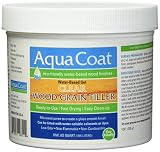
Aqua Coat Clear Wood Grain Filler Gel — Quart
Water-based, low-odor, and thin enough to actually flow into an oak pore rather than sit on top of it. The reason I reach for a water-based gel over the old oil-based paste fillers on a cabinet job is the drying window: you can fill in the morning and sand the same afternoon instead of losing a day to cure time, which matters when you have twenty doors to get through.
A quart is the right size for a standard kitchen. It sands to a powder with 220-grit rather than gumming the paper, and because it’s clear it doesn’t fight whatever primer goes over it. It is sandable and paintable, which is the only claim that matters for this use — the stainable part is for people finishing furniture clear, not for you.
✅ Pros
- Thin enough to reach the bottom of a pore
- Sands to powder instead of gumming the paper
- Water cleanup, low odor for indoor work
❌ Cons
- Shrinks as it dries — one pass is rarely enough
- Useless on maple, birch, or MDF
Best for: Red oak and ash doors headed for a semi-gloss finish. Pointless on closed-grain wood.
Check Price on Amazon →Via Amazon.com
The tool that decides whether you finish the job
Filling grain on one door by hand is a pleasant twenty minutes. Filling and sanding twenty-four doors and drawer fronts by hand is the reason half-painted kitchens sit in garages for months. This is the single place in a cabinet project where a power tool changes the outcome rather than just the speed — and at the price of a random orbit sander against the price of new cabinet doors, it’s the cheapest decision in the whole project.
Random orbit is the specific type you want. The pad spins and oscillates at the same time, so it never traces the same path twice and doesn’t leave the circular swirl marks a rotary sander does — swirls that a semi-gloss topcoat will find and display. It’s also the tool you’ll use to knock the nibs off between coats, which is where most of the smoothness in a brushed finish actually comes from.
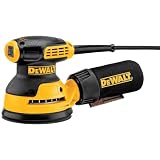
DEWALT DWE6421K Random Orbit Sander Kit — 5 inch, 3 Amp, 12,000 OPM
The short height is the feature that matters on cabinet doors. A tall sander body forces your hand up and away from the work, and on a flat door face that turns into unequal pressure and a dished panel. This one sits low enough that your palm is nearly on the surface, which is how you keep a door flat while sanding grain filler back.
Twelve thousand orbits per minute with a hook-and-loop pad handles both jobs in a cabinet project: aggressive enough with 120-grit to level filler and knock down old varnish, gentle enough with 220 to scuff between coats without cutting through primer at the edges. The one-handed dust bag matters more than it sounds — sanding shellac primer indoors without dust collection puts a fine white powder on every surface in the kitchen, and that powder lands in your wet paint later.
✅ Pros
- Low body height keeps pressure even on flat panels
- Random orbit leaves no swirl marks under semi-gloss
- Dust collection you’ll actually use indoors
❌ Cons
- Corded — you’ll be managing a cord across the garage
- Too aggressive for detailed profile edges; those stay hand-sanded
Best for: Anyone with more than eight doors, and anyone filling oak grain. For a bathroom vanity and two drawers, a sanding sponge is enough.
Check Price on Amazon →Via Amazon.com
Where Thirty Doors Go While They Dry
Do the arithmetic before you open a can, because almost nobody does and it’s the reason cabinet projects stall. A modest kitchen has somewhere between eighteen and thirty doors and drawer fronts. Each one gets primer plus two coats of paint, on both sides. That is six passes per door, and after each pass the door has to sit somewhere untouched for hours, on a surface that won’t mark the wet finish.
Thirty doors needing six coats is a hundred and eighty separate placements. If your plan is “the kitchen table,” the project is already in trouble.
What actually goes wrong
The three failures I see, in order of frequency: doors leaned against a wall to dry, which leaves a permanent contact mark along the top edge where the finish was still soft. Doors stacked to save space before they’ve cured, which welds them together and tears the film when separated. And flipping a door to coat the second side while the first is only dry to the touch, which presses the fresh finish flat against whatever it’s resting on.
That last one hinges on a distinction worth getting straight: dry to the touch is not cured. A cabinet enamel typically feels dry in a few hours and can be recoated the same day, but the film keeps hardening for weeks — most cabinet enamels list full cure somewhere in the two-to-four-week range, and your can will say. Until then the surface dents under sustained pressure. That’s why the last step of this project is reinstalling after cure, not after the paint stops feeling tacky.
The setup that fixes it
Elevate every door on small plastic stands with a point contact. Painter’s pyramids are the standard answer — a spiked cone that holds the door about an inch off the surface on a contact area too small to leave a visible mark. The reason they’re worth the trivial cost is that they let you coat a face and all four edges in one pass, then flip and do the back without waiting for a separate edge-drying cycle. That’s the difference between a six-day project and a nine-day one.
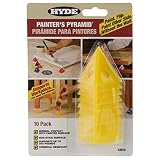
Hyde Tools 43510 Painter’s Pyramid — 10 Pack
Ten is the right count, not a number to economize on. Four pyramids hold one door, so a pack of ten lets you run two doors at a time with spares for drawer fronts — and running two at a time is what keeps a wet edge alive across a batch instead of racing one door at a time.
The point of contact is small enough that the mark it leaves in a wet finish flows out before the film sets. On the back side of a door it wouldn’t matter anyway, but on a face it does, and it’s the whole reason these exist rather than resting doors on scrap wood. They stack flat for storage and they’re the least expensive item on this entire page.
✅ Pros
- Coat edges and face in a single pass instead of two cycles
- Cheapest fix for the most common cabinet failure
- Stack flat, last forever
❌ Cons
- Tip over on an uneven garage floor — level your surface first
- Ten covers two doors at a time, not a whole kitchen at once
Best for: Any cabinet project with more than four doors. Skip only if you’re painting cabinet boxes in place and nothing comes off.
Check Price on Amazon →Via Amazon.com
Label before anything comes off the wall
Cabinet doors are not interchangeable, even when they look identical. Hinge mortises are cut by hand on older cabinets and a door that goes back one opening over will sit proud on one side. Before you remove a single screw, put a strip of painter’s tape inside the hinge mortise with a number on it, and a matching number inside the cabinet box where the paint will never show. Bag the hinges and screws for each door with the same number.
I skipped this once on a set of nine doors because they were obviously all the same. Reinstalling took longer than painting them did, and two of them never sat quite flush again. It costs ten minutes and it is the highest-return ten minutes in the project.
The space itself
You need roughly the floor area of a two-car garage bay, or a basement with a tarp down and something to stand doors on — two sawhorses and a sheet of plywood works. What you need more than square footage is temperature and dust control. Cabinet enamel levels properly in a moderate room and goes tacky fast in a hot garage in August, which is how brush marks lock in. And a garage floor kicks up dust every time you walk past a wet door, so sweep and damp-mop before you start, not after.
If the batch math is what’s putting you off the whole project, spraying compresses it considerably — one pass covers a face and its edges, and a batch of doors goes down in the time brushing takes for three. The cabinet sprayer guide covers what that setup actually requires, including the masking you’ll be trading the time into instead.
When Not to Paint Kitchen Cabinets
Everything above assumes your cabinet boxes are sound. Sometimes they are not, and learning how to paint kitchen cabinets is the wrong answer to the problem in front of you. These are the four situations where I tell people to stop and spend the money elsewhere.
Stop and reconsider if any of this is true
- The particleboard has swollen at the sink base. Water-damaged particleboard has lost its structure. Paint sits on top of a sponge and the door edge keeps crumbling. Replace the box.
- The doors are veneer and the veneer is lifting. Once veneer delaminates, primer wicks under the loose edge and pushes it further open. Re-glue and clamp first, or skip those doors entirely.
- You cannot give it five days. Cabinet paint needs cure time, not just dry time. Rehanging doors after 24 hours is how you get paint that peels off with the hinge. If your kitchen has to be functional tomorrow, wait for a week you can spare.
- The layout is the actual problem. A repaint fixes colour. It does not fix a cabinet run you hate. Paint is cheap; regret is not.
One more honest note on prep. Durability here is roughly half product and half surface preparation — prep matters more than the brand on the can, and no premium cabinet enamel will save a door you degreased in a hurry. If you want to shortcut the sanding stage specifically, there is a legitimate method for it in the paint kitchen cabinets without sanding guide, but the degreasing step is not optional in either approach.
Frequently Asked Questions
How long does it take to paint kitchen cabinets?
A standard kitchen with 12 cabinet doors takes 2–3 days of active work: roughly half a day for prep and priming, a day for two coats of paint (including dry time between coats), and a day of cure time before reinstalling hardware. The full cure takes 7 days.
Can I paint kitchen cabinets without removing them?
You can paint cabinet face frames in place. However, cabinet doors should always be removed and painted flat — it eliminates drips, gives you access to all edges, and produces a significantly better finish. Painting doors while hung is a shortcut that almost always shows.
What is the best way to avoid brush marks when painting cabinets?
Use a high-quality synthetic brush (like the Purdy XL Glide) for edges and a foam roller for flat faces. Apply thin coats and don’t over-work the paint — once applied, leave it alone. Thin coats self-level as they dry; thick, overworked coats show every stroke.
Do I need to sand kitchen cabinets before painting?
A light sand with 220-grit is recommended after deglossing and after priming — not to remove material, but to smooth raised grain and improve adhesion. You can use a liquid deglosser instead of the initial sand, but the post-prime sand is worth doing on any project where you want a professional result.
How do I prevent cabinet doors from sticking after painting?
Use a paint with good block resistance (like KILZ Tribute), allow full cure time before rehinging, and leave doors slightly ajar for the first week. Block resistance is a formulated property of cabinet-specific paints that prevents the painted door from fusing to the painted frame under pressure.
Is it worth painting kitchen cabinets instead of replacing them?
Yes — in almost every case. New kitchen cabinets cost $5,000–$25,000 installed. Painting existing cabinets costs $150–$600 in materials and produces a transformation that is visually comparable. The only scenario where replacement wins is when the cabinet boxes themselves are structurally compromised.