Can You Stain Trex Decking? The Answer Depends on Your Boards
Updated: August 2026 | By Sophie Ulman
Put a coat of stain on the wrong composite boards and you are not refreshing anything. You are starting a peeling problem that takes a belt sander and a lost weekend to undo. The question of whether you can stain Trex decking has one answer that costs you nothing and one answer that costs you your warranty, so the board generation you own decides everything before you open a can.
Here is the short version. You can stain Trex decking only if the boards are early-generation uncapped composite, which Trex stopped making around 2010. If your deck has a capped surface — anything sold as Transcend, Enhance, Select, or Signature — you cannot stain Trex decking with any product on the market and expect it to hold.
I learned the difference on somebody else’s deck. A client swore his boards were “the old kind” and wanted a solid stain to hide fading. I test-patched a two-foot section behind the grill instead of trusting him. Three weeks later that patch had lifted at every edge like sunburned skin. Those boards were capped. That test patch saved him about $400 in product and me a very bad phone call.
What’s in this guide
Quick picks at a glance
| Product | Job it does | Which deck it suits |
|---|---|---|
| DEFY Extreme Composite Deck Sealer | Clear waterproofing, no color change | Capped Trex — the safe answer |
| DEFY Composite Deck Cleaner | Strips grime before any coating | Every composite deck, every time |
| Rust-Oleum RockSolid 20X Deck Resurfacer | Thick opaque color coat | Worn uncapped first-gen boards |
| Olympic Rescue It Max | Fills cracks up to 1/4 inch | Uncapped boards with splinters |
| Wash Safe Spray & Clean | Kills black mold spotting | Shaded, damp decks |
The 5 products worth buying

DEFY Extreme Composite Deck Sealer
This is the product for people who came here wanting to stain Trex decking and found out they can’t. It is a clear water-based sealer carrying zinc nano-particles, and those particles are the whole point. They sit in the cured film and scatter UV light before it reaches the wood flour inside your boards. Wood flour is what fades. Block the UV and you slow the fade without laying a colored film on a surface engineered to reject films.
On a capped deck it does not change the color, and you should not expect it to. What it does is stop water from sitting in the grain texture and feeding mildew. That makes it a fit for a north-facing composite deck that greens up every spring. One honest limitation: at 100 to 150 square feet per gallon across two coats, it is thirsty. A 400 square foot deck eats three gallons and most people buy two.
Pros
- Will not void a Trex warranty the way stain does
- Water cleanup, no solvent smell
- Works on the wood sections of a mixed deck too
Cons
- Zero color change — it cannot hide fading
- Coverage is low for the price
- Needs 45°F and above for the full 24 hours
Via Amazon.com
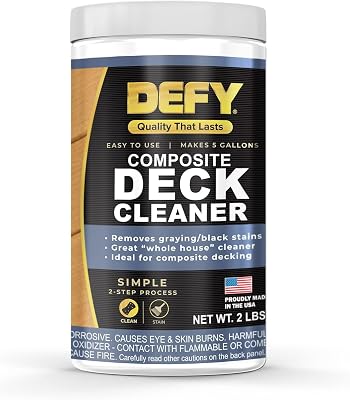
DEFY Composite Deck Cleaner
Composite boards hold grime differently than wood. The embossed grain pattern is a series of tiny valleys, and pollen, algae and grill grease settle into them where a garden hose cannot reach. This is an oxygenated powder you mix with water, and the oxygen release lifts that debris out of the valleys instead of pushing it deeper the way a pressure washer does. That distinction matters — pressure washing a composite deck at high PSI opens the surface and makes next year’s staining worse.
You need this whether or not you plan to coat anything. It is also the honest test: a lot of decks that look like they need stain just need a proper wash. I have handed people this bag instead of the color they asked for and had them tell me the deck looked new. The limitation is dwell time. It wants 15 minutes wet, and on a hot afternoon in direct sun it dries in six, which leaves streaks. Work in shade or work early.
Pros
- Biodegradable and safe near landscaping
- Lifts embedded grime out of the grain texture
- Cheap enough to use twice a year
Cons
- Dries too fast in direct sun
- Will not remove deep-set black mold spots on its own
- Powder needs proper mixing or it settles
Via Amazon.com
Rust-Oleum RockSolid 20X Deck Resurfacer
If you confirmed your boards are uncapped first-generation composite, this is the coating that actually stays down. It goes on roughly twenty times thicker than a standard stain, which is exactly why it works here. A thin stain relies on penetration, and there is nothing in a plastic-and-wood-flour board to penetrate. A high-build acrylic instead grips mechanically into the surface texture and bridges the micro-cracks that open in old composite.
The texture it leaves is gritty and slip-resistant, and that is not a marketing line — it is a real safety gain on a deck that gets wet. Be honest with yourself about the tradeoff, though. This is opaque. Once it goes on, the composite grain is gone and you own a painted deck forever, including the recoat cycle every few years. That is the deal you are making when you decide to stain Trex decking of the older uncapped type with a product this heavy.
Pros
- Sticks to uncapped composite where thin stains fail
- Textured finish adds real slip resistance
- Hides fading, blotching and old stains completely
Cons
- Permanent — there is no going back to bare board
- Heavy to roll; a deck this size is a two-person job
- Will fail fast if applied over a capped board
Via Amazon.com
Olympic Rescue It Max Resurfacer + Primer + Sealant
Old uncapped composite does something wood never does: the plastic binder degrades under UV and the exposed wood fiber starts fuzzing up into splinters. Rescue It Max is a 100 percent acrylic resurfacer built to lock that fiber down rather than coat over it. The film is thick enough to encapsulate raised fibers so they stop catching bare feet, and it carries its own primer and sealant, so you are not stacking three products on a surface that resists all of them.
Where it beats a straight resurfacer is on boards that have both fuzzing and cracking. Where it loses is on flatwork that still looks decent — it is overkill and it is heavy. Two thin coats always beat one thick coat, and that rule holds double here, because a single heavy pass skins over on top while the underside stays soft for days. I have seen a rushed job stay tacky through an entire humid week.
Pros
- Locks down splinters on degraded uncapped boards
- Primer and sealant built in — one product, not three
- Fills cracks up to 1/4 inch
Cons
- Long cure; a humid week will keep it tacky
- Overkill on boards that are only faded
- Sold in large pails, awkward for small repairs
Via Amazon.com
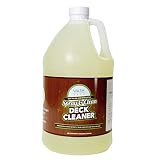
Wash Safe Spray & Clean Composite Deck Cleaner
Those small black dots on shaded composite boards are not dirt. They are artillery fungus or embedded mold colonies, and they sit below the surface where a general cleaner slides right past them. This one is a commercial-strength formula you hose-apply, and it works by penetrating the top layer of the board rather than scrubbing the face of it. That is the mechanism that gets the spotting instead of just brightening around it.
It covers a lot of ground for one gallon, which suits big shaded decks under mature trees. The limitation is that it is strong enough to demand respect — cover your plantings and wear eye protection, because the overspray drifts further than you expect on a breezy day. On very old spotting you will still need a second pass. One application lightens; two removes.
Pros
- Reaches mold sitting below the board surface
- Enormous coverage per gallon
- Hose-end application, no scrubbing on the first pass
Cons
- Overspray drifts — plantings need covering
- Old spotting needs two applications
- Stronger than most decks actually require
Via Amazon.com
Pro tips from the deck
Test behind the grill, not in the middle. Every composite job starts with a one-foot test patch somewhere nobody looks. Wait three weeks and try to lift an edge with your thumbnail. If it lifts, you just saved yourself the whole deck.
Skip the pressure washer above 1,500 PSI. High pressure opens the composite surface and pulls wood fiber to the face. That deck will look worse in a year than the one you left alone.
Coat the underside and the skirting, not the walking surface. Even Trex allows finishes on ends, undersides and fascia. That is where you get a color change without gambling the boards you actually walk on.
Two thin coats. Always. On composite this is not a preference. Thick coats trap solvent and moisture against a non-porous surface and stay soft underneath while the top skins over.
Sealer coverage calculator
Composite sealer covers far less than wood stain. Enter your deck size and get the gallons you need for two coats.
Before you stain Trex decking, check the board edge
Everything about whether you can stain Trex decking comes down to one question, and almost nobody answers it correctly from memory. Homeowners guess at installation dates and guess wrong. Here is how to check the board itself instead.
Look at the board edge
Kneel at a stair nose or an exposed board end. A capped board shows a visible shell — a thin outer layer in a slightly different tone from the core, like a candy coating on the perimeter. An uncapped board is one uniform color straight through. This is the single fastest check and it is right almost every time.
Do the water bead test
Splash a cup of water on a clean, dry section. On a capped board the water beads and sits. On uncapped composite it darkens the surface within a minute as the exposed wood flour drinks it in. That darkening is exactly why uncapped boards fade, spot and eventually accept a coating.
Check the manufacture era
Trex moved to capped composite around 2010. Boards installed before that are almost certainly uncapped; anything installed after is almost certainly capped. If your deck was installed in the transition years and the edge test is ambiguous, treat it as capped. That assumption costs you nothing. The other assumption costs you the whole deck.
What each answer means for you
Uncapped boards can take a high-build resurfacer, and a color change is on the table. Capped boards cannot, and your path is cleaning plus a clear sealer. The same logic drives what does and doesn’t work on painting Trex decking, and it is the reverse of what happens on wood, where a penetrating deck stain on pressure-treated lumber soaks in and locks down.
When NOT to stain Trex decking
Do not stain Trex decking if the boards are capped. The cap layer is a polymer shell engineered to shed moisture, dirt and — inevitably — coatings. Stain sits on top of it with nothing to grip. You get peeling within one seasonal cycle, and the failure is never uniform, so you end up with patchy flaking that looks worse than the fading you were trying to fix.
Do not stain if the warranty still matters to you. Trex tests and guarantees its boards uncoated. Applying paint or stain to the surface voids the manufacturer warranty. On a deck still inside its coverage window, that is a real financial decision, not a technicality.
Do not stain a deck that is already failing structurally. Soft spots, split ends and cupping mean the board core has taken on water. Coating that seals moisture inside, and the split widens through the next freeze cycle. Replace those boards first. The Family Handyman breakdown of composite deck coating reaches the same conclusion.
Do not coat over active mold. If you seal live mold under a film, it keeps growing and pushes the coating off from beneath. The EPA’s guidance on mold remediation is blunt about this: remove the growth and fix the moisture source before you cover anything.
Prep steps that decide the outcome
Prep matters more than the brand. On composite that is not a slogan — it is arithmetic, because a coating that cannot penetrate has only the surface to hold onto, and a dirty surface offers nothing. Here is the sequence that works.
- Identify your boards first. Run the edge and water tests above. Everything downstream depends on this answer.
- Clear the deck completely. Furniture, planters, grill, rugs. Grime hides under every one of them and you will see the outline later.
- Wash with a composite-specific cleaner. Soft-bristle brush, 15 minutes of dwell time, rinse thoroughly. Work in shade so it does not flash-dry.
- Treat any black spotting separately. General cleaner will not lift embedded mold. Use the targeted product and give it two passes if needed.
- Let it dry 48 hours. Composite holds water in the grain texture longer than wood looks like it should. Coating a damp board is the most common failure I see.
- Test patch and wait three weeks. Behind the grill, one square foot. Thumbnail test at the edge. No lift means proceed.
- Apply two thin coats. Pad applicator or a quality roller. A deck sprayer speeds this up on large areas, but back-roll each pass to work product into the grain.
The verdict
If your boards are capped — anything Trex sold after about 2010 — you cannot stain Trex decking, and the honest move is a proper composite cleaning followed by a clear composite sealer. You keep the warranty, you stop the mildew, and you accept the color you have.
If your boards are early-generation uncapped composite and genuinely worn, you have a real option. A high-build deck resurfacer will hold where thin stain will not, and it will change the color permanently. Go in knowing you now own a coated deck and a recoat cycle. That is a fair trade on a 20-year-old surface. It is a terrible trade on a five-year-old one.
Questions people actually ask
Can you stain Trex decking that is over 15 years old?
Probably yes, because a deck that old is almost certainly uncapped first-generation composite. Confirm with the board-edge test before you buy anything. Uniform color through the edge means uncapped, and uncapped boards accept a high-build acrylic resurfacer.
Will staining Trex decking void the warranty?
Yes. Trex tests and warrants its boards without coatings, and applying paint or stain to the deck surface voids that coverage. If your deck is still inside its warranty period, this is the main reason not to do it.
What happens if you stain capped composite decking?
The stain fails to bond to the polymer cap and starts peeling, usually within the first full seasonal cycle. It rarely comes off evenly, so you are left with patchy flaking that is harder to fix than the original fading.
Can you stain the underside of Trex decking?
Yes, and this is the exception worth knowing. Undersides, board ends and fascia are fair game for paint or stain because they are not walking surfaces and are not exposed the same way. If you want a color change on a capped deck, this is where you get it.
How do you restore faded Trex decking without stain?
Deep-clean with a composite cleaner, treat any mold spotting, then apply a clear composite sealer with UV inhibitors. That will not reverse fade already in the board, but it slows further fading and stops the mildew that makes fade look worse than it is.
Can you use regular deck stain on composite decking?
No. Ordinary deck stain is a penetrating product designed to soak into wood cells, and composite has no open cell structure to soak into. It sits on the surface and peels. Only products formulated for composite have any chance, and only on uncapped boards.
Is it cheaper to resurface or replace old composite boards?
Resurfacing an uncapped deck runs a fraction of replacement cost and buys several years. Replacement makes sense if boards are cupping, splitting or soft, because a coating over failing boards seals moisture in and accelerates the damage.