Best HVLP Paint Sprayer: 4 Models Compared for Cabinets, Trim, and Furniture
Updated: September 2026 · By Sophie Ulman
Why an HVLP Paint Sprayer Keeps Winning on Cabinets and Trim
Every HVLP paint sprayer promises a flawless, brush-mark-free finish, and most of them can deliver one — on the right project. The catch is that “right project” varies more than the marketing copy admits. A turbine built for trim and cabinet doors will choke on a full room of latex, and a sprayer sized for walls will turn a tabletop finish into orange-peel texture.
I have run cabinet doors, dressers, porch railings and garage shelving through more turbines than I can count, and the failures always trace back to the same mismatch: the wrong HVLP for the job in front of you.
This guide compares four HVLP sprayers I have used side by side, from a compact turbine built for chalk paint to a professional four-stage unit that handles solvent-based finishes. Each one wins at something specific, and none of them wins at everything. If your actual project is a full room of wall paint rather than cabinets or trim, our best airless paint sprayer guide is the better starting point.
How an HVLP Paint Sprayer Turbine Actually Works
HVLP stands for High Volume, Low Pressure. A turbine pushes a large volume of air through the gun at low pressure, and that air breaks the paint into a fine, controlled mist as it leaves the nozzle. Lower pressure means less bounce-back off the surface and a softer, more even coat than a fixed-pressure system produces.
This is the opposite approach from an airless sprayer, which forces paint through a tiny tip at very high hydraulic pressure to cover large areas fast — a Graco airless paint sprayer is the classic example. Airless wins on square footage. HVLP wins on control, and that’s exactly what a cabinet door, a stair spindle, or a porch railing needs more of.
I switch to HVLP the moment a project has more visible surface detail than raw square footage. The lower pressure means less material ends up anywhere except the target, and less overspray means less masking beforehand.
Best HVLP Paint Sprayers at a Glance
| Pick | Product | Best For |
|---|---|---|
| Best Overall | HomeRight Super Finish Max C800971 | Cabinets, trim, larger furniture runs |
| Best Dual-Use | Wagner FLEXiO 590 | Switching between an accent wall and its trim |
| Best Professional | Fuji Mini-Mite 4 PLATINUM T70 | Frequent cabinet and furniture spraying |
| Best High-Volume | Wagner Control Spray Max | Multi-day deck, fence, or cabinet jobs |
Best Overall: HomeRight Super Finish Max C800971
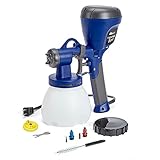
HomeRight Super Finish Max C800971 HVLP Paint Sprayer — A 450-watt turbine with three nozzle sizes (1.5mm, 2.0mm, 3.0mm) and a 40-ounce cup — the HVLP that scales from trim to full cabinet sets without switching machines.
Check Price on AmazonVia Amazon.com
✅ Pros
- 450W turbine handles thicker, unthinned materials
- Three nozzle sizes (1.5mm, 2.0mm, 3.0mm) cover stain to chalk paint
- 40-ounce cup means fewer refills on cabinet jobs
- Noticeably finer atomization than base-tier HVLP guns
❌ Cons
- Heavier and louder than compact handheld HVLP units
- Still not rated for spraying full walls
- Costs more than entry-level HVLP guns
Best for: Cabinet doors, trim, and larger furniture runs where you don’t want to refill every five minutes.
The Super Finish Max earns the overall pick because it doesn’t force a trade-off most buyers end up regretting. The 450-watt turbine pushes through thicker, less-thinned material than most consumer HVLP guns, and the three included nozzle sizes mean you’re not stuck re-thinning every time the project changes from stain to chalk paint.
The 40-ounce cup is the detail that matters most once you’re past a single drawer front. Refilling a small cup every few minutes is the fastest way to lose momentum on a full set of kitchen cabinet doors.
Best for Switching Between Walls and Trim: Wagner FLEXiO 590
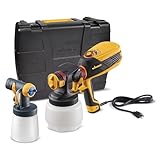
Wagner FLEXiO 590 Handheld HVLP Paint Sprayer — Two swappable nozzles — iSpray for bigger surfaces, Detail Finish for cabinets and trim — sprays most latex unthinned.
Check Price on AmazonVia Amazon.com
✅ Pros
- Sprays most latex unthinned
- Two nozzles cover both large and detailed work
- Simple single-dial control, easy for a first HVLP gun
- Light enough for overhead trim work
❌ Cons
- iSpray nozzle is still no substitute for a true airless on whole rooms
- Small cup forces refills on bigger runs
- Detail nozzle takes practice to avoid tailing
Best for: A homeowner who wants one HVLP gun for both an accent wall and the trim around it.
The FLEXiO 590 is built around a genuinely useful idea: swap the nozzle instead of buying a second sprayer. The iSpray nozzle handles a bigger surface, and the Detail Finish nozzle drops down for cabinets and trim, all from the same handheld turbine.
It’s not a replacement for a compact HVLP built purely for detail work — see our best small paint sprayer guide if that’s your only job — but for a homeowner tackling one room and its trim in the same weekend, one gun covering both is worth the compromise.
Best Professional-Grade Finish: Fuji Mini-Mite 4 PLATINUM T70
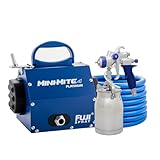
Fuji Mini-Mite 4 PLATINUM T70 HVLP Spray System — A four-stage turbine at 9 PSI with a bottom-feed cup, built for painters who spray often enough to justify the step up.
Check Price on AmazonVia Amazon.com
✅ Pros
- Four-stage turbine gives noticeably finer atomization
- Handles both waterborne and solvent-based coatings
- Pattern control knob adjusts fan size on the fly
- Built for daily use, not occasional projects
❌ Cons
- Priced well above hobbyist HVLP guns
- 23-lb turbine isn’t something you carry room to room casually
- Overkill for a single dresser or one-off project
Best for: Painters spraying cabinets or furniture regularly enough that finish quality and turbine life matter more than upfront cost.
The Mini-Mite 4 PLATINUM is the sprayer I’d point a serious hobbyist or a small contractor toward. The four-stage turbine produces a noticeably finer mist than the two-stage motors in the other three sprayers here, and the bottom-feed cup handles both waterborne latex and solvent-based finishes without a fuss.
That capability comes at a price most casual DIYers won’t want to pay for a single dresser. This is the pick if you’re spraying often enough that finish quality and turbine longevity matter more than the upfront cost.
Best for High-Volume Cabinet and Deck Jobs: Wagner Control Spray Max
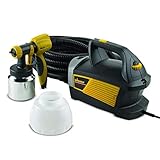
Wagner Control Spray Max HVLP Paint Sprayer — A 510-watt two-stage turbine on a stationary base, feeding the gun through a 20-foot hose so you aren’t hauling the motor around.
Check Price on AmazonVia Amazon.com
✅ Pros
- 510W two-stage turbine holds up through long sessions
- 20-ft hose keeps the heavy turbine off your arm
- Adjustable pressure dial plus material flow control
- Extra container included for switching materials fast
❌ Cons
- Base unit and hose take up more floor space
- Still needs thinned latex for best results
- Not built for quick, move-around spraying
Best for: Multi-day deck, cabinet, or fence projects where you’re spraying for hours, not minutes.
The Control Spray Max separates the turbine from the gun. The 510-watt motor sits on a stationary base and feeds the gun through a 20-foot hose, which means your arm is carrying a lightweight gun instead of a full turbine for hours at a time.
That layout is exactly right for a multi-day deck refinish, a full set of cabinets, or a fence — jobs measured in hours of active spraying rather than one quick pass over a side table. Wagner also builds a true airless line for anyone whose next job is a full exterior instead of cabinets and trim.

Photo by Createasea on Unsplash
🏗 Renovation Stage: PAINT
An HVLP paint sprayer belongs at the PAINT stage — surfaces are cleaned, primed, and ready for a finish coat. For prep-stage tools, see our kitchen cabinet primer guide first.
⚠ Before You Spray Indoors
Run cross-ventilation — two open windows, not one — any time you’re spraying indoors, and shut off a nearby water heater or furnace pilot light if you’re using a solvent-based finish. I always test the pattern on cardboard before the actual project; a nozzle that’s clogged or thinned wrong sprays unevenly, and on a vertical door face you won’t catch it until the finish has already gone on.
How to Choose the Right HVLP Sprayer for Your Project
Turbine Stages
Turbine stage count roughly tracks with air pressure and finish quality. Single- and two-stage turbines, like the FLEXiO 590 and Control Spray Max, are fine for latex, stain, and chalk paint. Four-stage turbines, like the Fuji, push thicker and solvent-based materials with a finer atomized mist.
Cup Size and Nozzle Options
A 27-ounce cup is plenty for a chair or a cabinet door. A 40-ounce cup matters once you’re spraying a full kitchen’s worth of doors and don’t want to stop and refill every ten minutes. Multiple nozzle sizes let one machine handle both thin stain and thicker furniture paint if your projects lean that direction.
How Much Thinning You’ll Actually Do
Every HVLP gun sprays best with material at the right viscosity, and most latex paint needs 10–15% water added before it will atomize cleanly. Higher-wattage turbines like the Super Finish Max and Control Spray Max tolerate less thinning than compact handheld guns, which is worth knowing before you’re standing at the sink with a paint stick.
🧮 How Much Water to Add When Thinning Latex
When HVLP Isn’t the Right Tool
If the project is a full room of wall paint rather than cabinets, trim, or furniture, a true airless sprayer will finish in a fraction of the time. See our airless sprayer for home use guide before you commit to an HVLP for a whole-room job.
⚡ Field Notes From My Shop
Match the nozzle to the material before you commit to a project, not partway through it — switching mid-job on the Super Finish Max costs you a full cleaning cycle. Keep a spare set of gaskets on hand; they’re the first part to wear out on any HVLP gun run weekly. Move the gun, not your wrist, at a steady 6–8 inches from the surface — stopping mid-stroke while the trigger is down is what causes runs.
Prepping Your Project Before You Spray
- Clean the surface. Grease, wax, and dust all show up as texture under a sprayed finish in a way they never do under a brush.
- Prime bare wood or glossy surfaces. HVLP lays down a thin, even coat, which means it will not hide poor adhesion the way a heavy brushed coat sometimes can — check our kitchen cabinet primer guide before spraying cabinet doors.
- Thin to the manufacturer’s spec, not by feel. Too thick and the gun sputters; too thin and you’ll be fighting runs on every vertical surface.
- Test the pattern on cardboard first. Two minutes here saves a reworked finish later.
- Contain the overspray if you’re working indoors. Even a low-overspray HVLP gun puts fine mist into the air — see our DIY spray paint booth guide if you don’t have a dedicated shop space.
Our Verdict
For most cabinet, trim, and furniture projects, the HomeRight Super Finish Max is the HVLP paint sprayer I’d tell a friend to buy first — enough power to skip heavy thinning, three nozzles for different materials, and a cup big enough to get through a real project. If you’re splitting time between a wall and its trim, the Wagner FLEXiO 590 earns its keep. Spraying often enough that finish quality is the priority? The Fuji Mini-Mite 4 PLATINUM is worth the step up. And if the job is measured in hours — a full cabinet set, a deck, a fence — the Wagner Control Spray Max is built to keep going after the handheld guns would leave your arm done.
Hvlp Paint Sprayer: FAQ
What is the best HVLP paint sprayer overall?
The HomeRight Super Finish Max C800971 is the best all-around HVLP paint sprayer for most buyers. Its 450-watt turbine and three interchangeable nozzles handle cabinets, trim, and larger furniture pieces without demanding heavy thinning first.
Is HVLP better than airless for cabinets?
Yes, for cabinet doors and trim. HVLP’s lower pressure produces a finer, more controlled mist that suits detailed surfaces. Airless sprayers push more volume at higher pressure, which is better suited to covering whole walls or exteriors quickly.
Do I need to thin paint for an HVLP sprayer?
Most latex paint needs about 10 to 15 percent water added to spray cleanly through an HVLP gun, though higher-wattage turbines like the Super Finish Max and Control Spray Max tolerate thicker, less-thinned material than compact handheld models.
How many turbine stages do I need?
A single- or two-stage turbine is enough for latex, stain, and chalk paint on furniture or trim. A four-stage turbine, like the Fuji Mini-Mite 4, is worth the extra cost only if you’re spraying often or working with solvent-based finishes.
Can an HVLP sprayer paint a whole room?
It can, but slowly and with more refills than an airless sprayer designed for walls. If the project is a full room of latex paint, a true airless unit will finish in a fraction of the time and handle unthinned paint more easily.
How much overspray does HVLP produce compared to airless?
HVLP produces noticeably less overspray than a conventional airless sprayer because it runs at much lower pressure. That’s part of why it’s the better choice indoors on cabinets and furniture, where drift onto nearby surfaces is a real concern.
How do I clean an HVLP sprayer after use?
Empty the cup, then run water (or mineral spirits for oil-based finishes) through the gun until it comes out clear. Remove the nozzle and soak it separately, and wipe down the turbine housing. Paint left to dry inside the nozzle is the most common cause of clogs.