Can You Paint Stainless Steel? Yes — Here’s the Prep That Makes It Stick
Updated October 2026 · By Sophie Ulman
So, can you paint stainless steel? You can — and people do it for good reasons. Kitchen appliances in an outdated color. A stainless steel door or railing that doesn’t match a refresh. Commercial kitchen equipment that needs a fresh appearance without replacement cost. The challenge isn’t the paint itself — it’s getting paint to adhere to a surface specifically engineered to resist chemical bonding. This guide covers exactly how to make that happen, step by step.
Why Stainless Steel Is Difficult to Paint
Can you paint stainless steel without special prep? Technically yes — and it will peel within days. Stainless steel gets its corrosion resistance from a thin, invisible chromium oxide layer that forms on the surface. This same layer is extremely smooth and chemically inert — meaning paint has no microscopic texture to grip and no chemical reactivity to bond with. Apply paint directly and it adheres by surface tension alone — which fails at the first flex, temperature change, or cleaning cycle.
Successful painting of stainless steel requires two things: physical abrasion (to create texture) and a primer engineered to chemically bond with metal. Without both, the paint will delaminate. With both, it holds remarkably well. Aluminum fails for the same reason, which is why the same etch-then-paint sequence runs through my guide to the best paint for aluminum.
What I learned the hard way on a dishwasher panel
The first time I painted a stainless appliance, it was a dishwasher front panel that clashed with a new kitchen. I degreased it, shot two coats of a metal spray enamel straight onto the steel, and it looked factory-finished for about five weeks. Then a fingernail caught the edge near the handle and lifted a strip of paint the size of a business card — in one piece, like a sticker. The paint had never bonded. It had simply dried on top of a surface engineered to reject it.
I redid it properly: 120 grit until the whole panel went uniformly dull, an acetone wipe, self-etching primer within the hour, then appliance epoxy in two thin coats. That panel went through three years of daily door slams and wipe-downs before I sold the house, and the only wear was a faint burnish at the handle. Same paint, same painter, same appliance. The only difference was the primer — and that is the whole article in one sentence. Prep matters more than the brand you buy.
If you want to check your own work before you topcoat, use the tape test painters use (ASTM D3359): press a strip of masking tape hard onto the cured primer, then rip it off fast. Primer that lifts with the tape was never bonded, and no topcoat will fix that.
What You Need Before You Start
Gather everything before starting — once you begin the cleaning and etching phase, you need to prime immediately before the surface re-oxidizes:
- 80–120 grit sandpaper or sanding sponge
- Acetone or isopropyl alcohol (90%+) for degreasing
- Self-etching primer (Rust-Oleum Self-Etching Primer or equivalent) — not standard primer
- Metal-rated topcoat paint (enamel, epoxy, or specialty metal paint)
- Painter’s tape and drop cloth
- Clean lint-free rags
- Gloves + eye protection for etching primer work
How to Paint Stainless Steel — Step by Step
1 Clean and Degrease Completely
Wipe the entire surface with acetone or 90%+ isopropyl alcohol on a lint-free cloth. Work in one direction — circular motions redistribute grease. Allow to evaporate fully (1–2 minutes). Repeat if the cloth picks up visible contamination on the second pass. No primer bonds well over grease, oils, or fingerprints — stainless steel surfaces accumulate both quickly from regular handling.
2 Abrade the Surface
Sand the entire area to be painted with 80–120 grit sandpaper. You’re not trying to scratch deeply — you’re creating microscopic texture (profile) that gives primer something to mechanically grip. Sand in one direction (with the steel’s grain lines if visible) rather than randomly. The surface should look uniformly dull — no shiny spots remaining. Shiny spots mean the chromium oxide layer is still intact and the primer won’t bond there.
After sanding, wipe down again with fresh acetone to remove all sanding dust before proceeding. Dust trapped under primer causes pinhole failures.
3 Apply Self-Etching Primer
This is the critical step. Self-etching primer contains phosphoric acid which chemically reacts with the metal surface — the only way to create a true chemical bond on stainless steel. Apply a thin, even coat immediately after the acetone wipe-down — the abraded surface re-oxidizes within hours, so don’t delay.
Apply in thin coats (one 6–8 inch sweeping pass). Self-etching primer applied too thickly bubbles and cracks as it cures. Two thin coats with 20 minutes between them is better than one heavy coat. Allow full cure — typically 1 hour before topcoat, but check your product label.

4 Apply Topcoat Paint
Once the self-etching primer has cured, apply your metal-rated topcoat in thin, even coats. Avoid applying paint over self-etching primer that has been left more than 24 hours — re-prime if the window has passed. Apply 2–3 thin coats, allowing each to dry per the manufacturer’s spec (typically 2–4 hours) before the next.
For appliances and high-touch surfaces, use a hard enamel or two-part epoxy topcoat rather than standard acrylic. These cure harder and resist scuffing, cleaning products, and temperature cycling better than soft latex formulas. For railings and decorative elements, standard metal enamel works well.
5 Cure and Protect
Paint is dry to the touch within hours but doesn’t reach full hardness for 7–30 days depending on the topcoat chemistry. Treat the surface gently during this curing window — no aggressive cleaning, no placing items that might scuff the surface. After full cure, consider applying a clear metal sealer over the topcoat on high-abrasion areas (door handles, railings) for additional durability.
Which Paint Types Work on Stainless Steel
| Paint Type | Bond Strength | Best For | Notes |
|---|---|---|---|
| Oil-based enamel | Excellent | Appliances, railings | Hard cure; strong chemical resistance |
| Two-part epoxy | Superior | Industrial, high-heat | Best durability; requires mixing, shorter pot life |
| Water-based acrylic (metal grade) | Good | Decorative, low-traffic | Easier application; less durable than epoxy |
| High-heat spray paint | Good (heat-specific) | BBQ grates, exhaust areas | Required if surface exceeds 200°F regularly |
| Standard acrylic wall paint | Poor | Not recommended | Will peel — not formulated for metal adhesion |
| Chalk paint | Poor | Not recommended | No chemical resistance; unsuitable for metal |
The bottom line: wall paint and chalk paint will go on and look fine for a month, then chip at every edge. Use paint labeled for metal surfaces, without exception. According to the This Old House metal painting guide, oil-based enamel over self-etching primer is the most reliable combination for most household metal painting projects.
The Two Products That Decide Whether This Holds
This is a two-product job, and only one of them is negotiable. The primer either bonds to the chromium oxide layer or it does not — there is no partial credit. The topcoat is a durability and colour decision, and I have split it into the two routes people actually pick between.
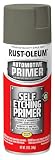
Rust-Oleum Automotive Self Etching Primer Spray, 12 oz
Who this is for: anyone painting raw stainless steel. There is no version of this job that skips it.
Self-etching primer carries phosphoric acid, and that acid is doing something a bonding primer cannot: it bites into the passive chromium oxide layer and leaves a chemically keyed surface behind. A bonding primer is formulated to grip glossy painted surfaces and laminate. It has no acid in it, and on bare stainless it lifts off with the tape test.
Where it disappoints: the etch window is short. Once it is down you have roughly 24 hours to topcoat; leave it a week and the primer itself chalks and you are re-priming. It also sprays on a blotchy grey-green — that is normal and it vanishes under the topcoat, but it looks alarming the first time.
One 12 oz can covers roughly 12 to 15 sq ft in the thin coats this product needs — a dishwasher front is one can, a fridge is two.
Best for: appliance panels, railings, brackets, and any stainless that gets touched daily.
Check Price on Amazon →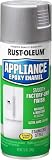
Rust-Oleum 7887830 Specialty Appliance Epoxy Spray, Stainless Steel, 12 oz
Who this is for: anything that gets wiped down, bumped, or sprayed with degreaser.
Appliance epoxy cures to a harder film than standard metal enamel, and hardness is the whole point on an appliance. The surfaces that fail first are the ones people clean — a soft acrylic film dulls in patches wherever the spray bottle lands. This one shrugs it off. The stainless-look shade is also the forgiving choice: it hides the slight orange-peel texture that spray application leaves behind.
Where it disappoints: the colour range is narrow — stainless look, white, almond, black, biscuit. Want a specific shade and you are back to metal enamel and accepting a softer film. The cure smell is also genuinely unpleasant for the first 48 hours, so ventilate a kitchen properly before you spray.
Dry to touch in 2–4 hours and about 7 sq ft per can, but do not treat it as cured — full hardness takes days, and rated only for surfaces staying under 200°F.
Best for: kitchen and laundry appliance exteriors: dishwasher fronts, fridge panels, range sides.
Check Price on Amazon →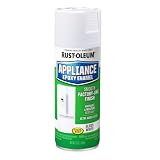
Rust-Oleum 7881830 Specialty Appliance Epoxy Spray, White, 12 oz
Who this is for: anyone whose actual goal is a white or retro kitchen, not a stainless repair.
Same epoxy chemistry as the stainless-look can, different pigment load. Worth calling out separately because most people arriving at this page assume the only reason to paint stainless is to fix stainless. It is not. The commonest job I get asked about is a lone stainless dishwasher stranded in a kitchen of white appliances, and this is the can that fixes it for the price of a takeaway.
Where it disappoints: white shows every application flaw the stainless shade hides — runs, thin spots, and orange peel all read clearly. This is the colour that punishes a heavy hand. Three thin coats, not two thick ones.
Two thin coats always beat one thick coat, and on white that stops being a slogan and starts being visible.
Best for: matching a mismatched appliance into an existing white or almond kitchen.
Check Price on Amazon →When NOT to Paint Stainless Steel
Painting is the right call on an appliance door that clashes with a new kitchen. It is the wrong call in four situations, and knowing them before you sand saves you the job. Skip the paint when:
- The surface sees direct heat above 200°F regularly. Standard topcoats break down under sustained heat. High-heat spray paint is required — and even then, cooking surfaces should not be painted.
- You need to maintain food-grade safety. No painted surface is food-safe. Interior appliance surfaces, cookware, and prep tables are off-limits.
- The steel is structural or load-bearing. Paint on structural steel requires professional-grade coatings and inspection — not a DIY project.
- You want a temporary fix. Painting stainless steel requires proper prep and isn’t easily reversed. If you’re unsure about the color or finish, consider appliance-specific wraps or films instead — they’re removable without damage.
🔧 Renovation Context: PREP + PRIME + PAINT
Painting stainless steel requires all three renovation stages done correctly and in sequence — unlike most surface painting where you can sometimes skip priming. Clean → Abrade → Self-Etch Prime → Topcoat. The sequence is non-negotiable. For more on surface-specific prep techniques, see our guides on best paint for metal fence and paint removal for metal surfaces.
🔗 More metal painting guides: best paint for metal fence · best engine paint · can you paint aluminum siding · best chrome spray paint · best paint remover for metal
Summary — Can You Paint Stainless Steel?
Yes, and it holds — if the primer is right. The full process from cleaning to final coat takes one day, plus the cure window. The process is: clean with acetone, abrade with 80–120 grit sandpaper, apply self-etching primer, then apply a metal-rated enamel or epoxy topcoat in thin coats. The self-etching primer is the step most DIYers skip that causes failure.
Avoid food-contact surfaces and high-heat zones. Use oil-based enamel or two-part epoxy for best durability. And be honest about why you’re painting — if you want a reversible finish or a temporary change, an appliance wrap is a better option than paint.
FAQ — Painting Stainless Steel
Can you paint a stainless steel refrigerator?
Yes — the exterior panels of a stainless steel refrigerator can be painted. Clean with acetone, sand lightly, apply self-etching primer, and topcoat with appliance epoxy or hard enamel. Avoid painting door seals, hinge mechanisms, or any rubber gaskets. The interior should never be painted.
What primer works on stainless steel?
Self-etching primer is the only primer that reliably bonds to stainless steel. It contains phosphoric acid that chemically reacts with the metal. Standard metal primer, bonding primer, and PVA primer don’t work on stainless steel — they adhere to already-primed or porous surfaces, not to the chromium oxide layer on raw stainless.
Can you paint stainless steel appliances without sanding?
You can — but the result will be far less durable. Sanding creates mechanical texture that dramatically improves primer adhesion. Without it, the self-etching primer relies on chemical bonding alone, which is still better than no primer, but the paint will be more vulnerable to chipping at edges and corners. For anything that gets regular handling, sanding is worth the extra 20 minutes.
How long does paint last on stainless steel?
With proper prep (abrasion + self-etching primer + metal-grade topcoat), paint on stainless steel lasts 3–7 years on low-traffic surfaces and 1–3 years on high-traffic or frequently cleaned surfaces. Using a two-part epoxy topcoat instead of standard enamel pushes durability toward the higher end of both ranges.
Can you paint stainless steel pots and pans?
No. Cookware interior surfaces come into contact with food and heat — no paint is food-safe or heat-stable enough for this application. Even the exterior of pots and pans (which gets direct stove-burner contact) reaches temperatures that will cause standard paint to blister and off-gas. This is not a safe DIY painting project.
Does painting stainless steel void appliance warranties?
Typically yes — any modification to the exterior surface that isn’t covered by the manufacturer’s warranty voids coverage for related damage. Check your specific appliance warranty before painting. Most residential appliance warranties exclude cosmetic modifications.