Best Foam Paint Roller for Cabinets, Doors and Trim
A foam paint roller is a finish tool, not a coverage tool. That single distinction decides whether you end up with a surface that looks sprayed or one covered in tiny craters, and it is why the same roller gets described as the best thing in the toolbox by one person and a waste of money by the next. This guide covers which foam roller to use for trim, cabinets and doors, the paint that makes foam behave, and the one defect foam produces that a woven cover never will.
Why Foam Rollers Are a Favorite
Foam rollers are often the top choice when you want that ultra-smooth, spray-like finish, especially on walls, wood, and metal. For rougher surfaces or masonry, a thick ¾” nap roller works better, but for smoothness, foam rollers are unbeatable.
They are also handy for touch-ups and trim work, making them an excellent option for DIYers and professionals alike. Foam rollers are perfect when you are refinishing wood, painting exterior doors, or aiming for the best paint roller smooth finish without visible strokes or lint.
If you are preparing your walls, make sure you review how to clean walls before painting for the best possible results.
Top Foam Rollers on the Market
Here are the top contenders for the best foam rollers for painting, each with unique strengths.
FoamPRO 2-inch Fine Finish Mini Roller (FoamPRO 162)
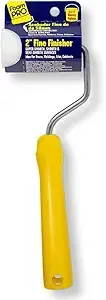
This roller is excellent for intricate woodwork, trim, and cabinets. Its high-density foam delivers a lint-free, spray-like finish, making it one of the best options when you want a professional look.
Pros: Provides ultra-fine finishes, reusable, works well with oil and enamel paints.
Cons: Small size limits efficiency for large areas.
Mister Rui 4-inch High-Density Foam Roller 10-Pack
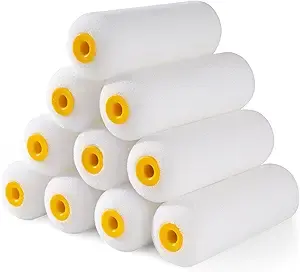
This budget-friendly multipack is perfect for trim, cabinets, and smaller projects. It is ideal for anyone who wants smooth results without spending too much.
Pros: Affordable, reusable, user-friendly, delivers clean finishes.
Cons: Limited to small-scale jobs.
Voomey 9-inch High-Density Foam Roller 3-Pack
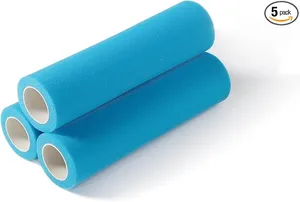
If you need to cover large flat surfaces such as walls or doors, this roller offers the right balance of size and finish quality. Its high-density foam ensures consistent coverage.
Pros: Covers surfaces quickly, holds paint evenly, durable.
Cons: Only three per pack and requires careful use around edges.
How the Three Compare
Specs only tell you so much. Here is how the three differ in the way that matters when you are holding one:
| Roller | Highlights | Cautions |
|---|---|---|
| FoamPRO 2-in | Smooth, lint-free, perfect for trim. | Small, slow on larger areas. |
| Mister Rui 4-in | Great value, versatile, smooth finish. | Limited to small projects. |
| Voomey 9-in | Excellent coverage for walls and doors. | Few rollers in pack, less precise edges. |
When Foam Rollers Shine and When They Don’t
Smooth Surfaces and Furniture
Foam rollers excel on smooth surfaces where you need that glass-like finish. They are commonly used for furniture, doors, and cabinets. Thin coats and light passes work best to avoid roller marks. If you are painting furniture, check our guide on the best furniture paint to pair with your roller.
Woodworking and Trim
For cabinets and trim, foam rollers produce outstanding results. Some professionals prefer low-nap woven rollers, but foam remains a reliable option for anyone seeking a clean look.
Exterior Painting
Foam rollers work well on smooth exterior surfaces like doors and siding. However, if you are working with brick or stucco, it is better to choose paint rollers designed specifically for rough surfaces. If you are considering large outdoor projects, also see our guide on how to stain a fence for step-by-step preparation.
Tips and Helpful Resources
- If you are painting a ceiling, you may want to look at our review of the best ceiling paint roller.
- For those working near tight corners, learn the best way to paint edges between wall and ceiling.
- To speed up projects, our guide on how to make paint dry fast will help you recoat quicker.
Final Thoughts: Which Foam Roller Should You Choose?
- If you are painting trim, cabinets, or woodworking projects, the FoamPRO 2-inch roller is your best bet.
- If you want a budget-friendly option for small to medium projects, the Mister Rui 4-inch pack provides smooth finishes without breaking the bank.
- If your goal is fast coverage on large surfaces, the Voomey 9-inch roller gives the efficiency and smoothness you need.
Foam rollers are an excellent tool when you want smooth finishes, but they require finesse, apply thin coats, replace rollers as needed, and pay extra attention to edges. With the right roller, you can achieve professional-level results at home.
The Thing Nobody Warns You About Foam Rollers: Pinholing
Foam gives the smoothest finish of any roller, and it also produces the one defect that a woven cover never will. As the foam compresses and springs back it pulls air into the wet film, and with a fast-setting water-based paint that air does not always escape before the surface skins over. What you get is a fine spray of tiny craters — pinholing — that you cannot see while it is wet and cannot miss once it dries.
Three things prevent it, and all three are about slowing the process down:
- Roll slowly. Speed is what whips air into the film. A foam roller moved at half the pace you would use on a wall gives a visibly better surface.
- Do not overwork it. One pass to lay the paint on, one light pass to level it, then leave it. Going back over a section that has started to set is what tears the surface and traps bubbles.
- Give the paint time to flow. Fast-dry latex is the worst case because it skins before air can rise out. A paint formulated for cabinets and trim is built to level slowly, which is precisely why it pairs with foam.
The Paint That Makes a Foam Roller Worth Using
INSL-X Cabinet Coat Urethane Acrylic Satin Enamel, White, 1 Gallon
If you are buying a foam roller, the odds are high that you are painting cabinets, doors or trim, and the roller is the cheap half of that decision. This is a urethane-acrylic cabinet enamel with a satin sheen, formulated to level out to a smooth surface rather than set where it lands — which is exactly the property that lets a foam roller do its job without pinholing. It covers 300 to 400 square feet per gallon and it is made for kitchen and bathroom cabinets, shelving, furniture, trim and crown moulding.
It resists chipping, scuffing, grease and water, which is the part that matters six months later on a cabinet door that gets opened with wet hands. Standard wall latex on cabinets fails at exactly that point regardless of how you applied it.
If cabinets are the actual job, the full process is in our guide to painting kitchen cabinets, and the primer question is covered in the best primer for kitchen cabinets.
A Bathroom Door I Had to Sand Twice
I painted a panelled bathroom door with a 4 inch foam roller and a fast-drying white latex, on a warm afternoon, with a fan running to speed things along. It looked beautiful going on. By the time it dried the flat panels were covered in a fine pepper of pinholes, close enough together that from three feet away the door just looked slightly grey rather than white.
I sanded it back and did it again, and made the same mistake again, because I assumed the problem was the roller. It was not. The second time I switched to a cabinet enamel that levels slowly, turned the fan off, and rolled at about half the speed. Same roller, same door, and the finish came out like it had been sprayed.
So when someone tells me foam rollers leave a bad finish, my first question is what paint they were using and how fast they were moving. It is almost never the foam.
When a Foam Roller Is the Wrong Choice
- Any textured surface. Foam has no nap to reach into a low point. On stucco, brick, knockdown or a textured ceiling it coats the peaks and leaves everything else bare, which looks far worse than an ordinary roller mark.
- Large wall areas. Foam holds less paint than a woven cover of the same size, so you reload constantly and the reload points show as lap marks. It is a finish tool, not a coverage tool.
- Strong solvents. Some foams break down in lacquer thinner and certain solvent-based products. Check the roller’s material rating before using it with anything harsher than mineral spirits, because a disintegrating roller in the middle of a finish coat is a bad afternoon.
- Fast-drying latex in hot, moving air. The combination that causes pinholing. If you cannot change the paint, at least turn off the fan and work out of direct sun.
- Sharp inside corners. Foam compresses and dumps a bead of paint into the corner, which then runs. Brush corners, roll flats.
Foam Roller Questions People Actually Ask
Do foam rollers leave bubbles?
They can, and it has a name: pinholing. The foam compresses and springs back, pulling air into the wet film, and if the paint skins over before that air escapes you are left with tiny craters. Rolling more slowly, avoiding a third pass over a setting surface, and using a paint that levels slowly all prevent it.
Is a foam roller better than a microfiber roller for cabinets?
Foam gives the smoother surface; microfiber holds more paint and is more forgiving of speed. For a small number of cabinet doors where the finish is the whole point, foam wins. For a full kitchen where fatigue and reloading start to matter, a short-nap microfiber is the easier tool to stay consistent with.
Can you reuse a foam paint roller?
Yes, if you wash it out before the paint sets. Squeeze rather than wring — twisting tears the foam off the core — and let it dry standing rather than lying on a flat surface, which flattens one side. A foam cover that has dried with paint in it is finished; the surface will never be smooth again.
What size foam roller for doors and trim?
A 4 inch for door panels and general trim, and a 2 inch for narrow mouldings, mullions and tight detail. A 9 inch foam roller only makes sense on large flat slabs such as flush doors or a tabletop, where the wider cover helps you finish the whole surface before any of it starts to set.
Can I use a foam roller with oil-based paint?
Generally yes, and oil-based enamels are where foam performs best because they flow and level for far longer than latex. The exception is strong solvents such as lacquer thinner, which can break some foams down. Check what the cover is rated for before you commit a finish coat to it.
Why does my foam roller leave lines at the edges?
The end of a foam cover is a hard edge, and pressing down puts more paint there than in the middle of the pass. Ease off the pressure as you approach the end of a stroke and overlap your passes by about a third rather than butting them together.
Do I still need to sand between coats?
On cabinets and trim, yes. A light pass with fine paper knocks down any raised grain and the faint texture a roller leaves, and it is the difference between a good home finish and one people assume was sprayed. Wipe the dust off before the next coat or you have simply added grit to the surface.
Written by Sophie Ulman. ThePaintly is reader-supported: when you buy through links on this site we may earn an affiliate commission at no extra cost to you.