VHT vs Rust-Oleum Engine Enamel: Which One Survives a Full Season Under the Hood?
Updated: August 2026 | By Sophie Ulman
Choose wrong here and you do not find out for four months. The paint looks perfect the day you close the hood. Then a summer of heat cycles goes through it, a little oil weeps down the block, you hit it with degreaser once, and the finish either shrugs or it goes dull and soft. That is the whole argument in VHT vs Rust-Oleum engine paint, and almost nobody frames it that way. They compare price and color range. Those are not what fails.
Here is the short version. VHT Engine Enamel is rated to 550°F intermittent. Rust-Oleum’s Automotive Engine Enamel is rated to 500°F. That 50-degree gap matters less than the second difference, which is how the two products reach full hardness — and that one decides which can belongs in your hand.
This is where people get caught. VHT only attains its properties after it is baked or run hot, and a part sitting on a shelf never gets there, so the finish can stay soft enough to dent with a thumbnail for weeks. With engine enamel, the cure schedule is a spec, not a suggestion.
What’s on this page
VHT vs Rust-Oleum engine paint: the head-to-head at a glance
Both are aerosol engine enamels sold in the same aisle for similar money, which is why VHT vs Rust-Oleum engine paint gets argued about at all. The published specs are where they separate. Everything in this table comes from the two manufacturers’ own product data, not from my opinion.
| Spec | VHT Engine Enamel | Rust-Oleum 500° Engine Enamel |
|---|---|---|
| Heat rating | 550°F (288°C) intermittent | 500°F (260°C) intermittent |
| Resin | Urethane and ceramic blend | Stops Rust enamel |
| Dry to touch | 30 minutes | 20 minutes |
| Dry to handle | 1 hour | 1 hour |
| Full cure | Bake 200°F for 20 min, or engine heat | 7 days air cure |
| Recoat window | Complete dry at 24 hours | Within 1 hour, or after 24 hours |
| Spray head | Standard aerosol tip | Any-angle, sprays upside down |
| Matching primer | SP148 Engine Enamel primer | 249410 Engine Primer, 500°F |
| Made by | Dupli-Color, a Sherwin-Williams company | Rust-Oleum |
Read that cure row twice. It is the line that settles most of these arguments. VHT is a heat-cure product that happens to air dry; Rust-Oleum is an air-cure product that tolerates heat. If the part goes back on a running engine, VHT gets what it needs for free. If the part lives on a trailer, a display stand or a project that will sit for a year, it does not.
The 5 cans worth buying
Five products, and they are not five competitors. Two are the color coats at the center of VHT vs Rust-Oleum engine paint, two are the primers those color coats were formulated to sit on, and one is the case you buy when you are doing a whole engine bay in a weekend.
Best heat margin on a driven engine
VHT SP124 550° Engine Enamel, Gloss Black, 11 oz
VHT builds this on a urethane and ceramic resin blend rather than a straight enamel. The ceramic portion is why the film keeps its hardness at temperature instead of softening the way a plain alkyd does. That is the mechanism behind the 550°F intermittent rating, and it is also why the can tells you to bake it at 200°F for twenty minutes. The resin needs heat to finish crosslinking. Skip that and you have a film that looks cured and is not.
On an engine that actually runs, you never think about it — the first few heat cycles do the baking for you. On a block that will sit through a long build, you need to plan for it. I now put small parts in an old toaster oven in the garage for twenty minutes and the difference in chip resistance the next morning is not subtle. The honest limitation: gloss black shows every ripple in your spray pattern, so on a rough cast surface you will want three light passes rather than two.
Pros
- Highest rated heat margin of the two, 550°F
- Formulated against fuel blends and degreasers
- Full matching system: primer, color, clear
Cons
- Needs a bake or engine heat to fully cure
- Standard tip, awkward on the underside of a block
Best for: a block, heads or manifold going straight back into a car that will be driven within a month.
Via Amazon.com
Best for tight spots and upside-down spraying
Rust-Oleum 248932 Engine Enamel, Gloss Black, 12 oz
Rust-Oleum rates this to 500°F intermittent and builds it on their Stops Rust chemistry, which is the meaningful difference in the can. It is designed to keep working as a barrier over metal that is already pitted, and it resists oil, gas, grease, salt and humidity by design rather than as a side effect. Where it genuinely beats VHT is the valve: the any-angle head sprays inverted, so you can paint the underside of a bracket or the back face of a bellhousing without pulling the part.
The trade-off is the recoat window, and it catches people. Rust-Oleum says to apply the second coat within one hour or after 24 hours. Come back at hour four, which is exactly when a Saturday project drifts, and the solvent in the fresh coat softens the half-set film underneath. You get wrinkling, and wrinkling means sanding back. Set a timer. That is not a criticism of the paint, it is a fact about how it dries.
Pros
- Sprays at any angle, including upside down
- Cures fully on air alone in 7 days
- Stops Rust base coat chemistry
Cons
- 500°F rating, 50 degrees under VHT
- Unforgiving recoat window between 1 and 24 hours
Best for: painting parts in place, on the car, where you cannot get a straight shot at the surface.
Via Amazon.com
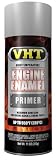
Best primer if you go VHT
VHT SP148 Engine Enamel Light Gray Primer, 11 oz
VHT publishes its engine finish as a three-part system: SP148 primer, then the color, then SP145 clear. The primer shares the same urethane and ceramic chemistry as the color coat, which is the point. When the block expands and contracts through a heat cycle, primer and color move at the same rate. Mix chemistries and the two layers argue with each other at the boundary, which is where you see hairline lifting a year later.
Light gray under a dark color also does something practical: it shows you your coverage. On raw cast iron you cannot tell where you have sprayed until it is too late. The limitation worth naming — do not use this as a general metal primer on cold parts. It is formulated for the same heat cycling as the color coat, and on a part that never gets hot it is simply an expensive gray primer. For that job a standard spray primer for wood and metal does more for less.
Pros
- Same resin system as VHT color coats
- Light gray reads coverage clearly on cast iron
- Rated for the same 550°F service
Cons
- Overkill and overpriced for cold metal
- Needs the same cure treatment as the color
Best for: bare, stripped or media-blasted cast iron that is getting a VHT color coat on top.
Via Amazon.com
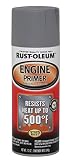
Best primer over metal that has already rusted
Rust-Oleum 249410 Automotive Engine Primer, Gray, 12 oz
This is the primer Rust-Oleum tells you to put under their engine enamel, and it is rated to the same 500°F. The formula bonds to bare metal and carries the Stops Rust package, which is the reason to reach for it over a generic sandable primer. On an engine that has been sitting, you are almost never priming clean steel — you are priming metal with a memory of surface rust, and a primer that only sticks will not stop what is underneath from coming back.
It shares the any-angle valve with the color coat, so the same reach advantage applies. One honest limitation: it is not a rust converter. If you have flaking scale rather than light surface oxidation, no primer in an aerosol can saves you — you strip first. My rule is simple. If a wire wheel changes the color of the metal, prime it. If the wire wheel changes the shape of the metal, you have a bigger job, and the paint for rusty metal conversation is a different one.
Pros
- Bonds directly to bare metal, no etch step
- Stops Rust corrosion package built in
- Any-angle spray like the color coat
Cons
- Not a rust converter, will not save flaking scale
- Gray only, no color options
Best for: a block or accessory with light surface rust that is getting a Rust-Oleum color coat.
Via Amazon.com
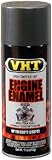
Best for a full engine bay in one session
VHT SP997 Nu-Cast Iron Engine Enamel, 11 oz, Case of 6
Nu-Cast Iron is VHT’s cast-metal look rather than a gloss color, and Rust-Oleum has no direct equivalent in their engine line. It reads as fresh, dry cast iron instead of painted cast iron, which is what you want on a restoration where a wet gloss black would look wrong next to original hardware. Same 550°F rating, same urethane and ceramic resin, same cure requirement.
The reason to buy the case of six rather than singles is not the discount. It is lap lines. A block, heads, manifold, water pump and brackets consume far more paint than people estimate, and running dry halfway through a coat leaves a visible edge that a second session will not blend out. Buy more than you think and keep the spare. That said, if you are painting one valve cover, this is the wrong purchase — a single can does that job with paint left over.
Pros
- Correct cast-metal appearance for restorations
- Enough volume for a complete engine and accessories
- Consistent color across the whole job
Cons
- Far too much paint for a single part
- Textured look hides less prep than gloss, but also less detail
Best for: a full engine and accessory set being refinished over one weekend.
Via Amazon.com
Pro tips before you spray either one
None of this changes with the brand. Whichever way you settle VHT vs Rust-Oleum engine paint, these five habits do more for the finish than the label on the can.
Degrease twice, and the second time after you sand. Sanding drives oil deeper into cast iron instead of removing it. Degrease, scuff, degrease again. This is the single step that separates a finish that lasts from one that peels in sheets.
Warm the can, not the part. Fifteen minutes in a bucket of warm tap water gets the propellant up to a working pressure and the spray pattern gets noticeably finer. Never use a heat source on an aerosol can.
Two thin coats always beat one thick coat. Always. On engine enamel a heavy coat traps solvent under a skinned surface, and the first heat cycle pushes it out as blisters.
Mask the machined surfaces before you mask anything else. Sealing faces, bolt holes and gasket lands do not want paint on them, and overspray there is a leak later.
Spray outdoors or with real airflow. Both products are solvent-based aerosols. OSHA’s spray finishing standard exists because these vapors are both a health and a flammability problem in a closed garage.
Renovation Stage: PAINT
This is a color-coat decision. If your metal is still bare, blasted or rusty, you are one stage earlier — prime first with a product rated to the same temperature, then come back here.
How many cans will you actually need?
Aerosol engine enamel covers far less than the can implies once you account for two coats and overspray. Pick what you are painting.

How to choose between VHT vs Rust-Oleum engine paint
Forget brand loyalty for a minute. Four questions settle VHT vs Rust-Oleum engine paint, and only one of them is about temperature.
Will the part get hot within the first month?
This is the question that matters most, and the one nobody asks. VHT reaches its rated hardness through heat — either a 200°F bake for twenty minutes or the engine’s own operating temperature. Rust-Oleum publishes a seven-day air cure with no heat required. So if the block is going back in a running car this month, VHT gets its cure for free. If the part is going on a shelf, into storage, or onto a project that will not fire for a year, Rust-Oleum finishes the job on its own and VHT does not.
Can you get a straight shot at the surface?
Rust-Oleum’s any-angle valve sprays inverted. That sounds like a gimmick until you are lying under a car trying to hit the bottom of an oil pan. When you cannot remove the part, that valve is worth more than fifty degrees of headroom you will never use. When the part is on a bench and you can rotate it freely, the advantage evaporates.
How hot does the surface actually get?
Be honest about this. A cast iron block on a street car runs nowhere near 500°F — coolant temperature caps it far lower. Exhaust manifolds and headers are the parts that punch past both ratings, and neither of these products belongs there. That job needs a proper header coating, which is a separate category covered in our guide to high heat paint for exhaust. The 550°F versus 500°F difference in VHT vs Rust-Oleum engine paint is a safety margin on a block, not a working requirement.
Do you want a color match or a look?
VHT carries factory-correct engine colors — Chevy Orange, Chrysler Hemi-Orange, Ford Red, GM Satin Black and more, plus the Nu-Cast finishes. Rust-Oleum’s engine line is narrower. If you are restoring to a specific factory shade, that decides it before any spec does. If you are picking something that simply looks right, both get you there, and our full breakdown of the best engine paint covers what else is on the shelf.
When neither one is the right paint
Exhaust manifolds, headers, turbo housings. These run far above 550°F. Engine enamel on a header burns off and smokes. Use a header-specific coating.
Brake calipers. Calipers take heat plus brake fluid plus road salt, and they need a caliper-specific product. We cover that in the best brake caliper paint.
Wheels. Wheel finishes need impact and chip resistance more than heat resistance, and engine enamel gives you the wrong trade-off. See paint for car rims instead.
Bare aluminum with no etch step. Aluminum grows an oxide skin within minutes of sanding, and neither of these primers is a self-etching product. Etch first or the whole system lifts as one sheet.
The prep sequence that decides everything
You can pick the winner of VHT vs Rust-Oleum engine paint correctly and still end up repainting in a year if you skip any of this. Prep is worth more than the can.
- Degrease cold. The engine must be completely cool. Solvent on hot metal flashes off before it lifts anything.
- Strip what is loose. Wire wheel or media blast anything flaking. Sound old paint can stay if it is scuffed.
- Scuff everything you are keeping. 220 grit is enough. Paint needs a mechanical key, not a polished surface.
- Degrease again. This is the step people skip and it is the one that matters. Sanding pushes oil in; the second wipe pulls it back out.
- Mask machined faces first. Gasket lands, sealing surfaces, bolt holes, pulley faces.
- Prime bare metal only. Match the primer’s heat rating to the color coat. Do not mix a 200°F primer under a 550°F topcoat.
- Two thin color coats. Respect the recoat window on the can you chose. Rust-Oleum wants you inside one hour or past 24.
- Cure it properly. VHT wants a bake or heat cycles. Rust-Oleum wants seven days of patience.
One more thing on cleanup: half-full aerosol cans are not household trash. The EPA classifies hazardous-waste aerosol cans as universal waste, and most counties have a drop-off that takes them.
The verdict
Going back on a running engine this month? VHT. The extra 50 degrees of margin, the urethane and ceramic film, and the factory color range all favor it — and the engine does the curing for you at no cost.
Painting in place, or painting something that will not run for a while? Rust-Oleum. The any-angle valve reaches what you cannot, and a seven-day air cure finishes the job without heat you do not have.
That is the real split in VHT vs Rust-Oleum engine paint. It is not which paint is better. It is whether your part is going to get hot soon enough to cure the one you bought.
Questions people ask
Is VHT better than Rust-Oleum for engine paint?
VHT has the higher heat rating at 550°F versus 500°F and a urethane and ceramic resin, so on spec it leads. But it only reaches those properties after a bake or engine heat, while Rust-Oleum air cures in seven days. On a running engine VHT wins. On a part that will sit, Rust-Oleum is the safer choice.
What temperature is VHT engine enamel rated for?
550°F, or 288°C, intermittent. That is a peak-exposure rating for engine components, not a continuous service rating, and it is well above what a cast iron block reaches on a street car.
Do you have to bake VHT engine enamel?
VHT specifies 200°F for 20 minutes, or the heat of normal engine operation. If the part goes back on an engine that gets driven, the engine does it. If the part will sit unused, bake it or the film never reaches full hardness.
Does Rust-Oleum engine enamel need primer?
On bare metal, yes. Rust-Oleum specifies their own Engine Primer, which is rated to the same 500°F. Over a sound existing finish that has been scuffed and degreased, you can go straight to the color coat.
Can you spray Rust-Oleum engine enamel over VHT?
Not advisable. The two use different resin systems and different cure paths, so they expand at different rates through a heat cycle and can separate at the boundary. Pick one system — primer, color and clear from the same brand — and stay in it.
How long before you can run the engine after painting?
Both are dry to handle in about an hour. With VHT, running the engine is the cure, so you can start heat cycling once the coat is fully dry at 24 hours. With Rust-Oleum, the paint is still hardening for seven days, so avoid degreasers and solvents in that window.
Is there a hotter option from Rust-Oleum?
Yes. Rust-Oleum publishes a 600°F Automotive Engine Enamel alongside the 500°F line. If your only concern is the rating, that closes the gap with VHT, though it comes in fewer colors.