Best Ceiling Paint to Overcome Nicotine Stains
The first flat I rented after university had been lived in by a smoker for eleven years. The ceiling was the colour of weak tea, and I did what everyone does: bought good white emulsion, rolled two coats, and stood back feeling pleased. Within a fortnight the yellow was back — not patchy, not where I had missed, but coming up evenly through the new paint like a photograph developing.
That is the thing nobody warns you about. Nicotine does not just sit on a ceiling looking bad. Tar is partly soluble, so when you put wet paint over it, it dissolves into the coating and travels up to the surface as it dries. You are not covering a stain. You are feeding it a new layer to bleed into.
So the best ceiling paint to overcome nicotine is, strictly speaking, not a paint at all — it is a primer, and the paint comes after. Below is what actually works, what to do about textured and artex ceilings that make the job harder, and why the stains sometimes come back even after you have done everything right.
Why Regular Paint Fails Against Nicotine Stains
Plain ceiling paint lacks two essentials: stain blocking and sealing power. Nicotine is oily and pigmented—it bleeds through standard formulas. To truly combat nicotine-stained ceilings, you need to:
- Clean thoroughly
- Apply a high-quality shellac or stain-blocking primer
- Finish with a proper ceiling paint
What Is a Stain-Blocking Primer?
These primers are specially formulated to lock in tars, smoke, and nicotine, preventing them from bleeding through finish coats. According to industry standards, stain-blocking primers improve adhesion and durability across surfaces like drywall, plaster, and wood.
Can You Prime a Nicotine Ceiling Without Cleaning It First?
Short answer: with shellac, you can get away with it more often than with anything else — but you should not plan on it, and there is one situation where skipping the wash guarantees failure.
Shellac primer is alcohol-based, and alcohol dissolves tar rather than being repelled by it. That is why it bonds to nicotine-stained surfaces that water-based primers slide off. On a lightly stained ceiling from a few years of occasional smoking, a coat of shellac straight over the top will usually hold and seal.
Where it fails is on a heavily stained ceiling where the tar has built into a sticky, physical layer. Primer sticks brilliantly to that layer — and the layer itself is not stuck to the ceiling. You get perfect adhesion to something that then peels away as a sheet, usually months later, taking your finish coat with it. If a dry cloth comes off the ceiling visibly brown, that is a physical deposit and it has to be washed off first.
The test takes ten seconds: press a clean, dry white cloth against the ceiling and look at it. Faint yellow tinge means you can prime directly if you want to. Brown smear means wash first. The full method for that wash is in our guide to cleaning walls before painting — the same TSP approach applies overhead, just with more drips and better eye protection.
How to Paint Nicotine Over Ceiling, Step-by-Step
- Clean thoroughly – Use a dry-cleaning sponge followed by sugar soap or TSP to remove residue.
- Let dry completely.
- Prime with a shellac-based or stain-blocking primer (one or two coats depending on severity).
- Let primer cure.
- Finish with a ceiling-specific, matte or flat paint designed to resist splatter and light reflection. For extra convenience, use a hybrid ceiling paint that includes staining indicators.
Artex, Swirl and Stipple: Painting a Textured Nicotine Ceiling White
A textured ceiling changes the job in three ways, and it is worth knowing all three before you start rather than discovering them at hour four.
You cannot wash it the same way. A swirl or stipple pattern has hundreds of small undercuts that hold tar and will not give it up to a sponge. Scrubbing hard enough to reach into them tends to damage the texture instead. On heavily textured ceilings I use a dry-cleaning sponge — the vulcanised rubber kind that lifts soot without water — worked in one direction, then a light damp pass rather than a proper wash. It removes less, which means the primer has to do more, which means shellac rather than a water-based stain blocker.
Coverage figures stop meaning anything. Texture massively increases the actual surface area. A ceiling that measures fifteen square metres on the floor plan can behave like twenty-five when you are trying to get paint into every hollow. Buy considerably more than the arithmetic suggests, and expect a full extra coat compared with a flat ceiling.
Rollers need a much deeper nap. A short-nap roller rides across the peaks and leaves every hollow yellow — which looks, from the doorway, like a ceiling you have not painted at all. You want a long-pile roller that pushes into the profile, and you want to work it in more than one direction.
One genuine warning that has nothing to do with paint: textured coatings applied in the UK before the mid-1980s may contain asbestos in the compound. Sanding or scraping that is a serious health matter. Painting over it is not — the accepted advice is to leave an intact textured coating undisturbed and coat over it. If you were planning to sand a ceiling of that age flat first, get it tested before you do anything.
Nicotine Spots Coming Back After You Painted
This is the most demoralising version of the problem, and it has three distinct causes that need three different responses.
Even yellowing across the whole ceiling, appearing within days. Classic bleed-through. The tar dissolved into your finish coat and migrated. No number of additional finish coats will fix this, because each new wet coat re-dissolves what is underneath. You have to seal it: one coat of shellac primer over the yellowed paint, then repaint. Painting more emulsion onto it is money and a weekend thrown away.
Spots and rings in specific places. That is usually not nicotine at all — it is a water stain from an old leak that the smoking disguised. Same fix, shellac, but check the roof or the pipework above it first or you will be doing this again.
Yellowing only in corners, above radiators, or in a band around the light fitting. These are the spots where warm, dirty air pooled for years, so the deposit is thickest. If you primed the whole ceiling in one coat, these areas simply needed two. Spot-prime them and recoat.
The uncomfortable rule underneath all three: once bleed-through has started, adding paint makes it worse, not better. Stop, seal, then paint.
Best Products for Nicotine-Stained Ceilings
Zinsser B-I-N Shellac-Based Primer
- Why it stands out: Alcohol-based shellac, which is the one primer chemistry that dissolves into tar rather than being repelled by it. It seals the stain and the smell in the same coat.
- Size to buy: linked here in the 1-gallon tin, which is the sensible size for a whole ceiling. For a single stained patch or a small bathroom ceiling, the 1-quart tin of the same primer is the one you want.
- What to expect using it: it dries fast enough to recoat inside an hour, and it is thin, so it runs off a roller and onto you. Ventilate properly — the alcohol carrier is strong in an enclosed room — and clean brushes with denatured alcohol, because water does nothing.

- Honest take: Powerful and fast-drying—essential for heavy nicotine stains, though it comes with strong fumes and a slightly higher price tag.
KILZ Stainblocking Ceiling Paint
- Why it stands out: It goes on faintly pink and dries white within about an hour, so you can see exactly where you have been. On a ceiling — where you are working overhead against your own shadow and white-on-white is nearly invisible — that is a genuinely useful feature rather than a gimmick.
- Coverage: KILZ rates the gallon at roughly 250 sq ft on porous surfaces and up to 400 sq ft on smooth ones. On a textured ceiling, plan closer to the lower figure.
- The limit, stated by the manufacturer: this is designed for minor to moderate staining, and KILZ itself directs you to a dedicated primer for severe stains. Heavy nicotine is severe staining. Treat this as your finish coat over shellac, not as a one-step answer to a smoker’s ceiling.
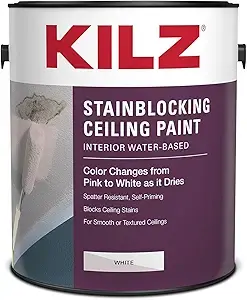
- Honest take: Great for moderate stains and speed, and easy to use, though deep nicotine stains may require multiple coats.
Zinsser Covers-Up Ceiling Paint & Primer Spray
- Highlights: A 13 oz aerosol that primes and covers in one pass, with a vertical spray head designed to be pointed straight up without the can sputtering. For a handful of spots, that beats opening a tin.
- Buy the right quantity: this link is the single can. The same product is also sold as a six-pack, which is worth knowing before you click something expecting one tin. For anything larger than a few patches, a tin of primer and a roller is cheaper and faster than chaining aerosols.
- Where it belongs: touch-ups, ceiling tiles, and the ring around a light fitting you missed. It is a finishing tool, not a way to do a room.

- Honest take: Convenient and useful for patch jobs, but not a full-room solution—spray overspray and quantity limitations keep it from being a universal fix.
Quick Comparison Table
| Product | Strengths | Weaknesses |
|---|---|---|
| Zinsser B-I-N Primer | Only chemistry that reliably seals tar and odour; recoat in about an hour | Strong alcohol fumes, thin and drippy overhead, needs denatured alcohol to clean up |
| KILZ Stainblocking Paint | Dries pink-to-white so you can see your coverage overhead | Rated by the maker for minor to moderate stains only — use over shellac on heavy nicotine |
| Zinsser Covers Up spray (13 oz) | Vertical spray head, no tin to open, good for spots and ceiling tiles | Uneconomical for a whole ceiling |
Related Guides
- Master the basics with our guide on the best way to paint a ceiling
- Need topcoat inspiration? Explore best ceiling paint color ideas
- Cut clean edges effortlessly—check best way to paint edges between wall and ceiling
- Want faster drying times? Learn in how to make paint dry fast
- Washing comes before priming — see how to clean walls before painting
Final Verdict: Which One for Which Ceiling
- Heavy nicotine or decades of smoking? Go with Zinsser B-I-N Primer—nothing else seals that deep.
- Moderate to light nicotine stains? Try KILZ Stainblocking Paint—you’ll save steps and get visual workflow aid.
- Small patches or touch-ups? Use the Zinsser Covers Up spray, but treat it as a supplement, not a solo solution.
Nicotine ceilings are tough—but with diligent prep, the right primers, and realistic expectations, you can restore brightness. Honest reviews matter: know that even the best products sometimes need more than one coat, strong fumes may linger, and prepping correctly is irreplaceable.
Does Any of This Work on Nicotine-Stained Walls?
Yes, and the chemistry is identical — but two practical things change.
Walls are usually worse than you think and better than the ceiling. Worse, because they get touched and cleaned and you notice the difference when you move a picture. Better, because tar rises with warm air, so ceilings and the top third of walls take the heaviest deposit while skirting level often stays comparatively clean. That uneven distribution is why a wall repainted in one uniform coat can come back yellow only along the top.
The other change is finish. A flat ceiling paint is fine overhead but too fragile for a wall you will lean on, so you seal with the same shellac primer and then use a wall paint in whatever sheen the room needs. Do not substitute ceiling paint on walls to save a trip — it marks the first time anything touches it.
If the smoke damage runs through the whole property, prime everything before you paint anything. Sealing the ceiling and leaving the walls simply relocates the smell.
Frequently Asked Questions
What is the best paint to cover nicotine on ceilings?
No finish paint covers nicotine on its own, because tar dissolves into wet paint and rises through it. The reliable combination is a shellac-based primer such as Zinsser B-I-N to seal the tar, followed by an ordinary flat ceiling paint. If the staining is light, a stain-blocking ceiling paint like the KILZ can work alone — but on a genuine smoker’s ceiling, skipping the primer is what causes the yellow to return.
How do I block nicotine on ceilings so it never comes back?
Wash off any physical tar deposit, let the ceiling dry completely, then apply shellac primer — two coats on heavy staining, and always two coats around light fittings, in corners and above where radiators sat. Those are the spots where deposits concentrate and where single-coat priming fails. Once sealed, any ceiling paint will do.
Why did nicotine spots reappear after painting?
Because the finish coat was applied without a sealing primer, or with a water-based primer that tar bled straight through. Adding more emulsion makes it worse, since each wet coat re-dissolves the tar underneath. Stop painting, apply shellac primer over the yellowed surface, then repaint.
Can you paint a stippled or artexed ceiling that is nicotine stained?
Yes. Clean it with a dry-cleaning sponge rather than scrubbing, since water and pressure damage the texture and will not reach into the undercuts anyway. Prime with shellac, use a long-pile roller that pushes into the profile, and buy considerably more material than the floor area suggests — texture can increase the real surface area by half again. Do not sand a pre-1980s textured coating; have it tested for asbestos first.
Can I prime a nicotine ceiling without cleaning it first?
Sometimes. Shellac bonds to lightly stained surfaces without washing. But if a dry white cloth pressed to the ceiling comes away brown, there is a physical tar layer, and priming over it means bonding to something that is not itself firmly attached — it will peel later as a sheet. Do the cloth test before deciding.
Does shellac primer get rid of the smoke smell as well as the stain?
It seals odour in the surfaces it covers, which removes most of the smell in a room where the walls and ceiling were the source. It cannot help with smoke absorbed into carpet, underlay, curtains or inside cupboards, and those are usually what is left when a freshly sealed room still smells faintly of smoke.
How many coats of paint go over the primer?
Two, normally. Once the shellac has sealed the tar, you are painting a clean white surface, so the finish coats are only about opacity and evenness — the stain is no longer part of the equation. If you find yourself on a third and fourth coat still chasing yellow, the primer step did not do its job and more paint will not rescue it.
Written by Sophie Ulman. ThePaintly is reader-supported: when you buy through links on this site we may earn an affiliate commission at no extra cost to you.