The Best Porch Floor Paints for Wood, Concrete and High Traffic
Updated: May 2026 · ✓ PAINT Stage
Finding the best paint for porch floor isn’t as simple as grabbing any exterior paint off the shelf. A porch floor takes direct sun, driving rain, and hundreds of footsteps every week — and most standard wall paints crack, peel, or fade within a season. The best paint for porch floor needs to bond hard to both wood and concrete, resist moisture from below, and stay slip-resistant even after years of use.
We compared five leading porch floor paints on adhesion, durability, finish quality, and ease of application on both wood and concrete surfaces, using manufacturer specifications and what painters report. Here’s what works and what’s worth skipping.
Quick Picks at a Glance
| # | Product | Best For | Finish | Link |
|---|---|---|---|---|
| 1 | KILZ Porch & Patio Low-Lustre Enamel | Best Overall | Low-Lustre | View |
| 2 | Valspar 1534 Porch & Floor Latex Enamel | Best for Wood | Satin | View |
| 3 | INSL-X Sure Step Anti-Slip Paint | Best Anti-Slip | Flat/Textured | View |
| 4 | Rust-Oleum 262360 Porch & Floor Urethane | Best for Durability | Satin | View |
| 5 | Valspar 1533 Porch & Floor Latex, Light Gray | Best Light Color | Satin | View |
Full Product Reviews
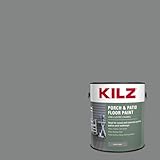
KILZ built its porch floor formula around one principle: the finish has to survive what a wall finish never could. This 100% acrylic latex enamel dries to a hard, low-lustre surface that handles moisture from below, UV from above, and constant foot traffic in between. Applied to properly primed wood or concrete, it forms a seal that’s resistant to mildew, cracking, peeling, and scuffing — covering 300–400 sq ft per gallon on smooth surfaces.
The low-lustre sheen is its best feature for porches. High-gloss finishes turn slippery when wet; KILZ’s matte-ish surface stays grippy. One coat delivers decent coverage; two coats give you the durability that outdoor floors demand. The main limitation is color selection — the ready-mixed Slate Gray and Silver Gray are the most available options on Amazon. If you need a custom color, you’ll be heading to a paint counter.
- Proven outdoor adhesion on wood and concrete
- Mildew-resistant formula
- Low-lustre finish stays grippy when wet
- Fast recoat window
- Limited ready-mixed color range online
- Requires solid surface prep for maximum adhesion
Best for: Front porches, back stoops, and covered patios where durability matters more than color variety.
Check Price on AmazonVia Amazon.com
Related Guides
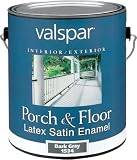
Valspar’s 1534 was engineered specifically for wood porch surfaces and earns its reputation on boards that flex with temperature changes. Its 100% acrylic latex base allows enough flexibility to move with expanding and contracting wood without cracking along grain lines — one of the biggest failure points for rigid paints on wooden floors. The satin finish looks clean and polished without going too shiny, and the formula is water-based for easy soap-and-water cleanup.
Coverage is 300–400 sq ft per gallon on smooth wood, slightly less on older, weathered boards. Adhesion to properly sanded and primed wood is excellent, and it holds up well to foot traffic. It works on concrete too, but we’d pick the KILZ or Valspar anti-skid options specifically for concrete surfaces. Forum users on Contractor Talk have called this one of the most reliable seasonal choices for traditional covered porches.
- Excellent adhesion to wood surfaces
- Flexible formula resists seasonal cracking
- Satin finish looks polished, stays clean
- Easy water-based cleanup
- Dark Gray only in this 1-gallon size
- Better on wood than bare concrete
Best for: Wood porch floors, covered verandas, and any painted wood floor that goes through cold winters.
Check Price on AmazonVia Amazon.com
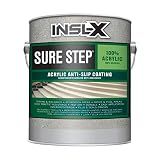
If your porch gets wet regularly — a rain-exposed front stoop, a porch with no roof overhang, or an entry that connects directly to a lawn — Sure Step is the one to reach for. It contains aggregate particles that create a subtle but effective texture, dramatically reducing slip risk on wet surfaces. The result isn’t rough like sandpaper, but it grips shoe soles the moment they touch it. It’s rated for both interior and exterior use and carries the formulation for excellent UV and abrasion resistance.
Applied in two coats at 200–250 sq ft per gallon, it produces a durable, hard-wearing finish that holds up to heavy foot traffic. The matte, textured finish won’t win aesthetic awards, but on a porch where safety matters, function wins. Some users find the texture traps dirt slightly more than a smooth paint, so plan on regular sweeping.
- Genuine anti-slip texture baked in
- Strong UV and abrasion resistance
- Works on concrete, wood, and masonry
- Available in multiple colors
- Lower coverage rate than smooth paints
- Textured finish traps fine debris
Best for: Rain-exposed porches, steps, stoops, and any surface where slip safety is the primary concern.
Check Price on AmazonVia Amazon.com
More from ThePaintly
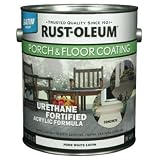
Rust-Oleum’s porch and floor formula adds a urethane compound to the standard acrylic base — and that difference shows up in longevity testing. Urethane fortification hardens the dried film, making it more resistant to scuffs, chemical stains (think motor oil drips at the edge of the porch), and abrasion. If you’re applying this to a porch that does double duty as a work area or sees heavy outdoor gear storage, that extra toughness justifies the slight cost premium over basic acrylics.
The satin finish levels well, leaves few brush or roller marks, and covers 300–400 sq ft per gallon. It adheres to both wood and concrete with proper priming. Dry-to-touch in one hour, recoatable in four. It is built for longer intervals between touch-ups than budget formulas.
- Urethane-fortified for superior scuff resistance
- Excellent color retention under UV
- Works on wood and concrete
- Clean satin finish with good leveling
- Slightly higher price than basic acrylics
- Limited ready-mix color options online
Best for: High-traffic porches, covered patios that double as work areas, and anyone who wants maximum years between repaints.
Check Price on AmazonVia Amazon.com
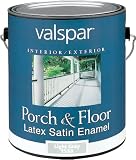
A lighter porch floor color makes a space feel bigger and stays cooler underfoot in direct summer sun — and Valspar’s 1533 in Light Gray delivers both. It’s the same proven acrylic latex formula as the 1534, just in a lighter tone that reflects more heat than darker options. If you’re painting a south-facing porch where the floor gets baked all afternoon, the color difference alone can lower surface temperature noticeably.
Performance is on par with the 1534: 300–400 sq ft coverage, fast recoat time, excellent adhesion to sanded wood. The lighter color does show scuffs and dirt slightly more, so plan for a quick sweep between uses. Two solid coats on primed wood give you a finish that should comfortably last two to three seasons before touching up.
- Reflects heat — cooler underfoot in summer
- Makes smaller porches feel more open
- Same reliable formula as the 1534
- Good for north-facing or shaded porches
- Light color shows dirt and scuffs faster
- May need more frequent cleaning
Best for: South-facing porches, smaller spaces that need visual lightness, and anyone who prefers a traditional light-colored porch floor.
Check Price on AmazonVia Amazon.com
💡 Pro Tips: Porch Floor Paint That Lasts
- Temperature window: Apply porch paint between 50°F and 90°F — outside that range, adhesion and curing suffer significantly.
- Two thin coats beat one thick coat every time. Thick coats trap solvent and peel. Thin coats cure all the way through.
- Don’t skip the primer on raw wood or bare concrete. One coat of bonding primer doubles the life of your topcoat.
- On concrete: Etch with diluted muriatic acid or a TSP substitute before priming. This opens the pores for maximum paint adhesion.
🖌️ PAINT Stage
This guide covers the PAINT stage of the Renovation Protocol. You’ve already filled, sanded, and primed — now it’s time to apply the finish coat. Choose your product based on surface type (wood vs. concrete) and the level of foot traffic your porch receives.
🧮 Porch Floor Paint Coverage Calculator

How to Choose the Best Paint for Porch Floor
How to Prep a Porch Floor Before Painting
For a complete step-by-step walkthrough of the full exterior painting process, see our exterior house painting guide.
Our Verdict
For most porches, the KILZ Porch & Patio Low-Lustre Enamel is the safest, most proven choice — it handles both wood and concrete, dries fast, and resists the mildew and peeling that kill average paints in one season. If your porch is all wood and you care about grain flexibility, go with the Valspar 1534. If the floor gets rained on and slip safety matters, INSL-X Sure Step is the only pick. For maximum longevity on a high-traffic concrete surface, the Rust-Oleum urethane formula outlasts all the basic acrylics. The Valspar 1533 Light Gray rounds out the list for anyone who wants a cooler, brighter porch color without sacrificing performance.
Frequently Asked Questions
KILZ Porch & Patio Low-Lustre Enamel is rated for both wood and concrete and is the most versatile option. For wood specifically, Valspar 1534 is excellent. For concrete, INSL-X Sure Step and Rust-Oleum’s urethane formula perform particularly well.
Yes, on bare wood or bare concrete, primer is essential. It doubles the adhesion of the topcoat and prevents peeling. Skip it only if you’re recoating an existing, sound paint surface in good condition.
Porch floor paint is formulated for abrasion, foot traffic, and moisture exposure that standard wall paint can’t handle. It dries harder, resists scuffing and UV fading better, and is typically tested against mildew and ponding water. Using wall paint on a floor leads to rapid peeling within months.
With proper prep and two coats, a quality porch floor paint lasts 2–5 years depending on foot traffic, weather exposure, and surface type. The Rust-Oleum urethane formula tends toward the longer end of that range. Unprotected south-facing concrete or wood floors in hot climates may need refreshing sooner.
Two coats are the standard recommendation for all five products reviewed here. A first coat seals the surface; the second coat provides the full film thickness that makes the finish durable. On bare, heavily weathered surfaces, apply three coats.
Not recommended. Sanding removes old peeling paint and creates surface profile for the new coat to grip. Skipping sanding is the most common cause of early porch paint failure. At minimum, sand with 80-grit where paint is peeling and 120-grit on sound surfaces.
Standard porch floor paints in low-lustre or satin finish offer moderate slip resistance when dry. They become slippery when wet, especially high-sheen versions. For certified anti-slip performance, use INSL-X Sure Step, which contains aggregate particles for texture, or add fine silica grit to any porch paint at one pound per gallon.
Apply porch floor paint when air and surface temperature are between 50°F and 90°F (10°C–32°C). Below 50°F, the paint doesn’t cure properly and will peel prematurely. Above 90°F, it dries too quickly, leaving lap marks and poor adhesion. Avoid painting in direct midday sun — the surface temperature can spike well above ambient air temperature.
🔗 Deep-Dive Guides in This Cluster
- Best paint for wood porch floor — flex-rated formulas for wood grain movement
- Best paint for concrete porch floor — anti-slip picks for concrete slabs
- How to paint a porch floor — complete 7-step technique guide