Can You Spray a Popcorn Ceiling Without Wrecking the Texture?
A wet roller nap grabs popcorn texture and pulls it off the ceiling in clumps. That is the whole reason people go looking for the best paint sprayer for popcorn ceiling in the first place — a sprayer never touches the surface, so the texture survives. But there is a fork in the road most guides skip, and picking the wrong side of it costs you either a ruined ceiling or a few hundred dollars on a tool you did not need.
The fork is this: are you painting an existing popcorn ceiling, or applying or patching the texture itself? Those are two different machines. Below I cover both, and I will tell you plainly which one this page is actually stocked for.
Do you need a texture gun or an airless sprayer for a popcorn ceiling?
This is the question that decides everything, so answer it before you spend a dollar.
If you are painting a popcorn ceiling that already exists, you want an airless sprayer with a 0.015 tip — a 515 in Graco’s numbering, which throws a 10-inch fan. Graco’s own homeowner guidance names the popcorn ceiling as a job for the Magnum line with that tip. An airless pumps thinned ceiling paint at high pressure and lays it into the valleys of the texture without ever contacting the peaks. That is the tool for the job, and it is not the tool reviewed further down this page. Start instead with our best airless paint sprayer for ceiling comparison, or the broader best ceiling paint sprayer roundup.
If you are spraying new popcorn texture on, or patching a bald spot after a leak or a drywall repair, you need a hopper texture gun. Texture material is aggregate suspended in mud — it is far too thick and too gritty for an airless tip, which will clog on the first pull of the trigger. A hopper gun feeds it by gravity and blows it on with compressed air. Those are the two guns reviewed below.
Get this backwards and the failure is immediate and obvious. I watched a neighbour load joint compound into a borrowed airless because the box said “sprayer” on it. He killed the pump inside ten minutes. The machine was not defective; it was the wrong machine.
While you are prepping either way, our guide to the best way to paint a ceiling covers the cleaning and priming that has to happen first — and prep matters more than the brand on the box, every single time.
The 2 hopper texture guns worth buying
Both of these are pneumatic hopper guns for applying texture, not for painting over it. Both need an air compressor you supply yourself — neither one is a plug-and-play machine, and that is the detail most listings bury.
Jeanoko 1.45-Gal Hopper Texture Sprayer
Use case: Budget-friendly for DIY popcorn ceiling paint jobs
Pros: Large 1.45 gal hopper; includes interchangeable 4 mm, 6 mm, 8 mm nozzles; fills textures consistently
Cons: Needs external compressor; messy overhead spraying; cleanup intensive
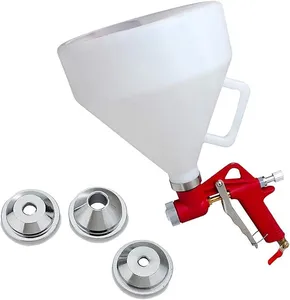
From customer descriptions: this model is frequently recommended for those searching for a sprayer for popcorn ceiling thanks to its affordability and decent performance.
HILTEX 31229 1.32-Gal Air Texture Gun
Use case: Ideal for homeowners and pros applying popcorn, knockdown, or orange-peel finishes
Pros: High-quality ergonomic handle; adjustable spray angle for ceiling work; smooth spray pattern; consistent flow; three nozzle sizes
Cons: Occasional clogging if mixture is not sufficiently strained; needs compressor; setup takes practice
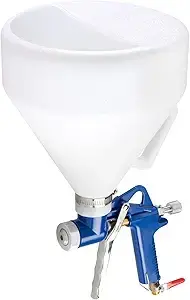
The first time I patched popcorn texture with a hopper gun, I mixed the compound to what looked like a pourable consistency and sprayed it straight up. Half of it came back down on me and the other half landed as a wet blob that slid two inches before it set. The lesson was not about the gun. It was that texture mud has to be thicker than you think — closer to soft-serve than to paint — and you spray it in short bursts from about 18 inches, then let it grab before you add a second pass. Two thin coats, even here.
The other thing nobody tells you: match the nozzle to the existing texture before you commit. The 4 mm nozzle throws a fine orange-peel; the 8 mm throws the coarse popcorn most 1970s ceilings actually have. Spray a test board, let it dry, hold it up next to the ceiling. A patch that is the right colour but the wrong grain size is more visible than no patch at all.
Why these two, and not an aerosol can
- Gravity-fed hoppers move aggregate that would jam an airless tip on the first pull.
- Interchangeable nozzles let you match the grain of the existing ceiling instead of guessing.
- Brass air-regulating parts on the HILTEX are replaceable, which matters because that is the part that wears.
- For a whole ceiling they are far cheaper per square foot than aerosol texture cans.
Aerosol texture cans from Homax or DAP have a place, but it is a small one: a patch the size of a dinner plate, once. Over a full ceiling they go inconsistent, the propellant cools and the pattern shifts halfway down the can, and the cost climbs past the price of the gun.
How to Use These Spray Guns Effectively
Prep & Cleaning
Clean the surface thoroughly using the techniques in our how to clean walls before painting guide.
Protect adjacent surfaces: seal walls, fixtures, floors with plastic and tape following tips from best way to paint edges between wall and ceiling.
Mixing & Testing
Strain texture mix or paint before filling the hopper to avoid nozzle clogs.
Perform a test spray on scrap material to calibrate spray distance (12–18 in), nozzle angle, and pattern.
Technique
Hold the sprayer steady in even strokes across the surface, overlapping each pass slightly.
Let the first coat dry before inspecting. A light second pass may be necessary in some areas.
Cleanup
Flush the nozzle with water (latex-based) or solvent immediately after use.
Disassemble the nozzles and clean thoroughly to ensure future use without clogging.
Pros & Cons Comparison
| Model / Type | Pros | Cons |
|---|---|---|
| Jeanoko 1.45-Gal Hopper Texture Sprayer | Extremely budget-friendly; good hopper size; interchangeable nozzles | Messy overhead spraying; requires compressor; heavy setup |
| HILTEX 31229 Texture Gun | Comfortable handle; reliable spray; adjustable angle; versatile nozzles | Needs smooth mix; technique-sensitive to avoid clogs |
These are real tools proven effective for popcorn ceilings—whether you’re painting directly or applying fresh texture. They handle thicker texture material where typical sprayers fail.
When to Choose Which
Best for Full Ceiling Jobs on a Budget
Go with Jeanoko if you’re on tight budget and tackling a single room.
Best for Consistent, Clean Performance
Choose HILTEX 31229 if you want smoother control, fewer clogs, and better ergonomics.
When NOT to use a hopper texture gun
Skip the texture gun if any of these is true
A hopper texture gun is the wrong call in four situations, and buying one anyway is money gone:
- You only want to repaint the ceiling. Use an airless with a 515 tip, or a thick-nap roller. A hopper gun cannot spray ceiling paint — it is too thin to gravity-feed properly and it will run.
- You do not own an air compressor. Neither gun includes one. The HILTEX alone wants about 7 CFM at a quarter-inch NPT, which is more than a small pancake compressor delivers continuously. Price the compressor into the decision, not after it.
- The ceiling was built before about 1980 and you have not tested it. Popcorn texture from that era can contain asbestos. Spraying over it is fine; scraping, sanding or disturbing it is not. The EPA has plain-language guidance on asbestos in the home — read it before a scraper touches that ceiling.
- The patch is smaller than a dinner plate. One aerosol texture can and a steady hand beats setting up a hopper gun, a compressor and a full mask for a five-minute repair.
Honest version: most people who land on this page are trying to paint a popcorn ceiling, not texture one, and for them neither gun on this page is the answer.
On the paint side of the decision, our best ceiling paint comparison covers what actually goes through the gun, and how to make paint dry fast is worth a look if you are working in a humid room where texture takes forever to set. If you are cutting in by hand where the ceiling meets the wall, the best way to paint edges between wall and ceiling saves a lot of taping.
Final verdict
If you are texturing: the HILTEX 31229 is the one I would buy. The replaceable brass air-regulating parts and the locking trigger are the difference between a gun you use once and a gun you still own in five years. The Jeanoko makes sense only if the budget is genuinely tight and this is a one-room job you never intend to repeat.
If you are painting an existing popcorn ceiling — which is what most people searching for the best paint sprayer for popcorn ceiling actually mean — neither of these is your tool. Go to the airless sprayers for ceilings instead, fit a 515 tip, and thin the paint. It will cost more up front and it will finish the job in an afternoon without a single clump of texture on the floor.
Popcorn ceiling spraying: common questions
Can you use an airless sprayer on a popcorn ceiling?
Yes — to paint one. Fit a 0.015 tip (a 515 in Graco’s numbering) and thin the ceiling paint per the label. What an airless cannot do is spray popcorn texture itself; the aggregate in texture mud jams the tip immediately.
Do I need an air compressor for a hopper texture gun?
Yes, and it is not optional. Both guns here are pneumatic. The HILTEX 31229 draws roughly 7 CFM through a quarter-inch NPT fitting, which is beyond what a small pancake compressor sustains. Budget for the compressor as part of the tool.
What nozzle size should I use for popcorn texture?
The 8 mm nozzle for the coarse popcorn found on most older ceilings, 6 mm for a medium grain, 4 mm for fine orange-peel. Spray a test board, let it dry fully, and hold it against the ceiling before you commit — the grain has to match or the patch reads as a patch.
Is it better to spray or roll a popcorn ceiling?
Spray, if the texture is staying. A loaded roller nap grips the peaks and tears them off. If you must roll, use a slit-foam acoustical roller or a nap of at least three-quarters of an inch, load it lightly, and make one pass only — never back-roll.
Can I spray over a popcorn ceiling that has water stains?
Not directly. The stain will bleed through paint within days. Seal it with a shellac-based stain-blocking primer first, spot-applied and dried, then spray your finish coat over the whole ceiling.
How thick should texture mud be for a hopper gun?
Closer to soft-serve than to paint. If it pours freely off the mixing paddle it is too thin and will run down the ceiling before it sets. Mix, let it slake for ten minutes, then re-check — it thickens as it sits.
Is popcorn ceiling texture dangerous to spray?
Spraying new texture over an old ceiling is low-risk with a respirator and eye protection. Disturbing an old ceiling is the risk: popcorn texture applied before roughly 1980 may contain asbestos. Do not scrape, sand or drill into it until it has been tested.
About the author
Sophie Ulman has renovated and painted more rooms than she can count — and made every mistake in the book so you don’t have to. She focuses on real-world durability: not how products perform on day one, but whether the repair holds through a full seasonal cycle.
ThePaintly is reader-supported. We only recommend products we’ve personally evaluated. When you buy through links on this site, we may earn an affiliate commission at no extra cost to you.