
Can You Paint a Vinyl Fence? Here’s What Holds Up (and What Peels)
Updated: July 2026 | By Sophie Ulman
Choose the wrong product and you will watch it flake off in sheets by the second summer — a peeling fence looks worse than the faded one you started with. So can you paint a vinyl fence? Yes, you can — but only if you respect two rules that most weekend guides skip: prime for adhesion, and never go darker than the original color. Get either one wrong and the coating fails. Related: best paint for plastic.
The first time I helped a neighbor paint a vinyl fence, we rolled straight over the panels with leftover exterior latex — no primer, no sanding. It looked great for about six weeks. Then the first heat wave hit and the paint lifted at every rail edge like sunburned skin. Here’s what I learned: vinyl is non-porous, so paint has nothing to grip unless a bonding primer gives it teeth. We stripped it and started over. Never again.
Quick Picks: Can You Paint a Vinyl Fence With These?
These four are the exact chain I trust to repaint vinyl and keep it stuck through a full seasonal cycle — clean, prime, then topcoat.
| Product | Best for | Stage |
|---|---|---|
| INSL-X STIX Bonding Primer | The adhesion layer — non-negotiable | PRIME |
| KILZ Siding, Fence & Barn Paint | Durable full-fence topcoat | PAINT |
| Krylon Fusion All-In-One | Small fences, posts & touch-ups | PAINT |
| Krud Kutter Cleaner/Degreaser | Prep — kills the invisible film | PREP |
The Products, Reviewed
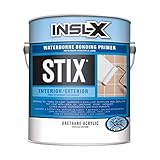
INSL-X STIX Acrylic Waterborne Bonding Primer
STIX is an acrylic-urethane primer, which matters more than it sounds. That urethane resin chemically keys into slick, non-porous surfaces like vinyl — it doesn’t just sit on top the way a standard wall primer does. On a non-porous surface like this, that primer decides whether the whole job survives. It bonds to PVC, glossy trim, and even galvanized metal without a sanding marathon.
STIX is made to grip vinyl shutters and PVC trim after a light scuff-sand, and a fingernail scratch on a hidden spot is a cheap way to check adhesion before you topcoat everything. One honest limitation: it’s thin and drippy compared to a wall primer, so it runs on vertical rails if you overload the brush. Two thin coats. Always.
Cures fully at temperatures as low as 35°F, so late-season fence projects still work.
- Grips vinyl/PVC without heavy sanding
- Soap-and-water cleanup
- Recoats in 2–4 hours
- Runs on verticals if applied thick
- Pricey per gallon
Best for: Anyone painting a full white or almond PVC fence who wants the topcoat to still be attached in three years.
Check Price on Amazon →Via Amazon.com
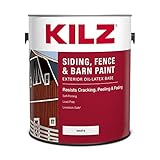
KILZ Siding, Fence & Barn Paint (Exterior)
This is a hybrid oil/water-based exterior paint built specifically for large outdoor surfaces that flex and bake all day. The formula is engineered to resist cracking, peeling, and blistering — the three failure modes that kill a fence coating. Over a STIX primer, it gives you a thick, self-leveling film that covers a lot of fence per gallon (roughly 200–400 sq ft).
A fence-and-barn paint like this is made for weathered picket runs that go through freeze-thaw, and the rail joints are exactly where cheaper exterior latex splits. The limitation you should know: it’s sold mainly in white and barn red, so if you want a designer gray, you’ll be tinting a general exterior paint instead.
Rated to resist cracking and peeling on fences and siding — not a repurposed interior wall paint.
- Purpose-built for fences & siding
- Excellent coverage per gallon
- Handles freeze-thaw without splitting
- Limited stock colors
- Still needs a bonding primer on vinyl
Best for: A full-length white or red vinyl or wood fence where you want one product to cover the whole run.
Check Price on Amazon →Via Amazon.com
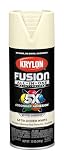
Krylon Fusion All-In-One Spray Paint
Fusion is the shortcut for small jobs: it carries its own bonding agent, so it grips plastic and vinyl without a separate primer step. The aerosol lays down an even satin film on the rounded post caps and lattice where a roller leaves streaks. If your “fence” is really a short decorative panel or a gate, this is the fastest way to coat a vinyl fence section cleanly.
Fusion is made for plastic outdoor chairs and small vinyl pieces like a lattice screen, and it dries tack-free fast. Real limitation: a 12 oz can covers maybe 25 sq ft, so spraying a 100-foot property line would drain your wallet and your patience. Keep this for accents, not acreage.
Bonds directly to plastic and vinyl — no separate primer needed on small pieces.
- No primer step on small parts
- Even coat on caps, lattice, hardware
- Dries to handle fast
- Expensive for large areas
- Overspray needs masking
Best for: Gates, post caps, lattice panels, and touch-ups — not a whole backyard perimeter.
Check Price on Amazon →Via Amazon.com
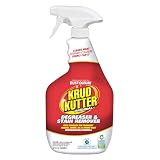
Krud Kutter Original Cleaner/Degreaser
Vinyl fences build up an oily film from pollen, mildew, and hose water — invisible, but it’s a bond-killer. Krud Kutter is a water-based degreaser that cuts that film so your primer touches actual vinyl, not grime. This is the step that separates a job that lasts from one that peels, and it costs a few dollars.
Prep beats product every time — durability is 50% the paint and 50% the surface underneath it. I’ve skipped a proper degrease before and paid for it with edge-lifting; now I wipe every panel and rinse before I ever open a primer can. The limitation is simply that it’s a cleaner, not a miracle: heavy mildew still needs a scrub and full dry time.
Water-based and residue-free, so it rinses clean and won’t interfere with primer adhesion.
- Cuts the invisible bond-killing film
- No harsh fumes, rinses clean
- Cheap insurance for the whole job
- Heavy mildew still needs scrubbing
- Requires full dry before priming
Best for: Every vinyl fence — this is the first thing you buy, not the last.
Check Price on Amazon →Via Amazon.com
- Paint on an overcast day. Direct sun flash-dries the primer before it can bite into the vinyl, and that’s how you get lifting.
- Scuff every panel with 220-grit before priming. It’s tedious, but that microscopic tooth doubles your adhesion.
- Two thin coats of topcoat beat one thick coat — thick coats stay soft underneath and print your fingerprints in August.
- Wrap post caps and hardware you don’t want painted before you start, not after the overspray lands.

How to Paint a Vinyl Fence That Actually Lasts
The products only work in the right order. Here’s the sequence I use every time, whether it’s a gate or a full property line.
1. Clean until the film is gone
Wash the whole fence with a degreaser and a soft sponge, then rinse. A pressure washer on a low setting speeds this up, but keep the tip moving so you don’t score the vinyl. This is where our surface-prep habits pay off — clean vinyl is the entire ballgame.
2. Scuff, then let it dry fully
Lightly sand every panel with 220-grit to create tooth, wipe the dust, and let the fence dry 24–48 hours. Damp vinyl traps moisture under the primer and guarantees blisters later.
3. Prime for adhesion
Roll a bonding primer on the flat panels and brush the posts, rails, and edges. This is the single step that makes it possible to paint a vinyl fence and have the color stay put. Let it cure per the label — usually 2–4 hours.
4. Topcoat in two thin coats
Apply a 100% acrylic exterior paint (or a fence-and-barn paint) in two thin coats, letting the first dry before the second. The same logic applies whether you paint vinyl siding, vinyl windows, or a fence — thin and patient wins.
Do not paint a vinyl fence a darker color than the original. Dark paint absorbs heat, and vinyl expands and warps when it gets hot — you’ll cook the panels into a wavy mess. Same or lighter shades only, full stop.
Skip painting entirely if the fence is brittle, cracked, or chalking heavily. Paint won’t restore failing vinyl; it just hides it until it snaps. And if your fence is under a manufacturer color warranty, painting it will void that warranty — check before you open a can.
Which Colors Are Actually Safe on a Vinyl Fence?
“Same or lighter” is the shorthand, and it is right, but it is vague enough that people still talk themselves into a charcoal fence. There is an actual number behind the rule, and once you know it the decision stops being a judgement call.
The measurement is LRV — Light Reflectance Value, a 0-to-100 scale printed on nearly every paint chip and listed on every manufacturer’s colour page. Zero is absolute black, 100 is pure white. The guidance that traces back to the Vinyl Siding Institute, and that the major paint companies repeat in their own vinyl-safe programmes, is to stay at LRV 55 or higher on vinyl. Some panel manufacturers set their own floor higher still, in the 55–65 range.
The reason is heat, not appearance. Dark surfaces run well above ambient air temperature in direct sun, and standard residential vinyl starts to soften and distort somewhere around 165°F. That is not an exotic number on a south-facing fence in July. Once a panel passes it, it buckles, sags, or pulls off its fasteners — and unlike a bad colour choice, that damage does not come out.
| Colour family | Typical LRV | Safe on vinyl? |
|---|---|---|
| White, off-white, almond | 80–92 | Yes, with margin to spare |
| Soft grey, greige, pale tan | 60–75 | Yes |
| Mid grey, sage, dusty blue | 45–58 | Only above 55 — check the chip |
| Navy, forest, charcoal | 10–25 | No |
| Black | Under 10 | No |
Two practical notes. First, the LRV floor applies to the colour you are applying, not the colour underneath — a white fence painted mid-grey is still a mid-grey fence as far as the sun is concerned. Second, several manufacturers now sell vinyl-safe lines that use heat-reflective pigments to hit darker-looking shades while behaving like a lighter one; if you genuinely want a deep colour, that formulation is the only honest route, and it is worth asking for by name at the counter.
The same heat-warp arithmetic governs every slick exterior surface, which is why painting vinyl shutters follows the identical lighter-colour rule. If the colour you want is off the table, a wood fence has no such limit — our guide to staining a fence covers the dark, saturated finishes vinyl will never hold.
Roll It or Spray It?
On a gate or a single panel this does not matter. On a property line it decides whether the job takes a weekend or a week.
Rolling is slower but it is also self-correcting: you can see the film thickness building and you can feel when a rail is starved. On flat vinyl panels a short-nap roller lays down a clean coat, and you brush the posts, caps and rail edges behind it. If you have never sprayed before, this is the lower-risk path, and on a fence under about 60 feet the time saved by spraying is mostly eaten by masking.
Spraying wins past that point, and it wins by a lot on lattice, pickets and anything with gaps a roller cannot follow. A cup-fed HVLP unit like the HomeRight Super Finish Max handles both a bonding primer and a latex topcoat through its brass tip set, needs no compressor, and atomises finely enough that you are not fighting orange peel on a surface as smooth as vinyl. The honest limitation is the 39-ounce cup: on a long run you will be refilling constantly, and at that scale an airless rig is the better tool.
Whichever you choose, the sequence does not change. Mask first — overspray travels much further than you expect, and vinyl fence panels are usually the boundary between your yard and someone else’s. Then prime, then two thin topcoats.
The verdict
Yes — you can paint a vinyl fence, and it’ll last five to ten years if you do it right. Buy the STIX bonding primer and a real exterior topcoat, clean and scuff first, and stay same-or-lighter on color. Cut any of those corners and you’ll be stripping flakes next summer. For broader outdoor color work, our exterior house paint guide covers the topcoat side in depth, and if the run you are looking at is metal rather than vinyl, the problem is rust before it is color — see our guide to rust-resistant paint for metal fences.
Frequently Asked Questions
What kind of paint do you use on a vinyl fence?
A 100% acrylic exterior paint over a bonding primer. The acrylic flexes with the vinyl instead of cracking, and the primer is what makes it grip a non-porous surface. Standard interior latex will peel.
Do you have to prime a vinyl fence before painting?
Yes. Vinyl is non-porous, so paint has nothing to hold onto. A bonding primer like STIX chemically keys into the surface — it’s the difference between a coating that lasts years and one that flakes in weeks.
Does painted vinyl fence peel?
Only if you skip prep or prime. Clean it, scuff it with 220-grit, prime it, then use two thin topcoats and it stays put. Rolling paint straight onto dirty, glossy vinyl is what causes peeling.
Can you paint a vinyl fence a darker color?
No — avoid going darker than the original. Dark colors absorb heat and warp the panels. Stick to the same shade or lighter. This is the most common mistake I see.
How long does paint last on a vinyl fence?
A properly prepped and primed job lasts roughly five to ten years before it needs a refresh, depending on sun exposure and how well it was cleaned before painting.
Can I spray paint a vinyl fence instead of rolling?
For small sections, yes — a bonding aerosol like Krylon Fusion grips vinyl without primer. For a full property line, rolling a primer plus topcoat is far more economical.
What LRV do I need to paint a vinyl fence safely?
Stay at LRV 55 or higher. That figure traces to the Vinyl Siding Institute and is repeated by the major paint manufacturers in their vinyl-safe colour programmes; some panel makers set their own floor at 65. Below it, the panel absorbs enough heat to approach the roughly 165°F point where standard residential vinyl softens and distorts.
Will painting my vinyl fence void the warranty?
Usually yes. Most vinyl fence warranties cover the factory colour, and applying a coating is treated as an alteration. If the fence is still inside its warranty period and you have a colour or fading claim you might realistically make, get that resolved before you paint — the coating cannot be undone.
Further reading from trusted sources: This Old House on exterior fence painting, and Family Handyman on fence prep and technique.