Inflatable Paint Booth: How to Size, Power, and Vent One (2026)
Updated: October 2026 | By Sophie Ulman
An inflatable paint booth is a free-standing bladder-walled enclosure — not a pop-up tent — that uses one or more blowers to hold its shape and pull overspray out through a filter, which is why it can house an entire car, truck, or motorcycle instead of just a chair or a cabinet door. If you spray anything bigger than furniture, this is the category that actually works in a garage or driveway, and the size you need depends entirely on what’s going inside it.
The first spray booth I ever built wasn’t inflatable — it was PVC pipe and plastic sheeting, and it collapsed in on itself the second I switched the fan on. I’d used 1-inch pipe, and the negative pressure folded the whole frame inward like a paper bag. Rebuilding it with 1.5-inch pipe for about fourteen dollars more fixed it completely. That taught me something that applies directly here: an inflatable booth has no frame at all. Its entire structure is air pressure held up by the blower, every second it’s in use. A booth that’s underpowered for its size doesn’t sag a little — it goes slack, and overspray starts drifting instead of venting.
Below are five booths that scale from a motorcycle in a one-car garage to a full-size truck, what their blower setup actually buys you, and how to size, power, and vent one without guessing. If you’d rather build an enclosure than buy one, I covered the PVC-and-plastic version in my DIY spray paint booth guide — it costs less but doesn’t pack away and won’t fit a car.
What’s in this guide
The two decisions that matter
Every other spec is secondary to these two. Get them wrong and you’ve bought the wrong booth no matter how good the filters are.
| Decision | Why it matters | What to do |
|---|---|---|
| What’s going inside it, at its largest | A motorcycle booth and a full-size truck booth aren’t the same product scaled up — the blower count and total wattage change, not just the floor size | Measure your largest project, add at least 2 ft of working space on every side for the gun and your arm |
| Where you’ll run it and what power you have | A single-blower 550W model runs off a standard outlet; a triple-blower 2,650W+ setup needs its own circuit or it trips a breaker mid-job | Check your garage’s circuit amperage before you buy a multi-blower booth, not after |
Everything in the buying guide below — filters, venting, fire safety — only matters once those two are settled.
Quick picks
| Product | Best for | Why it earns the spot |
|---|---|---|
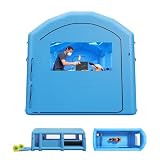
| VEVOR Inflatable Paint Booth 9.8×8.2×8.2 ft | Motorcycles and small furniture | Single 550W blower, fits a one-car garage with room to walk around |
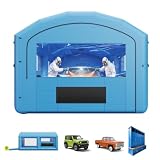
| VEVOR Inflatable Paint Booth 20x10x8 ft | Sedans and compact cars | Dual 480W+750W blowers plus a built-in changing area |
| VEVOR Inflatable Paint Booth 21x13x10 ft | Trucks and SUVs | Single 1100W blower — more headroom than the sedan model needs |
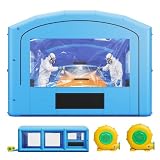
| VEVOR Inflatable Paint Booth 30x16x12 ft | Full-size trucks and vans | Dual blowers, 1,700W combined, enough volume for a work van |
| FLAPKWAN 28x15x10 ft, Three Blowers | Fastest overspray clearing | Three blowers, 2,650W total — the quickest air exchange in this guide |
5 inflatable paint booths, by size


What will it cost to run per session?
Enter the booth’s total blower wattage, how many hours you’ll run it per session, and your electricity rate per kWh (check a recent bill — it’s usually 12-18 cents).
How to choose: size, blowers, filters, power
Size by what’s actually going inside
Measure your largest project, bumper to bumper or tip to tip, then add at least 2 ft of clearance on every side. A motorcycle needs under 10 ft. A sedan needs about 18-20 ft with room for a prep bench. A full-size truck or van needs 28-30 ft or more. Buying tight to the vehicle’s exact length means you can’t walk around it with a gun in hand, which defeats the booth.
Blower count and total wattage
One blower is enough up to roughly 1,100W for a sedan-sized enclosure. Past that, manufacturers split the load across two or three smaller blowers rather than one huge one. That split also builds in redundancy: one clogged filter or dead motor doesn’t collapse the whole structure. More blowers also means faster air exchange, which matters if you’re painting more than one vehicle a week — the same logic that makes a stronger industrial sprayer worth it once you’re past hobby volume.
Filters are a recurring cost, not a one-time one
Every blower pulls air through a filter wall, and that filter loads up with overspray fast — faster with lacquers and faster still if you’re spraying metallic coats. Budget for replacement filter cotton on a schedule, not just when airflow visibly drops, because by the time you notice the drop you’ve already been breathing dirtier air for a while. If the stock blower on a smaller booth isn’t pulling air fast enough, an add-on from my exhaust fan picks is a cheaper fix than buying a bigger booth.
Power: check your circuit before you check out
A single 550W blower runs on any standard household outlet. Once you’re above about 1,500W combined, you’re close to or past what a typical 15-amp circuit handles alongside anything else plugged into it. The 2,650W triple-blower model above effectively needs its own 20-amp circuit. This is the single most common reason a new inflatable booth trips breakers in its first week — not a defective unit, just the wrong outlet.
Flammable solvents change the safety math
If you’re spraying anything with a flammable solvent base — lacquer, some primers, most automotive clears — ventilation isn’t optional comfort. It’s explosion prevention. NFPA 33 governs spray finishing operations for exactly this reason. Vent the exhaust outdoors through ducting, never just into the garage air. Keep any ignition source — water heater pilot lights, running vehicles, power tools that spark — out of the room entirely while spraying. Water-based coatings are far more forgiving if you’re still working out your ventilation setup; my low-overspray sprayer picks cut down on how much filter load you’re creating in the first place.
How to set up an inflatable paint booth in 6 steps
- Clear and sweep the floor. Grit under the booth floor works into the material and can eventually puncture it under load.
- Unfold fully before connecting any blower. Trying to inflate a folded or twisted booth stresses seams unevenly.
- Connect the blower and run an empty test cycle. Watch for full, even wall pressure for a few minutes before you bring the project inside — a slow leak shows up as a soft wall, not a sudden collapse.
- Route exhaust ducting outdoors, not just toward a garage door. A door left cracked open is not the same as a sealed duct run to outside air, especially with solvent-based coatings.
- Bring the vehicle or piece in, then re-check clearance on all sides. You want room to walk the gun around the whole surface without brushing the booth wall.
- Keep the blower running for the full session, including flash time between coats. Shutting it off between coats to “save power” is how overspray settles back onto a tacky surface.
Pro tips from the garage floor
A dual-blower booth survives a clogged filter better than a single-blower one. That redundancy is worth more in practice than the spec sheet makes it look — a single point of failure on a structure that’s literally made of air pressure is not a small risk.
Match your sprayer to the booth, not the other way around. An HVLP unit produces less overspray volume than an airless rig, which matters inside an enclosed space this size — see my HVLP sprayer picks if you’re spraying anything with fine detail work, or my car paint sprayer picks if a vehicle is what’s going inside.
Wear a proper respirator regardless of the booth’s filtration. The booth protects the room, not your lungs — I cover the right cartridge types in respirators for paint.
If you only spray small pieces, don’t buy a booth this size at all. My portable pop-up tent shelters cost less, store smaller, and handle cabinet doors and small furniture just fine.
Before you buy, confirm these three things
Your garage circuit can handle the blower load. Multi-blower booths above 1,500W combined usually need a dedicated circuit — check your panel, not just the outlet.
You can vent to true outdoor air. A booth that only recirculates garage air with solvent-based paint is a fire and health risk, not a convenience.
You have the floor space plus clearance, not just the booth’s footprint. Add the 2 ft of working room on every side to the booth’s listed dimensions before you measure your garage.
Frequently asked questions about inflatable paint booths
What size inflatable paint booth do I need for a car versus a motorcycle?
A motorcycle fits comfortably in a booth under 10 ft long, like the 9.8 ft model above. A sedan needs roughly 18-20 ft with a prep area, and a full-size truck or van needs 28-30 ft or more. Always add clearance for walking around the vehicle with a spray gun, not just the vehicle’s own length.
How much electricity does an inflatable paint booth use?
It depends on blower wattage and run time. A single 550W blower run for three hours uses about 1.65 kWh — a few cents to a bit over a dollar depending on your local rate. A triple-blower 2,650W setup uses roughly five times that per session. Use the calculator above with your own rate for an exact figure.
Can I use an inflatable paint booth indoors?
Yes, in a garage or shop, but the exhaust still has to be ducted to true outdoor air — recirculating fumes back into an enclosed room defeats the point, especially with flammable solvent-based coatings. Check NFPA 33 guidance on spray finishing ventilation if you’re spraying anything solvent-based regularly.
How many blowers do I actually need?
One blower up to around 1,100W handles up to a sedan or small SUV-sized enclosure. Larger booths split the load across two or three blowers, which also means the structure survives one blower failing or a filter clogging without fully losing pressure.
How often do I need to replace the filters?
There’s no fixed interval — it depends on how often you spray and what coating you’re using. Metallic and lacquer coatings load filters faster than basic primer. Budget for replacement filter cotton as an ongoing cost, not a one-time purchase, and check airflow at the start of every session.
Is an inflatable booth safe for flammable solvent-based paints?
It can be, but only with proper ducted ventilation to outdoor air and no ignition sources nearby. NFPA 33 covers spray finishing operations for exactly this reason. If you’re unsure your setup meets that standard, stick to water-based coatings until you can vent it properly.
Do I need a dedicated circuit for a multi-blower booth?
Usually, yes, above about 1,500W combined. A single 550W blower runs on any standard outlet. A 2,650W triple-blower setup is close to what a small clothes dryer draws and typically needs its own 20-amp circuit — check your garage panel before ordering a large booth.
Can one booth handle both a motorcycle and a car?
Only if it’s sized for the car — a booth sized for a motorcycle is too small for a sedan, but a sedan-sized booth has more than enough room for a motorcycle. Size for the largest thing you’ll ever put inside it, not the average.
The verdict
Motorcycle or furniture only: the 9.8 ft VEVOR. You don’t need the power draw or footprint of anything bigger.
Sedan or compact SUV, DIY pace: the 20 ft VEVOR with dual blowers — the changing area alone is worth the upgrade.
Full-size truck, van, or more than one vehicle a month: the 30 ft VEVOR or the FLAPKWAN triple-blower model, but only after you’ve confirmed your garage circuit can carry it.