Can You Paint Composite Decking? The Cap Decides Everything
Updated: August 2026 | By Sophie Ulman
Paint the wrong composite boards and you do not get a refreshed deck. You get a peeling deck, a voided warranty, and a stripping job that no chemical on the shelf makes pleasant. Whether you can paint composite decking comes down to one detail almost nobody checks first: does your board have a factory cap on it or not?
Here is the short answer. You can paint composite decking if the boards are early-generation uncapped composite. If the boards are capped — the shelled products that took over the market in the early 2010s — the surface is engineered to reject coatings, and paint will lift within a season or two. Same deck, same paint, opposite outcome. The cap decides it.
I found that out on a rental property in 2021. The owner told me his deck was “the cheap old stuff,” so I skipped the test patch and primed a 40-square-foot section on a Friday. By the next spring the coating had let go along every board edge in long ribbons, and the sanding took me two full days. Those boards had a cap. Now I test a hidden board before I open anything, every single time, and it takes about a minute.
What’s in this guide
Quick picks at a glance
| Product | Job it does | Which deck it suits |
|---|---|---|
| KILZ Adhesion Primer | Bonds to slick, low-porosity surfaces | Uncapped boards, and board ends on any deck |
| KILZ Over Armor Textured Coating | Thick solid color that hides fade | Uncapped boards that look tired but sound |
| Rust-Oleum RockSolid 20X Deck Resurfacer | Bridges cracks up to 1/4 inch | Uncapped boards with splits and holes |
| INSL-X Sure Step Anti-Slip | Adds grip to a painted surface | Steps, pool surrounds, shaded landings |
| Wash Safe Spray & Clean | Lifts black spotting and grime | Capped decks — the no-paint answer |
The 5 products worth buying
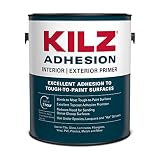
KILZ Adhesion High-Bonding Primer
Standard exterior primer is designed to soak into a porous surface and grip mechanically. Composite gives it almost nothing to soak into, which is why ordinary primer sits on top and shears off. KILZ Adhesion uses a modified acrylic resin that bonds chemically to slick substrates instead — the manufacturer lists PVC, vinyl, fiberglass, glossy finishes and Kynar among them. That is the same family of surfaces your deck boards belong to, and it is the reason this is the only primer step I recommend before you paint composite decking.
Coverage is roughly 300 square feet per gallon, it is dry to touch in 30 minutes and recoatable in an hour, so a small deck primes in a morning. The honest limitation: adhesion primer buys you grip, not miracles. On a capped board it still fails, just a few months later than a cheap primer would. It is also thin-bodied and runs into board gaps if you load the roller, so keep it light.
Pros
- Bonds where standard exterior primer will not
- One-hour recoat keeps a weekend job on schedule
- Water cleanup, low odor
Cons
- Thin body — drips through gaps if overloaded
- White only, so dark topcoats need a full second coat
- Will not save you on a capped board
Via Amazon.com
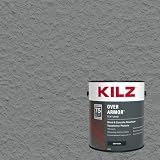
KILZ Over Armor Textured Solid Coating
This is a resurfacer, not a paint, and the difference matters. It goes on many times thicker than a deck paint, and it carries aggregate that leaves a gritty texture once cured. That texture does two jobs: it hides the surface scratching and colour blotching that makes an old composite deck look dead, and it gives you traction that a smooth paint film never will. KILZ names wood, composite and concrete on the label, which is rarer than it sounds — most deck paints stay silent on composite.
The limitation is coverage, and it catches people out. One gallon covers about 75 square feet at the two coats this product needs. A modest 300-square-foot deck is four gallons, not one, and I have watched more than one homeowner run dry halfway across and leave a visible lap line. Buy all of it up front and box the cans together so the colour matches end to end.
Pros
- Thick enough to bury surface scratches and fading
- Textured finish adds real grip underfoot
- Composite is named on the label, not just implied
Cons
- Coverage is low — costs add up fast on a big deck
- Texture traps dirt in shaded, damp spots
- Needs a full dry window; do not chase a forecast
Via Amazon.com
Rust-Oleum RockSolid 20X Deck Resurfacer
RockSolid 20X goes on about twenty times thicker than a standard deck stain, which is where the name comes from. That build is what lets it bridge cracks up to a quarter inch, nail holes and the small surface defects that make old boards look beyond saving. Rust-Oleum lists wood, most composite decks and porous concrete as suitable substrates, so it is one of the few high-build coatings that will not have you guessing.
Two things to know before you buy. It has to be tinted before use, so a return is unlikely once you open it, and Rust-Oleum specifies its own 20X roller cover — one cover per eight gallons. I tried a standard 3/4-inch nap on a porch section once to save a trip. The film went on uneven, thin over the high spots and puddled in the grain, and I ended up recoating the whole area. Use the roller they sell.
Pros
- Fills splits and nail holes in one pass
- Slip-resistant textured finish
- Composite is explicitly listed as a substrate
Cons
- Must be tinted — no returns after opening
- Requires the proprietary 20X roller cover
- Sold mostly in 4-gallon kits, so small jobs overbuy
Via Amazon.com
INSL-X Sure Step Acrylic Anti-Slip Coating
Composite already gets slick when it is wet, and a smooth paint film makes that worse — you have replaced a textured surface with a sealed one. Sure Step is a 100% acrylic coating carrying a fine aggregate that stays proud of the film after curing, so the grip comes from the particles rather than from a rough substrate underneath. On stairs and pool surrounds that is not a nice-to-have. It is the difference between a resurfaced deck and a hazard.
I keep a gallon of this specifically for steps. On a shaded set of composite stairs that greened over every autumn, two thin coats of Sure Step gave grip that was still there the following spring. The limitation is honest and worth hearing: the same texture that grips also holds dirt, and it needs a stiff brush rather than a rinse. If you want a surface you can hose clean in two minutes, this is not it.
Pros
- Real traction on wet stairs and landings
- Aggregate is suspended, not sprinkled on
- Recoats easily in future seasons
Cons
- Texture traps dirt and needs brushing
- Limited colour range
- Feels rough underfoot for bare feet
Via Amazon.com
Wash Safe Spray & Clean Composite Deck Cleaner
Most people who search for whether they can paint composite decking do not actually want colour. They want the grey-black spotting gone. That spotting is usually mould feeding on the wood flour and pollen sitting in the surface grain, and it lifts with a cleaner rather than hiding under a coating. This one is oxygen-based rather than chlorine-based, which matters because chlorine bleach strips the surface and kills the planting at the deck edge.
On a capped deck this is the answer, full stop. Two seasons of cleaning costs a fraction of a resurfacing job and keeps the warranty intact. The limitation: it works on organic staining, not on fade. If your boards have gone chalky and uneven from ten years of UV, no cleaner brings the colour back, and at that point you are choosing between living with it and replacing boards. Do not let a cleaner listing tell you otherwise.
Pros
- Keeps a capped deck’s warranty intact
- Safe around planting and pets once dry
- Costs a fraction of any coating job
Cons
- Does nothing for UV fade
- Needs a stiff brush on heavy mould
- Coverage claims assume light soiling
Via Amazon.com
Pro tips from the deck
Test-patch behind the grill, not at the stairs. Prime and coat a two-foot square somewhere nobody looks, wait three weeks through at least one rain, then try to lift an edge with your thumbnail. If it moves, stop. Three weeks of patience beats two days of sanding.
Two thin coats always beat one thick coat. On composite this is not a style preference. A thick film cures on the surface first and traps solvent underneath, and the trapped layer is where adhesion fails months later.
Sand with 240 grit, not 80. You want to dull the sheen, not cut into the board. Aggressive grit tears the plastic fraction and leaves fuzzy edges that show through every coat you put over them.
Coat the board ends whatever you decide. Cut ends expose the wood-flour core on every composite board made. A pass of adhesion primer there does more for the deck’s lifespan than the entire top surface job.
Do not paint below 50°F, and mind the dew point. Acrylics need the full cure window. An afternoon start in October means the film is still soft when the deck goes damp at dusk, and that shows up as a chalky bloom you cannot buff out.
How much will you actually need?
Textured resurfacers cover roughly a quarter of what normal exterior paint covers. Enter your deck size and see the real number before you get to the checkout.

How to paint composite decking without it peeling
Capped or uncapped: the test that decides everything
Capped composite has a hard polymer shell moulded around a wood-flour and plastic core. Uncapped composite is that core, exposed. The shell is why modern boards resist stains and fading, and it is also why coatings slide off them. Two checks tell you which you own, and both take under a minute.
The water test. Drop a tablespoon of water on a clean, dry board and wait five minutes. On a capped board it sits as a bead and wipes away leaving nothing. On an uncapped board the edge of the drop darkens the surface as the wood flour takes on moisture. Darkening means the board is porous, and porous means paintable.
The underside scratch. Get under the deck and scrape a hidden board edge with a screwdriver. A cap shows as a distinct thin outer layer of a different shade to the core beneath it. No visible layer line means uncapped.
Which brands and years are capped
| Board type | Roughly when | Can you paint it? |
|---|---|---|
| Uncapped composite (all brands) | Late 1990s to about 2010 | Yes, with adhesion primer |
| Trex capped / shelled lines | About 2010 onward | No — surface only. Ends and undersides are fine |
| Capped composite, other brands | Roughly 2010–2014 onward | No, unless the maker says otherwise in writing |
| Capped PVC (no wood content) | All years | No — nothing bonds reliably |
Trex's own position, given to Family Handyman by group marketing VP Leslie Adkins, is direct: the company does not recommend painting a composite deck unless you know for certain the material is an uncapped, early-generation product. She also confirms the useful exception — the exposed ends and undersides of capped boards can be coated, and some makers sell an approved end coating for exactly that. If your boards are capped, our companion guide on painting Trex decking walks the same decision brand by brand.
The order of operations
Clean first, and let the deck dry for a full 48 hours after — trapped moisture in the grain is the second most common failure after capped boards. Sand with 240 grit until the sheen is gone, then vacuum and wipe with a damp rag. Prime with an exterior adhesion primer, not a general-purpose one. Then two thin topcoats, with the full recoat window between them. If you are spraying rather than rolling, the right sprayer setup for decks saves a day on anything over 300 square feet, but back-roll every pass so the film keys into the surface texture.
What this shares with other slick surfaces
The mechanism here is the same one that governs painting plastic and painting vinyl siding: low surface energy means nothing keys in mechanically, so the bond has to be chemical. That is the entire job of an adhesion primer, and it is why choosing the right primer matters more here than the topcoat you put over it. If you want the buying-guide version of the coatings themselves, we cover those in depth in the best paint for composite decking.
When NOT to paint composite decking
Do not paint capped or shelled boards. The cap is engineered to shed coatings. Paint will hold through the first summer and start releasing at board edges in the second. There is no primer that changes this.
Do not paint if the warranty still has years left. Composite warranties commonly run 25 years, and a coating will usually void yours. Check the document before you buy anything — this is the single most expensive mistake available on this project.
Do not paint boards that flex underfoot. Movement means the joists or the boards themselves are failing, and paint over a structural problem just hides it. Fix the framing first.
Do not paint to escape maintenance. This is the trade that surprises people. As This Old House notes, composite exists to spare you the annual refinishing cycle. The moment you coat it, that clock starts running again — the deck now needs recoating like a wood deck does.
Prep steps that decide the outcome
Prep matters more than the brand on the can. I would rather see a mid-price coating over honest prep than the most expensive product on the shelf over a deck that was rinsed and rushed. Here is the sequence I use, and I do not skip any of it.
- Confirm the boards are uncapped. Water test plus underside scratch. If either says capped, stop and clean instead.
- Clean thoroughly. Composite deck cleaner and a stiff brush. Skip the pressure washer, or keep it under 1,500 PSI with a fan tip — high pressure furs the surface and drives water into the core.
- Dry for 48 hours. Two dry days, not two dry hours. Wood flour holds water longer than the surface suggests.
- Scuff-sand with 240 grit. Dull the whole surface. Vacuum, then wipe with a damp rag and let it dry again.
- Mask and protect. Tape the siding at deck level and cover planting. Textured resurfacers spatter more than paint does.
- Prime the ends and undersides too. Every cut end is exposed core. This is the step that adds years.
- Two thin coats, full recoat window between. Check the can, not the weather app optimism.
The verdict
If your boards are uncapped, you can paint composite decking successfully — clean, scuff-sand with 240 grit, prime with KILZ Adhesion, then two thin coats of KILZ Over Armor. If the boards are cracked and gouged, step up to RockSolid 20X for the crack bridging.
If your boards are capped — and if the deck went in after about 2013, they almost certainly are — do not paint them. Clean them with Wash Safe, coat the exposed ends with adhesion primer, and keep the warranty you paid for. That is the unglamorous answer, and it is the one that saves the most money.
Questions people actually ask
Can you paint composite decking that is already faded?
Only if it is uncapped. Fade on uncapped boards is a good candidate for a solid textured resurfacer, which buries the uneven colour completely. On capped boards, fade is happening inside the shell, and paint over it lifts within a season or two.
Does painting composite decking void the warranty?
Usually yes. Manufacturers commonly treat a coating as an alteration to the product, and composite warranties often run 25 years. Read yours before you buy paint — the warranty is frequently worth more than the deck's appearance problem.
What paint sticks best to composite decking?
An exterior acrylic latex over an adhesion primer. Acrylic stays flexible, which matters because composite expands and contracts more than wood across a season. Rigid films crack at the board edges first.
Can you stain composite decking instead of painting it?
Same rule applies. Stain needs somewhere to penetrate, and a cap gives it nothing. On uncapped boards an acrylic latex stain with UV and mildew inhibitors works, though it needs recoating sooner than a solid coating does.
How long does paint last on composite decking?
On properly prepped uncapped boards, expect three to five years before a recoat, less on a south-facing deck or one that gets furniture dragged across it. That is a real trade against composite's low-maintenance promise.
Can you paint the ends and undersides of capped boards?
Yes, and you should. Cut ends expose the wood-flour core on every composite board. Trex confirms these surfaces can be coated, and some manufacturers sell an approved end coating specifically for it.
Do you have to sand composite decking before painting?
Yes. Use 240 grit and dull the sheen without cutting into the board. Coarser grit tears the plastic fraction and leaves a fuzzy surface that telegraphs through every coat above it.