Does Storing Paint Cans Upside Down Actually Work?
Does storing paint cans upside down actually work? Technically yes — and it is still the wrong default. Flipping the can does form a liquid seal against the lid, which is why the trick has survived for decades. But it only works on a can you sealed properly in the first place, and if you sealed it properly, you did not need to flip it.
The variable that actually decides whether your leftover paint is usable in two years is not orientation. It is headspace — how much air is trapped in the can with the paint. Get that right and the can can sit any way up. Get it wrong and no amount of flipping saves it.
Why People Store Paint Upside Down
The logic is sound as far as it goes. Latex paint skins because oxygen reaches the surface and the acrylic binder cures where air touches it. Flip the can and paint sits against the underside of the lid, plugging the tiny gaps in a friction-fit seam that air would otherwise creep through.
What the trick does not do is remove the air. The same volume of oxygen is still in there — it has just migrated to what is now the top, which is the bottom of the can. Skin still forms; it forms where you cannot see it, and when you flip the can back upright, that skin drops into the middle of your paint. Chasing skin fragments around a can with a stir stick is a worse job than lifting one intact skin off the top.
Can You Store Paint Cans Upside Down Safely?
Yes, within limits. Three things decide whether it is fine or a mess:
- The seal, first and last. A steel paint can lid is a friction fit with no gasket. Tap it home evenly with a rubber mallet — a hammer deforms the rim, and a deformed rim never seals again. If the lid was pressed down by hand, do not invert the can.
- Paint type. Latex is thick enough to plug a marginal seam. Thin oil-based paints and stains find every imperfection and will weep down the side.
- Where it sits. On a garage shelf where nobody will knock it, over a tray. Not stacked, not on a wire rack, not somewhere a slow weep goes unnoticed for a year.
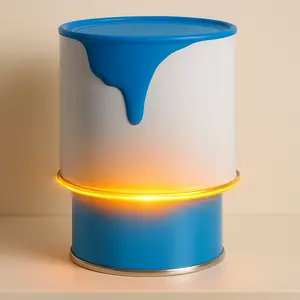
Notice the pattern: every condition is really a condition about the seal. Which is the tell that the seal — not the orientation — is the thing doing the work.
What Manufacturers Actually Recommend
Benjamin Moore’s own guidance on storing leftover paint does not mention flipping cans at all. What it specifies instead:
- Clean the rim and the lid before resealing — dried paint in the channel is the single most common reason a lid never seals again.
- Lay a piece of plastic wrap across the opening, then press the lid down through it. The wrap acts as the gasket the can does not have.
- Seat the lid with a rubber mallet, tapping around the edge rather than driving the centre.
- Store between 60°F and 80°F. Not the garage floor in a cold climate, not an attic in summer.
That is the whole method, and it takes ninety seconds. The plastic wrap is the part people skip, and it is the part that makes the biggest difference — it gives a gasketless steel seam an actual gasket.
Headspace Is the Real Variable
A gallon can with a quart of paint left in it is three-quarters full of air. That trapped oxygen is what skins the paint and oxidises the binder, and it will do so whichever way up the can sits.
Decant instead. Move the leftovers into a container sized to the volume — a quart can, a wide-mouth glass jar, a food storage tub with a snap lid. Fill it as close to the top as you can. You have removed the oxygen rather than trying to seal it in, and you have also solved the flipping problem, because a jar with a screw lid genuinely does seal.
One caveat on glass: label it clearly and keep it off a high shelf. A dropped jar of latex is a considerably worse afternoon than a dropped steel can.
Sophie’s Note: The Shelf That Taught Me This
I flipped every can on my garage shelf for about three years, on the strength of a tip from a decorator I trusted. It seemed to be working — until I went for a half-gallon of hallway white that had been sitting inverted for roughly eighteen months.
The seal had held. There was no leak, no crust on the rim. But when I turned it back over and opened it, the skin that had formed against the base was floating in the middle of the paint in rubbery sheets, and it would not stir back in. I strained it through a paint filter, lost the best part of a pint, and got a wall that needed a third coat because the pigment ratio had shifted.
Now I do it the boring way: wipe the rim, plastic wrap, mallet, label, upright, indoors. Nothing I have stored that way in the last six years has skinned badly enough to matter.
Upside Down Paint Storage: Honest Pros and Cons
| Method | Seal quality | Mess risk | Best for |
|---|---|---|---|
| Upright, lid pressed by hand | Poor | None | Nothing — this is how paint dies |
| Upright, wrap + mallet | Very good | None | The default for almost everyone |
| Inverted, mallet-sealed | Very good | Moderate | A nearly full latex can, short term |
| Decanted into a filled jar | Excellent | Low | Touch-up quantities you want in 2+ years |
Read across that table and the conclusion writes itself: inverting buys you nothing over wrap-and-mallet, and costs you leak risk plus a skin you cannot see.
When NOT to Store a Paint Can Upside Down
- The can is less than half full. All you are doing is relocating a large volume of air. Decant it.
- It is oil-based paint, stain or varnish. Thin enough to find any flaw in the seam, and far harder to clean up when it does.
- The lid has been off more than twice. Each reseal deforms the rim slightly. By the third opening the friction fit is no longer trustworthy under a head of liquid.
- You are storing it more than a year. The hidden skin problem compounds with time. Long-term storage wants a full, sealed container sitting upright.
- The can is rusted or dented at the rim. Rust means the seam is already compromised, and a dented rim will not seat at all.
- It has been through a freeze. Frozen and thawed latex may already be ruined — check consistency before you store it at all, not after.
How to Store Paint Cans Properly: The Five-Step Version
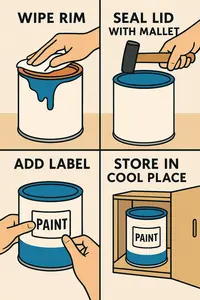
- Clean the rim channel. Wipe it out with a rag while the paint is still wet. Dried paint in that groove is what kills the seal permanently.
- Lay plastic wrap over the opening. One sheet, overhanging the edge. This is the step that matters most.
- Seat the lid with a rubber mallet. Tap around the perimeter, not the middle. A steel hammer bends the rim and you will never get a seal again.
- Label it properly. Colour name, code, room, sheen and date. A can labelled “white” in 2024 is useless to you in 2027.
- Store it indoors, upright, off the floor. Between 60°F and 80°F. A concrete floor in an unheated garage is the worst spot in the house for paint.
Storage method is only half the question. If you are trying to work out whether a can you already have is still usable, that is a different test — our guide on whether paint expires covers the shelf life by type and the smell-and-stir check that settles it. And if it fails that check, recycling the paint is the right disposal route, not the household bin.
Frequently Asked Questions
Does storing paint cans upside down actually work?
It works in the narrow sense that paint against the lid blocks air from entering through the seam. But it only works on a can that was already mallet-sealed, and a can sealed that well does not need flipping. It also moves the skin to the bottom, where you cannot see it and cannot lift it off cleanly.
Should paint cans be stored upside down or upright?
Upright, with plastic wrap under a mallet-seated lid, stored between 60°F and 80°F. That is what manufacturers specify and it delivers the same seal without the leak risk or the hidden skin.
Why does paint skin over in the can?
Oxygen in the headspace cures the binder at the paint-air boundary, forming a rubbery film. The larger the air gap, the faster and thicker the skin. Reducing the headspace does more than any resealing trick.
Is plastic wrap under the lid better than flipping the can?
Yes, and it is the method Benjamin Moore recommends. The wrap acts as a gasket on a can seam that has none, so the seal is achieved at the lid instead of relying on a column of paint to plug it.
Can I store paint in a glass jar?
Yes, and for touch-up quantities it is the best option — a filled screw-top jar has almost no headspace and genuinely seals. Label it clearly and keep it low down and out of the way, since dropped glass full of latex is a serious clean-up.
Can I use a hammer to seal a paint can lid?
Use a rubber mallet. A steel hammer concentrates force and deforms the soft rim, and a deformed rim will not seal on any subsequent closing. If a mallet is not to hand, lay a block of wood over the lid and tap the wood.
Does storing paint in the garage ruin it?
It can. Latex paint is water-based, and repeated freezing breaks the emulsion so the paint never re-mixes into a usable film. Heat is gentler but shortens shelf life. An interior closet or a heated basement beats a garage every time.
Final Verdict
Upside-down storage is a real effect solving a problem that a rubber mallet and a square of plastic wrap solve better. If you have a nearly full latex can, you sealed it properly, and you will use it within a few months, flipping it does no harm. For everything else — half-empty cans, oil-based products, anything you want to still be good in two years — decant it, fill the container, seal it, and stand it upright indoors.
Storage is the same as every other part of this trade: preparation beats tricks. Clean rim, real gasket, right temperature, honest label.
About the author — Sophie Ulman
Sophie Ulman has renovated and painted more rooms than she can count — and made every mistake in the book so you don’t have to. She focuses on real-world durability: not how products perform on day one, but whether the repair holds through a full seasonal cycle.