Best Paint for Aluminum: What Sticks Without Peeling
Paint slides straight off bare aluminum. Not in a year — often within one season, in sheets, because the metal grows an invisible oxide film within minutes of being sanded and that film is what your paint is actually gripping. The best paint for aluminum is therefore only half the answer; the primer under it decides whether the job survives a full seasonal cycle.
I learned this on an aluminum storm door. I degreased it, scuffed it, rolled on a good exterior enamel, and it looked sharp for about eight months. Then one hot week in July it started lifting at the corners and I could peel a strip off with a fingernail — the paint came away clean, with no metal on the back of it. That is the signature of an adhesion failure, not a paint-quality failure. I redid it with a self-etching primer and the same topcoat. Four years on, it has not moved.
Below is what actually sticks, broken down by what you are painting — boat, wheels, siding, or old oxidised parts — plus the prep sequence that makes any of them last.
Why Aluminum Is Challenging to Paint
Aluminum is lightweight and corrosion-resistant, but it has a naturally slick oxide layer that resists paint adhesion. It also expands and contracts with temperature changes. This means:
- Surface prep is critical
- A self-etching primer is often needed
- The paint must withstand weather, UV, and chemical exposure
Degrease before you sand, not after. Sanding a greasy panel grinds the contamination into the scratch pattern and no primer recovers from that. Wipe with a wax-and-grease remover or denatured alcohol, sand with 180–220 grit, then wipe again with a clean cloth and fresh solvent. The surface-cleaning principles I use on walls apply here, just with a stronger solvent and no water left behind.
Self-Etching Primer: The Step That Decides Everything
A standard primer sits on top of the surface. A self-etching primer contains a mild phosphoric acid that bites microscopically into the aluminum and leaves a phosphate layer the topcoat can key into. That is a chemical bond rather than a mechanical one, and on a metal with no pores it is the difference between four years and four months.
- Etch within the hour. Aluminum re-oxidises almost immediately after sanding. If you scuff on Saturday and prime on Sunday, you are priming a fresh oxide layer and you have wasted the sanding.
- Go thin. Etching primer is meant to be a haze, not a colour coat — you should still see the metal tone through it. Applied heavy it stays soft and the topcoat sinks.
- Do not use it under water-based acrylic without checking. Some etch primers are solvent-only systems. Mismatched chemistry lifts the primer as the topcoat dries.
- Anodised aluminum is the exception. The anodised layer is already a hard oxide coating and etch primer barely touches it. Sand it back to bright metal or use an adhesion promoter made for anodising.
My rule: if the aluminum will be outdoors, wet, hot, or touched, it gets etch primer. Indoor decorative pieces that will never be handled can get away with a quality adhesion-promoting spray primer — the same category covered in the best spray primers for wood and metal.
What to Look for in the Best Paint for Aluminum
When choosing durable paint for aluminum, look for these qualities:
| Feature | Why It Matters |
|---|---|
| Adhesion & Etch Compatibility | Prevents peeling caused by moisture or thermal stress |
| Corrosion Resistance | Stops oxidation and rusting on outdoor or marine aluminum |
| UV Stability | Keeps the color from fading or chalking |
| Toughness & Flexibility | Helps paint survive impacts, vibration, and temperature swings |
| Surface Compatibility | Ensure it matches your specific surface (boat, wheel, siding) |
Best Paint for Aluminum Boat
Boats face water, UV rays, and abrasion, so they need marine-grade protection.

- One-part polyurethane made specifically for aluminum — no separate etching primer needed on clean, scuffed metal
- Resists UV, water, and chemicals; recoats in about an hour at 72°F
- Applies by brush, roller, or spray; sold by the quart in eight flat colours
Pros: Excellent protection and adhesion, durable finish
Cons: Limited colors, not for continuous underwater use
Read the listing before you click buy. TotalBoat sells an aluminum boat paint and an aluminum boat primer under names that look nearly identical on a phone screen, and the primer is white. I have watched someone open a quart expecting Olive Drab and find undercoat. The link above goes to the paint. Pick your colour on the listing page — each shade is its own listing, and switching colour switches the item.
Topside paint is for the hull above the waterline only — it is not antifouling and it will not survive permanent immersion. Strip old flaking coatings and any white powdery oxidation back to sound metal first. If a boat is your whole project rather than one item on a list, I go deeper on hull prep and colour holdout in the best paint for an aluminum boat.
Best Paint for Aluminum Wheels
Wheels face heat from braking, road salt, and constant wear. You’ll need something built for harsh conditions.

- This is the clear topcoat, not the colour. It is the last step over wheel paint, or a standalone gloss over bare polished aluminum
- Resists brake dust and road grime; sprays from any angle
And here is the colour that goes underneath it. The clear above protects; it does not change a thing about how the wheel looks. If the wheels are pitted, kerbed, or that chalky grey that aluminum goes after a few winters of road salt, you need pigment first.
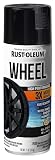
Rust-Oleum High Performance Wheel Spray Paint, Gloss Black
Same automotive-grade line as the clear above, with pigment in it. It is formulated to sit on a wheel face that swings past 200°F under hard braking and then gets hit with cold rain, which is the cycle that makes ordinary enamel discolour and then flake at the spoke edges. Two thin coats, fifteen minutes apart, then the clear over the top once the colour has flashed off.
The honest limitation: it is a spray can, not a powder coat. On a daily driver in a salted-road state I get two to three seasons before the leading edge of the spokes starts to dull. That is the trade for spending twenty dollars instead of four hundred at a refinisher. It is also not a repair — deep kerb gouges need filling and sanding first, or the gloss will point straight at them.
Key fact: brake dust is baked-on iron, not loose dirt. Wash, then use an iron-fallout remover, then degrease, then scuff. Skip the fallout step and the paint lifts in sheets at the first pressure wash.
Best for: refinishing tired factory alloys on a driver, where you want a uniform gloss rather than a factory-match silver.
Via Amazon.com
Brake dust is baked-on iron, not loose dirt — soap will not shift it. Use a dedicated iron-fallout remover, then degrease, then scuff. Mask the tyre with card rather than tape alone, and remember the wheel face runs well over 200°F under hard braking, so a standard enamel will discolour. Full picks and the clear-coat question are in my wheel paint guide.
Best Spray Paint for Aluminum
Spray paints are great for small aluminum parts and intricate shapes where brushes are tricky.

- Smooth metallic finish, easy to apply
- Heat-resistant up to 200°F
- Ideal for parts near engines or grills
Pros: Quick application, covers complex shapes
Cons: Needs several thin coats for durability
Best Paint for Old Aluminum
Older aluminum often has oxidation, chalking, or stains. To restore it:
- Degrease and clean thoroughly
- Sand lightly to remove oxidation
- Apply an etching primer if needed
- Paint with a durable topcoat like enamel or polyurethane
For more tips on prepping surfaces, see our full guide on how to remove paint with steam, it shows how to strip old layers cleanly before repainting.
How to Paint Aluminum
Here’s a quick step-by-step method for how to paint aluminum correctly:
- Wash with soap and water
- Sand to remove oxidation and roughen the surface
- Apply a self-etching primer for aluminum
- Spray or brush on thin, even coats of paint
- Let each coat fully dry
- Optionally finish with a clear coat for extra protection
Two thin coats always beat one thick coat, and on aluminum that is not a slogan — the metal conducts heat away so fast that a heavy coat skins on top while the underside is still solvent-wet, and that trapped solvent is what causes the finish to go soft or bubble weeks later. If the piece will see sun, abrasion, or road grime, a clear coat over the top roughly doubles how long the colour holds — Rust-Oleum Stops Rust Crystal Clear is the one I keep on the shelf, and the alternatives are compared in the clear coat guide.
When the Aluminium Is Bigger Than a Rattle Can
Everything above works from a can, and on a wheel or a bracket that is the right tool. A boat hull, a set of aluminium fenders or a bank of window frames is a different problem, and the reason is the etching primer rather than the colour.
Self-etching primer has a window. It bites the aluminium, and you want the topcoat on while that bite is fresh — not tomorrow, after the primer has fully hardened and gone chemically quiet. On a hull that means priming and topcoating a large area inside one working session. With aerosols you cannot: you run out of can, you stop, you shake, and by the time you are back at the bow the stern has moved on without you.
TCP Global Professional HVLP Spray Gun, 1.3 mm Gravity Feed with 1-Litre Cup and Air Regulator
A full-size gravity-feed gun with a 1.3 mm stainless needle and nozzle set, a one-litre aluminium cup and a micrometer air regulator with a gauge at the gun inlet. The 1.3 mm tip suits light-to-medium viscosity material, which covers both a reduced etch primer and most aluminium topcoats.
The one-litre cup is what buys you the primer window — you mix once and cover the whole panel without stopping. The regulator is what keeps the film even from one end of a hull to the other, because pressure drifts as the compressor cycles and drifting pressure is what leaves you with a glossy bow and a dull stern.
Pros: One mix covers a large panel, even film across the whole surface, stainless needle and nozzle that solvent will not pit, and it shoots the etch primer and the topcoat through the same set-up.
Cons: It wants roughly 4.2 to 7.1 CFM, which is more air than a small pancake compressor holds, and you have to reduce and strain everything you put in the cup.
When not to buy it: for a set of wheels, a ladder or a patio table, the aerosols above are genuinely the better buy and you will finish sooner. This is a tool for hulls, siding runs and full panel sets. And price the compressor before the gun — on a gun this size the compressor is the expensive half of the decision.
If you do not own a compressor, buy the turbine instead of the gun. The compressor maths above is where most aluminium projects stall, and the way around it is a self-contained turbine unit such as the Wagner Control Spray Max. The turbine supplies its own air, so there is no CFM sum to fail and no tank cycling to drift your pressure mid-panel, and the 20-foot hose means the heavy part stays on the ground while you walk a hull or a siding run. It holds a quart and a half at a time, which is enough to keep the etch-primer window open across a large panel — the whole reason this section exists.
When not to buy it: a turbine will not match a full-size gravity gun on a mirror-finish topcoat, so if you already own a compressor that can feed the TCP gun, keep it. And if the job is a set of wheels or a patio table, both of these are the wrong purchase — the aerosols above finish sooner and cost less.
Most Durable Paint for Aluminum
If durability is your top priority, go with marine-grade polyurethane or multi-step systems (primer + base coat + clear coat).

- High coverage, classic metallic look
- Heat- and weather-resistant
Pros: Very tough, great shine
Cons: Requires proper prep and long cure time
Aluminum Siding: A Different Problem Entirely
Siding is the one aluminum surface where etch primer is usually the wrong call. Factory-finished siding already carries a baked enamel coating, so you are painting over paint, not over bare metal. What you are fighting instead is chalk — that powdery film that comes off on your hand. Chalk is degraded binder, and anything applied over it bonds to dust.
Wash with a chalk-removing exterior cleaner, rinse hard, and keep rubbing test panels with a dark cloth until the cloth stays clean. Then use a masonry-and-siding bonding primer followed by a 100% acrylic exterior paint. Acrylic matters here for the same reason it matters on decks: the cured film stretches as the panels expand in the sun instead of cracking at the laps. Full detail lives in can you paint aluminum siding.
When NOT to Paint Aluminum
Some of these jobs are not worth doing, and it is cheaper to hear that now:
- White corrosion pitting that has eaten into the surface. Aluminum corrosion is not surface rust — it undercuts. Paint over pitting and it keeps spreading beneath the film. Grind back to bright metal or replace the part.
- Anything continuously submerged. Topside and enamel paints are not antifouling and are not designed for permanent immersion.
- Exhaust components and anything over about 400°F. Standard enamel discolours then burns off. That needs a ceramic high-heat coating, which is a different product class.
- Aluminum window and door frames you still need to open. Paint build in the channel binds the slide, and stripping it back out later is miserable work.
Prep matters more than the brand. I would rather use a mid-priced enamel over a properly etched, properly degreased panel than a premium marine polyurethane over a surface I rushed. The failures I see are almost never the paint.
Comparing Popular Paint Types
| Paint Type | Pros | Cons |
|---|---|---|
| Polyurethane (marine) | Extremely durable, UV-resistant | Expensive, strong fumes |
| Enamel (oil-based) | Glossy, weatherproof | Slow drying, can yellow |
| Acrylic (water-based) | Easy cleanup, low odor | Less durable under stress |
| Spray paint | Quick and convenient | Thin film, needs multiple coats |
Use Cases and Best Options
| Use Case | Best Type | Example |
|---|---|---|
| Boats | Marine polyurethane | TotalBoat Aluminum Boat Paint (the paint, not the primer) |
| Wheels | Wheel enamel, then clear | Rust-Oleum HP Wheel, Gloss Black + Gloss Clear over it |
| Siding | Exterior enamel | Diamond Brite Paint |
| Decorative parts | Metallic spray | Rust-Oleum Painter’s Touch 2X Metallic Aluminum |
Frequently Asked Questions
Do you need a special primer for aluminum?
For bare aluminum, yes — a self-etching primer. It uses a mild acid to bite into the metal and leave a phosphate layer the topcoat can bond to chemically. A standard wall or wood primer only sits on the surface, and on a non-porous metal that bond fails within a season. Already-painted aluminum siding is the exception: there you want a bonding primer over cleaned, de-chalked paint. If you are set on skipping the primer step entirely, the products that can actually carry that — and the surfaces where the shortcut still fails — are covered in best paint for aluminum without primer.
Will spray paint stick to aluminum?
Only over primer. Rattle-can paint applied straight to bare aluminum looks fine for a few weeks and then chips off at the first knock. Etch-prime first, then build the colour in three or four light passes rather than two wet ones — aluminum pulls heat out of the film and heavy coats stay soft underneath.
Do you have to sand aluminum before painting?
Yes, and then prime the same day. 180–220 grit is enough to break the oxide layer and give tooth. The critical part is timing: aluminum re-oxidises within minutes, so sanding one day and priming the next puts you back where you started.
What is the most durable paint for aluminum?
A two-part marine polyurethane over etch primer, which is what boatyards use and what holds gloss longest in UV. It is expensive, it has strong fumes, and it needs a respirator and real ventilation. For most household jobs a single-part urethane-modified enamel gets you 80% of the durability at a third of the hassle.
Can you paint aluminum without sanding?
On clean factory-finished aluminum, sometimes — a bonding primer plus thorough degreasing can carry it. On bare, oxidised, or chalking aluminum, no. Skipping the abrasion there is the single most common reason these jobs peel.
How long does paint last on aluminum?
Etch-primed and topcoated properly, five to ten years outdoors, longer under a clear coat. Skipping the etch primer typically buys you one season, and the failure is dramatic — the film releases in sheets rather than flaking gradually.
Is aluminum paint the same as paint for aluminum?
No, and the naming trips people up constantly. “Aluminum paint” is a silver metallic finish that contains aluminum flake — you can put it on wood or steel. “Paint for aluminum” is any coating formulated to bond to the aluminum substrate. Check what the label is describing before you buy.
For the safety side of stripping and spraying metal — particularly on anything painted before 1978 — the EPA lead guidance and OSHA respirator standards are the references I work from.
The Bottom Line
The best paint for aluminum depends on what you’re painting and where it will be used. Boats need marine-grade coatings, wheels need high-heat resistant sprays, and decorative pieces can be done with metallic spray paints.
Always degrease, scuff, and etch-prime before painting. Two thin coats, each fully dry, will outlast one heavy coat every time — and on aluminum, the prep is doing more work than the can you chose.
About the author: Sophie Ulman has renovated and painted more rooms than she can count — and made every mistake in the book so you don’t have to. She focuses on real-world durability: not how products perform on day one, but whether the repair holds through a full seasonal cycle.
ThePaintly is reader-supported. Our picks are based on manufacturer specifications and what users report. When you buy through links on this site, we may earn an affiliate commission at no extra cost to you.