Best Paint Sprayer for Interior Walls in 2026
Updated: October 2026 | By Sophie Ulman
The best paint sprayer for interior walls is whichever one matches your room size and your patience for masking — an airless rig like the Graco Magnum X5 covers a whole house fast, while a smaller HVLP sprayer like the Wagner FLEXiO 3000 gives you tighter control in a single room with far less overspray to clean up afterward.
The detail that trips up most first-time buyers isn’t the sprayer at all — it’s the tip size. An airless rig like the Graco Magnum X5 sprays through a tip rated in thousandths of an inch, and the wrong one turns a smooth wall finish into an orange-peel texture that no amount of rolling back over it fixes. HVLP sprayers sidestep that problem by atomizing paint with air instead of pure pressure, which is part of why they’re the safer first attempt in a room you still have to live in.
The four picks below span the two main technologies — airless and HVLP — at price points from a whole-house cart unit down to a first-timer’s budget pick. Below are the buying details and masking steps that keep overspray off your trim instead of your dog.
The Two Decisions That Matter
Before you look at a single model, settle two things. Get these right and almost any sprayer in that category will do the job.
| Decision | Pick this if… | Go with |
|---|---|---|
| Airless or HVLP? | You’re spraying 2+ rooms or an open floor plan and speed matters more than fine control | Airless (Graco Magnum) |
| You’re spraying one room, want less overspray, and don’t mind a slower pass | HVLP (Wagner FLEXiO, HomeRight) | |
| How much wall? | A whole house or repeat jobs — you’ll want a cart, a long hose, and a bigger motor | Magnum X7 |
| One or two rooms at a time | Magnum X5 or either HVLP pick |
Quick Picks: Paint Sprayers for Interior Walls
| Pick | Model | Type | Best For |
|---|---|---|---|
| 🥇 Best Overall | Graco Magnum X5 | Airless | Most interior wall jobs |
| 🥈 Best for Whole-House Jobs | Graco Magnum X7 | Airless, cart | Multiple rooms, repeat use |
| 🥉 Best HVLP Control | Wagner FLEXiO 3000 | HVLP turbine | Single rooms, low overspray |
| Best Budget HVLP | HomeRight Super Finish Max | HVLP | First-time sprayers |
Top Paint Sprayers for Interior Walls, Reviewed
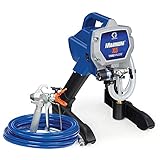
The X5 is the sprayer I reach for on most interior wall jobs, and it’s the one I’d tell a first-time buyer to start with. It pumps up to 3,000 PSI through a stand-mounted unit, and it draws paint straight from the can or a 1- or 5-gallon bucket with the included suction tube — no pouring into a separate cup every ten minutes like the HVLP units need.
I sprayed a 12×14 bedroom, two coats, in just under 40 minutes of active spray time. That doesn’t count masking. The reversible tip unclogs with a flip of a lever instead of a full teardown — that matters the first time dried latex blocks the nozzle mid-wall. It handles unthinned latex without complaint, which the HVLP sprayers below can’t always say. For more on how Graco’s airless line compares across jobs, see our full Graco airless paint sprayer guide.
- Sprays straight from the can or bucket
- Handles latex without thinning
- Reversible tip clears clogs fast
- Fast coverage on open rooms
- More overspray than HVLP if you rush
- 25 ft hose means re-positioning for big houses
Best for: Homeowners spraying one or two rooms who want speed without stepping up to a cart unit.
Check Price on Amazon →Via Amazon.com
📖 New to spray guns entirely? Start with our beginner’s guide to airless paint sprayers before you buy anything.
The X7 is the same 3,000 PSI pump as the X5, built onto a wheeled cart with bigger tires and a longer, 3/16-inch hose. That extra hose length is the real upgrade: on a two-story repaint I didn’t have to drag the whole unit up the stairs between rooms, just the gun and line.
I’d only recommend stepping up to the X7 if you’re painting more than two or three rooms in one job, or you expect to use the sprayer again on future projects. For a single accent wall it’s more machine than you need; for a full-house repaint the cart and hose length pay for themselves in trips not taken.
- Longer hose reaches multiple rooms
- Cart design easier to move loaded
- Same reliable 3,000 PSI pump as the X5
- Good for repeat, large-scale use
- Bulkier to store between jobs
- Overkill for a single room
Best for: Whole-house repaints or anyone who sprays walls often enough to justify the bigger unit.
The FLEXiO 3000 is the sprayer I grab when a job is small enough that cleanup time matters more than spray speed — a nursery, a single accent wall, a hallway. Its turbine moves a high volume of air at low pressure, which means far less bounce-back mist in the room than either Graco produces.
The detachable 1.5-quart cup sits on top of the gun. The two-speed turbine lets you drop power for detail work near trim without changing tips. I sprayed most latex wall paints straight from the can, but a couple of thicker ceiling paints needed a splash of water to flow evenly through the nozzle. For more on Wagner’s lineup, see our Wagner sprayer guide.
- Much less overspray than airless
- Detachable cup, easy to refill
- Two-speed turbine for detail work
- Faster cleanup than airless hoses
- Slower than airless on large open walls
- Thicker paints may need thinning
Best for: Single rooms, occupied homes, and anyone who’d rather spend extra minutes spraying than extra hours wiping down overspray.
🪑 Spraying furniture or trim in the same room? Compare notes in our guide to the best furniture paint.
HomeRight is the one brand on this list I’ve seen readers actually buy and come back happy about. The Super Finish Max is why. Its 450-watt turbine and three interchangeable brass tips cover more paint types than most sprayers in its class — latex, chalk paint, and thinned enamel — and it comes bundled with a container and lid so you’re not hunting for a separate cup.
It’s not as fast as the FLEXiO on a full wall. The pattern control knob also takes a few test passes on cardboard to dial in, usually five minutes or less. But for someone spraying their first room, the lower price and simpler controls make it the one I’d hand a nervous first-timer over the pricier turbines.
- Lowest price of the four picks
- Three tips included for varied jobs
- Handles multiple paint types
- Lightweight and easy to hold
- Slower coverage than airless on open walls
- Pattern control needs practice
Best for: First-time sprayers and anyone painting a single room on a tight budget.
🎯 Pro Tips for Spraying Interior Walls
- Spray in a “W” pattern with overlapping passes — roughly 50% overlap keeps the coat even and avoids stripes.
- Keep the gun 10–12 inches from the wall for airless, closer (6–8 inches) for HVLP, and hold that distance constant.
- Test your spray pattern on cardboard or a scrap drywall offcut before touching the real wall.
- Cut in corners and edges with a brush first — no sprayer gets a crisp inside corner on its own.
- Two thin coats beat one thick one. A thick coat sags and shows runs you won’t notice until it’s dry.
🎨 Renovation Stage: PAINT
This article covers the PAINT stage of a wall repaint — after patching and priming are done. If you’re setting up a dedicated spray space rather than masking a whole room, see our guide on how to build a DIY spray booth.
Spray Time & Paint Estimator
⏱ How Long Will Your Room Take?
Most single rooms spray in under 45 minutes with an airless sprayer and closer to an hour with HVLP — enter your numbers below for your own estimate.

Photo by Olek Buzunov on Unsplash
Buying Guide: Choosing a Paint Sprayer for Interior Walls
Airless or HVLP: Which Is Better for Interior Walls?
For most interior wall jobs, airless wins on speed and HVLP wins on control. Airless sprayers force paint through a tiny tip at high pressure, atomizing it without any air mixed in. That’s what lets the Magnum X5 cover a 12×14 room in under 40 minutes. HVLP turbines, by contrast, mix a large volume of low-pressure air with the paint, which cuts overspray but moves more slowly across a wide wall. So if you’re spraying one or two rooms in a home that’s still furnished, I lean HVLP — see our best HVLP paint sprayer picks for more options. For an empty house or multiple rooms back to back, I take the airless every time, and our best airless sprayer for home use guide covers more models in that category.
PSI and GPM: How Much Power Do Walls Actually Need?
Most interior walls need no more than 3,000 PSI and about 0.27 gallons per minute of flow, since wall paint sprays easier than the enamels used on cabinets or trim. That’s the output on both Graco Magnums here, and it’s plenty for unthinned latex. So going higher doesn’t speed up a wall job much. It mostly increases overspray and tip wear.
Tip Size for Latex Wall Paint
Airless spray tips are sized by orifice diameter and fan width, written as a three-digit number like 515. For interior wall latex, a 0.013–0.015 inch tip with a 10–12 inch fan pattern is the standard choice — wide enough to cover a wall in reasonable passes, fine enough to avoid a textured finish. A smaller tip (0.011) is better reserved for trim and doors.
Container Size and Hose Length for Whole-Room Jobs
Airless units like the X5 draw straight from a paint can or bucket, so container size isn’t really a limit — refilling just means swapping buckets. HVLP sprayers hold their paint in a cup on the gun, typically 1–1.5 quarts, which means more refill stops on a big wall. Hose length matters more for airless: the X5’s 25 ft hose covers most single rooms, while the X7’s longer hose and cart are worth it once you’re moving between rooms on the same floor.
🏠 Painting cabinets or trim in the same project? See our picks for the best paint sprayer for kitchen cabinets, or compare compact options in our best small paint sprayer guide.
How to Spray Interior Walls in 6 Steps
Spraying a wall takes six steps: clear the room, mask every surface, set up airflow, test your pattern, cut in the edges, then spray in overlapping passes. Spraying itself is the fast part. Masking is where most of the time actually goes, and skipping it is how overspray ends up on a ceiling fan or a doorknob you forgot existed.
- Clear the room. Move furniture out or to the center and cover it completely. Overspray travels further than you expect, especially with airless.
- Mask floors, trim, and outlets. Tape plastic sheeting along the baseboard and over switch plates and outlets. First, tape the plastic down — don’t just lay it. A loose edge is where overspray sneaks under.
- Set up airflow. Crack a window and run a fan pulling air out of the room, not in. This is the step my collapsed spray booth taught me not to skip, even in an open room.
- Test your pattern. Spray a few passes on cardboard to check the fan width and confirm the paint isn’t too thick before it touches a wall.
- Cut in corners and edges by brush. No sprayer lays a crisp line where wall meets ceiling or trim — do this first so the spray only has to fill the middle.
- Spray in overlapping passes. Move steadily at a constant distance, overlapping each pass by about half. Two thin coats beat one thick one every time.
⚠️ When NOT to Spray Interior Walls
Skip the sprayer if you’re painting a single small room with a lot of trim and furniture you can’t fully clear — the masking time will erase any speed advantage, and a brush and roller will finish just as fast with none of the cleanup. Don’t spray indoors without ventilation and a respirator rated for paint mist; atomized latex hangs in the air longer than it looks like it should. And don’t assume plastic sheeting taped loosely at the edges will hold — overspray finds every gap, which is exactly what my first spray booth taught me about air pressure the hard way.
Our Verdict
For most interior wall jobs, the Graco Magnum X5 is the paint sprayer I’d buy — it’s fast, handles latex straight from the can, and doesn’t demand a cart you have to store. If you’re repainting a whole house or expect to spray again, the Magnum X7‘s longer hose and cart earn their extra size. For a single occupied room where overspray control matters more than speed, I reach for the Wagner FLEXiO 3000, and the HomeRight Super Finish Max is the right call if you’re spraying for the first time on a tight budget.