Is It Safe to Paint an Old Radiator? Yes, With 2 Conditions
Yes — it is safe to paint an old radiator, with two conditions that almost nobody mentions: the existing paint has to be handled as lead until you prove otherwise, and the colour you choose changes how much heat the radiator puts into the room. Get either one wrong and you are not looking at a cosmetic problem. You are looking at lead dust in a living room, or a cold room in January.
I have painted cast-iron radiators in three houses. The first one taught me more than the other two combined, and I will get to that. What follows is the order of operations that keeps the job safe: check for lead, cool the unit, strip and prep, prime, then paint with the right finish, which for a hot-water radiator means a protective enamel such as Rust-Oleum Stops Rust over primed metal — and skip the silver.
The Real Safety Question: Is There Lead Under That Paint?
If the radiator is old, the paint on it is probably old too. Lead-based house paint was not banned for residential use in the United States until 1978, and cast-iron radiators are frequently older than the house’s last full repaint. That matters because the dangerous step is not painting — it is sanding.
The EPA is blunt about this: sanding, scraping and cutting painted surfaces in pre-1978 homes creates lead-contaminated dust that settles across the room and stays there long after the job is finished. Its lead-safe renovation guidance for DIYers also bans the shortcuts people reach for on stubborn radiator paint: open-flame torching, power sanding or grinding without HEPA extraction, and heat guns running above 1,100°F.
So before any abrasive touches that radiator, test the paint. Our walkthrough on how to identify lead paint covers the swab technique and — more importantly — why a negative result from a cheap kit is not the same as a clean bill of health. Cut through to bare metal with a V-notch so the swab reads every layer, not just the top coat.
If it tests positive, you have two honest options: leave the old paint intact and paint over it (encapsulation — no sanding, wet-wipe only), or bring in a certified renovator. Neither of those is dramatic. Both beat aerosolising lead in a room where people sleep.
Can You Paint Old Radiators?
Once lead is ruled out or managed, the answer is a clean yes. A few things decide how the job goes:
- Material: most older radiators are cast iron or steel. Both take paint well, provided it tolerates the operating temperature — a hydronic radiator typically runs 140–180°F, a steam radiator can exceed 212°F. Steam is the harder case, and it is where cheap enamel yellows fastest.
- Condition: surface rust and flaking are fixable. Weeping seams, a wet spot on the floor, or a valve that drips are not paint problems — fix the leak first or you are sealing paint over active corrosion.
- Function: paint never improves output. The best case is neutral. The realistic worst case is a measurable heat loss, which is the next section.
Turn the radiator off and let it go fully cold — not warm, cold. Paint flashing off a hot cast-iron surface skins over before it levels, which gives you brush drag, trapped solvent and a finish that stays soft for weeks.
Silver Paint Will Cost You Up to 20% of Your Heat
This is the part of the job that gets ignored, and it is the one with a number attached to it.
A free-standing cast-iron radiator moves roughly 70% of its heat by convection — air warming as it passes through the fins — and about 30% by radiation, straight off the surface into the room. That radiant share depends on the surface’s emissivity: how readily a surface sheds heat as infrared rather than reflecting it back.
Ordinary non-metallic paint — white, black, navy, sage, it makes no difference which colour — sits around 95% emissivity. Aluminium and bronze metallic paints drop it to roughly 70%. Heating engineers put the resulting output loss at up to 20%. The physics is unglamorous: metallic flakes are reflective, and a reflective surface is a poor radiator.
Two practical takeaways. First: if you inherited a silver radiator that never seems to warm the room, you do not need a new radiator. A non-metallic topcoat over the existing metallic paint recovers almost all of that lost output — a genuinely cheap heating fix. Second: colour choice is free. A matte black radiator and a gloss white radiator of the same size put out the same heat, so pick on looks, not on thermal folklore.
The only case for metallic paint on a radiator is the inverse problem — a room that overheats and has no working valve. There, the reflectivity is doing you a favour.
Is Painting Old Radiators Safe?
The process is safe when three things are true:
- The paint tolerates the heat: standard wall paint does not. It softens, yellows and releases solvent odour every time the unit cycles on. Radiator enamels and direct-to-metal formulations are rated for the temperature range; a wall latex is rated for a wall.
- The room is ventilated: oil-based enamel and aerosol both carry solvent load. Open two windows for cross-flow, not one.
- The surface is sound before you coat it: rust and dust under paint guarantee flaking. Prep is where radiator jobs are won.
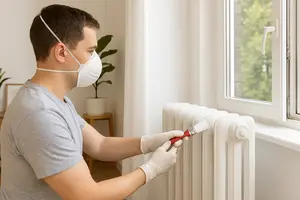
The same rule that applies when you clean walls before painting applies harder here — a radiator collects an oily film of dust that no primer will bond through.
How to Paint a Radiator: Step-by-Step
1. Shut it down and prepare the area
- Turn the radiator off at the valve and leave it overnight. Cast iron holds heat far longer than it feels like it does.
- Drop cloth underneath, painter’s tape on the wall behind and the floor edge.
- Slide a sheet of card behind the radiator — it catches overspray and lets you paint the back edge without repainting the wall.
2. Clean, then de-rust
- Degreaser or a strong detergent solution, then rinse and dry completely. Skipping the rinse leaves a detergent film that blocks adhesion.
- Loose rust comes off with a wire brush by hand. If the lead test came back positive, do not abrade at all — wet-wipe and encapsulate instead.
- Hand tools only here, and by hand I mean a small three-piece wire brush set rather than a wheel on a drill. A drill wheel throws dust across the room and burnishes cast iron until primer slides off it. The stainless brush takes scale off the flat faces, the brass one works between fins without scoring the metal, and the nylon one gets the loose grit out afterwards. Whatever you use, wear a respirator — even a lead-free radiator is decades of oxidised iron going airborne.
- For heavy multi-layer buildup on a lead-free unit, a chemical stripper beats sanding. Our guide to the best paint remover for metal covers which formulations bite through enamel without pitting cast iron.
3. Prime bare metal
- Any spot you took back to bare metal needs a metal primer rated for heat. Bare cast iron will flash-rust within a day in a humid room.
- Sound, well-adhered old paint does not need stripping — scuff it dull and prime the bare patches only.
- The principle is the same one in our piece on using primer on problem surfaces: the primer is not a filler, it is the bond.
Which primer, though? This is the part people get wrong, and it is the reason a radiator repaint fails in year two rather than year ten. There are two different situations and they take two different products. If you brushed the rust back and the metal underneath is clean and grey, use a clean metal primer — it is built for bare, sound metal and gives the topcoat something to bite. If the pitting goes deeper than you can reach, and on a cast iron radiator that has sat in a damp hallway it usually does, use a rusty metal primer instead. That one is formulated to bond to the rust you could not get off. Putting clean metal primer over residual rust is the single most common way this job comes back to haunt you: it looks perfect for a winter, then blisters from underneath.
Both are oil-based, both smell, and both want ventilation and a full overnight before the topcoat. If you are priming a whole radiator rather than patching a few spots, our roundup of the best spray primers for wood and metal covers the aerosol versions of the same chemistry.
4. Two thin coats
- Radiator enamel, direct-to-metal acrylic, or an aerosol rated for the temperature. Aerosol gives the cleanest result on finned column radiators, where a brush cannot reach between sections.
- Two thin coats always beat one thick coat. Thick enamel on a radiator stays soft under the skin and prints a permanent mark from the first thing that leans against it.
- Work top-down and finish each section before moving on — enamel drags badly once it starts to set.
The tool decides how this looks more than the paint does. On a flat panel radiator, a standard sash brush cannot get behind the unit and you end up with an unpainted strip everyone can see from the doorway. A bent radiator brush — angled head on a long handle — reaches the back face and the wall behind it without unbolting anything. It is the one tool on this list I would not substitute. On an old column radiator with narrow gaps between the sections, no brush works at all, and that is where an aerosol version of the same protective enamel earns its keep: several passes from different angles, each one light enough that nothing runs into the gap and pools.
One caveat on the spray, because it caught me out: an aerosol lays down a much thinner film than a brush, so what feels like two coats is usually one. Plan on three light passes and check the underside of the fins with a phone torch before you call it done.
5. Cure before you fire it up
- Touch-dry is not cured. Give solvent-based enamel a full 24 hours minimum, longer in a cold room, before turning the heat back on.
- Expect an odour on the first two or three heating cycles as residual solvent bakes out. Ventilate through it. If it is still strong after a week, the coat went on too thick.
- If you are trying to compress the timeline, the ambient conditions matter more than the product — see how to make paint dry fast.
What Paint Should You Use on Old Radiators?
The biggest mistake is standard interior wall paint. Instead:
- Radiator enamel: purpose-made, non-yellowing, rated to the temperatures a hydronic or steam unit reaches. The default choice.
- Direct-to-metal (DTM) acrylic: lower odour, faster recoat, no yellowing on white. Slightly softer film than solvent enamel in the first month.
- Aerosol radiator spray: the only realistic way to get an even film into the gaps on a column radiator.
- Not needed: true high-heat stove or engine paint rated to 1,200°F. That is the right product for an exhaust manifold, and overkill for a radiator that peaks near boiling.
What I keep on the shelf for this job
For a hot-water radiator that has surface rust and bare patches, the route I use is a rust-inhibiting metal primer on the bare spots followed by a solvent protective enamel — Rust-Oleum Stops Rust is the one I reach for, because it bonds over de-rusted metal and stays hard rather than staying tacky through the first heating season. It is a general protective enamel rather than a dedicated radiator enamel, so check the label’s temperature rating against your system: hot-water radiators sit comfortably inside it, and steam radiators, which run hotter, do not. For steam, buy a purpose-made radiator enamel instead.
Whichever can you land on — two thin coats, and let it cure before the heat comes back on. This is the step people rush and then repaint.
Check Price on Amazon →Via Amazon.com
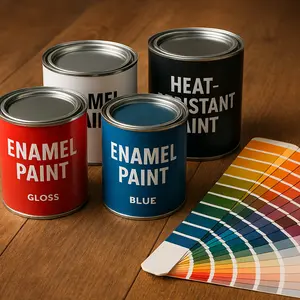
Before any of that matters: prep matters more than the brand. On a radiator, durability is roughly half the coating and half what you did to the metal underneath it. Flaking rust that stays put under a fresh film takes the film with it when it lets go. If the old finish is thick, blistered, or you have decided the lead has to come off rather than be sealed in, start with the stripping guides — our roundup of the best paint remover for metal and the wider paint remover guide for metal and wood cover the chemical strippers that lift a film without sanding lead into the air. For the primer step itself, the picks in our spray primer guide for wood and metal are the ones that grip de-rusted steel.
Radiators sit in the same family of jobs as painting other tricky metals — the substrate dictates the product, not the colour chart. It is the same reasoning behind whether you can paint stainless steel and behind what paint to use on wood: match the coating to what it has to stick to and survive.
Sophie’s Note: The Radiator I Painted Twice
The first old radiator I painted was in a 1930s terrace, and I did it in the silver-bronze finish the previous owner had used, because I assumed matching was the safe choice. It looked sharp. That winter, that room never got properly warm — I blamed the boiler, then the valve, then the windows.
A heating engineer looked at it, tapped the radiator and asked why I had painted it silver. I repainted it the following summer in a plain matte off-white, over the top of the metallic, no stripping. Same radiator, same boiler, same valve — and a room that finally held its temperature. The lesson stuck: on a radiator, the finish is not decoration, it is a thermal spec.
Common Mistakes When Painting Old Radiators
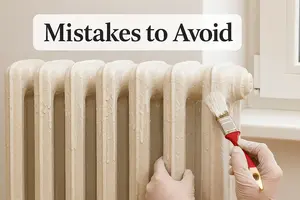
- Sanding pre-1978 paint without testing it: the mistake I see most often, and the only one on this list with a health consequence.
- Skipping prep: rust and dust under paint peel within a heating season.
- Wall paint on a hot surface: yellows, softens and smells every time the heat cycles.
- Painting a warm radiator: the film skins before it levels, leaving brush drag and trapped solvent.
- Painting the valve body and TRV head: mask them. Paint in the mechanism seizes the pin, and a seized TRV is a stuck-open or stuck-shut radiator.
- One thick coat: traps solvent, drips between fins, and never fully hardens.
When NOT to Paint an Old Radiator
- The lead test is positive and you plan to sand. Encapsulate over the top or hire a certified renovator. There is no safe DIY sanding path here.
- It is leaking or weeping at a seam. Paint over active corrosion buys you a season at most, and hides the evidence you needed.
- The radiator is undersized for the room already. Any added film is a small insulator. If the room is borderline, sort the sizing before you add coats.
- It is a modern powder-coated panel radiator in good condition. Factory powder coat outlasts anything you can brush on. Clean it instead.
- You cannot shut the heat off for 48 hours. Mid-winter is the wrong time. Do radiators in summer.
Can you paint a radiator without taking it off the wall?
Yes, and for most people it is the only realistic option — removing a cast-iron radiator means draining the system, breaking a threaded union that has not moved in fifty years, and finding two people willing to carry roughly 300 pounds down a staircase. In place is fine. What changes is the technique, not the outcome.
Work cold. A radiator that is even slightly warm flashes the solvent off the surface before the film levels, and you get a rough, streaky finish that never quite hardens. Shut the valve, let it sit overnight, and touch it before you start.
Protect the wall behind it properly. Slide stiff card or a sheet of hardboard down the back gap rather than taping plastic to the wall — plastic sags into wet paint and lifts it off. On a column radiator, the back face and the inner faces of the columns are where the finish will look worst if you rush, and an aerosol radiator spray is genuinely easier there than a brush, because a brush cannot reach the middle of a column without loading the edges too heavily.
Ventilate hard, and accept that this is the part that decides whether you enjoy the job. Solvent enamel in a closed room with no airflow is unpleasant and slows curing at the same time. Open a window, put a fan pointing out of it rather than at the radiator, and take breaks.
The one case where taking it off the wall wins: a radiator with heavy rust on the back face that you cannot reach or de-rust properly in place. Painting over rust you could not treat buys you a season, no more.
Style Tips for Painting Old Radiators
Since colour is thermally free — as long as it is not metallic — you can choose purely on looks:
- Classic white or cream: disappears against most walls. Use a non-yellowing acrylic enamel; solvent enamels drift warm over a few heating seasons.
- Matte black or deep navy: turns a Victorian column radiator into a feature. Radiates exactly as well as white does.
- Wall-matched: the most effective way to make a bulky radiator visually recede. Get the wall colour matched into a radiator enamel base rather than using the wall paint itself.
Alternatives to Painting
- Professional reconditioning: shot-blasting and powder-coating off-site. Expensive, and the correct answer for a heavily leaded cast-iron unit worth keeping.
- Radiator covers: hide the unit, but they also trap the convective airflow that carries 70% of the output. A cover costs you more heat than any non-metallic paint colour ever will.
- Replacement: if the unit leaks or is badly undersized, paint is cosmetics on a mechanical problem.
Frequently Asked Questions
Is it safe to paint an old radiator yourself?
Yes, provided you test for lead first and use a paint rated for the temperature. The painting itself is low-risk; the sanding step in a pre-1978 home is the part that carries real hazard, because it produces lead dust that settles across the room.
Does painting a radiator reduce its heat output?
Non-metallic paint has almost no effect — a thin film sits near 95% emissivity, the same as bare painted iron. Metallic silver or bronze paint is different: it drops emissivity to roughly 70% and cuts total output by up to 20%. Colour does not matter; metallic content does.
Can I paint over silver radiator paint to get the heat back?
Yes, and it is the cheapest heating improvement in this article. A non-metallic topcoat over existing metallic paint restores most of the lost radiant output. Scuff the surface, prime any bare spots, and apply two thin coats.
What paint do you use on a radiator?
Radiator enamel or a direct-to-metal acrylic rated for the operating range. Standard wall paint yellows and softens. Stove or engine paint rated to 1,200°F is unnecessary — a domestic radiator peaks near 212°F at most.
Do you need to sand a radiator before painting?
Only enough to dull the gloss and remove loose rust — and only after a lead test comes back clean. Sound old paint can stay. If the test is positive, do not sand at all: wet-wipe and paint over the top.
How long should paint dry before turning the radiator back on?
At least 24 hours for solvent enamel, longer in a cold or damp room. Turning the heat on early bakes solvent out through a partly cured film, which leaves a soft finish and a lingering smell.
Why does my radiator smell after painting?
Residual solvent burning off during the first few heating cycles. That is normal and fades within a week. If the smell persists beyond that, the film was applied too thick and never fully cured — the fix is to strip that coat back and reapply thinly.
Final Verdict: Is It Safe to Paint an Old Radiator?
Safe, yes — with the lead test first and the sanding treated as the hazardous step, not the painting. Choose any non-metallic colour you like and the radiator will heat exactly as it did before. Choose silver and you have quietly turned the thermostat down.
Durability here is about half product and half preparation, same as every other job on this site. Cold radiator, clean surface, primed bare metal, two thin coats, full cure before the heat goes back on. Do that and the finish will run for a decade.
About the author — Sophie Ulman
Sophie Ulman has renovated and painted more rooms than she can count — and made every mistake in the book so you don’t have to. She focuses on real-world durability: not how products perform on day one, but whether the repair holds through a full seasonal cycle.