What Is Paint Made Of? The 4 Ingredients Explained Simply
What is paint made of? Four ingredients: pigment (the color), binder (the glue that makes it stick and last), solvent (the liquid that carries it), and additives (everything else — mildew blockers, thickeners, dry-time boosters). Every can on the shelf is just a different ratio of those four, and once you can read that ratio, you can predict how a paint will behave before you open the lid. That is the real reason to understand the ingredients — I have watched a bargain wall paint chalk off under a damp windowsill for the simple reason that it was thin on binder, and no amount of technique fixes a formula problem.
Materials Used to Make Paint
The key ingredients that make up paint include pigments, binders, solvents, and additives. Each of these components plays a vital role in determining the color, texture, durability, and performance of paint.
1. Pigments
Pigments are the substances that give paint its color. They can either be natural or synthetic. Natural pigments come from minerals, plants, or animals, while synthetic pigments are made through chemical processes. These pigments are finely ground into powder and suspended in the paint to create the desired color. For example, titanium dioxide is often used as a white pigment, while carbon black is used for black paint.
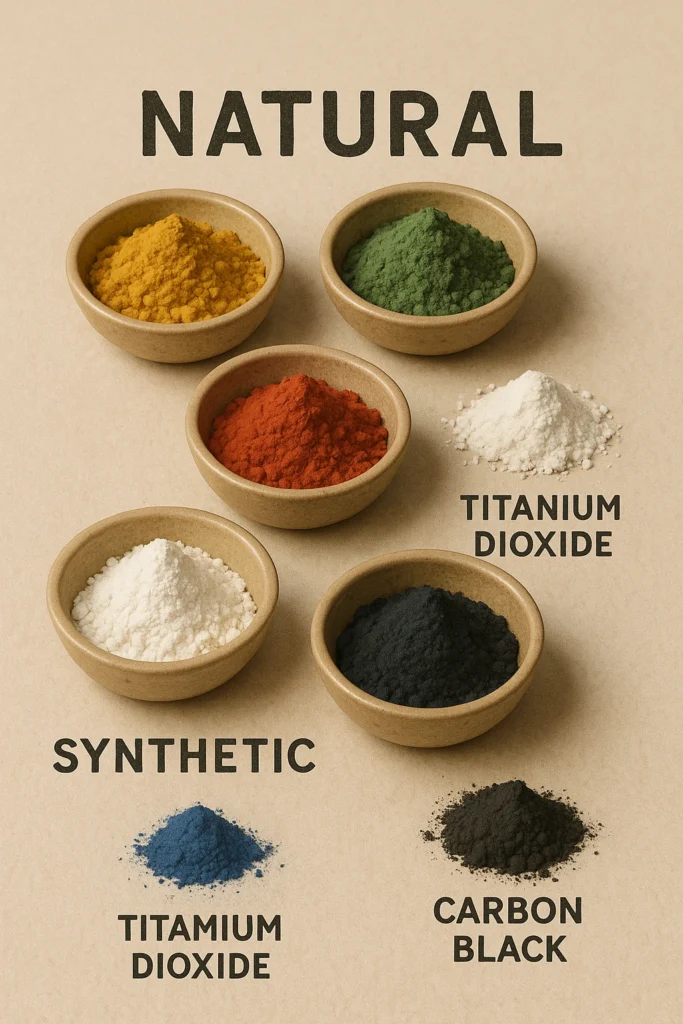
There is a distinction inside this category that matters more than any other single fact in this article: prime pigments versus extenders. Prime pigments — titanium dioxide above all — are what actually hide the surface underneath. Extenders such as calcium carbonate, clay and talc are cheap mineral fillers that add bulk, flatten the sheen, and cost a fraction of what TiO2 costs.
Both show up on an ingredient list as “pigment”. Only one of them covers your wall. The ratio between them is the main reason two cans that look identical on the shelf need two coats and four coats respectively.
2. Binders
Binders (also called resins) are the components in paint that hold the pigments together and help them stick to surfaces. They also provide the paint with its durability and adhesion properties. Acrylic, latex, and alkyd are common types of binders used in various paints.
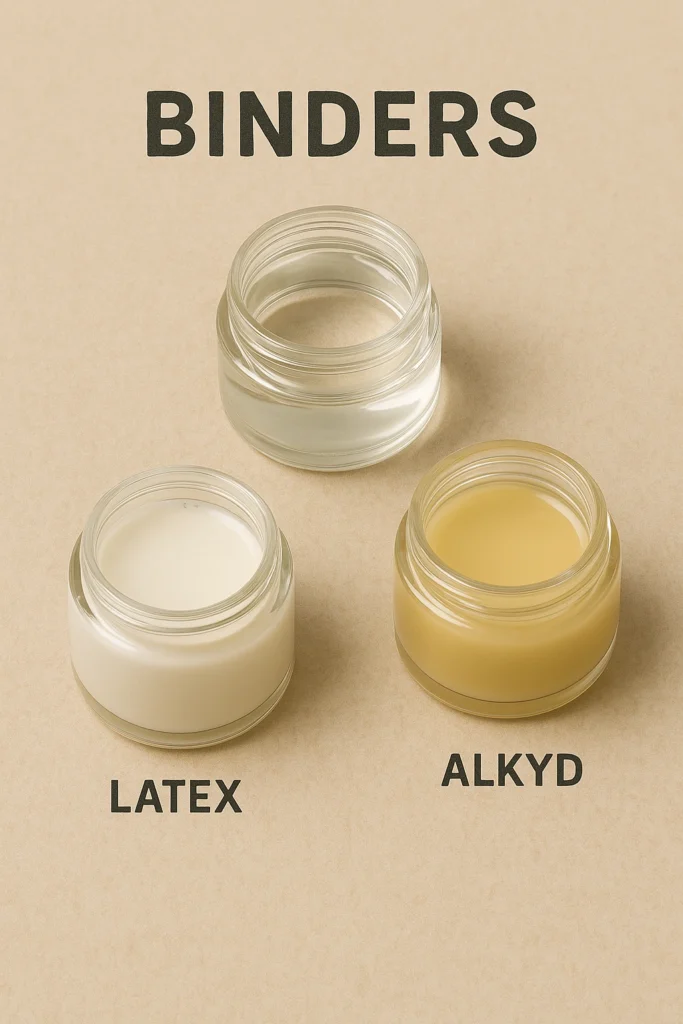
For instance, latex paints use water-based acrylic binders, while oil-based paints contain alkyd resins. The type of binder used can significantly impact the ease of application, drying time, and weather resistance of the paint.
Within water-based paints there is a further split worth knowing. 100% acrylic binders are the flexible, UV-stable option — they stretch as a substrate moves and resist chalking outdoors. Vinyl-acrylic binders are cheaper, stiffer, and fine on an interior wall that never sees weather or sunlight. Exterior paint labelled “100% acrylic” is not marketing garnish; it is the difference between a facade that survives a decade and one that powders off in four years.
3. Solvents
Solvents are liquids that help adjust the paint’s viscosity, making it easier to apply. They also help dissolve the binder and pigment to form a smooth, workable paint mixture. Solvents evaporate as the paint dries, leaving behind the binder and pigment on the painted surface. Water is the most common solvent for water-based paints, while mineral spirits or turpentine are used in oil-based paints.

The solvent is the part of the can you are guaranteed not to keep — it leaves. That is the whole story behind volatile organic compounds, which the EPA measures at 2 to 5 times higher indoors than outdoors on average — and notes that during and for several hours after activities like paint stripping, levels can reach 1,000 times outdoor background. Emissions continue for a period after painting as the film keeps curing, not just while the brush is moving.
The industry has moved steadily toward low-VOC and zero-VOC formulations as a result. Worth knowing: “zero-VOC” is a claim about the base paint, and adding a deep tint can put measurable VOCs back in. If low emissions are the reason you are buying, ask about the colorant too, not just the base.
4. Additives
Additives are chemicals added in small quantities to improve certain properties of the paint, such as its drying time, texture, or mildew resistance. For example, thickeners may be added to create a heavier texture, while anti-foaming agents can prevent bubbles in the paint. Mildew inhibitors are also commonly used in paints intended for bathrooms or kitchens, where moisture can encourage mold growth.

Additives are perhaps 1–2% of the can by volume and a wildly disproportionate share of what makes one paint different from another. Biocides are also what give latex paint a shelf life at all — they deplete over time, which is why an old can eventually smells sour. That is also why storage method matters more than people think — see whether storing paint cans upside down actually works.
The Ratio That Decides Everything: PVC
This is the concept that turns a list of ingredients into something you can act on.
Pigment volume concentration — PVC — is the proportion of a paint’s dried film made up of pigment and extender, versus binder. It is not printed on the can, but you can read it straight off the sheen, because sheen is a consequence of it:
| Sheen | Typical PVC | What that means in practice |
|---|---|---|
| Gloss / semi-gloss | Low (roughly 15–30%) | Binder-rich. Hard, washable, scrubbable, shows every surface flaw. |
| Eggshell / satin | Mid (roughly 30–45%) | The working compromise for most walls. |
| Flat / matte | High (roughly 45–75%) | Pigment-rich, low binder. Hides flaws, marks easily, can chalk. |
There is a threshold in that range called critical PVC: the point at which there is no longer enough binder to fill the gaps between pigment particles. Below it, every particle is fully wrapped in resin and the film is continuous and tough. Above it, the film contains microscopic voids — it becomes porous, loses scrub resistance, and eventually releases loose pigment when you rub it. That powder on your fingers from an old flat wall is a paint that was formulated above critical PVC.
This is why cheap flat paint is cheap. Extender costs a fraction of what binder and titanium dioxide cost, so the cheapest way to make a can is to push PVC up. It still looks fine on day one. It is the seasonal cycle that finds it out.
Volume Solids: The Number That Tells You How Many Coats
The second useful number, and this one is published — on the technical data sheet rather than the can. Volume solids is the percentage of the liquid paint that remains on the wall after the solvent evaporates.
Everything else is going into the air. A paint at 30% volume solids leaves a dry film less than half as thick as one at 45%, from the same wet coat. That is the entire mechanism behind “this cheap paint needed three coats” — you were not applying it badly, you were applying less paint.
It also reframes cost. A can at 45% solids at twice the price of a can at 28% is roughly break-even on coverage before you count the labour of the extra coat, and it will outlast the cheap one. Comparing paints by price per gallon without checking solids is comparing nothing at all.
What This Looks Like in a Real Can
Two paints on my own shelf show these four ingredients doing their jobs. Rust-Oleum Painter’s Touch 2X Ultra Cover is a paint-and-primer formula — the binder is doing double duty, gripping bare surfaces that would normally need a separate primer coat. That is why it covers plastic, wood, and metal in fewer passes: more binder, more pigment, less filler.
On the additive side, Zinsser Perma-White interior paint is essentially a standard acrylic with a mildewcide package added — the additive alone is what lets it sit on a steamy bathroom wall for years without black spots. Same four ingredients, one tweak, completely different job.
What Is Paint Used For?
Paint is not just for aesthetics; it also serves various practical purposes. Whether it’s for protection, decoration, or insulation, paint serves as a versatile solution in many industries.
- Protection: Paint helps protect surfaces from environmental factors like moisture, UV rays, and chemicals. For instance, exterior paints are designed to withstand harsh weather conditions, preventing rust and decay on metal surfaces.
- Decoration: Paint enhances the appearance of walls, furniture, and other surfaces. From vibrant colors to subtle shades, paint allows individuals to express their creativity.
- Insulation: Energy-saving paints contain special additives that help regulate temperature and reduce energy consumption. These paints are ideal for homes and commercial buildings.
What Chemicals Are in Paint?
Paint contains a variety of chemicals, some of which are essential for its function, while others are included for specialized purposes. Here are some common chemicals found in paint:

- Titanium Dioxide (TiO2): The most widely used white pigment, and the single most expensive ordinary ingredient in a can. It is what provides opacity — the reason one paint hides in two coats and another does not.
- Calcium carbonate, clay, talc: Extender pigments. They add volume and flatten sheen at low cost, and above critical PVC they are what makes a film chalky.
- Acrylics: Used as binders in water-based paints — durable, fast-drying, and water-resistant once cured.
- Alkyd resins: The oil-based binder. It cures by oxidation rather than evaporation, which is why oil paint keeps hardening for weeks and why it eventually yellows.
- Coalescing agents: Small amounts of slow-evaporating solvent in latex paint that soften the polymer particles just long enough for them to fuse into a film. Without them, water-based paint would dry as powder in cold weather.
- Lead: Banned for residential use in the US in 1978, but still present under later coats in older homes. If you are disturbing paint in a pre-1978 property, test for lead before you sand anything.
Is Paint Made from Petroleum?

Partly, and more than most people expect. Oil-based paints use petroleum distillates as solvents and petroleum-derived alkyd resins. But water-based paint is not petroleum-free either: acrylic polymers are synthesised from petrochemical feedstocks. The water is the solvent, not the binder.
What water-based paint genuinely does avoid is the petroleum solvent — the part that evaporates into the room. That is where the health and emissions difference sits, not in the resin.
Types of Paint
Paint comes in various types, each designed for specific applications. Some of the most common types include:
1. Water-Based Paint
Also known as latex or acrylic paint. Water is the solvent, so it cleans up with water, dries by evaporation, and re-coats in hours. The standard for walls, ceilings and most furniture.
2. Oil-Based (Alkyd) Paint
Cures by oxidation rather than evaporation, which is why it keeps hardening for weeks and levels out brush marks as it goes. Harder final film, longer recoat window, and it yellows over time — which is why it has largely disappeared from white trim.
3. Enamel Paint
A description of the finish rather than a chemistry: a hard, glossy, low-PVC film. Available in both oil and modern water-based versions. Used on doors, windows, trim and metal furniture.
4. Spray Paint
The same four ingredients thinned heavily and pushed through an aerosol with a propellant. The high solvent content is why it dries in minutes and why it attacks polystyrene foam.
5. Two-Part (Catalysed) Coatings
Epoxies and urethanes are the outlier: they do not dry at all, they cure through a chemical reaction between two components you mix on the day. That is why they have a pot life measured in hours and why they end up far harder and more chemical-resistant than anything in a single can. This is the chemistry behind garage-floor coatings, automotive finishes and industrial metal paint — and it is also why you cannot brush a second coat on three days later without sanding first, since there is nothing left for it to bond into.
Where the Chemistry Changes What You Buy
Knowing the four ingredients is only useful if it changes a purchase, so here is where it does. Heat is the clearest case: an ordinary acrylic binder softens and discolours well below the temperature of an engine block or an exhaust, which is why those need a silicone-resin binder instead — see best engine paint and high-heat paint for exhaust. Metal is the second: rust is a chemical problem, not a covering problem, and a converter works by reacting with iron oxide rather than hiding it, which is the whole logic of paint for rusty metal. And on ceilings the pigment volume concentration is deliberately pushed high to kill sheen and hide flaws, which is why ceiling paint behaves nothing like the same brand’s wall paint even though the tin looks similar.
Difference Between Types of Paint
The primary differences between types of paint lie in the binder, solvent, and intended use. Oil-based paints tend to have a smoother finish and better durability, while water-based paints offer ease of application and quick drying times. The binder is also what decides which surfaces a paint can grip — slick plastics need specific formulas, which is why we keep dedicated guides to the best paint for plastic and the best paint for 3D prints.
Where Reading the Ingredients Will Not Save You
- On a surface that was never prepped. Durability is roughly half formula and half preparation. The best-formulated paint in the store still peels off a greasy, glossy or dusty surface.
- Between two paints in the same tier. Two mid-range eggshells from competing brands are formulated to hit the same price and perform within a hair of each other. The spec sheet only separates paints that are genuinely different.
- On adhesion problems. PVC and volume solids tell you about the film’s toughness, not whether it will grip. Slick plastic, bare aluminium and glossy trim need a bonding primer regardless of how good the topcoat is.
- When the retail can has no data sheet. Volume solids are frequently published only for professional lines. If nobody will tell you the number, that is itself informative.
Frequently Asked Questions
What is paint made of?
Four things: pigment for colour and opacity, binder to form the film and make it stick, solvent to carry it and control flow, and additives for everything else — thickeners, biocides, defoamers and dry-time modifiers. The ratio between them, not the brand on the can, determines how the paint behaves.
What is the main ingredient in paint?
By volume, the solvent — which is water in latex paint and typically over half the can. But it all evaporates. The main ingredient in what stays on your wall is the binder, and that is the one worth paying for.
Why does cheap paint need more coats?
Lower volume solids and less titanium dioxide. Volume solids is the share of the wet paint left behind after the solvent leaves, so a paint at 28% solids deposits far less film per coat than one at 45%. Less TiO2 on top of that means poorer hiding.
What makes flat paint chalk and glossy paint scrub-resistant?
Pigment volume concentration. Flat paints are pigment-rich and binder-poor; above the critical PVC threshold there is not enough resin to encase every particle, so the film is porous and eventually releases loose pigment. Gloss paints are binder-rich, so the film is continuous and washable.
Is paint made from petroleum?
Partly. Oil-based paints use petroleum distillates as solvent and petroleum-derived alkyd resins. Water-based acrylics also use petrochemical-derived polymers — the water replaces the petroleum solvent, not the resin.
What is titanium dioxide used for in paint?
It is the white pigment that provides opacity. It has an unusually high refractive index, which is what scatters light and hides the colour underneath. It is also the most expensive ordinary ingredient in the can, so the amount used is the clearest signal of where a paint sits in the market.
Does zero-VOC paint really have no VOCs?
The base usually meets the standard, but colorants added at the mixing counter can reintroduce measurable VOCs, particularly in deep shades. If low emissions are the reason you are buying, ask whether the tint system is zero-VOC as well.
Conclusion
Paint is pigment, binder, solvent and additives — and the useful version of that answer is that the ratios are the product. Read the sheen to infer the pigment volume concentration, check the volume solids to know how many coats you are buying, and treat “100% acrylic” on an exterior can as a specification rather than a slogan.
None of it replaces preparation. But it does explain why the cheap can chalked off my windowsill, and it means the next time you are standing in front of two tins that look identical, you know which questions actually separate them. And because those same ingredients make leftover paint hazardous to dump, see our guide on how to recycle and dispose of old paint responsibly when the project is done — and whether the paint has expired before you open an old can at all.
Sophie Ulman has renovated and painted more rooms than she can count — and made every mistake in the book so you don’t have to. She focuses on real-world durability: not how products perform on day one, but whether the repair holds through a full seasonal cycle.
ThePaintly is reader-supported. We only recommend products we’ve personally evaluated. When you buy through links on this site, we may earn an affiliate commission at no extra cost to you.
Why Two Cans of White Paint Behave Nothing Alike
I once primed a hallway with two gallons of white that came from the same store on the same day. One rolled out flat and covered in a coat. The other stayed streaky through three coats and showed every roller lap under a side light.
Same color, same sheen, same claimed square footage. The difference was eighteen dollars and a line on the back of the can that I had not learned to read yet: one of them listed titanium dioxide first, and one listed calcium carbonate.
Paint is not one substance. It is four categories of ingredient doing four separate jobs, and every meaningful difference between two cans comes from the ratio between them. Once you can see that ratio, the price differences stop being mysterious.
This page is the plain version of what is paint made of: what is in the can, what each part does, and which part decides whether the paint holds on your surface. I have wasted enough weekends on the wrong can to think it is worth twenty minutes.
The Pigment: Coverage, and Why Titanium Dioxide Costs So Much
Pigments split into two groups that share a name and do opposite jobs. Understanding the split explains most of the price gap between a $25 gallon and a $65 one.
- Prime pigments provide hiding power and color. Titanium dioxide for white and opacity, iron oxides for earth tones, carbon black, phthalo blues and greens.
- Extender pigments provide bulk and cost almost nothing. Calcium carbonate, clay, talc, silica. They add body and matte the sheen, and they hide almost nothing.
Titanium dioxide is the expensive one and there is no substitute for it. It has an unusually high refractive index, which is a technical way of saying it scatters light so effectively that a thin layer stops you seeing what is underneath.
A cheap gallon is cheap because extender has been swapped in for TiO2. It still says white on the label. It simply takes three coats to do what the expensive can does in one, which is how my hallway ended up with a streaky wall and a wasted afternoon.
This matters most where the light is unforgiving. On a ceiling, every thin patch reads as a shadow — which is why ceiling technique guides insist on a high-hiding paint before they discuss anything about rollers.
The Additives: The 3% That Fixes Everything
Additives are a rounding error by volume and the reason modern paint works at all. A can without them would separate in the tin, foam under the roller, grow mold and dry with visible brush marks.
- Rheology modifiers make it thick in the can and thin under the brush. This is why paint clings to a roller but flows out on the wall.
- Defoamers collapse the bubbles a roller whips in.
- Biocides and mildewcides stop bacterial spoilage in the can and mold growth on the wall.
- Coalescing agents soften the acrylic particles so they fuse into one film. Historically the main VOC source in latex.
- Driers catalyse the oxidation of alkyds. Without them oil paint stays tacky for weeks.
- Surfactants keep the pigment dispersed instead of settling into a brick at the bottom.
Flood Floetrol Latex Paint Additive, 1 qt — The additive category in a bottle. Extends open time, kills brush marks.
This is the additive category sold on its own. It is mostly rheology modifier and coalescing agent, and it extends the open time so the paint keeps flowing after the brush has left. Brush marks level themselves out instead of curing in place.
It is worth knowing what it is not. It does not thin paint, does not change the color, and does not reduce the solids. That distinction is the difference between a conditioner and a thinner, and it is exactly the additive-versus-solvent distinction on this page.
What VOCs Are, and What Zero-VOC Really Means
Volatile organic compounds are carbon-based chemicals that evaporate at room temperature. In paint they come from the solvent and from the coalescing agents, and they are what you are smelling in a freshly painted room.
| Label | US limit | What it actually means |
|---|---|---|
| Traditional oil-based | 250–450 g/L | Ventilate, wear a respirator |
| Conventional latex | 50–150 g/L | Mild smell for a day or two |
| Low-VOC | <50 g/L | Barely detectable |
| Zero-VOC | <5 g/L | Base only — before tinting |
The catch is in the last row. Zero-VOC is measured on the untinted base. Universal colorants carry their own VOCs, and a deep saturated color can add 10 to 20 g/L back into a can that was certified at zero.
If it genuinely matters — a nursery, a bedroom, someone with asthma — ask for zero-VOC colorant specifically, or choose a mineral-pigment product like milk paint or limewash where the question does not arise.
VOCs are also unrelated to mold resistance, which people conflate. That is a biocide question, and it is why bathroom paint is chosen on its additive package rather than its smell.
How to Read a Paint Can Label in 20 Seconds
Four things, in this order. This is the whole page turned into a checklist you can run in the aisle.
- Find the binder. “100% acrylic” is the signal you want on latex. “Vinyl-acrylic” or an unnamed “acrylic blend” is the budget tier.
- Check the solids by volume, on the data sheet if it is not on the can. Above 38% is genuinely good. Below 30% means thin coats.
- Look at where titanium dioxide sits in the ingredient list. First or second means real hiding power. Behind calcium carbonate or clay means extender is doing the bulk.
- Read the VOC number, and remember it is the base, not your tinted color.
- Ignore the coverage claim on the front. It is measured on a sealed, primed, perfectly smooth surface that your wall is not.
That checklist is the practical answer to what is paint made of. Not the chemistry itself, but the four decisions the chemistry forces on you every time you stand in front of a shelf.
Those four numbers explain the price of every can on the shelf. My two gallons of white differed on exactly one of them, and it cost me an afternoon and two extra coats to find out which.