Best Paint for a Stipple Ceiling: 5 Picks That Fill Texture
A stipple ceiling punishes the wrong paint faster than any flat surface will. All those small peaks and hollows mean the roller is fighting three or four times the surface area the floor plan suggests, the light rakes across it and shows every missed hollow, and if the paint is too thin or you press too hard, bits of the texture come off on the roller and end up on your floor.
I learned that on a hallway ceiling I tried to do with leftover wall emulsion and a standard nap roller. From directly underneath it looked finished. From the doorway, with the light coming down the hall, every hollow was still the old cream colour — a ceiling that looked worse than before I started, because now the peaks were bright white and the shadows had somewhere to hide.
So the best paint for a stipple ceiling is one that carries enough body to fill the profile, is flat enough not to throw light into the texture, and — ideally — shows you where you have actually been while it is still wet. Below are the five worth considering, plus what to do if your ceiling is bare, and how to avoid taking the texture off.
Stipple Is Not Popcorn — and the Difference Changes What You Buy
These two get used interchangeably online and they are not the same thing. It matters, because one of them can be painted freely and the other has a rule attached.
Stipple is a pattern worked into joint compound or a texture coating while it is wet — with a stipple brush, a roller with a coarse sleeve, or a trowel. The peaks are relatively low and firmly part of the surface. It is durable, it takes paint well, and rolling over it is normal maintenance.
Popcorn, or acoustic ceiling, is a spray-applied aggregate — polystyrene or vermiculite chips in a binder, blown onto the ceiling. It is much deeper, much more fragile, and it dissolves when it gets wet. Roll a wet coat onto an unsealed popcorn ceiling and you will pull the texture off in clumps.
If yours is the crumbly, deep, chip-like kind, you are in popcorn territory and the method is different — read the best way to paint a popcorn ceiling without losing texture instead of this page. If it is a shallower, worked pattern that feels solid when you press it, carry on here.
Why Choosing the Right Stipple Ceiling Paint Matters
A stippled ceiling adds character but traps dust, casts small shadows, and shows up any patch you have made. The right paint gives you:
- Superior coverage in fewer coats
- Reduced splatter during application
- Gentle adhesion without flattening the texture
- Long-term whiteness and resistance to yellowing
For tips on prep work, don’t miss our guide on the best way to paint a ceiling.
Smart Stipple Ceiling Painting Ideas
Want to revitalize your stipple ceiling? Consider these stipple ceiling ideas:
- Crisp white refresh—brightens and opens the room
- Soft neutrals—adds warmth and subtle contrast
- Bold accent ceilings — navy or charcoal look striking, but be warned that a dark colour on texture exaggerates every peak and hollow, and shows roller marks that white would hide. It is the highest-risk option on a stippled surface, not the easiest
- Gradient effects—create a designer look with ombré tones
Explore color inspiration further in our best ceiling paint color resource.
Top Paint Picks for Stipple Ceilings
The short version, if you do not want to read five reviews: for a normal stipple ceiling that needs freshening, buy the INSL-X — it is the only one here the maker rates for textured ceilings specifically, it primes itself, it covers the most ground per tin, and it is ultra-flat. Buy the Perma-White instead if the ceiling is in a bathroom or basement, and the KILZ or the aerosol if you are dealing with stains rather than a whole-ceiling recoat.
1. Zinsser Covers Up Stain Sealing Ceiling Paint (Aerosol)
What it is for: a 13 oz aerosol with a vertical spray head, for spots — a water mark, the ring round a light fitting, a patched hollow. On texture that is genuinely useful, because a spray reaches into the profile without a roller pressing on it.
What it is not: a way to do a ceiling. This link is the single can; the same product also sells as a six-pack, and even then aerosols work out slower and dearer than a tin for any real area. Treat it as the repair tool you keep after the job, not the paint you buy for it.

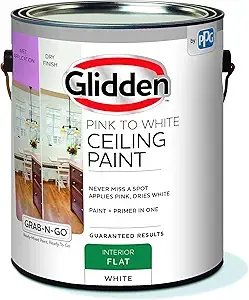
2. Glidden Grab-N-Go Pink-to-White Ceiling Paint
Why it stands out: it rolls on pink and dries to ceiling white, which on a textured ceiling is worth more than it sounds — white-on-white overhead, working against your own shadow, is close to invisible until the light changes and you see everything you missed.
Coverage: Glidden rates the gallon at 200–300 sq ft on primed, smooth, non-porous surfaces. Stipple is neither smooth nor, if bare, non-porous, so treat 200 as your ceiling rather than your floor and buy accordingly. It is spatter-resistant, which matters when you are rolling above your own face.
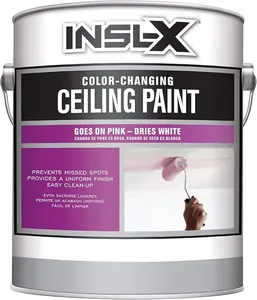
3. INSL-X Color-Changing Acrylic Ceiling Paint
Why it stands out — and why I would start here for stipple: it is the one product in this list whose manufacturer explicitly rates it for textured as well as smooth ceilings, it is self-priming, and it is ultra-flat, which is the finish that stops light raking across the peaks and exaggerating them.
Coverage: INSL-X rates it at roughly 400–450 sq ft per gallon, recoating in about two hours — noticeably further than the Glidden, which on a textured ceiling that drinks paint is the difference between one tin and two. It also has the same pink-to-white indicator.
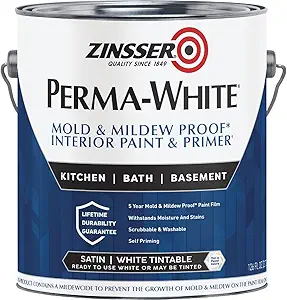
4. Zinsser PERMA-WHITE Mold & Mildew Proof Interior Paint
Why it stands out: it is formulated to stop mould and mildew growing on the paint film itself, which is the argument for using it on a stipple ceiling in a bathroom, kitchen or basement — all those hollows hold moisture and are miserable to clean. Zinsser rates coverage at 350–400 sq ft per gallon.
The caveat nobody mentions: this ASIN is the satin finish, and satin on a textured ceiling reflects light straight into the profile and makes every peak and shadow more obvious. In a small windowless bathroom that trade is usually worth it for the washability. In a room with a window along one wall, it will show. Perma-White is also made in a flat, so check which finish you are ordering rather than assuming.
5. KILZ Stainblocking Ceiling Paint
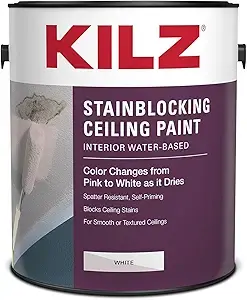
Why it stands out: stain-blocking resins plus the pink-to-white indicator, at roughly 250 sq ft per gallon on porous surfaces and up to 400 on smooth ones. On stipple, assume the lower number.
Where it stops: KILZ rates this for minor to moderate staining and points you to a dedicated primer for severe stains. If your stipple ceiling is smoke- or nicotine-stained, that counts as severe — see the primer-first method for nicotine ceilings, because painting straight over tar will bleed back through whatever you use.
Painting a Bare, Never-Painted Stipple Ceiling
A freshly textured ceiling that has never been coated behaves nothing like a repaint, and this is where people burn a whole tin for no visible result.
Bare joint compound is porous and thirsty. The first coat mostly disappears into it — you will roll a section, step back, and see almost no change in colour. That is normal and it is not a reason to press harder or to load the roller more heavily, which are the two things that actually damage the texture.
Two ways to handle it. Either prime the ceiling first with a drywall primer and then apply one finish coat, or use a self-priming ceiling paint and accept that you are doing two full coats. The INSL-X above is self-priming, which is why it is the one I would reach for on bare texture — the price of a separate primer plus a topcoat is usually higher than the price of doing two coats of one product.
Make sure the texture is properly dry before you coat it. Fresh compound can take several days to cure through the peaks, and painting a ceiling that is still holding moisture is how you end up with dull patches and poor adhesion.
One thing worth doing before any of it: dust it. New texture sheds a fine powder that you cannot see against a white ceiling but which will absolutely stop paint bonding. A vacuum with a soft brush head, ceiling to floor, and then leave the dust to settle before you start. The wider version of that argument is in how to clean walls before painting.
Will Painting Flatten or Wreck the Stipple?
This is the fear that stops people starting, and the honest answer is that stipple is fairly robust — but there are three ways to damage it, and all three are avoidable.
Pressing too hard. The roller should be carrying the paint into the hollows, not being forced into them. If you are leaning on it to get coverage, the roller is underloaded or the nap is too short. Reload rather than push.
Rolling back over a half-dry coat. Paint that has started to set will lift when you go over it again, and on texture it takes the peaks with it. Lay it on, spread it out, and leave it alone. Any hollow you missed is a job for the next coat, not for another pass now.
Over-wetting old texture. If the ceiling has never been sealed and the texture is soft, a heavy wet coat can soften it. A light first coat that seals the surface, then a full second coat, avoids this entirely.
The tool matters more than the technique here. A short-nap roller skates over the peaks and leaves the hollows unpainted; too long a nap holds so much paint it runs. Getting that choice right is most of the job — we go through it properly in what nap roller you need for a textured ceiling.
Should You Spray a Stipple Ceiling Instead?
Spraying solves the two problems rolling creates: nothing touches the texture, so nothing can pull it off, and the paint reaches into every hollow without you working at it. On a deep or fragile texture it is the better method, and on a large ceiling it is dramatically faster.
What it costs you is preparation. Everything in the room gets masked, including the walls, because ceiling overspray drifts further than people expect. For a single small room the masking usually takes longer than rolling would have taken in total, which is why spraying makes sense on empty rooms, whole floors and new builds rather than on one bedroom with furniture in it.
If you go that way, thin according to the tin rather than by eye, keep the gun moving at a consistent distance, and overlap each pass by about half. Stopping mid-pass on a textured ceiling leaves a heavy band that will show. The full method, including tip sizes and how to avoid drips, is in how to spray a textured ceiling without wrecking the texture.
Tools & Techniques for Painting Stipple Ceilings
Get professional results with the right tools and approach:
- Use a medium–high nap roller to reach deep textures without flattening them
- Always clean the ceiling—use a vacuum with soft attachment or damp cloth to remove dust
- Cut in edges first with a high-quality brush, then roll the main surface, maintaining a wet edge
- Avoid overloading the roller to prevent textured material from coming off
Stain Blocking & Texture Preservation
If your stippled ceiling has tough discoloration, choose a stain-blocking product like Zinsser aerosol or KILZ ceiling paint to seal and hide damage without disturbing the texture.
Related Reading
- Improve edges with our best way to paint edges between wall and ceiling guide.
- Need fast drying tricks? Check out how to make paint dry fast.
- Wondering how long a room takes to paint? We’ve got you covered in how long does it take to paint a room.
Final Verdict – Which Paint Is Right for You?
| Scenario | Best Choice | Why |
|---|---|---|
| Stained or yellowed ceiling | KILZ Stainblocking for the whole ceiling, or the Zinsser aerosol for isolated marks | Stain-blocking with a coverage indicator. Heavy smoke staining needs a shellac primer first |
| Precision application | INSL-X, or Glidden Grab-N-Go | Both go on pink and dry white so you can see your coverage overhead. INSL-X goes considerably further per gallon |
| High moisture areas | Zinsser PERMA-WHITE | Resists mould growing on the paint film. Note this ASIN is the satin finish, which shows texture more than a flat |
| Bare, never-painted stipple | INSL-X (self-priming) | New texture is porous and drinks the first coat; a self-priming paint saves a separate primer step |
| General refresh/DIY ease | Glidden Grab-N-Go | Simple, widely stocked, and the pink indicator forgives a distracted afternoon |
By selecting one of these premium ceiling paints—designed for coverage, minimal splatter, and maintaining texture—you’ll give your stippled ceiling the fresh, clean look it deserves. Pair with the right prep tips and tools, and you’re set for a seamless, professional finish.
Frequently Asked Questions
What paint is recommended for a stipple ceiling?
A flat or ultra-flat interior ceiling paint with enough body to fill the texture. Flat matters more than the brand: any sheen throws light across the peaks and makes the texture look harsher and any missed hollow more obvious. A colour-change formula that goes on pink and dries white is worth paying for overhead, because white-on-white is nearly impossible to track while you work.
What is the best paint for an unpainted stipple ceiling?
A self-priming ceiling paint, applied as two full coats. Bare joint compound is porous and swallows the first coat almost entirely — that is expected, not a sign you need to press harder. The alternative is a drywall primer followed by one finish coat, which usually costs more in total. Let fresh texture cure fully first, and vacuum off the loose powder before anything else.
Will painting ruin the stipple texture?
Not if you avoid three things: pressing hard on the roller, rolling back over a coat that has begun to set, and flooding old unsealed texture with a heavy wet coat. Load the roller properly instead of leaning on it, lay the paint on and leave it, and use a light first coat on anything soft. Stipple is far more robust than popcorn, which genuinely does come off when wetted.
Is a stipple ceiling the same as a popcorn ceiling?
No. Stipple is a pattern worked into joint compound while wet — shallow, firm, part of the surface. Popcorn is a sprayed aggregate of chips in a binder, deeper and fragile, and it softens when wet. They need different methods, and the words get used interchangeably online in a way that causes real damage to popcorn ceilings.
How much paint does a stipple ceiling need?
More than the floor area suggests, because texture increases the real surface area substantially. Take the manufacturer’s stated coverage, assume the lower end of the range, and add a margin on top. Running out part-way across a ceiling and opening a second tin is how you end up with a visible difference in tone across the room.
Can you spray a stipple ceiling instead of rolling it?
Yes, and on deep or fragile texture it is the better method, since nothing touches the surface. The cost is masking — ceiling overspray travels, so the walls and everything in the room have to be covered. That makes spraying worthwhile on empty rooms and whole floors, and rarely worthwhile on one furnished bedroom.
My stipple ceiling is stained yellow from smoke. Will ceiling paint cover it?
Not on its own. Tar dissolves into wet paint and rises back through it as the coat dries, so the yellow returns within days no matter how many coats you apply. Seal it with a shellac-based primer first, then use any of the ceiling paints here over the top.
Written by Sophie Ulman. ThePaintly is reader-supported: when you buy through links on this site we may earn an affiliate commission at no extra cost to you.